Designing custom puzzles requires a highly reliable foundation. Traditional blank canvases often misalign under the stress of added weight or custom surface finishes. This ruins the final solving experience. When layers lock up, modders and creators lose hours of intricate work. You need base hardware capable of supporting heavy modifications without sacrificing structural integrity.
You will discover how engineered magnetic bases permanently solve these frustrating structural issues. We bridge the gap between understanding the mechanical advantage of internal magnets and applying these benefits to custom projects. You will learn objective evaluation criteria, from plastic tensile strength to neodymium N-ratings. We also break down common implementation risks and how to avoid them. Whether you are a puzzle modder, a competitive speedcuber, a STEM educator, or a custom merchandise creator, this guide provides the exact framework you need to select the perfect hardware.
Key Takeaways
- Magnetic cube blanks provide a structurally stable, high-performance foundation for puzzle modding, prototyping, and custom stickering.
- The inclusion of factory-installed magnets prevents layer misalignment, which is critical when applying custom graphics or tactile elements.
- Evaluating these blanks requires looking beyond basic turning speed; buyers must assess magnet N-rating, factory glue tolerances, and plastic surface finish.
- Upgrading to magnetic blanks carries a higher initial unit cost but significantly reduces the failure rate of complex custom modifications.
Understanding the Primary Use Cases for Magnetic Cube Blanks
Builders rely on Magnetic cube blanks across several distinct applications. Each use case demands specific hardware traits to guarantee success. You must match the base mechanism to your final project goals.
Custom Puzzle Modding (Shape Mods)
Shape modders drastically alter the exterior of a puzzle. They attach 3D-printed extensions or sculpt heavy epoxy clay onto the pieces. This added mass throws off traditional tensioning systems. Utilizing a stabilized internal core keeps everything aligned. Magnets compensate for the uneven weight distribution. They ensure complex layers snap precisely into place. This prevents the puzzle from feeling loose or fragile.
Tactile and Blindfold Training
Competitive speedcubers use unstickered canvases to build pure muscle memory. They train layer control without relying on visual cues. The tactile feedback of the magnets tells the solver exactly when a turn is complete. You can also add raised textures to these blanks. This creates specialized puzzles for visually impaired users. The magnetic click provides crucial sensory feedback.
Merchandising and Prototyping
Corporate clients and retail brands often commission custom-printed promotional puzzles. Providing a premium, reliable base mechanism is non-negotiable. A cheap, lock-up-prone puzzle damages brand perception. By using a high-quality magnetic foundation, you deliver a bespoke retail product. It feels expensive and functions flawlessly out of the box.
Force Cubes
Force cubes are a niche but popular project. Builders disassemble multiple stickerless puzzles. They recombine single-color pieces to create solid-color puzzles. These are used in mechanical demonstrations or specific solving constraints. Magnetic cubes are ideal for this. They maintain consistent friction and turning speed across every newly assembled unit.
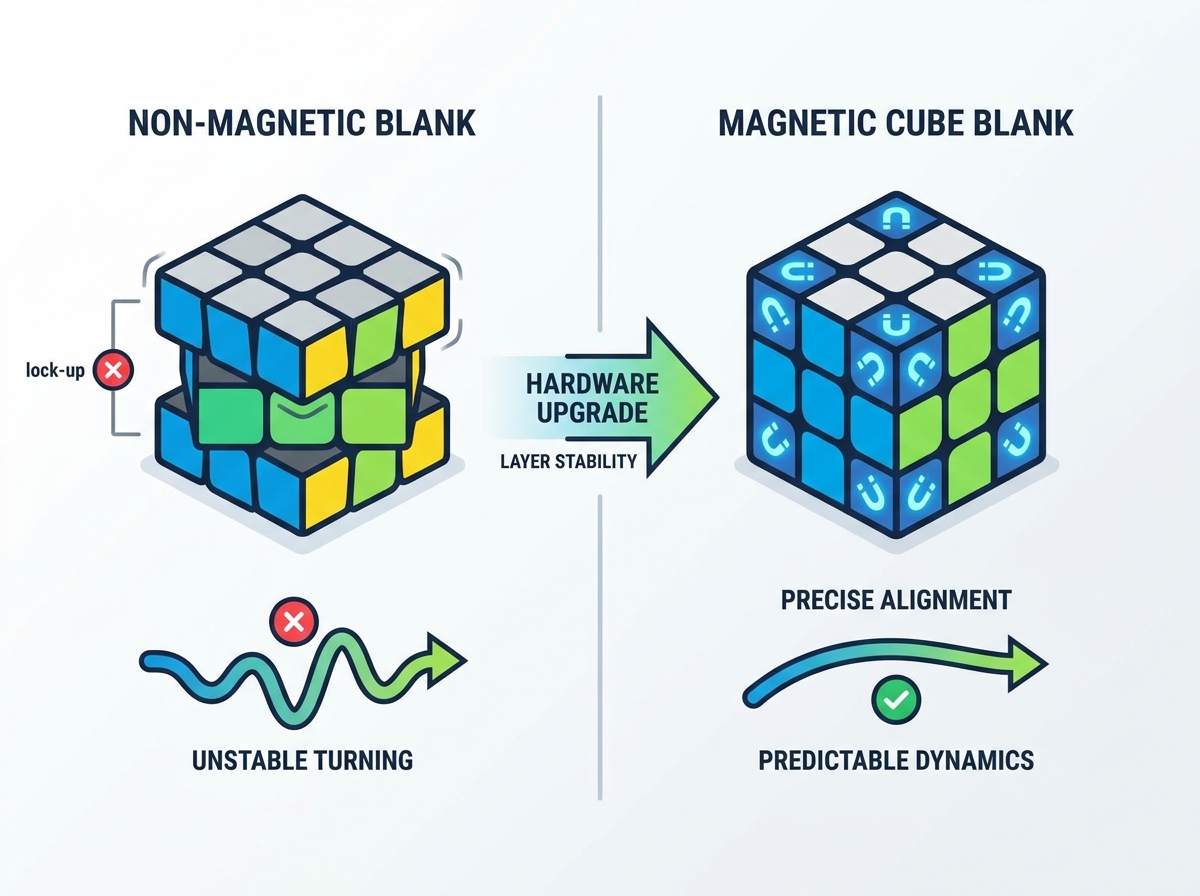
Magnetic vs. Non-Magnetic: Justifying the Hardware Upgrade
Choosing between magnetic and non-magnetic hardware defines the trajectory of your project. Upgrading to magnetic variants requires a slightly higher upfront investment. However, the structural advantages heavily outweigh the extra expense.
Layer Stability
Neodymium magnets sit inside the corners and edges of the puzzle. They magnetically attract as a turn completes. This snaps layers precisely into place. It completely eliminates the frustrating "lock-ups" common in heavily modified non-magnetic blanks. When you add custom plastics, standard puzzles struggle to align. Magnets force the pieces into a perfect cubic shape after every rotation.
Predictable Turning Dynamics
Altering the exterior weight changes how a puzzle behaves in motion. Heavy vinyl stickers or epoxy sculpts add momentum to the layers. Standardizing tactile feedback matters. Magnets act as brakes. They catch the heavy layers before they overshoot the target alignment. This predictable dynamic gives you complete control over the final product feel.
Cost-to-Value Ratio
You must assess the price premium of magnetic models carefully. Compare the extra cost against your own labor. Manually drilling holes and gluing magnets into standard blanks takes hours. It also introduces human error. Factory-installed magnets save massive amounts of time. This significantly boosts the value proposition for high-volume custom builders.
Hardware Comparison Chart
| Feature | Non-Magnetic Blanks | Magnetic Blanks |
| Layer Alignment | Manual correction required | Automatic magnetic snapping |
| Handling Heavy Mods | Poor (frequent lock-ups) | Excellent (stable core) |
| Initial Unit Cost | Lower | Slightly Higher |
| Labor Time | High (if manual magnetizing) | Low (ready to mod) |
Key Evaluation Dimensions for Magnetic Cube Blanks
Not all magnetic bases offer the same performance. You must evaluate them across three critical dimensions. This ensures your chosen hardware survives the modification process.
1. Magnet Strength and Polarity (N-Rating)
Magnet strength dictates how the puzzle handles added mass.
- Light vs. Strong Magnets: You must match magnet strength to the intended final weight of the cube. Heavier custom mods require stronger magnets. Look for N48 or N50 ratings to maintain stability under thick epoxy. Lighter sticker mods perform well on standard N35 magnets.
- Factory Alignment: Evaluate the consistency of the magnetic polarity. Poorly assembled factory bases might have flipped magnets. This causes repellent feedback mid-turn. You must ensure the manufacturer uses strict quality control to avoid these dead zones.
2. Plastic Quality and Surface Finish
The exterior material determines how well your customizations adhere.
- Frosted vs. Glossy Plastic: Determine which surface fits your needs. Frosted plastic resists scratches but often repels certain adhesives. Glossy plastic offers much better adhesion for custom vinyl stickers, specialized paints, or epoxy resins. Some builders lightly sand glossy bases to create a perfect physical bond.
- Material Durability: Assess the ABS plastic tensile strength. This is crucial for users who intend to sand, drill, or sculpt the exterior pieces. Thin, brittle plastic will crack under the pressure of a rotary tool. Always choose bases cast from thick, high-density ABS.
3. Core Mechanics and Corner-Cutting
The internal mechanism must adapt to exterior changes.
- Tensioning Systems: Ensure the core features adjustable tensions. Modern bases use screws, springs, or MagLev technology. You need to tighten the puzzle to compensate for added exterior weight post-modification. A static core will easily buckle under heavy shape mods.
- Anti-Pop Mechanisms: Verify the internal piece design. Look for extended anchor feet, often called torpedoes. These structures prevent pieces from dislodging or "popping" during high-speed solves. This is especially vital when layers become heavier than factory standard.
Implementation Risks and Common Modding Pitfalls
Even premium Magnetic Cube Blanks carry implementation risks. Modding introduces chemical and physical stress to the hardware. You can avoid ruined projects by understanding these common pitfalls.
Magnet Drop-out: You face the risk of factory cyanoacrylate (CA) glue failing. The stress of custom sanding creates intense vibrations. Heavy drops can also shatter brittle factory glue.
Mitigation: Inspect internal piece seams before applying custom finishes. Gently tap the pieces to listen for loose magnets. Re-glue them using a flexible, impact-resistant adhesive if necessary.
Lubricant Contamination: Excessive factory silicone lube can bleed onto the exterior blank surface. This causes custom stickers, primers, or acrylic paints to instantly fail and peel off.
Mitigation: Mandatory degreasing protocols are required prior to customization. Wipe down the exterior using isopropyl alcohol. Ensure no residue remains in the crevices between pieces.
Weight Imbalance: There is a danger in adding asymmetrical modifications. If you sculpt a heavy design on only one side, it conflicts with the internal magnetic alignment. This causes the puzzle to feel wildly unbalanced.
Mitigation: Plan your modifications symmetrically. If symmetry is impossible, you may need to open specific pieces and add counterweights (like small metal washers) to balance the kinetic feel.
Purchasing Framework: Shortlisting the Right Base
Selecting the right hardware saves time and money. Use this framework to align your purchasing decisions with your project scope.
- For High-Volume Merchandising: Prioritize budget-tier magnetic blanks. Look for flat, glossy surfaces and moderate magnet strength. Focus strictly on unit cost and reliable sticker adhesion. You do not need complex tensioning systems for promotional giveaways.
- For Competitive Speedcubing (Force Cubes): Shortlist flagship-tier magnetic cubes. They must offer dual-adjustment systems for spring compression and travel distance. Look for models featuring interchangeable magnet capsules. This allows you to fine-tune the tactile response.
- For Heavy Shape Modding: Select blanks featuring thick ABS plastic walls. You need strong magnetic profiles to handle the massive addition of epoxy sculpts or 3D-printed extensions. A robust anti-pop mechanism is mandatory here.
- Next-Step Action: Do not order hundreds of units blindly. Request sample units from manufacturers first. Test your CA glue reactions, paint adhesion, and sticker tolerances. Commit to wholesale orders only after validating your modification process on these samples.
Conclusion
Magnetic base mechanisms serve as the superior foundation for custom puzzle projects. They leave legacy non-magnetic options far behind by solving core stability issues. The automatic layer snapping provided by neodymium magnets prevents catastrophic lock-ups. This protects your hard work from falling apart during a solve.
Always align your evaluation criteria strictly with your intended end-use case. Assess the magnet strength, plastic finish, and core stability before starting your build. If you build shape mods, prioritize thick plastic and strong N-ratings. If you create custom merchandise, focus on glossy surfaces for optimal sticker adhesion. By choosing the right magnetic hardware, you guarantee a professional, highly durable final product.
FAQ
Q: Can I change the magnet strength in a factory-assembled magnetic cube blank?
A: Depends on the model. Flagship bases offer interchangeable magnetic capsules, allowing easy adjustments. Budget blanks require manually splitting the plastic pieces to replace the factory-glued magnets. This process takes time and risks breaking the internal pins.
Q: Are custom-stickered magnetic blanks legal in WCA (World Cube Association) competitions?
A: Yes, provided the stickers are uniformly applied. They must not be thicker than standard allowances. Furthermore, the stickers cannot provide any discernible tactile advantages during a blind solve. Always check current regulations before competing.
Q: Do magnetic cubes require different maintenance than non-magnetic blanks?
A: The exterior requires the exact same care. However, the interior must be carefully protected from harsh solvents. Acetone or strong degreasers could dissolve the factory glue holding the magnets in place. Stick to pure silicone lubricants for internal maintenance.