Buyers looking for unstickered puzzle bases usually fall into three categories. They are modders, competitive speedcubers, or specialized puzzle builders. Speedcubers often need them to design custom color schemes. Builders use them to construct solid force cubes and tactile blind-solving trainers. These distinct projects require a highly reliable mechanical foundation. Selecting a blank involves more than just buying a stickerless puzzle. You must actively match the base plastic feel to your goals. You also need to evaluate internal magnet layouts and tensioning systems. Glossy surfaces grip vinyl decals differently than frosted plastic. Standard edge magnets provide an entirely different tactile response than modern core magnets. We objectively evaluate the specifications of current market options. We analyze price-to-performance ratios and physical hardware realities. This guide helps you make a data-backed purchase decision. You will learn exactly how to evaluate core mechanics. We also explore common modding pitfalls you should avoid. By the end, you can confidently select the exact hardware tier needed for your next custom build.
Key Takeaways
- Price vs. Performance: Budget magnetic blanks ($8–$15) offer fixed edge-corner magnets suitable for basic mods, while premium blanks ($25+) feature adjustable core-magnet systems for competitive speedsolving.
- Spec Prioritization: Magnet strength and core stability matter more than out-of-the-box lubrication when purchasing blanks, as you will likely dismantle and set up the puzzle yourself.
- Implementation Reality: Pairing the right custom sticker vinyl with the blank's plastic finish (frosted vs. glossy) is critical for longevity and grip.
- Avoid Overbuying: Don't pay for flagship MagLev tensioning systems if the blank is solely for a display art project; reserve premium specs for main speedsolving hardware.
The Business Case for Magnetic Cube Blanks: Why Build Custom?
Customizing puzzle hardware provides solutions standard factory models cannot offer. Modders and competitive solvers face unique visual and tactile challenges. Building a customized puzzle from a raw base solves these specific issues directly. You gain total control over the puzzle's final aesthetic and performance.
Defining the Use Cases
- Custom Speedcubes: Many solvers struggle to distinguish standard factory colors during high-speed solves. Applying specialized color shades solves this visual bottleneck. You might apply half-brights or full-brights to your base. These custom neon palettes cater directly to your personal color recognition needs. Better contrast yields faster recognition times.
- Force Cubes & Modding: Builders frequently combine multiple single-color bases. They dismantle them to construct a solid-color magnetic puzzle. This is widely known as a "force cube." Modders also use these robust bases for complex shape modifications. A strong internal mechanical structure prevents catastrophic pops during heavy modifications.
- Tactile and Blind Solving: Visually impaired solvers rely entirely on physical texture. Sighted blindfolded competitors also utilize tactile markers during practice. You can easily add textured, raised stickers to high-performance bases. This precise customization enables highly efficient multi-sensory solving.
Factory Magnetic vs. Self-Magnetized Hardware
You must evaluate your return on investment when sourcing bases. Decades ago, modders manually glued magnets into hollow plastic pieces. Today, buying factory-installed Magnetic Cube Blanks saves hours of tedious labor. Gluing neodymium magnets manually carries high assembly risk. A single misplaced polarity ruins the entire puzzle's alignment mechanism. Factory options guarantee strict precision alignment out of the box. They cost slightly more upfront but save significant time. You avoid the messy application of cyanoacrylate adhesives. You also eliminate the risk of chemical blooming on the plastic. For most builders, factory-magnetized bases represent the most logical investment.
Core Evaluation Dimensions: Specs That Dictate Performance
Evaluating hardware requires a deep understanding of internal mechanics. You cannot judge a base solely by external appearance. Turning speed, stability, and lock-up frequency depend entirely on internal geometry. You must scrutinize the magnet layout, plastic finish, and anti-pop mechanisms.
Magnet Layout & Positioning
Modern puzzle designers utilize several distinct magnetic architectures. Standard edge-corner positioning serves as the industry baseline. Manufacturers embed small neodymium magnets inside the hollow edge and corner pieces. They interact across a small air gap. This layout provides clear tactile feedback. It offers reliable alignment assistance during casual solving. It prevents layers from overshooting your intended turns.
Core-corner positioning dominates mid-to-high tier bases. Engineers place magnets directly inside the central core mechanism. They embed corresponding magnets in the long corner piece stalks. These internal magnets actively pull the pieces inward toward the core. This setup dramatically reduces mechanical friction. It creates a highly desired auto-homing effect. It also increases structural stability during extreme corner-cutting maneuvers.
Repelling edge magnets represent the latest flagship innovation. The community calls this MagLev technology. Designers replace traditional metal springs entirely. They install opposing magnetic rings inside the center pieces. The repelling magnetic fields generate mechanical tension. This eliminates metal-on-metal spring noise completely. It reduces core friction to near zero. It speeds up the overall turning feel significantly. You get a uniquely bouncy and fluid tactile response.
Plastic Finish & Core Mechanics
The exterior plastic texture dictates your sticker longevity. You will typically choose between glossy or frosted finishes. Glossy blanks hold standard vinyl decals exceptionally well. The smooth surface provides maximum surface area for the adhesive. Frosted blanks require much stronger industrial adhesives. If you use standard stickers on frosted plastic, they often peel rapidly. You must endure a lengthy break-in time to polish the frosted plastic naturally before applying decals.
Internal plastic composition affects the turning sensation heavily. You will often see un-dyed internal plastic on premium models. Manufacturers refer to this as "primary" internals. Un-dyed ABS plastic lacks chemical dye additives. It offers a noticeably smoother and softer turning feel. Black plastic internals often feel slightly denser or scratchier out of the box. Primary plastic provides the softest possible tactile feedback during fast algorithms.
Corner-Cutting & Anti-Pop Mechanisms
You must evaluate standard acceptable flexibility metrics. Look for bases capable of 45-degree normal corner-cutting. This means the puzzle can complete a forward turn even when misaligned by 45 degrees. You also need line-to-line reverse corner-cutting capabilities. This handles backward misalignment effectively. Substandard bases lock up constantly under these conditions.
Evaluate the internal torpedo design on the edge pieces. The torpedo is the internal plastic flange anchoring the edge into the core. A robust torpedo ensures the pieces will not derail. This stability matters immensely during high-TPS (turns per second) execution. When evaluating various Magnetic cubes, checking the torpedo depth is a critical best practice. Shallow torpedoes lead to frustrating explosions during competitive solving.
Pricing Tiers & Market Solutions
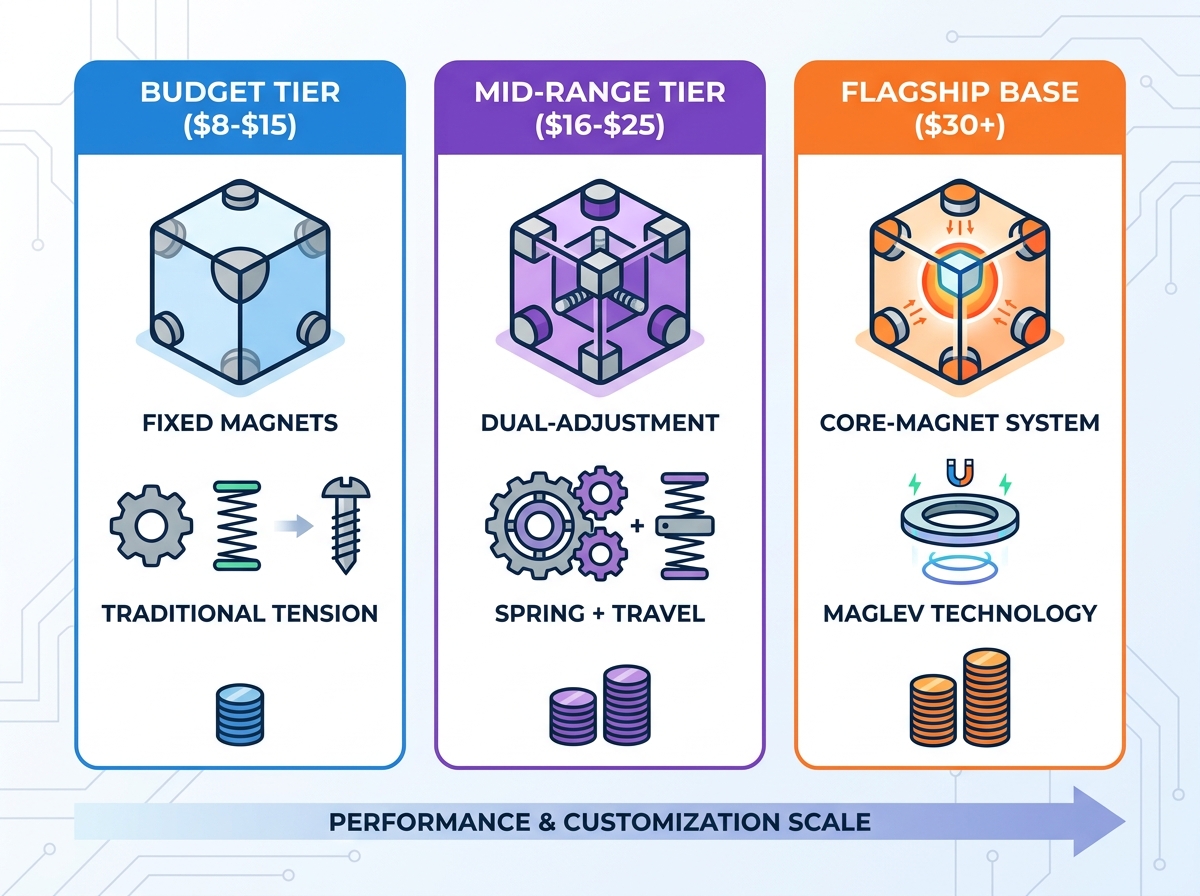
The hardware market offers distinct tiers catering to different project budgets. Understanding what each tier provides helps you avoid unnecessary spending. You want to match the internal technology to your specific project needs.
Budget Blanks ($8 – $15)
These entry-level bases feature fixed, moderate-strength magnets. They typically employ standard N35 grade neodymium inserts. You will find traditional spring-and-screw tensioning systems inside the center caps. Manufacturers usually offer them in standard black or white ABS plastic. First-time modders should always start here. They work perfectly for bulk mosaic art projects. You can also use them to prototype risky custom modifications. However, you face distinct limitations. You cannot customize the magnetic pull strength. The plastic walls might feel slightly hollow. Some ultra-budget models use brittle plastic blends.
Mid-Range Blanks ($16 – $25)
This tier introduces advanced dual-adjustment tensioning systems. You can adjust spring compression and axis travel distance entirely independently. This lets you tune flexibility and bounciness separately. They offer stronger factory magnets and seamless exterior piece designs. Intermediate speedcubers favor this specific tier heavily. They offer reliable, competition-ready hardware for custom color schemes. You get exceptional performance without massive financial outlay. The primary limitation is core technology. Core-to-corner magnets rarely appear at this specific price point. You mostly rely on refined edge-corner magnetism.
Flagship Blank Bases ($30+)
Premium bases include highly advanced core-magnetic systems. You frequently find MagLev tensioning technology here. Some models offer UV-coated exteriors for extreme durability. They also feature adjustable magnet capsules inside the pieces. Elite solvers require this world-class hardware. They refuse to compromise on their custom sticker shades while chasing records. This tier delivers absolute peak tournament performance. However, the high barrier to entry deters casual builders. Stripping hard UV-coatings for heavy physical shape mods can be highly destructive and dangerous.
Market Tier Comparison
| Hardware Tier | Estimated Price | Tension System | Magnet Layout | Best Application |
| Budget Base | $8 – $15 | Standard Spring & Screw | Fixed Edge-Corner | First-time mods, bulk mosaic art |
| Mid-Range Base | $16 – $25 | Dual-Adjustment System | Strong Edge-Corner | Intermediate speedsolving, custom colors |
| Flagship Base | $30+ | MagLev / Advanced Springs | Adjustable Core-Corner | Elite competition, blindfold training |
Implementation Risks: Modding and Setup Pitfalls
Building a custom puzzle introduces several technical hazards. Many newcomers ruin excellent hardware through simple oversights. Modifying Magnetic cube blanks requires careful planning and precise execution. You must prepare the surfaces, check polarities, and use safe chemicals.
Adhesive Failure on Frosted Plastics
Applying standard vinyl decals to heavily frosted surfaces usually fails. The textured microscopic peaks prevent the adhesive from bonding fully. The stickers will peel off within days of aggressive solving. You must properly prep the plastic surface first. Clean the exterior thoroughly using 91% isopropyl alcohol. This strips away factory oils and microscopic debris. Allow it to air dry completely. If the base remains too frosted, you might need stronger transfer tape. Skipping this vital preparation step guarantees frustrating peeling issues.
Polarity Mistakes in DIY Upgrades
Some builders decide to upgrade the internal magnets manually. They might drill into the core to add stronger pull. If you add internal magnets, you must test the polarity rigorously. Use a marked tester magnet to confirm the attracting side. Failing to do this before the superglue cures ruins the puzzle entirely. The pieces will repel each other aggressively. The base will refuse to align. Always use a permanent marker to dot the correct poles before applying cyanoacrylate adhesive. Let the glue ventilate properly to prevent white chemical blooming on the internal tracks.
Chemical Lubricant Interactions
Incompatible lubricants destroy raw puzzle plastic quickly. Aggressive, petroleum-based lubricants degrade ABS plastic molecularly. WD-40 or Vaseline will literally melt the internal mechanisms. Cheaper blanks are especially vulnerable to chemical stress cracking. Stick exclusively to 100% silicone speedcube lubricants. You can mix different cSt (centistokes) viscosities safely. Low viscosity silicone promotes fast turning speeds. High viscosity silicone dampens spring noise effectively. Water-based lubricant options also work perfectly safely, though they dry out faster.
Tensioning Imbalance During Reassembly
Taking a base apart disrupts the careful factory tensioning. You might dismantle the puzzle to dye the plastic or modify the internal piece shapes. When you reassemble it, you face a tensioning nightmare. Users must possess a clear mathematical framework for re-tuning. Dual-adjustment systems require perfectly balanced settings across all six center faces. Start by tightening the screws completely down. Then, loosen each screw outward by exact quarter-turns. Ensure the travel distance clicks match uniformly. Uneven tensioning causes unpredictable lock-ups and asymmetrical flexibility.
Shortlisting Logic: How to Choose Your Magnetic Blank
Navigating the hardware market feels overwhelming initially. You see dozens of slightly different models. You need a structured elimination process to find the right base. Follow these sequential steps to filter out unsuitable options efficiently.
- Step 1: Define the End Goal. Are you building a competition-legal main puzzle? Do you need a simple aesthetic display piece? Maybe you want a dedicated, heavy practice tool to build finger strength. Your ultimate goal dictates your strictly required specifications. Display pieces do not need MagLev technology.
- Step 2: Establish the Hardware Baseline. Filter out substandard options immediately. Remove any hardware lacking basic corner-cutting capabilities. Ensure the pieces feature deep anti-pop torpedoes. If you demand a customizable tactile feel, filter out anything lacking adjustable magnet capsules. Do not compromise on your baseline requirements.
- Step 3: Factor in Total Setup Expense. Do not look at the base price alone. You must calculate the complete financial investment. Add the base retail price. Add the cost of custom pre-cut sticker sets. Include the necessary application transfer tape. Do not forget specialized silicone setup lubricants. Tallying these items gives you the true project expense. This prevents mid-project budget surprises.
- Step 4: Vendor Selection. Buy exclusively from reputable, dedicated speedcubing retailers. Avoid generic online marketplaces when sourcing raw bases. Dedicated shops guarantee you receive the latest batch versions. Manufacturers silently update internal plastic molds frequently. Reputable vendors help you avoid outdated designs. They also ensure you receive fresh, non-degraded factory magnets.
Conclusion
Building a custom puzzle is a rewarding technical project. You must apply a logical buying framework to succeed. Match the internal magnetic technology directly to your intended performance level. Standard edge magnets suit casual display modding perfectly. Advanced core magnets fit aggressive competitive needs. You must also match the exterior plastic finish to your specific stickering strategy. Glossy bases always provide superior adhesive grip.
For most customizers, mid-range dual-adjustment bases offer the absolute optimal balance. They provide modern, reliable speedsolving mechanics. They also carry a very affordable financial modding risk. You get competitive performance without the flagship price penalty.
Now is the time to start your build. Measure your preferred sticker dimension sizes accurately. Verify your available hobby budget using the setup expense formula. Review the detailed specification tables on specialized retailer websites. Secure your ideal base hardware today and begin your custom project.
FAQ
Q: Do magnetic cube blanks come pre-lubricated?
A: Most factory bases arrive with very light, automated factory lubrication applied to the core hardware. However, the internal plastic piece tracks usually remain completely dry. A complete wipe-down of factory oils and a fresh custom silicone setup is highly recommended for optimal performance.
Q: Can I change the magnet strength in a standard budget blank?
A: Typically no. Budget bases have internal magnets glued securely into fixed plastic slots. You cannot extract them safely without damaging the pieces. You must purchase a mid-range or flagship model featuring adjustable magnet capsules to alter the magnetic pull strength.
Q: Is white plastic or black plastic better for a blank?
A: This remains strictly an optical preference for color recognition. Neither color changes the physical turning mechanics. However, black plastic provides significantly higher visual contrast against bright custom neon stickers. This stark contrast makes black plastic the standard choice for competitive speedcubers.