The speedcubing community is rapidly moving past factory-standard puzzles. Enthusiasts now prefer custom-tailored modifications to achieve optimal competitive performance. Selecting the wrong base puzzle or incorrect magnet specifications usually ruins a build. Poor choices inevitably cause unbalanced weight, inconsistent tactile feedback, or outright structural failure. This guide provides an objective, evidence-based framework for evaluating unmagnetized base cubes. You will learn how to select the precise hardware necessary for your custom modification projects. We will thoroughly explore neodymium grades, adhesive selections, and structural tolerances. This structured approach ensures your final product performs exactly to your unique turning style. Proper planning eliminates guesswork and protects your hardware investment from permanent damage. By mastering these foundational techniques, you gain complete control over your puzzle's mechanical behavior.
Key Takeaways
- Base Compatibility Dictates Options: Not all non-magnetic cubes have internal tracks wide enough to house standard magnets; measuring internal edge-piece tolerance is a mandatory first step.
- N-Rating Trumps Size: The grade of the neodymium (e.g., N35 vs. N50) affects tactile feedback more efficiently than simply increasing the magnet's physical dimensions, saving crucial puzzle weight.
- Polarity and Placement Mitigate Risk: The majority of project failures stem from incorrect polarity alignment or using brittle adhesives, not the hardware itself.
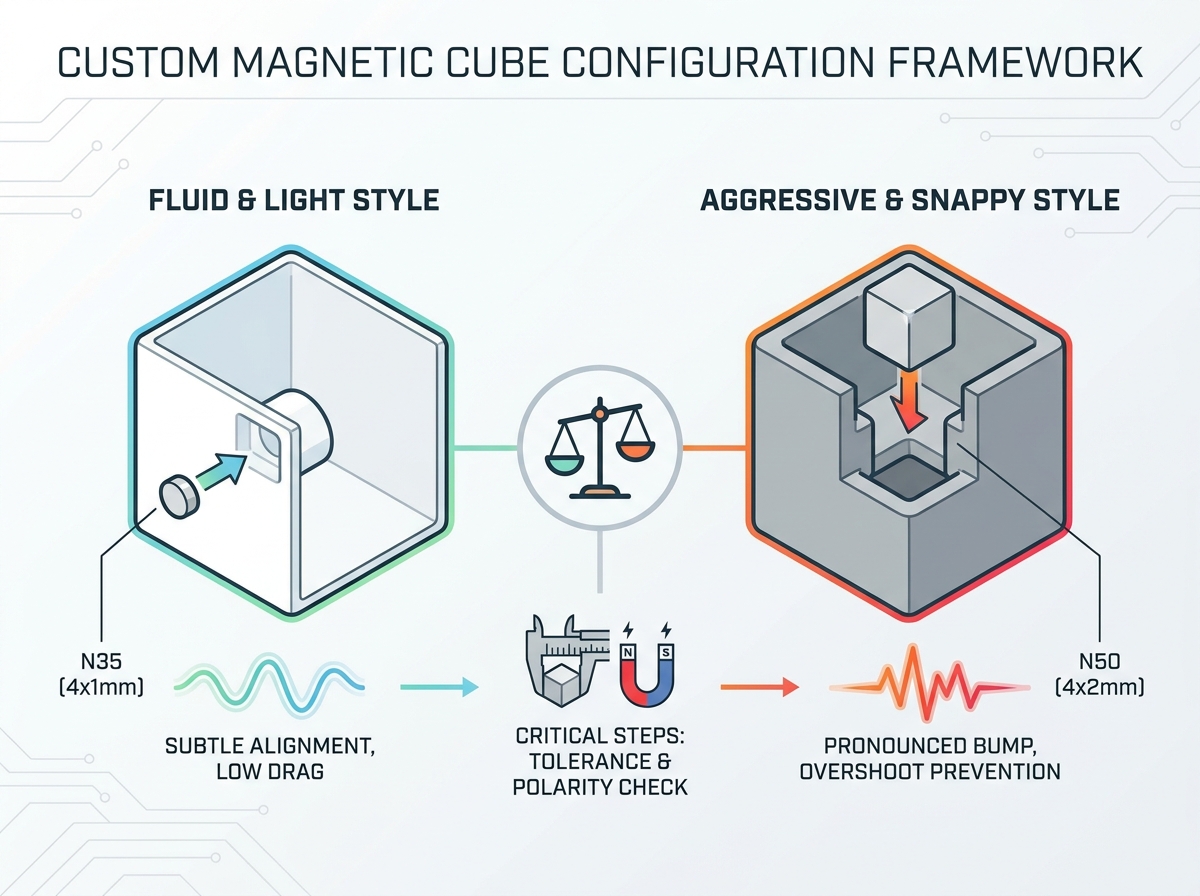
- Matching Style to Setup: Aggressive turning styles require stronger tactile bumps (N48/N50), while fluid/light turners benefit from weaker stabilization (N35).
Defining Your Project’s Success Criteria
Success requires defining your performance goals before modifying any hardware. Every hardware alteration changes how a puzzle reacts under tension. You must establish clear expectations regarding feedback, weight, and durability.
Tactile Feedback vs. Turning Resistance
Builders constantly balance tactile feedback against physical turning resistance. A strong magnetic click effectively prevents layer overshoot. This distinct bump helps aggressive turners snap layers into perfect alignment. However, strong pulling forces demand higher initial turning effort. Overcoming this static friction repeatedly causes severe finger fatigue. High resistance makes long practice sessions incredibly tiring. Conversely, weak pulling forces reduce fatigue but offer negligible stabilization. You must find the precise middle ground matching your finger strength.
Weight Distribution
Adding metal components fundamentally alters the puzzle's moment of inertia. Magnets placed deep inside edge pieces centralize the mass. Centralized mass allows layers to start and stop spinning effortlessly. Conversely, installing heavy metal near the outer corners increases rotational drag. Outer mass requires more force to initiate a turn. It also requires more force to stop a turning layer. Heavy corner pieces can make a fast puzzle feel sluggish and uncontrollable. Strategic weight distribution dictates your ultimate turning speed.
Longevity and Stability
A successful build relies on long-term mechanical stability. High-impact solves generate intense shockwaves through the plastic framework. These repeated impacts can dislodge improperly seated hardware. A loose magnet rattling inside a closed edge piece causes immediate mechanical lockups. It ruins tournament solves instantly. True project success involves preventing hardware dislodgement entirely. You achieve this through meticulous seating and deliberate adhesive selection.
Evaluating Base Puzzles (Magnetic Cube Blanks)
Your chosen unmagnetized puzzle serves as the structural foundation. Poor foundations yield poor results. You must rigorously assess the physical architecture of these base units before proceeding.
Internal Plastic Thickness
Assess the structural integrity of the plastic inside every corner and edge stalk. Thin plastics create massive risks during modification. Cyanoacrylate glue releases significant heat during its rapid curing phase. This thermal output easily warps thin plastic walls. Additionally, strong pulling forces constantly stress the plastic housing. Thin walls may eventually bow inward under this continuous pressure. You must measure stalk thickness using digital calipers. Robust walls handle thermal and mechanical stress much better.
Track Design and Slot Availability
Negative space dictates your installation options. You must identify exactly how much empty volume exists inside the pieces. Models utilizing hollow stalks offer incredibly easy mounting points. Builders can drop hardware directly into these pre-existing cavities. Solid-cast pieces present severe challenges. Modifying solid internal structures requires precision drilling and routing. When sourcing Magnetic Cube Blanks, prioritize designs featuring generous internal clearance. Abundant clearance simplifies alignment and reduces friction risks.
Baseline Performance
Hardware upgrades never fix fundamentally flawed mechanisms. A catchy, rigid base cube remains catchy after modification. The base puzzle must possess excellent corner-cutting natively. Smooth rotation is an absolute prerequisite. You should fully lubricate and tension the unmagnetized puzzle first. Test its mechanical limits thoroughly. Only proceed if the baseline performance meets your competitive standards. Modifying a low-performing unit wastes valuable time and expensive materials.
Decoding Magnet Specs: Ratings, Shapes, and Sizes
Understanding neodymium specifications separates amateur builds from professional-grade equipment. Selecting the correct geometry and pull force dictates the puzzle's final personality.
Magnet Specifications Comparison Chart
| Neodymium Grade | Primary Characteristic | Ideal Turner Profile | Plastic Thickness Requirement |
| N35 | Subtle alignment, low initial friction | Fluid, light touch | Safe for thin walls |
| N48 | Snappy click, medium friction | Aggressive, fast | Requires medium walls |
| N50 / N52 | Harsh bump, high resistance | Forceful, inaccurate | Requires thick, rigid walls |
Neodymium Grades (N35 to N52)
The N-rating denotes the maximum energy product of the material. This rating controls the raw strength of the pulling force. Using N35 hardware provides a very subtle alignment feeling. It perfectly suits light turners who prefer fluid motions. It also safely integrates into Magnetic cube blanks featuring delicate internal structures. Alternatively, N48 and N50 grades deliver a snappy, pronounced tactile bump. These higher grades demand thicker surrounding plastic to prevent surface warping over time.
Dimensions (Common Configurations)
Physical dimensions change both surface area and total mass. You must evaluate the surface area to volume ratio carefully.
- 4x1mm vs. 4x2mm: The 4x1mm size offers lightweight stabilization. The 4x2mm size doubles the mass and drastically increases pulling force. We recommend a simple prototyping trick. You can stack two 4x1mm discs together inside a test piece. This safely simulates the heavier 4x2mm feel before you finalize any purchases.
- Cylinders vs. Cubes: Builders traditionally use standard disc cylinders. Discs fit easily into round injection-molded cavities. However, Magnetic cubes offer superior flat-edge alignment benefits. The flat faces maximize surface contact for adhesives. This maximizes bond strength. They do require incredibly precise seating to prevent angular protrusion inside the plastic blank.
Implementation Realities and Risk Mitigation
Execution determines the lifespan of your custom build. Proper chemical bonds and strict polarity mapping prevent catastrophic project failures.
The Adhesive Dilemma
Adhesive selection dictates structural resilience. Builders usually choose between two distinct chemical families.
Cyanoacrylate (Super Glue) offers extremely fast curing times. You can finish a project in hours. However, it presents major downsides. Super glue emits fumes causing plastic "frosting" or chlorosis. It also cures into a rigid, brittle bond. This brittle bond shatters easily during hard drops.
Epoxy resins require patience. They typically demand 24 hours to cure fully. Despite the wait, epoxy provides immense benefits. It cures into a slightly flexible matrix. This flexibility absorbs physical shocks effortlessly. Epoxy guarantees permanent retention during the most aggressive competitive solves.
The Polarity Trap
Polarity inversion ruins entire builds instantly. You must utilize the "master edge piece" method. First, finalize one single edge piece perfectly. You will use this specific piece to test every subsequent component.
- Mark your master edge piece clearly.
- Hold a loose corner piece near the master edge.
- Allow the new hardware to snap onto the master piece's exterior.
- Mark the exposed outward-facing side using a permanent marker.
- Glue the piece exactly as marked into the new corner housing.
This process guarantees uniform attracting and repelling forces across all 48 installation points. A single reversed piece creates permanent repelling forces where attraction should exist.
Tolerance Checking
Friction rub destroys turning speeds. This occurs when hardware protrudes slightly past the internal plastic housing. The exposed metal scrapes directly against adjacent plastic pieces during layer rotation. This scraping creates audible scratching noises. It also generates immense rotational drag. You must constantly monitor seating depth. Push every metal piece flush against the internal cavity walls. Wipe away any excess adhesive immediately before it hardens. Maintain pristine internal clearances to preserve native corner-cutting abilities.
Decision Framework: Shortlisting Your Setup
You must align your hardware choices directly to your personal turning style. Randomly selecting components yields unpredictable and often disappointing results.
For the Aggressive/Inaccurate Turner
Aggressive turners constantly battle layer overshoot. Forceful hands push layers past their intended stopping points. We highly recommend stable, thick-plastic blanks for this profile. Pair these sturdy bases alongside N48 hardware measuring 4x2mm. The intense pulling force provides massive mechanical deceleration. It catches the spinning layer aggressively. This combination forcefully corrects inaccurate turning habits and completely prevents overshoot lockups.
For the Fluid/Light Turner
Fluid turners rely on gentle fingertip control. They maintain momentum rather than forcing layers. High pulling forces disrupt their rhythm. We recommend lightweight, thin-walled blanks for this group. Pair these delicate bases alongside N35 hardware measuring 4x1mm. This combination adds a very subtle alignment sensation. It guides the layers into place gently. It introduces zero rotational drag, preserving the turner's rapid, flowing execution.
Next-Step Actions
- Measure the target blank's internal clearance utilizing precise digital calipers.
- Order a small test batch of hardware including both N35 and N48 grades.
- Prototype one corner-edge pair thoroughly before purchasing bulk quantities.
- Select your preferred adhesive based strictly on your curing time patience and shock-absorption needs.
Conclusion
Building custom puzzles is a precise engineering science. It is never a guessing game. Careful planning always yields a superior, competition-ready result. You must rigorously evaluate internal tolerances before buying materials. You must match N-ratings to your specific finger strength. You must map polarity flawlessly. By following this objective framework, you will create a highly specialized tool. This custom build will easily outperform standard factory options. Take your time, measure twice, and execute your modifications systematically.
FAQ
Q: Can I put magnetic cubes in any non-magnetic blank?
A: Not universally. Internal track clearance dictates viability. Some older or budget designs lack the hollow space required for seating magnets. You must always measure internal dimensions before attempting modifications.
Q: Will stronger magnets make my cube slower?
A: Yes. Higher pull forces increase the initial friction required to break the magnetic bond. This translates directly to a heavier, slower turning feel. You must exert more finger force to initiate every turn.
Q: What is the best way to fix a reversed magnet?
A: If cyanoacrylate was used, soaking the specific piece in warm soapy water helps. Carefully applying a debonder can sometimes release the bond. However, this risks plastic degradation. Prevention via a polarity guide remains critical.
Q: Do neodymium magnets lose strength over time?
A: For standard projects, no. Unless exposed to extreme heat (above 80°C/176°F) or severe physical cracking, they will easily outlast the internal plastic components of your puzzle.