The fidget toy market recently evolved from simple novelties into specialized focus tools. Professionals and neurodivergent individuals now seek optimal sensory feedback for daily routines. These everyday tools influence productivity and stress management in profound ways. Fidgeting is no longer dismissed as mere distraction. Experts recognize it as a valid method for regulating nervous systems.
Buyers face a distinct choice today. You must choose between standard repetitive-motion tools like spinners or cubes, and unstructured modular tools like neodymium magnet spheres. We provide an objective, evidence-based evaluation of both categories here. We evaluate tactile feedback, focus retention, safety compliance, and overall value. You will discover exactly how Magnetic Balls compare to traditional everyday carry devices. We highlight the ideal environments for each type. You will learn to match specific sensory requirements to the right physical tool. This analysis ultimately guides safer, more effective purchasing decisions.
Key Takeaways
- Mechanism: Traditional toys offer mindless, closed-loop repetition; magnetic balls provide open-ended, visually engaging manipulation.
- Focus Impact: Traditional fidgets are better for "blind" fidgeting; magnetic balls excel at structured breaks and tactile problem-solving.
- Safety Reality: Magnetic balls carry significant ingestion risks and strict age restrictions, disqualifying them for young children or unmonitored environments.
- Selection: Choosing between the two depends entirely on the user's age, environment (office vs. classroom), and sensory requirements.
Structured Repetition vs. Open-Ended Modularity
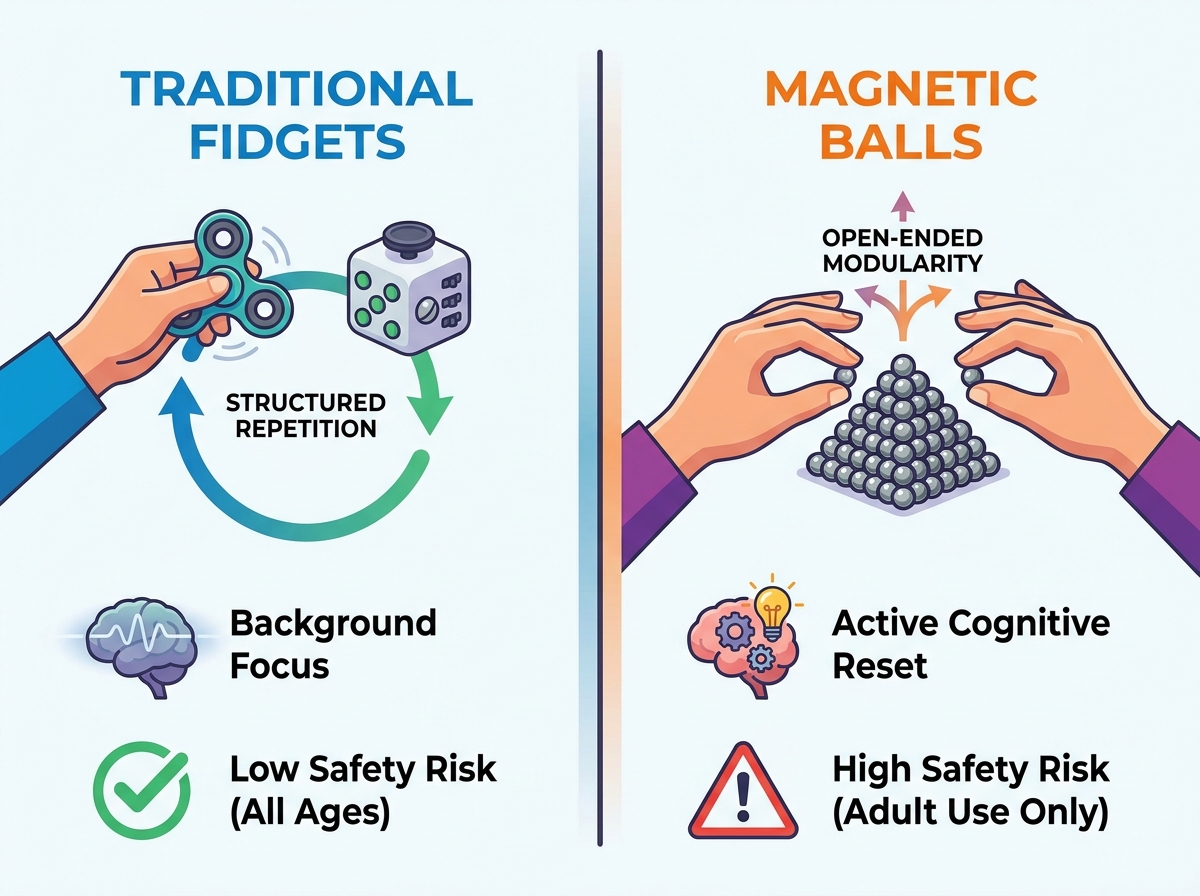
Different tools solve different behavioral needs. Traditional fidgets provide highly predictable experiences. Spinners, sensory cubes, and mechanical sliders guide your fingers along predefined sensory paths. You click a button. You spin a central bearing. You push a tactile switch. The sensory loop remains closed and entirely predictable.
This structured repetition offers a distinct advantage. Traditional options require zero visual attention. They act as passive anchors for nervous energy. You can maintain steady eye contact during a critical meeting. You can read complex documents on a screen. Your hands stay busy, but your visual cortex remains free.
Neodymium spheres operate on a completely unstructured, modular framework. They do not force a specific motion. They adapt to your immediate creative intent. Users combine individual spheres to build complex geometric shapes. This opens up diverse magnetic balls applications. They extend far beyond simple hand manipulation. They facilitate 3D modeling, desktop architecture, and complex geometric puzzle-solving.
We must evaluate these tools through two distinct lenses:
- Background Stimulation: Traditional fidgets excel here. They provide a steady rhythm to keep mild anxiety at bay while you work.
- Active Cognitive Reset: Modular magnets dominate this space. They pull you out of a mental rut. They require active spatial reasoning to construct new shapes.
Performance Evaluation: Sensory Feedback & Focus Retention
Tactile and auditory profiling defines user satisfaction. Standard fidget devices cover a massive sensory spectrum. Silicone squish toys offer complete silence. They serve well in quiet library settings. Conversely, mechanical metal clickers deliver loud, satisfying auditory snaps. Buyers choose the exact noise level their environment permits.
Neodymium spheres produce highly specific feedback. When they connect, they create a distinct "crunch" or snapping sound. The neodymium pull creates intense tactile resistance. Pulling two magnets apart engages fine motor muscles effectively. This resistance grounds the user physically.
Sensory assist programs often evaluate these tools for neurodivergent populations. Many adults use them to manage ADHD symptoms or alleviate generalized anxiety. Structured motion channels nervous energy efficiently. However, we must introduce a necessary limitation check here. Magnets can easily cross a critical boundary. They sometimes become too engaging. They transform from a background focus aid into a primary distraction. Users frequently stop working to perfect a geometric dodecahedron.
Manufacturers constantly explore material innovations to solve these drawbacks. We now see the emergence of silicone-coated magnetic balls. This coating serves multiple functions. It drastically reduces the audible clicking noise. It alters the tactile experience by providing a softer, highly grippable surface. This innovation makes them slightly more appropriate for shared office spaces.
Technical Specifications: Sizing and Form Factors
Shoppers often feel overwhelmed by technical measurements. Understanding core magnetic balls specifications prevents buyer remorse. The industry relies heavily on two primary size formats.
The 5mm sphere serves as the undisputed industry standard. It provides a substantial surface area for your fingertips. It is much easier to manipulate. It delivers stronger tactile feedback. Most users find 5mm ideal for structural building and casual desk use. Micro-sized 2.5mm spheres require extremely high dexterity. They are highly portable. However, they easily fall into keyboards or carpet fibers. Users with larger hands or fine motor limitations find the 2.5mm size deeply frustrating.
Traditional fidget specifications remain highly varied. Manufacturers use injection-molded plastic, machined brass, or aerospace-grade titanium. Enthusiasts judge spinners by bearing quality and total spin time. They judge sliders by internal switch tension.
Durability creates a major dividing line. Neodymium spheres rely on surface coatings like nickel, gold, or synthetic paint. These coatings inevitably chip over time due to constant friction. Moisture accelerates this degradation. High-end traditional metal fidgets offer lifetime durability. A solid titanium slider rarely degrades from normal hand wear.
Comparison of Fidget Specifications | Feature | Traditional Metal Fidgets | Magnetic Spheres (5mm) |
| Primary Material | Brass, Titanium, Stainless Steel, Plastic | Neodymium Core, Nickel/Paint Coating |
| Dexterity Required | Low to Medium | Medium to High |
| Visual Attention | None (Blind operation possible) | High (Visual coordination needed) |
| Long-term Durability | Excellent (Lifetime for solid metals) | Moderate (Coatings may chip over time) |
The Trust & Safety Mandate: Navigating Compliance Risks
Safety constitutes the most critical differentiator in this comparison. You must approach neodymium magnets with strict authoritative caution. The CPSC issues severe warnings regarding high-powered magnets. These products present catastrophic ingestion hazards. If a person swallows two or more powerful magnets, they pull together inside the digestive tract. They trap intestinal tissue between them. This causes severe infections, tissue necrosis, and requires emergency surgical intervention.
Age appropriateness dictates purchasing boundaries entirely. Traditional fidgets generally remain safe for all ages. You only need to avoid small parts for toddlers. High-powered neodymium spheres are strictly for adult use. Jurisdictions mandate a minimum age of 14 or 18. You must never introduce these items into unmonitored environments.
Proper manufacturer vetting ensures safer procurement. Responsible brands prioritize clear safety warnings. They comply strictly with federal toy magnet regulations. They utilize robust, child-resistant packaging. They actively educate consumers on the medical risks. You should immediately avoid white-label sellers who ignore age-rating protocols. Clear compliance labeling separates reputable engineering firms from negligent overseas drop-shippers.
Buying Guide for Magnetic Balls and Traditional Alternatives
Selecting the right tool requires logical shortlisting. You should base your decision on user demographics, environment, and specific sensory goals. Any comprehensive buying guide for magnetic balls will stress the importance of environment analysis.
You should choose traditional tools if the primary user is under 14. They also win if you need a strictly silent tool for crowded meetings. They remain perfect for "blind" one-handed fidgeting while reading emails.
You should choose modular spheres if the user is an adult. They suit professionals seeking a dedicated desktop focus tool. They reward users who enjoy tactile building. They provide an excellent active cognitive break during long coding or writing sessions.
Cost-to-value ratios reveal interesting market dynamics. A standard 216-piece 5mm magnetic sphere set generally costs less than premium EDC traditional fidgets. Machined titanium sliders often command high luxury prices. Magnets provide incredible geometric variety for a relatively modest initial investment.
Corporate buyers must carefully structure their procurement strategy. Purchasing magnetic balls in bulk presents distinct advantages and severe risks.
- Identify the End-User: Bulk orders make sense for adult tech teams or engineering departments. They encourage lateral thinking during brainstorming sessions.
- Verify Packaging Standards: Ensure bulk orders arrive in individual, child-resistant safety tins.
- Acknowledge Liability Risks: We strongly advise against bulk buys for school environments, daycare centers, or pediatric therapy clinics. The liability and safety protocols surrounding ingestion risks make them entirely inappropriate for these spaces.
Conclusion
The decision matrix ultimately highlights two divergent paths. Modular neodymium sets remain superior for creative, tactile engagement. They demand spatial reasoning. They provide a highly satisfying, active reset for the brain. However, they carry strict safety constraints. They demand responsible ownership and absolute separation from young children.
Traditional fidgets remain the undisputed champions for mindless, universal focus retention. They accommodate all ages. They survive drops and heavy friction. They allow you to maintain eye contact and process information without distraction.
We encourage you to audit your physical environment before checking out. Assess your daily noise constraints. Acknowledge the ages of the people sharing your living or working space. Select the tool aligning precisely with your daily behavioral needs.
FAQ
Q: Are magnetic balls safe for children with ADHD?
A: Strictly no. High-powered magnets present severe, life-threatening ingestion hazards. Children and teenagers may accidentally swallow them. We strongly recommend alternative traditional fidgets, like sensory chew necklaces or silent silicone sliders, for children managing ADHD.
Q: Which size is better for beginners: 2.5mm or 5mm magnetic balls?
A: The 5mm size is universally recommended for beginners. The larger surface area makes them much easier to manipulate. You experience stronger tactile feedback. Micro 2.5mm spheres demand high dexterity and easily roll off desks.
Q: How do you clean and maintain magnetic balls?
A: Wipe them gently using a dry, clean microfiber cloth. You must avoid water, harsh solvents, or soapy solutions. Moisture degrades the protective nickel or paint coatings, causing the magnets to chip and rust prematurely.
Q: Can I take magnetic balls on an airplane?
A: Generally, yes. TSA guidelines permit small magnetic desk toys in carry-on bags. However, extremely large or hyper-powerful industrial magnet setups may face scrutiny. Keep standard 216-piece 5mm sets in their original metal tin for smooth security processing.