Navigating the educational toy aisle often feels overwhelming. Parents and educators constantly search for the perfect building manipulative. You want tools fostering creativity, motor skills, and spatial reasoning. Choosing between traditional gravity-based building elements and modern, customizable Magnetic Cube Blanks creates a genuine dilemma. Both offer unique developmental benefits. You must balance classic tactile feedback against advanced, multi-purpose functionality. The ideal choice depends heavily on your specific teaching environment. You might prioritize Montessori principles, classroom curriculum integration, or general open-ended play. We will examine the core mechanics, developmental impacts, and critical safety considerations of both options. You will discover how they align differently with early childhood milestones. By the end, you will understand exactly how to match these learning manipulatives to your specific educational goals. Neither option is universally perfect. However, one will likely serve your immediate needs better.
Key Takeaways
- Functionality: Magnetic cube blanks allow for custom labeling (phonics, math, sight words) and defy gravity, while regular blocks rely on traditional balance and spatial physics.
- Developmental Value: Regular blocks build foundational gross motor skills and patience; magnetic cubes accelerate complex 3D modeling and reduce early builder frustration.
- Safety & Durability: Solid regular blocks last generations but pose impact risks; magnetic cubes require vetting for secure, ultrasonically welded enclosures to prevent magnet exposure.
- Cost: Regular blocks offer a lower barrier to entry; magnetic cube blanks require a higher upfront investment but provide extended lifecycle value through curriculum customization.
The Core Mechanics: Magnetic Cube Blanks vs. Traditional Blocks
Understanding the fundamental differences between these two building manipulatives requires a close look at their core mechanics. They operate on entirely different physical principles. These principles directly dictate how children interact, learn, and play.
Magnetic Cube Blanks Defined
Manufacturers design Magnetic cube blanks as versatile, modern learning tools. These are hollow plastic cubes housing internal neodymium magnets. The term "blank" refers to their exterior. The surfaces remain completely smooth and unmarked. This intentional design choice invites pure DIY customization. Educators can modify these surfaces endlessly. You can use dry-erase markers directly on the plastic. You can apply vinyl stickers. You can attach printed labels for specific daily lessons. The internal magnets allow these cubes to snap together instantly from almost any angle.
Regular Blocks Defined
Regular blocks represent the traditional standard of childhood play. They consist of solid materials. Maple wood, beech wood, and solid molded plastics dominate this category. These manipulatives rely purely on fundamental physics. Weight, surface friction, and gravity dictate their success. A child must physically balance one block perfectly atop another. There are no hidden mechanisms assisting the construction. They offer a grounded, highly tactile sensory experience.
The "Frustration Factor" in Early Play
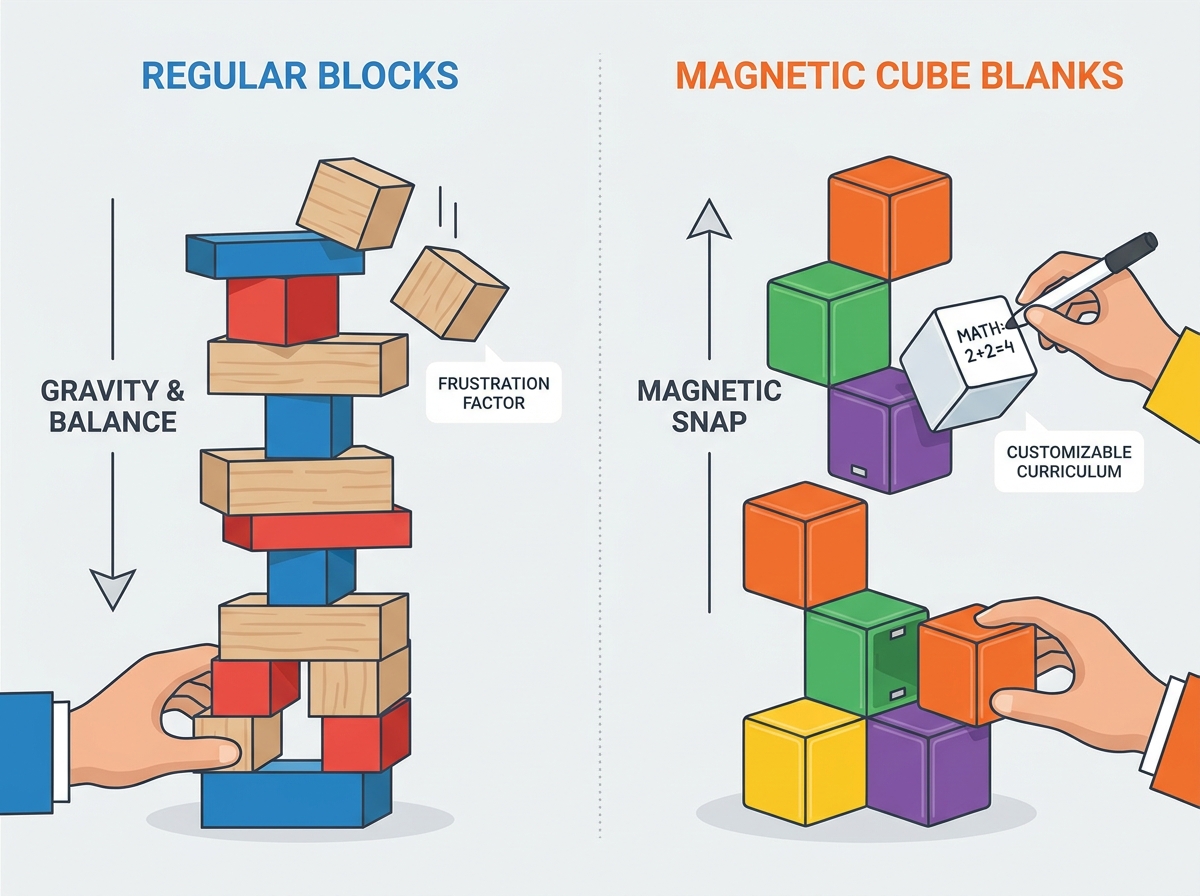
Early childhood educators frequently discuss the frustration factor during building sessions. Young children often experience fine-motor delays. They lack the precise dexterity required for tall wooden towers. A slight bump causes traditional blocks to tumble. This often leads to tears and abandoned playtime.
Magnetic connections act like training wheels for 3D construction. They eliminate premature structural failures. When a child brings two magnetic cubes close together, they snap securely into place. This instant success builds immediate confidence. Children will happily build larger, more ambitious structures. They bypass the strict dexterity requirements of gravity-dependent play. However, you must consider whether bypassing this frustration is always beneficial. Overcoming gravity-induced failures teaches valuable resilience.
Evaluating Educational & Developmental Impact
Every toy in a learning environment should serve a distinct developmental purpose. The choice between magnetic elements and solid wood drastically changes the daily curriculum.
Physics and Spatial Awareness
Different materials teach different lessons about the physical world. Consider the following developmental pathways:
- Real-World Physics Mastery: Regular blocks excel at teaching natural laws. Children learn about cause and effect intimately. If a block is not centered, the structure falls. They develop an intuitive understanding of weight distribution, load-bearing walls, and symmetry.
- Abstract Spatial Visualization: Magnetic elements encourage advanced geometric thinking. They allow for cantilevered structures. Children can build bridges extending outward into thin air. They explore abstract spatial visualization previously impossible in traditional block centers.
Traditional wood grounds children in reality. Magnets allow them to defy it. Both concepts hold immense educational value.
Customization for Curriculum: The "Blank" Advantage
The greatest strength of blank magnetic manipulatives lies in their academic versatility. You are not buying just a building toy. You are acquiring a blank canvas for literacy and numeracy.
Educators transform these blank surfaces daily. You might stick consonant and vowel decals onto the cubes. Children then snap them together to build CVC (consonant-vowel-consonant) words. The satisfying click reinforces the combination of sounds. During math blocks, teachers apply numbers and arithmetic symbols. Students physically connect equations. They physically manipulate abstract math concepts. You can color-code them for sensory sorting exercises. Magnetic cubes adapt effortlessly to whatever subject you teach that morning.
Montessori & Open-Ended Play Alignment
Montessori environments prioritize self-directed learning and natural materials. Traditional hardwood blocks fit this philosophy perfectly. They isolate the specific difficulty of balance. They offer organic sensory feedback.
However, blank magnetic options adapt remarkably well to Montessori-inspired stations. Their unmarked nature aligns with open-ended play principles. They do not force a specific narrative. Children dictate their purpose. While they use synthetic plastics, their supreme adaptability makes them highly favored in modern progressive classrooms.
Safety, Durability, and Implementation Risks
Selecting classroom manipulatives requires strict risk assessment. You must protect children from physical harm while ensuring the materials withstand daily abuse.
Material Longevity in High-Traffic Spaces
Regular hardwood blocks boast legendary durability. High-quality maple sets routinely survive generations of aggressive play. They might suffer minor dents or chipped corners. Yet, they rarely suffer catastrophic structural failure. They are nearly indestructible.
Magnetic plastic equivalents face different wear patterns. Constant snapping causes micro-scratches on the plastic surfaces. Over time, clear plastics may become cloudy. Furthermore, hollow plastic can crack. If a heavy adult accidentally steps on a magnetic cube on a hard floor, the casing might shatter. This poses significant safety risks.
The Magnet Safety Imperative
We must address the critical safety risks associated with cheap magnetic toys. Swallowing loose neodymium magnets causes severe, life-threatening internal injuries. You cannot compromise on manufacturing quality here.
Never purchase unverified magnetic building sets from unknown third-party sellers. You must strictly evaluate manufacturers for ultrasonic welding. High-quality brands do not use standard glues. They use high-frequency acoustic vibrations to melt the plastic halves together. This creates a permanent molecular bond. The internal magnets cannot escape. Always demand proof of compliance with local toy safety standards. Look for ASTM F963 certification in the United States. Look for EN71 certification in Europe. Conduct routine visual inspections. Discard any cracked units immediately.
Classroom Implementation and Scale
Storage logistics differ wildly between these two options. Cleanup times vary significantly.
Magnets naturally clump together. A child can grab a massive cluster of cubes at once. Cleanup is remarkably fast. The sets hold themselves together neatly inside storage bins. Conversely, traditional wooden blocks require dedicated, organized shelving. You must stack them neatly. Dropping heavy wooden blocks into plastic bins generates excessive noise and damages the blocks.
Table: Durability and Safety Characteristics
| Feature | Traditional Solid Blocks | Magnetic Blank Cubes |
| Core Material | Hardwood (Maple, Beech) or Solid Plastic | ABS Plastic (Hollow shell) |
| Connection Method | Gravity and Friction | Internal Neodymium Magnets |
| Primary Safety Risk | Impact injuries (dropping on toes) | Ingestion risk if plastic casing shatters |
| Required Certification | Standard non-toxic paint/finish checks | ASTM F963 / EN71 (Magnet safety) |
| Cleanup & Storage | Requires systematic stacking | Self-clumping, fast bulk storage |
Decision Framework: Which Should You Shortlist?
You now understand the mechanics, educational impacts, and safety profiles. You must apply these factors to your specific situation. Review the following frameworks before making your final selection.
Choose Magnetic Blank Manipulatives If:
- You need adaptable, multi-subject learning tools: You want a single product serving spelling, math, and spatial puzzles simultaneously. You value the ability to write directly on the toys.
- You work with easily frustrated children: You support toddlers or students needing early occupational therapy. You want to eliminate gravity-based failures to build immediate fine-motor confidence.
- You require travel-friendly options: You need materials for road trips, waiting rooms, or mobile therapy clinics. The inherent magnetism keeps the entire set clumped together securely during transit.
Common Mistakes to Avoid
Do not use permanent markers on the blank faces unless you intend to never change them. Always test a small corner with your specific dry-erase marker brand first. Some plastics ghost or stain easily. Furthermore, do not submerge them in soapy water during cleaning. Water will seep into microscopic seams. This rusts the internal magnets and ruins the toy.
Choose Regular Solid Blocks If:
- You prioritize traditional, natural materials: You operate a strict Waldorf or classical Montessori environment. You want children interacting with organic textures and natural wood grain.
- You need high-volume accessibility: You manage a massive daycare facility. You need hundreds of units available for multiple children simultaneously without worrying about cracked plastic hazards.
- You want to strictly teach foundational physics: You want children learning absolute truths about gravity, balance, and structural integrity. You want them experiencing the natural consequences of an unbalanced tower.
Best Practices for Implementation
Rotate wooden block shapes weekly to maintain high engagement. Pair them with varying loose parts like wooden ramps or small animal figures. Teach children architectural vocabulary. Use terms like "base," "column," and "load" while they build. This maximizes the specific educational advantages of solid materials.
Conclusion
The choice between these two excellent learning tools fundamentally changes your educational environment. Regular blocks remain the undisputed champions of classic, durable physical play. They teach irreplaceable lessons about gravity, balance, and natural physics. Conversely, magnetic blank manipulatives represent a superior choice for interactive, highly customizable curriculum design. They bypass physical frustration and adapt instantly to daily lesson plans.
Your next step requires an immediate audit of your current learning space. Assess your primary developmental goals for the upcoming year. Are you struggling with student frustration during free play? Or do you lack robust natural materials? Review your safety protocols, especially regarding magnetic toy certifications. Choose the manipulative aligning closest with your specific teaching methodology. You will watch your students' engagement soar.
FAQ
Q: Are magnetic cube blanks safe for toddlers?
A: Yes, provided you purchase high-quality sets. Most legitimate brands set an age grading of 3+ due to standard regulations. You must strictly check for sealed magnet safety. Ensure the manufacturer uses ultrasonic welding. Never let a toddler play with cracked or deeply scratched magnetic toys. Always supervise younger children closely.
Q: Can I write directly on magnetic cube blanks?
A: It depends heavily on the specific plastic finish. Many feature dry-erase compatibility. You can write on them and wipe them clean easily. Others possess a matte finish prone to ghosting. In those cases, use semi-permanent vinyl stickers or masking tape labels to customize the surfaces safely without causing permanent stains.
Q: Do magnetic blocks replace traditional building blocks?
A: No. Treat them as complementary tools rather than strict replacements. Traditional blocks teach necessary lessons about physical balance, weight distribution, and gravity. Magnetic options teach abstract geometry, advanced spatial reasoning, and support custom curriculum concepts. A well-rounded classroom benefits immensely from having access to both distinct types of manipulatives.
Q: How do you clean magnetic cubes without rusting the internal magnets?
A: Never submerge them in buckets of water. Liquid will penetrate microscopic seams and rust the internal neodymium elements. Instead, use a damp microfiber cloth. Wipe each surface down individually. For deeper sanitization, spray a mild disinfectant onto a paper towel first, then wipe the plastic. Dry them immediately.