While many people picture Magnetic Balls as simple desk toys or consumer novelties, industrial engineers view them quite differently. They recognize these neodymium spheres as highly precise, foundational components for critical machinery. Designing high-stress mechanical systems requires flawless execution and strict component reliability from the ground up. Relying on sub-par or untested magnetic materials often leads to catastrophic failures in automated manufacturing lines and sensitive fluid controls. A single out-of-tolerance sphere can cause severe systemic downtime. This article analyzes how spherical magnets function under extreme industrial conditions. We will break down their technical limitations, required performance metrics, and the essential criteria for B2B procurement. You will discover how to evaluate vendors properly. We focus heavily on verifiable data, clear operational limits, and rigorous industry compliance standards to ensure engineering project success.
Key Takeaways
- Primary Uses: Integral to check valves, 360-degree joint couplings, magnetic filtration, and automated quality control systems.
- Specification Criticality: Success depends on matching magnetic grades (e.g., N35–N52), heat tolerance, and coating materials to the specific operational environment.
- Risk Factors: Brittleness and thermal demagnetization are the primary failure points requiring engineering workarounds.
- Sourcing: Purchasing requires stringent vendor evaluation, focusing on precise dimensional tolerances and verifiable material certifications.
High-Value Magnetic Balls Applications in Engineering and Manufacturing
Engineering teams constantly seek efficient methods to reduce mechanical wear. They leverage spherical magnets across various demanding sectors. Exploring different magnetic balls applications reveals immense industrial potential. We see these components replacing traditional mechanical parts daily. They offer unique physics-based advantages across fluid dynamics and robotics.
Magnetic Filtration and Quality Control (QC)
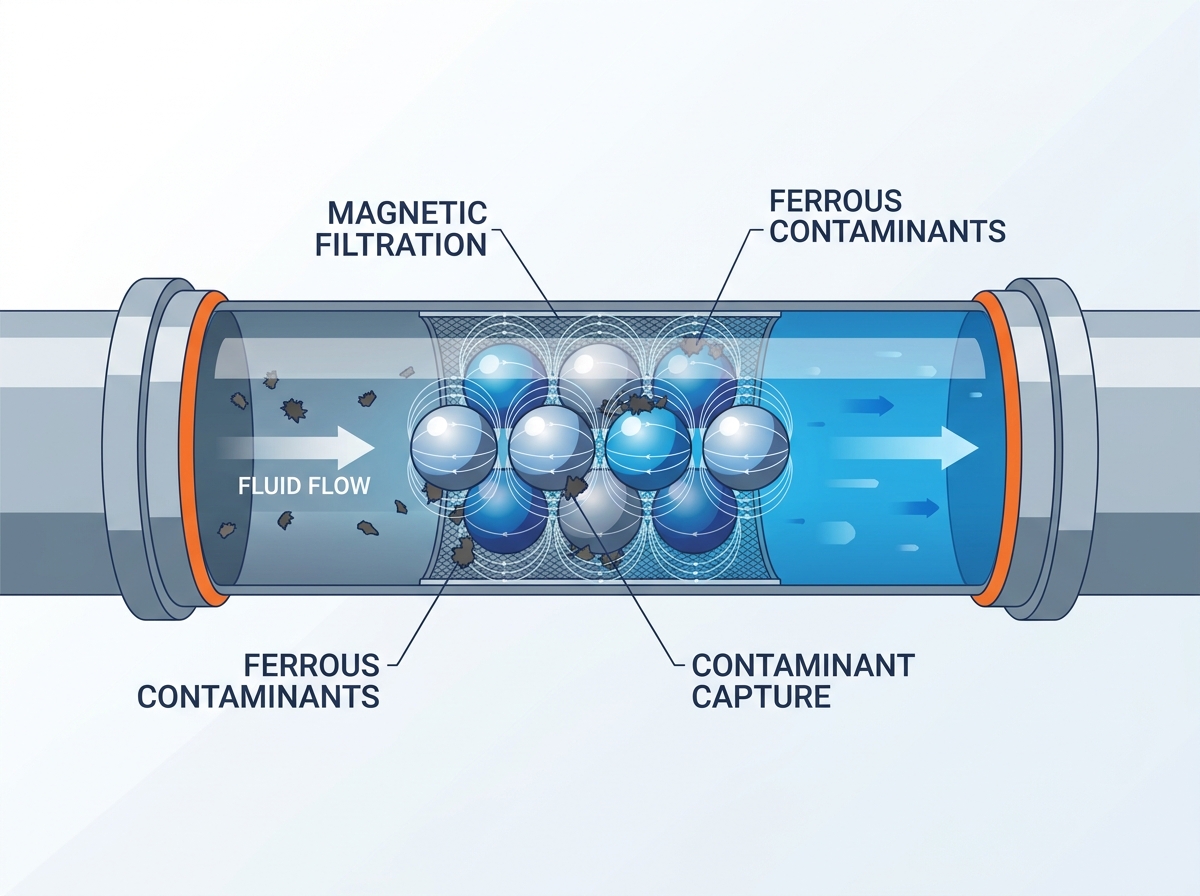
Food processing plants face incredibly strict purity standards. Ferrous contaminants threaten product safety and brand reputation. Pharmaceuticals and chemical manufacturing lines share these exact concerns. Engineers install complex arrays of neodymium spheres inside fluid lines. These spherical arrays capture microscopic metal shavings efficiently. The fluid passes around the spheres naturally. This action prevents severe machinery damage downstream. It also ensures full compliance with rigorous industry purity standards. Businesses avoid costly product recalls through preventative magnetic filtration.
Precision Check Valves and Flow Control
Traditional mechanical valves rely heavily on internal springs. These springs suffer mechanical wear over time. Spherical magnets offer a drastically superior alternative. Engineers utilize the perfect spherical shape to create omnidirectional seals. They deploy these seals inside complex hydraulic and pneumatic systems. The advantage over mechanical valves becomes immediately clear. We see fewer moving parts in these specific designs. You gain highly consistent seating capabilities. Reduced mechanical friction extends the overall lifespan of the entire system.
Articulated Joints and Sensor Housings
Advanced robotics require completely frictionless movement. Sensor housings demand uninterrupted 360-degree rotational freedom. Traditional mechanical ball joints experience severe wear and tear. Point-contact magnetic fields make frictionless movement entirely possible. Engineers design highly versatile optical mounts using these exact components. Automotive sensors also rely heavily on this rotating technology. Concentrated magnetic fields hold the sphere securely in place. The joint moves smoothly across all physical axes. This creates highly responsive, wear-free articulated joints.
Defining Magnetic Balls Specifications for Operational Success
Engineers must define strict magnetic balls specifications before beginning any mechanical assembly. Guessing parameters leads directly to system failure. Precise material selection dictates the operational lifespan of the component.
Material Selection (Neodymium vs. Alternatives)
NdFeB (Neodymium) remains the undisputed industry standard for spherical magnets. It delivers an incredibly high strength-to-volume ratio. Engineers need maximum magnetic pull inside tiny physical footprints. Ferrite or Alnico alternatives simply cannot match this concentrated power. Neodymium allows for ultra-compact mechanical designs. You save valuable space inside complex sensor housings.
Magnetic Grades and Field Strength
We must evaluate N-grades carefully during the design phase. Available grades typically range from N35 to N52. Buyers often assume a higher number guarantees better performance. This assumption represents a fundamental engineering mistake. Higher numbers certainly mean stronger magnetic fields. However, stronger fields do not equate to better durability. Extremely high grades often exhibit increased physical brittleness. They might crack under repetitive industrial stress.
Chart: Magnetic Grade Selection Summary
| Grade Designation | Relative Field Strength | Best Industrial Use Case |
| N35 - N38 | Standard | General sensor housings, basic filtration arrays |
| N40 - N45 | High | Precision check valves, moderate stress robotics |
| N48 - N52 | Maximum | Heavy-duty articulation, compact space constraints |
Surface Coatings and Corrosion Resistance
Raw neodymium corrodes rapidly when exposed to environmental moisture. Surface coatings prevent this severe oxidative degradation.
- Ni-Cu-Ni (Nickel): This serves as the standard industrial baseline. It handles general indoor mechanical applications perfectly.
- Epoxy: Engineers prefer epoxy for high-moisture environments. It protects the sphere heavily against chemical exposure.
- Teflon/PTFE: Cleanroom environments require this specialized coating. It also handles specialized fluid control settings effectively.
Dimensional Tolerances
Industrial spheres require strict micrometric tolerances. Mechanical seating demands exact physical measurements. We often specify tolerances around +/- 0.002 inches. Without this extreme accuracy, precision arrays fail completely. A slightly oversized sphere blocks pneumatic flow entirely. An undersized sphere causes dangerous fluid leaks. You must demand verifiable dimensional inspection logs from your manufacturer.
Implementation Realities: Mitigating Risks and Structural Limitations
Working around rare earth materials involves inherent structural risks. Engineers must design robust mitigations to prevent operational failure. Ignoring these physical limitations guarantees rapid mechanical breakdown.
Handling the Brittleness of Rare Earth Materials
Brittleness remains a massive physical challenge for neodymium. High-impact collisions cause these spheres to chip easily. Uncoated magnets suffer the worst abrasive damage. Chipping releases sharp abrasive particles directly into mechanical systems. This specific debris destroys sensitive gears and ball bearings rapidly.
Best Practices for Brittleness Mitigation:
- Design protective housing buffers using polyurethane or soft plastics.
- Utilize highly impact-resistant epoxy coatings on the spheres.
- Control mechanical engagement speeds to prevent high-velocity snapping.
Thermal Degradation and Curie Temperatures
Thermal degradation ruins magnetic performance permanently. Standard Neodymium loses its magnetism above 80°C (176°F). This curie temperature limitation restricts many heavy industrial uses. You must specify high-temperature series magnets for extreme heat applications. Look for specific suffix designations like M, H, or SH. These specialized variants withstand much harsher thermal conditions. Failing to account for operational heat leads to total demagnetization.
Assembly and Safety Hazards
Factory assembly lines face unique safety hazards handling these components. Strong magnetic spheres create severe skin pinch hazards. Two spheres snapping together can crush human fingers easily. Factory workers need specialized safety training. You must integrate specific non-magnetic tooling during factory assembly. Brass or titanium tweezers prevent dangerous magnetic snapping. Standard steel tools will cause immediate, dangerous accidents. Strict safety protocols prevent severe workplace injuries.
Buying Guide for Magnetic Balls: Vendor Evaluation and Procurement
Creating a reliable buying guide for magnetic balls requires understanding global supply chains. You must protect your engineering project through strict vendor evaluation. Sub-standard components destroy expensive industrial machinery.
Assessing Supplier Capabilities
You must differentiate between simple consumer distributors and true industrial-grade manufacturers. Consumer distributors cannot guarantee precise mechanical tolerances. They typically sell novelty items lacking technical documentation. Industrial suppliers provide comprehensive, verifiable testing documentation. You must request detailed Hysteresis graphs for your specific grade. Always ask for recent Gauss meter test reports. Review their dimensional inspection logs carefully before signing contracts.
| Required Vendor Document | Purpose for Engineering | Risk if Missing |
| Hysteresis Graph | Verifies magnetic performance curve | Unexpected demagnetization under load |
| Gauss Test Report | Confirms exact surface field strength | Weak holding force in articulated joints |
| Dimensional Logs | Ensures sphere fits the mechanical housing | Fluid leaks in precision check valves |
Compliance and Traceability
Compliance ensures global market access for your final product. Your magnetic materials must meet RoHS and REACH standards. Toxic heavy metals have no place in modern manufacturing. Traceability remains absolutely crucial for highly sensitive sectors. Aerospace, medical, and food-grade applications require complete lot-tracking. You must know exactly where each material batch originated. If a component fails, you need to isolate the exact production lot instantly.
Strategies for Sourcing Magnetic Balls in Bulk
Purchasing magnetic balls in bulk demands careful logistical planning. Lead times vary dramatically based on custom magnetizing directions. Spheres possess unique polarity orientations. Diametrical and axial orientations behave completely differently in sensor applications. Specifying the correct polarity orientation matters immensely.
Common Mistakes in Bulk Ordering:
- Skipping the prototyping phase completely.
- Ordering millions of units without physical accelerated wear testing.
- Assuming all epoxy coatings use food-safe chemicals.
Always follow strict sampling protocols first. Run accelerated wear-and-tear tests on a small prototype batch. Subject them to your exact operational temperatures. Submerge them in your specific hydraulic fluids. Complete these rigorous tests entirely before committing to bulk volume.
Conclusion
Spherical magnets offer incredible mechanical utility for industrial applications. However, this utility relies entirely on the necessity of precise specification. Ignoring thermal limits or dimensional tolerances leads directly to mechanical failure. You must balance the physical strength of Neodymium against its inherent structural brittleness.
Decision-makers should take clear action steps today. First, audit the exact environmental constraints of your intended application. Measure the peak operational temperature accurately. Identify any potential chemical exposure or high-moisture conditions. Second, determine your required dimensional tolerances for mechanical seating. Finally, compile this data before requesting any vendor quotes.
Do not guess your technical requirements. Consult with an experienced magnetic engineer to review your operational blueprints. Request a comprehensive technical data sheet from an industrial supplier. Shortlist your materials based on verifiable data rather than assumed strength.
FAQ
Q: What is the maximum operating temperature for standard industrial magnetic balls?
A: Standard NdFeB magnets lose their magnetic properties above 80°C (176°F). This curie temperature limits their use in high-heat environments. If your application exceeds this threshold, you must specify high-temperature alternatives. Series variants carrying M, H, or SH suffixes handle much higher thermal loads safely.
Q: Can magnetic balls be machined or drilled after purchasing?
A: No. Machining neodymium poses a severe fire hazard. The dust ignites highly easily. Drilling also breaks the protective coating, causing rapid corrosion. Furthermore, mechanical stress destroys the existing magnetic properties. Always order your exact specifications directly from the manufacturer.
Q: How do I verify the magnetic grade when ordering magnetic balls in bulk?
A: Demand comprehensive third-party testing documentation from your vendor. Ask for certified Gauss measurements mapped to the specific batch. Require the supplier to provide detailed pull-test data and Hysteresis graphs. Randomly sample the bulk delivery upon arrival using an in-house Gauss meter.
Q: Are Neodymium sphere magnets safe for direct food contact in QC systems?
A: Raw neodymium is toxic and highly unsafe for food contact. You must specify FDA-approved, food-safe coatings. Specialized food-grade epoxies work well. For ultimate safety in quality control systems, engineers frequently enclose the magnets entirely inside seamless stainless-steel encapsulation.