Procuring neodymium magnets online presents a major consistency challenge. Buyers face hundreds of identical-looking spec sheets daily. These listings show similar products with wildly different price points. Choosing the lowest price carries significant long-term risks. You might easily fall into the "cheap magnet" trap. Unreliable vendors frequently cut corners on grade authenticity. They compromise on coating quality and loosen dimensional tolerances. These hidden shortcuts lead to disastrous product failures later.
This article provides a comprehensive, vendor-neutral evaluation framework. Our goal is to help you compare prices accurately. You will learn how to spot hidden fees easily. We will guide you in selecting a truly reliable supplier. This framework works perfectly for rapid prototyping or bulk manufacturing.
Key Takeaways
- Price is dictated by material volume, not just pull force: A thick N42 disc may cost more and perform differently than a thin N42 block, even if advertised pull forces are similar.
- Coating and tolerance impact the bottom line: Cheaper N42 magnets often cut costs via single-layer plating or loose manufacturing tolerances (±0.004" vs. ±0.002"), leading to high failure rates in assemblies.
- Bulk discounting is non-linear: Supplier tier pricing varies heavily; the most cost-effective vendor at 50 units is rarely the cheapest at 5,000 units.
- Authenticity matters: N42 is the industry workhorse grade, but unscrupulous vendors frequently substitute cheaper N35 disguised as N42.
The Core Variables That Drive N42 Magnet Pricing
Prices for a strong N42 Magnet do not exist in a vacuum. The "N42" designation refers to the maximum energy product (MGOe) of the material. Global commodity rates dictate the baseline cost of raw neodymium, iron, and boron. When rare-earth prices fluctuate, manufacturers adjust their unit costs accordingly. However, raw material is just one part of the equation. Machining complexity plays an equally crucial role in final pricing.
Discs and Cylinders
Disc and cylinder shapes typically cost less. Manufacturers mass-produce them using straightforward pressing and slicing techniques. The factory presses raw powder into a standard cylindrical mold. They then slice it to the required thickness. Sticking to standard sizes yields an excellent price-to-performance ratio. You avoid the heavy premiums associated with custom tooling. Round shapes also experience less structural stress during the manufacturing process. This efficiency keeps defect rates low and prices highly competitive.
Blocks and Rectangles
Block shapes introduce significantly more complexity. Pricing depends heavily on the chosen magnetization direction. Magnetizing a block through its thickness remains the industry standard. Magnetizing it across its length requires specialized handling and equipment. Custom rectangular shapes incur substantial machining premiums. Factories must cut them from much larger sintered blocks. This extensive cutting process generates excessive material waste. You ultimately pay for this wasted neodymium material.
Coating and Plating Standards
Coating quality drastically impacts both lifespan and pricing. Triple-layer plating (Nickel-Copper-Nickel) serves as the industry standard. It provides exceptional corrosion resistance for demanding commercial environments. Budget vendors frequently cut their costs here. They apply substandard single-layer zinc or cheap epoxy coatings. These inferior coatings often result in premature surface chipping. Once the coating fails, the raw neodymium oxidizes rapidly. Rust degrades the magnetic field and destroys the component.
Comparing N42 vs. Alternative Grades (Cost-to-Performance)
Selecting the right grade prevents unnecessary overspending. Understanding how a standard N42 Magnet compares to adjacent grades is vital.
N42 vs. N35 (The Budget Alternative)
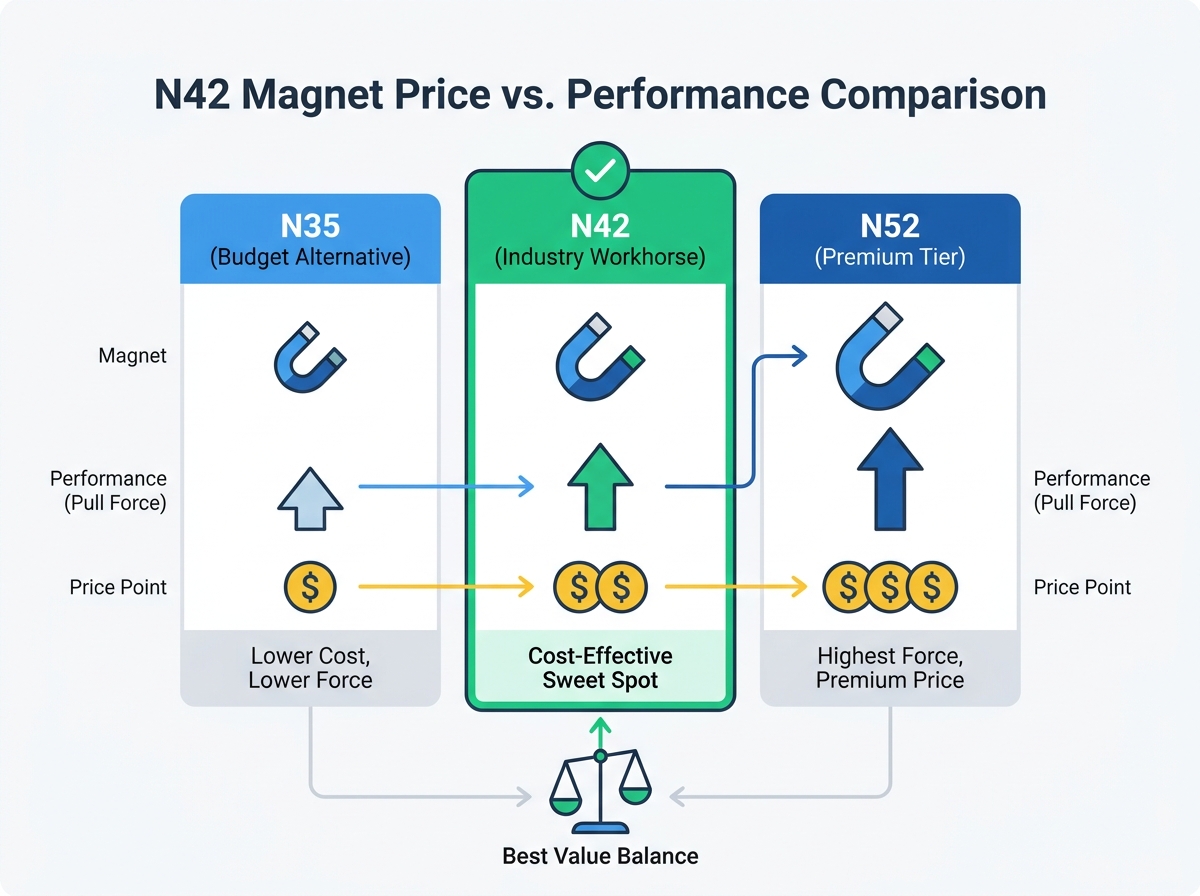
N35 sits at the lower end of the neodymium spectrum. Unscrupulous sellers sometimes pass it off as higher grades. N42 delivers roughly 20% more magnetic pull than N35. The price increase for N42 is typically marginal. This makes N42 the superior choice for size-constrained applications. You get much more power without drastically increasing the magnet footprint. Upgrading to N42 often solves weak magnetic latching issues instantly.
N42 vs. N52 (The Premium Tier)
N52 represents the strongest commercially available grade today. It offers extreme magnetic pull for specialized applications. However, it commands a steep price premium over lower grades. N52 material is also noticeably more brittle. It chips and shatters easily during automated assembly or handling. For most standard industrial and commercial uses, N52 is overkill. N42 operates as the most cost-effective "sweet spot". It balances mechanical strength, durability, and affordability perfectly.
Success Criteria
You must evaluate your actual application requirements carefully. Does your project actually require the expensive N52 premium? Often, a slightly larger N42 option achieves the exact same pull force. It achieves this performance at a significantly lower cost. Smart engineering adapts the housing design to accommodate the cheaper grade. This simple adjustment saves thousands of dollars in bulk manufacturing.
Neodymium Magnet Grade Comparison Matrix
| Grade | Relative Pull Strength | Cost Profile | Durability Profile |
| N35 | Baseline strength | Lowest upfront cost | Moderate durability |
| N42 | +20% over N35 baseline | Moderate (High Value) | Moderate durability |
| N52 | Maximum commercial strength | Highest price premium | Highly brittle material |
Evaluating Supplier Pricing Models and Hidden Costs
Buyers must look beyond the initial unit quote. Several hidden factors dictate the final invoice amount. Ignoring these variables ruins procurement budgets quickly.
Tiered Bulk Pricing Structure
Vendors structure their minimum order quantities (MOQs) very differently. A supplier might offer fantastic rates for a 10-unit sample. However, their 1,000-unit price might remain completely uncompetitive. Always ask for full tiered pricing schedules upfront. Compare the unit costs across 10, 100, and 1,000 unit benchmarks. This comparison reveals their true production scalability. It highlights which vendors genuinely own their manufacturing facilities.
Shipping Hazardous Materials
Neodymium magnets are incredibly dense and heavy materials. They also generate strong magnetic fields during transit. Air freight regulations (IATA) require special magnetic shielding for transportation. Unshielded magnets pose serious risks to aircraft navigation systems. Some suppliers lure buyers in with an incredibly cheap base price. They then inflate the unshielded shipping costs drastically. This bait-and-switch tactic creates a dangerous false economy. Always request quotes inclusive of compliant IATA shipping and shielding fees.
Lead Times and Inventory Stability
Sourcing directly from overseas manufacturers usually yields the lowest per-unit price. However, ocean freight transit times can stretch into several months. Domestic distributors hold local inventory for much faster delivery. They naturally charge a premium for this logistical convenience. You must factor in the cost of potential production delays. Relying on unreliable overseas drop-shippers can halt your entire assembly line. Time is literally money in hardware manufacturing.
Supplier Red Flags and Trust Signals
Identifying a reputable N42 Magnet supplier requires careful vetting. Spec sheets often look identical at first glance. You must dig deeper to verify vendor claims.
Tolerances and Specs Transparency
Trustworthy suppliers clearly publish their dimensional tolerances. A premium manufacturer holds tolerances strictly to +/- 0.002 inches. Budget vendors often allow +/- 0.004 inches or even worse. These loose tolerances cause massive fitment issues in tight assemblies. Reliable vendors also provide exact pull force calculations. They base these numbers on standardized 10mm steel plate testing. Vague descriptors like "super strong" act as immediate red flags.
Demagnetization Curves and Testing
Rigorous quality control separates professional vendors from amateurs. Reliable suppliers gladly provide technical documentation upon your request. You should ask for demagnetization curves or hysteresis graphs. They can also supply recent Gauss meter readings for their batches. Material Safety Data Sheets (MSDS) should be readily available online. If a vendor dodges these documentation requests, you must walk away.
Reviewing Return Policies on Brittle Items
Sintered neodymium is inherently fragile by nature. Impacts cause chipping, cracking, or complete shattering instantly. Transit damage occurs frequently, even with careful protective packaging. Evaluate the vendor return policies carefully before buying anything. Do they cover items chipped during transit? A supplier refusing to replace transit-damaged goods pushes the risk entirely onto you. Trusted partners absorb the cost of shipping failures.
Procurement Checklist: How to Shortlist and Buy
Follow a structured approach to ensure consistent procurement. Haphazard buying leads directly to inconsistent product quality.
Step 1: Standardize the RFQ (Request for Quote)
Never leave technical details up for vendor interpretation. Define your exact specifications clearly in writing.
- State the exact dimensions and acceptable tolerance range.
- Specify the preferred geometric shape clearly.
- Demand verifiable N42 grade material specifically.
- Indicate the precise magnetization direction required.
- Request a specific coating type (e.g., Ni-Cu-Ni).
Sending identical RFQs ensures you compare apples to apples. It prevents suppliers from quoting cheaper substitute materials.
Step 2: Calculate Total Landed Cost
The per-unit price tells only part of the story. You must calculate the comprehensive final expense. Add the base unit price to the quoted shipping fees. Include any required magnetic shielding surcharges for air freight. Estimate the expected defect rate based on published tolerance data. This final calculated number reflects your true investment per usable part. It provides the only accurate metric for vendor comparison.
Step 3: Order Prototypes
Never commit to large bulk orders blindly. Always request a small prototype run first to verify quality.
- Order a 10-unit sample batch from the shortlisted vendor.
- Measure the physical dimensions using a digital caliper.
- Perform internal pull-force testing to verify the stated strength.
- Check the plating adhesion for any signs of flaking.
Passing these physical tests validates the supplier's initial claims. It gives you the confidence to proceed with bulk manufacturing.
Conclusion
Securing the best deal requires diligence and careful analysis. You must look past the initial per-unit sticker price. Evaluating the total landed cost reveals the true financial picture. Quality control standards dictate long-term project success. Supplier reliability prevents costly assembly line shutdowns. An authentic N42 Magnet provides exceptional value when sourced correctly.
Take immediate action to streamline your next purchase. Consolidate your exact engineering specifications into a single document. Select two or three vendors who publish transparent tolerance data. Request small sample batches from each selected supplier. Run internal pull-force tests and mechanical fitment checks rigorously. This methodical approach guarantees optimal performance and highly competitive pricing.
FAQ
Q: Why are two N42 magnets of the same size priced differently?
A: Price variances are usually due to differences in plating quality (triple vs. single layer), tighter dimensional tolerances, or whether the supplier actually verifies the N42 grade batch via testing.
Q: Is it cheaper to buy one large N42 magnet or multiple smaller ones?
A: It depends on the application, but standard-sized smaller magnets (like generic discs) are often cheaper to mass-produce than custom large blocks, making stacking small magnets a viable cost-saving workaround for some non-precision tasks.
Q: Can I negotiate bulk pricing for N42 magnets?
A: Yes. Direct distributors and manufacturers almost always offer tiered pricing. Negotiating power increases significantly past the 1,000-unit mark or by setting up scheduled recurring orders.
Q: How do I know I actually received an N42 magnet and not N35?
A: Without a Gauss meter or a standardized pull-test rig, it is difficult to verify. This is why purchasing from industrial-grade suppliers who provide spec sheets is crucial compared to buying from unverified third-party marketplace sellers.