Engineers and procurement teams face a common dilemma during product design. They must balance the ubiquitous, cost-effective N35 grade against the higher-performance N42 Magnet. The N35 serves as the reliable industry baseline for modern neodymium magnets. It offers fantastic utility for standard applications. However, substituting it into a design without evaluating space constraints can cause significant problems. It might lead to unexpected product failure if the pull force is insufficient. Conversely, it can result in unnecessarily bloated assemblies if the magnet takes up too much room. You need to know exactly when a design requires an upgrade.
This guide provides a clear, evidence-based framework for your selection process. We will explore how to choose between N35 and N42 effectively. You will learn to assess magnetic output, environmental constraints, and unit cost at scale. By understanding these variables, you can optimize your product performance confidently. You will avoid over-engineering while ensuring your assemblies meet stringent functional thresholds. Let us dive into the core differences and practical applications.
Key Takeaways
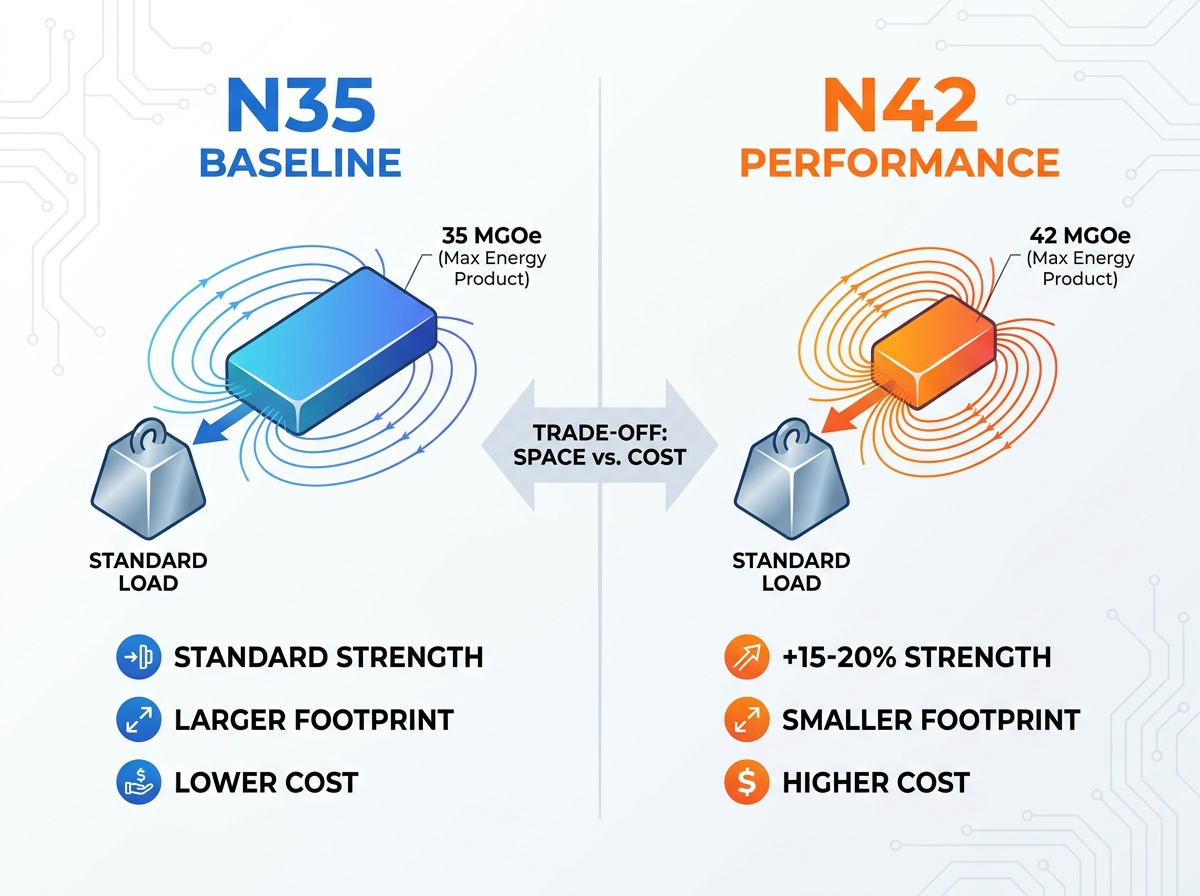
- Strength Variance: An N42 magnet offers approximately 15–20% more Maximum Energy Product (BHmax) than an N35 magnet of identical dimensions.
- Space Optimization: N42 allows engineers to achieve the same pulling force as an N35 magnet while using a smaller, lighter magnet footprint.
- Cost vs. ROI: While N42 carries a unit cost premium, the ability to miniaturize assemblies often offsets the raw material expense in high-volume production.
- Operational Parity: Both grades share similar thermal limits (standard grades max out at 80°C / 176°F) and require identical protective coatings (e.g., Ni-Cu-Ni) to prevent oxidation.
Decoding the Grades: What N35 and N42 Actually Mean
Let us unpack the standard industry nomenclature first. The letter "N" stands for Neodymium (NdFeB). It represents the core rare-earth alloy used in production. The number following it indicates the Maximum Energy Product. We measure this specific value in Mega-Gauss Oersteds (MGOe). This metric tells you the maximum magnetic energy stored within the material itself. It essentially dictates the baseline potential of the magnet before shaping.
N35 serves as the default starting point for general-purpose commercial manufacturing. It balances decent magnetic strength with excellent market accessibility. Most standard magnetic products rely on N35 for reliable performance. It offers highly predictable results for non-critical holding applications. Procurement teams love it because suppliers stock it extensively globally. It keeps initial prototyping costs quite low.
The step up to a mid-tier performance grade changes the engineering equation. An N42 Magnet provides a significantly denser magnetic field. This higher MGOe rating translates directly to a stronger pull relative to its mass. You get more magnetic flux density out of the exact same physical volume. This density makes it a highly popular upgrade path for engineers seeking optimization.
Keep in mind these grade numbers represent theoretical maximums. Actual performance depends heavily on your chosen manufacturer. Their specific sintering process controls the internal grain structure of the alloy. Their strict quality control tolerances dictate the final magnetic output you receive. You must always request batch-specific testing data from your supplier to guarantee authenticity.
Pulling Force and Magnetic Field: The Real-World Differences
How do these grades compare in physical applications? Let us look at a direct, practical comparison. Imagine an identically sized 1" x 1" x 1/4" block magnet. Under ideal conditions against a thick steel plate, the N35 block might hold around 12 pounds. The N42 Magnet equivalent will hold roughly 14 to 15 pounds. Surface Gauss readings measured by instruments will also reflect this 15-20% strength bump accurately.
However, this theoretical strength increase is rarely perfectly linear in application. Geometry plays a massive role in actual holding force. Several physical variables influence the tangible difference you experience. The specific shape of the magnet matters immensely. Discs, blocks, and rings all project magnetic fields differently. The chosen magnetization direction also alters performance. Axial magnetization behaves differently than diametrical magnetization in a mechanical assembly.
The thickness of the mating steel surface is another crucial factor. If your mating steel plate is too thin, it will saturate magnetically very quickly. A stronger magnet will not increase the holding force in this specific scenario. The excess magnetic energy essentially goes to waste. You must match the magnet strength to the capacity of your steel.
Air gaps also highlight the tangible performance gap between grades. Magnets rarely touch their targets directly in modern product designs. They often sit hidden behind plastic housings or fabric protective layers. N42 magnets maintain their magnetic circuit much better across these small air gaps. They project their magnetic field slightly further than standard N35 counterparts.
Theoretical Performance Matrix: N35 vs. N42
| Performance Metric | N35 Specification | N42 Specification |
| Maximum Energy Product (BHmax) | 33-36 MGOe | 40-43 MGOe |
| Relative Pulling Force | Baseline Reference (100%) | Approximately 115% - 120% |
| Air Gap Performance | Standard flux projection | Enhanced flux projection |
Design and Application: When an N42 Magnet Justifies the Premium
Weight and space constraints heavily influence material selection in modern engineering. Consumer electronics demand extreme miniaturization year after year. Smartwatches, headphones, and precision motors have incredibly tight assembly footprints. If the bulky N35 variant cannot physically fit inside the casing, you must upgrade. An N42 Magnet allows you to achieve the exact required strength in a much smaller volume. It solves severe spatial limitations beautifully while keeping devices lightweight.
Holding reliability represents another critical decision factor. You must thoroughly evaluate functional safety thresholds for your product. Some mechanical use cases cannot tolerate any unexpected drop in magnetic force. Magnetic latches in moving vehicles experience intense, continuous vibrations. Industrial fastener systems must hold secure under dynamic, shifting loads. A stronger magnetic field provides an essential safety margin against accidental disengagement during operation.
When is N35 sufficient for your project? Do not upgrade if you simply do not have to. If space is ample in your product housing, N35 works perfectly well. If total product weight is not a primary concern, stick with the reliable baseline. Applications requiring simple, static holding rarely need premium magnetic grades. Basic packaging closures, cabinet doors, and point-of-sale displays function flawlessly with N35. It remains the most logical, economical choice for these straightforward tasks.
Best Practices for Material Selection:
- Audit your available physical housing space before selecting a magnetic grade.
- Calculate the exact pull force needed for functional product safety.
- Assess the thickness of your mating steel to prevent magnetic saturation.
- Test physical prototypes using both grades to measure real-world performance accurately.
Cost-to-Performance Ratio for B2B Procurement
Raw material costs primarily dictate the price delta between these two grades. Higher magnetic grades require a higher concentration of expensive rare-earth elements. Refining neodymium and praseodymium involves complex, costly chemical processes. Furthermore, producing stronger magnets demands stricter processing requirements during manufacturing. You will inevitably pay a distinct unit premium for the N42 variant compared to the baseline.
However, your ordering volume fundamentally changes this dynamic. Consider scalability and Minimum Order Quantities (MOQ) closely. In large-scale manufacturing runs, magnet miniaturization offers hidden financial benefits. You can safely reduce the physical size of the magnet component. This directly reduces the overall bulk shipping weight of your final product. It also shrinks the surrounding plastic housing material costs significantly. Sometimes, these combined downstream savings completely neutralize the magnet's initial price premium.
Supply chain stability remains consistently strong for both of these options. They are standard, highly accessible grades produced globally. You avoid the severe lead-time risks associated with extreme upper-tier grades. Procurement teams often struggle to source N52 or N55 reliably in massive quantities. N35 and N42 offer reliable, consistent availability for long-term mass production runs.
Cost Components and Assembly Impact Chart
| Cost Component | Impact on N35 Assembly | Impact on N42 Assembly |
| Raw Material Unit Expense | Lower baseline cost | Higher premium cost |
| Housing Material Volume Needed | Requires larger, thicker housing | Allows smaller, cheaper housing |
| Global Shipping Weight | Heavier total package weight | Lighter total package weight |
| Sourcing Availability | Extremely high global stock | Very high global stock |
Quality Control, Testing, and Implementation Risks
Supplier verification requires strict, ongoing attention from procurement teams. The magnet industry sometimes suffers from intentional grade inflation. Unscrupulous suppliers might sell high-quality N35 batches branded as N42 to increase margins. You must actively protect your manufacturing pipeline against this practice. Always advise your quality assurance team to require certified demagnetization curves. B2B purchases should include mandatory Gauss meter test reports for every single production batch.
Safety handling practices must evolve aggressively alongside stronger magnets. As magnetic strength increases, physical assembly risks escalate rapidly. Sintered neodymium materials are inherently highly brittle by nature. High-velocity collisions between two magnets can cause severe structural chipping. A shattering magnet releases sharp, dangerous metallic shrapnel into the workspace. Furthermore, stronger attractive forces significantly increase pinching injuries among workers. A powerful N42 Magnet demands stricter assembly line Standard Operating Procedures (SOPs). You must train operators to use non-magnetic tools and safety spacers properly.
Do not ignore environmental degradation risks during product development. Neither grade is inherently more corrosion-resistant than the other. Raw neodymium oxidizes and crumbles rapidly in humid or wet environments. Both grades require strict, uniform coating specifications to survive long-term. You might specify triple-layer Nickel (Ni-Cu-Ni), Zinc, or durable Epoxy coatings. Choose the protective layer based solely on the final operational environment of your product.
Common Mistakes in Implementation:
- Assuming higher-strength grades naturally resist rust better than lower grades.
- Letting assembly workers handle powerful magnets without proper safety spacers.
- Skipping incoming quality assurance pull-force checks on new supplier shipments.
- Designing complex assemblies without accounting for the brittleness of the material.
Conclusion
The final engineering decision requires careful, holistic analysis. The choice between an N35 and an N42 Magnet comes down to a fundamental trade-off. You must intelligently balance spatial efficiency requirements against raw material unit costs. Both grades offer immense value when applied to their optimal use cases. Understanding their distinct capabilities empowers you to design better, safer products.
Consider implementing this straightforward decision framework for future projects:
- Choose N35 for cost-sensitive, space-flexible, and static holding projects.
- Choose N42 for performance-critical, highly compact, or weight-sensitive dynamic designs.
Take proactive action before finalizing your initial product blueprints. We highly encourage decision-makers to request physical samples of both magnetic grades. Conduct rigorous empirical pull tests within your specific prototype assemblies. Real-world testing provides invaluable clarity that theoretical data sheets simply cannot match. Secure this empirical data firmly before committing your budget to massive bulk material orders.
FAQ
Q: Can I replace an N35 magnet with an N42 magnet of the same size?
A: Yes, it will instantly increase the holding force by roughly 15-20%, provided the mating material can handle the increased pull without damage.
Q: Is an N42 magnet more brittle than an N35 magnet?
A: Structurally, all sintered neodymium magnets are highly brittle. The increased attractive force of N42 makes high-velocity impacts more likely, increasing the perceived risk of shattering.
Q: Do N42 magnets lose their magnetism faster than N35?
A: No. Assuming standard operating temperatures—under 80°C—and absence of extreme external demagnetizing fields, both grades will retain their strength indefinitely.
Q: How do I test if my supplier actually provided an N42 magnet?
A: Explain the necessity of using a Gauss meter or a standardized pull-force testing rig and comparing the results against theoretical data sheets for that specific dimension.