Sourcing neodymium magnets often feels like a relentless race for the absolute highest grade. Many buyers default directly to N52 simply because they see it labeled as the strongest available option. However, this reflex usually leads straight into a costly procurement trap. Companies end up wasting valuable budget by over-engineering products. Standard applications rarely require maximum magnetic field strength.
In reality, the true industry workhorse is the N42 Magnet. It perfectly balances material cost, physical durability, and raw magnetic force for most commercial and industrial use cases. You do not always need the absolute strongest magnet. You need the smartest one for your specific design footprint.
We designed this comprehensive guide to give you a transparent, engineering-focused evaluation framework. You will discover exactly how to choose the right neodymium grade. We will explore physical footprint limitations, structural risks, and practical performance differences. This framework helps you specify the exact magnetic power required for your next project.
Key Takeaways
- An N52 magnet offers roughly 20% more magnetic energy (MGOe) than an N42 magnet of the exact same dimensions, but at a premium price.
- If your design allows for a slightly larger magnet volume, an N42 magnet can achieve the exact same pull force as a smaller N52, significantly reducing unit costs at scale.
- Both standard N42 and N52 grades share an 80°C (176°F) maximum operating temperature, but N52 is often more susceptible to irreversible flux loss near that threshold.
- N52 is mandatory for strict miniaturization (e.g., micro-sensors, aerospace); N42 is optimal for general manufacturing, magnetic closures, and standard motor assemblies.
Understanding the Baseline: What the "N" Rating Actually Means
Engineers classify neodymium magnets using an alphanumeric grading system. Many buyers see these numbers and assume higher always means better. To make informed decisions, you must understand the underlying physics driving these ratings. The grade tells you exactly how much magnetic energy the material stores.
We evaluate these grades using three core metrics:
- Material Type: The letter at the beginning designates the alloy family.
- Maximum Energy Product: The two-digit number quantifies the stored magnetic strength.
- Temperature Tolerance: Optional trailing letters indicate thermal stability limits.
Let us demystify the Maximum Energy Product first. The industry measures this in Mega-Gauss Oersteds (MGOe). This complex term simply represents the total magnetic energy stored inside the material. When you compare grades, the number signifies this exact MGOe value. An N52 grade holds roughly 52 MGOe. An N42 grade holds roughly 42 MGOe.
Next, we must look at the "N" prefix. The letter "N" stands for standard Neodymium Iron Boron (NdFeB). It also serves as a critical temperature indicator. A standard "N" rating means the magnet has a maximum operating temperature of 80°C (176°F). If you heat the material past this point, irreversible magnetic degradation occurs. Both N42 and N52 share this exact same thermal ceiling.
Finally, you must grasp the relationship between strength and volume. This forms the core physics principle for smart procurement. Total magnetic pull force relies on two variables combined: grade and physical volume. A larger volume of a lower grade easily outperforms a smaller piece of a higher grade. If you increase the physical size of your magnet just slightly, you can completely offset the weaker material grade.
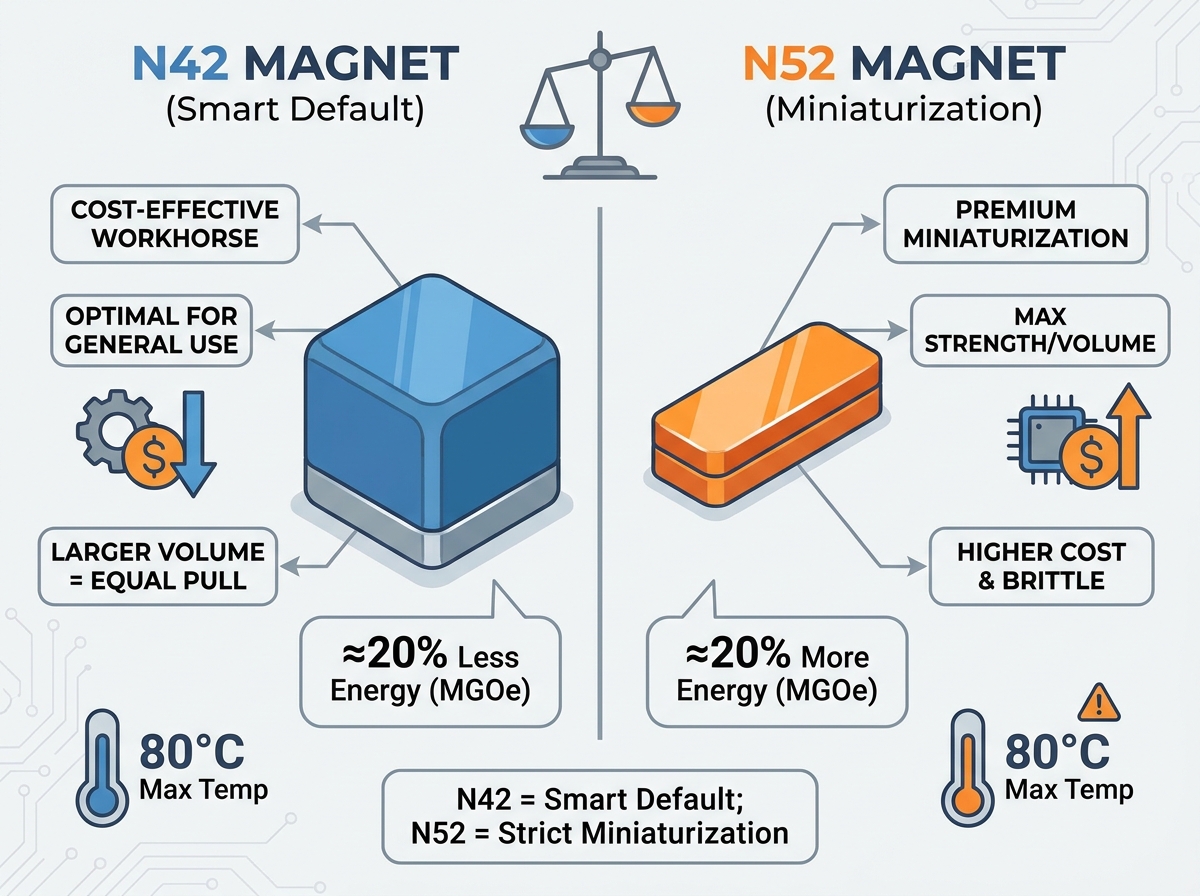
N42 Magnet vs N52: Core Performance and Cost Deltas
When you evaluate these two popular grades, you must analyze both physical performance and economic impact. The decision rarely comes down to strength alone. You must weigh the practical holding power against the financial premium required to achieve it.
Pull Force and Magnetic Field Strength
Pull force dictates how much weight a magnet can hold against a flat steel plate. If you machine two identical shapes, the N52 version yields about 15% to 20% more pull force. For example, a standard one-inch block might hold 25 pounds in N42. The exact same block in N52 might hold 30 pounds.
You must also consider surface gauss. This measures the density of the magnetic field projecting outward. Surface gauss heavily impacts electronic applications. Hall effect sensors rely on specific gauss thresholds to trigger circuits. An N52 grade projects a stronger field over a longer distance. If you use the lower grade, you may need to move the sensor one millimeter closer to guarantee a clean signal.
Magnetic Strength Comparison Chart (Relative MGOe Value)
| Magnet Grade | Energy Level (MGOe) | Relative Pull Force (Same Volume) | Field Projection Distance |
| N42 | ~42 | Baseline (100%) | Standard |
| N52 | ~52 | 115% - 120% | Extended |
The Cost-to-Performance Ratio
Raw material economics drive the massive price gap between these grades. Manufacturers create neodymium magnets from a sintered rare-earth alloy. Pushing the energy product up to 52 MGOe requires highly specific material ratios. Factories must use higher-purity rare earth elements like Dysprosium.
Furthermore, manufacturing N52 demands much stricter tolerances. The process yields higher rejection rates during sintering and magnetization. The factory must pass these wasted material costs down to the buyer.
Smart engineers leverage spatial scaling to beat this premium. Adding just two millimeters to a magnet's diameter often costs pennies per unit. Paying the N52 premium for a smaller diameter can add dollars per unit. If your product housing contains empty space, filling it with a slightly larger N42 Magnet drastically reduces your manufacturing expenses.
The Hidden Risks of Over-Speccing to N52
Buyers generally focus entirely on strength. They ignore the mechanical and thermal risks associated with extreme energy products. Pushing neodymium to its absolute physical limits introduces several hidden vulnerabilities into your supply chain and assembly floor.
Brittleness and Machining Vulnerability: Sintered neodymium acts like a dense ceramic. It chips easily upon sharp impact. However, higher-grade neodymium proves structurally more brittle. N52 features a highly packed grain structure. It is significantly more prone to chipping, flaking, and cracking upon impact. If your product experiences sudden mechanical shocks, the lower grade offers slightly better structural resilience.
Thermal Instability at the Limit: Standard grades list an 80°C threshold. However, they do not fail uniformly. We look at the demagnetization curve to understand thermal behavior. N52 possesses a much steeper demagnetization curve. Pushing N52 near 75°C poses a very high risk of permanent flux loss. Standard N42 maintains a flatter curve. It handles localized heat spikes near 80°C much more gracefully.
Assembly and Handling Hazards: Manufacturing floors face severe safety risks when handling extreme magnetic fields. The violent pinch-force of N52 complicates automated assembly lines. Pick-and-place robots struggle to release them. Workers risk crushed fingers if two pieces snap together unexpectedly. Handling the lower grade requires fewer specialized jigs and significantly reduces workplace safety incidents.
Common Safety Best Practices:
- Always require thick protective gloves when handling anything above 40 MGOe.
- Use non-magnetic workstation surfaces (e.g., aluminum, wood, or thick plastic).
- Keep specialized pry wedges nearby to separate pieces securely.
- Never allow operators to process raw magnets near pacemakers or sensitive electronic testing equipment.
Application Decision Matrix: Matching Grade to Use Case
Successful procurement relies on matching the exact alloy parameters to the physical constraints of the final product. Different industries demand entirely different approaches to magnetic engineering.
When to Choose an N42 Magnet (The Smart Default)
You should default to this grade for approximately 80% of standard commercial applications. It protects your profit margins without sacrificing reliable functionality. Choose this option for the following scenarios:
- Budget-Sensitive Scaling: High-volume consumer goods, magnetic packaging, retail displays, and point-of-sale fixtures. When you manufacture millions of units, minor material savings compound massively.
- Unconstrained Footprints: Applications where adding a few extra millimeters to the magnet's diameter or thickness remains structurally permissible.
- DIY & Prototyping: Initial proof-of-concept builds benefit greatly from cheaper materials. The lower grade proves easier to handle, cheaper to source, and highly forgiving when you make iterative design mistakes.
When N52 is Absolutely Necessary (The Miniaturization Mandate)
You should reserve the maximum energy product exclusively for projects demanding extreme miniaturization. When space serves as your ultimate constraint, you must pay the premium.
- Micro-Electronics & Sensors: Smartphones, hard drive voice coils, and implantable medical devices. In these ecosystems, every fraction of a millimeter remains critical. You cannot simply use a thicker magnet.
- Weight-Restricted Engineering: Aerospace applications, racing drones, and high-performance servo motors. When maximizing the strength-to-weight ratio dictates product viability, the premium cost becomes entirely justified.
Procurement and Implementation Considerations
Your engineering team must also evaluate real-world supply chain dynamics. Sourcing raw materials efficiently keeps production schedules on track. Grade selection directly impacts how quickly you can secure inventory.
Availability and Lead Times: The standard 42 MGOe grade acts as a ubiquitous global standard. Factories maintain highly stable supply chains for it. You can usually secure stock within days. Conversely, finding massive quantities of N52 often requires custom fabrication. Suppliers run fewer batches of extreme grades. You might face much longer lead times.
Coating and Corrosion Protection: Neodymium corrodes incredibly fast. The high iron content rusts rapidly when exposed to ambient moisture. Regardless of your chosen grade, you must specify proper plating. Standard applications rely on a Nickel-Copper-Nickel (Ni-Cu-Ni) triple layer. Marine or outdoor applications require thick Epoxy coatings. Medical devices typically demand Gold plating.
High-Temperature Alternatives: We must reiterate the 80°C threshold limit. Standard industrial motors frequently exceed 100°C. If your application runs hot, neither standard grade will survive. You must pivot entirely to high-temperature variants. Engineers specify N42SH for environments reaching 150°C. They specify N42EH for extreme applications reaching 200°C.
Implementation Guidelines Summary:
| Factor | Standard N42 Implementation | Standard N52 Implementation |
| Supply Chain | Highly accessible, fast turnaround | Often requires custom batch runs |
| Required Space | Needs slightly more housing volume | Ideal for ultra-compact housings |
| Heat Sensitivity | Stable up to 80°C limit | High risk of flux loss near 75°C |
Conclusion
Sourcing the ideal neodymium material requires careful balance. You must weigh physical constraints against financial reality. We strongly advise using the N42 Magnet as your default standard. It serves beautifully for roughly 80% of typical commercial applications. It protects your margins, reduces handling hazards, and offers highly reliable magnetic field strength. You should reserve the expensive N52 grade exclusively for projects demanding absolute extreme miniaturization.
Your next steps require practical testing. First, measure your available housing space precisely. Determine if you can accommodate an extra millimeter of thickness. Next, calculate your exact required pull force. Finally, request a sample pack containing both grades. Consult with a dedicated magnetic engineer to test both variations in your physical prototype before committing to mass production.
FAQ
Q: Can I replace an N52 magnet with an N42 magnet in my current design?
A: Yes, but you will lose roughly 20% of your holding force unless you can increase the size of the N42 magnet to compensate.
Q: Is an N42 magnet strong enough for magnetic therapy?
A: Yes, N42 provides more than enough surface gauss for these applications, and N52 offers no verifiable medical advantage.
Q: Does N52 degrade faster than N42?
A: Over years at room temperature, both degrade at the same negligible rate. However, N52 is more sensitive to heat-induced degradation near the 80°C threshold.
Q: Why is the price gap between N42 and N52 so wide?
A: Sourcing the specific rare-earth alloy ratios required to push the energy product to 52 MGOe is highly resource-intensive and yields higher manufacturing rejection rates.