For engineers and procurement teams, selecting the right neodymium magnet grade is critical. It is a strict balancing act between magnetic performance, operating environment, and unit cost. Finding this exact intersection prevents costly over-engineering. It also keeps your project budgets strictly under control. As the baseline grade for sintered neodymium-iron-boron (NdFeB) magnets, the N35 Magnet is incredibly popular. It remains the most widely specified option available today. We see it used frequently across commercial and industrial projects. You should choose it when extreme miniaturization is not the primary constraint. However, misunderstanding its physical properties can cause severe problems. Overestimating its thermal limits leads to sudden mechanical failures. This guide breaks down the technical specifications and physical limitations. You will learn about their true cost-to-performance ratios. We will help you determine if this grade meets your strict compliance rules. You will understand how to fulfill your unique operational requirements.
Key Takeaways
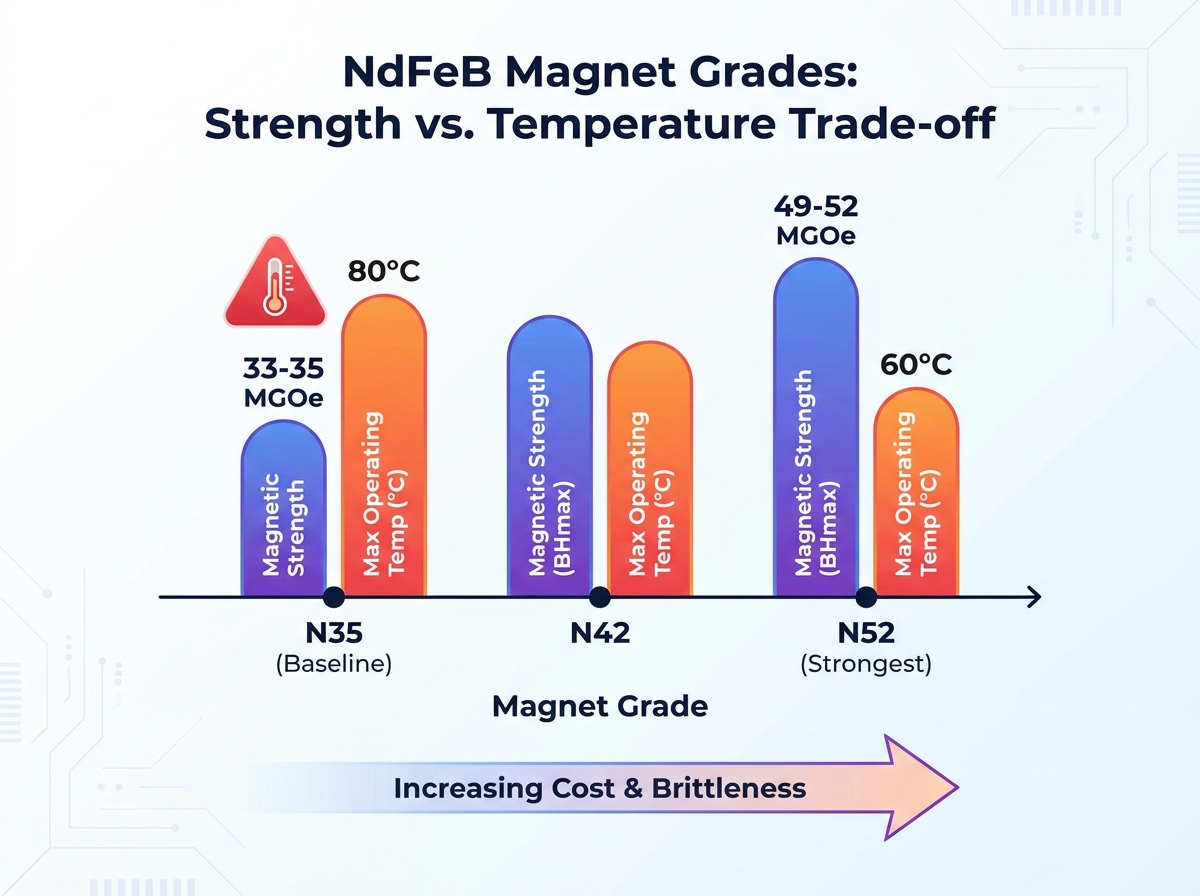
- Performance Baseline: An N35 magnet offers a Maximum Energy Product (BHmax) of 33-35 MGOe, providing a highly cost-effective magnetic field for standard commercial use.
- Thermal Constraints: Standard N35 grades degrade at temperatures exceeding 80°C (176°F); high-temperature variations (e.g., N35H, N35SH) are required for thermal-heavy applications.
- Cost vs. Strength: While 20-30% weaker than N52 grades, N35 offers superior batch consistency and lower raw material costs, making it ideal for high-volume manufacturing where space permits slightly larger magnet dimensions.
- Vulnerability: Like all NdFeB magnets, N35 is highly susceptible to corrosion and requires appropriate surface plating (typically Ni-Cu-Ni or epoxy) to ensure longevity.
What the "N35" Specification Actually Means
To use these components effectively, you must understand their naming convention. The nomenclature holds specific scientific weight in our industry. Let us decode the naming structure first.
The letter "N" denotes Neodymium. Specifically, it refers to the NdFeB composition. This is a highly powerful rare-earth alloy. The number "35" represents the Maximum Energy Product (BHmax). We measure this metric in MegaGauss-Oersteds (MGOe). This specific number dictates the maximum magnetic energy density. Higher numbers indicate a stronger magnetic field per unit volume.
Let us look at its position in the NdFeB spectrum. You will often see commercial grades ranging from N30 to N54. In this lineup, an N35 Magnet serves as the entry-level tier. It offers robust performance without the premium price tag. Engineers often prefer it for bulk manufacturing tasks.
We must also discuss the physical composition. The material relies on the standard Nd2Fe14B tetragonal crystalline structure. This specific alloy combination dictates two major behavioral characteristics. First, it ensures incredibly strong magnetic remanence. Second, it creates an inherent physical brittleness. We must account for this fragility during product assembly. The crystalline structure cannot handle high mechanical stress. It will shatter under heavy direct impact. Therefore, careful handling is an absolute necessity during manufacturing.
N35 Magnet Strength and Evaluation Metrics
Engineers use specific metrics to evaluate overall magnet strength. Let us explore the most critical scientific measurements.
Magnetic Remanence (Br) typically ranges from 11,700 to 12,100 Gauss. In standard units, this translates to 1.17 to 1.21 Tesla. This value defines the residual magnetic flux density. It tells you how strong the magnetic field remains permanently.
Coercive Force (Hcb and Hcj) is equally important. It evaluates the magnet's resistance to external demagnetization. Standard grades offer an intrinsic coercivity (Hcj) of ≥ 12.0 kOe. This rating provides excellent operational stability in normal ambient conditions.
We must also discuss pull force realities. Theoretical pull force depends heavily on the magnet's geometry. The thickness of the mating steel plays a massive role. The air gap between surfaces changes everything drastically. Even a thin layer of paint reduces holding power significantly.
Do not rely solely on theoretical pull-force calculators. They often overestimate real-world holding capabilities. Physical prototyping is mandatory for proper design validation. We recommend testing prototypes against standard 1018 steel plates. This testing validates your exact mechanical holding requirements.
Next, let us examine the decision matrix. When should you choose standard grades over stronger ones? We built a simple comparison to help you decide.
Decision Matrix Parameters
| Criteria | Standard Grade | Premium Grade |
| Primary Use Case | Budget-conscious projects | Extreme miniaturization |
| Footprint | Allows slightly larger sizes | Requires highly compact designs |
| Procurement Expense | Highly economical | Premium pricing |
| Batch Consistency | Superior mass production yield | Harder to maintain uniformity |
| Ideal Application | Retail displays, standard motors | Micro-sensors, consumer electronics |
Review this matrix carefully before finalizing your design. You should choose standard grades when your design footprint allows extra space. A slightly larger dimension can achieve the required Gauss rating. This strategy prioritizes budget while maintaining excellent performance. Conversely, you should upgrade when extreme miniaturization is required. Micro-sensors and compact electronics demand stronger variants. In those specific cases, cost becomes a secondary constraint.
Evaluating N35 for Your Specific Applications
Many modern industries rely on these specific magnetic properties. Let us review the most common commercial application categories.
First, we see heavy use in commercial sensors and switches. They are ideal for standard Hall-effect sensors. Engineers also use them constantly in reed switches. These specific devices require a stable, predictable magnetic field. The surrounding environment must remain over a standard temperature range. If temperatures spike unexpectedly, sensor readings will become inaccurate.
Second, they power many electric motors and mechanical actuators. Manufacturers frequently utilize them in BLDC motors. Brushless DC motors rely on them for efficient rotation. Stepping motors also benefit from their economical price point. Magnetic couplings rely on them heavily for torque transfer. Operating temperatures must remain tightly controlled in these motor scenarios. Heat sinks often help maintain optimal operating conditions.
Third, consumer goods and packaging depend on them daily. They are the standard choice for high-volume magnetic closures. You see them constantly in premium retail displays. Mounting hardware utilizes them extensively due to low per-unit costs. Tablet covers and jewelry clasps use millions of them annually.
Finally, you must apply strict compliance and sourcing lenses. Ensure your selected N35 Magnet components meet RoHS compliance guidelines. You must also verify full REACH compliance documentation. This is particularly crucial for European manufacturing deployments. North American regulatory bodies also demand strict adherence. Failing compliance audits can stall your production indefinitely.
Environmental Limitations and Implementation Risks
You must understand the environmental limitations of any magnetic assembly. Ignoring these risks will inevitably cause complete mechanical failure.
Thermal demagnetization is a massive primary concern. Standard grades have a Maximum Operating Temperature of 80°C. Exceeding this exact threshold causes irreversible flux loss. Your system will permanently lose its holding strength. To mitigate this risk, monitor your application temperatures carefully. Specify the N35M grade for environments reaching 100°C. Choose N35H for ambient temperatures climbing up to 120°C. Select N35SH if the application involves high heat generation. High-speed enclosed motors frequently require these higher-temperature variants.
Corrosion susceptibility presents another major industrial challenge. Uncoated NdFeB material oxidizes very rapidly in ambient air. You must evaluate and select the proper surface coating. Nickel-Copper-Nickel serves as the standard industrial protection layer. It offers great durability and a shiny finish. Zinc provides a low-cost option but offers lower overall protection. Epoxy coatings work best for humid or aquatic environments. Always base your coating selection on environmental exposure testing. Salt spray tests provide excellent validation data for long-term durability.
Mechanical brittleness requires very careful handling protocols. These precise items are highly prone to chipping. They can crack instantly upon high-impact collisions. Design guidelines must address this physical fragility directly. You should include specific press-fit tolerances in your CAD models. We recommend using adhesives like cyanoacrylate for mounting. Two-part epoxies also provide excellent long-term securing bonds. Never perform mechanical machining post-magnetization under any circumstances.
Shortlisting Logic: Specifying N35 for Procurement
Procurement teams need specific parameters to ensure quality delivery. Follow these logical steps for accurate global sourcing.
Start by defining your physical manufacturing tolerances. The standard industry tolerance remains at ±0.1mm. Precision aerospace or medical applications may require specifying ±0.05mm. You must remember tighter tolerances will impact both yield and unit price. You will pay more for higher dimensional precision.
Next, define the exact magnetization direction clearly. Specify whether the application requires standard axial magnetization. You might need diametrical or specialized multipole magnetization instead. Discuss this detail heavily during the engineering review phase.
Batch consistency is absolutely crucial for mass production runs. Engineers measure this uniformity using the Cpk index. Request magnetic flux consistency data from your chosen supplier. This statistical data prevents frustrating assembly line variations. It ensures every single unit performs exactly the same.
Finally, move from theoretical evaluation to physical testing. Your next step is requesting first-article inspection samples. These FAI samples allow you to conduct proper hands-on evaluations. In-situ prototype testing reveals hidden design flaws immediately. Iterate on these initial prototypes before approving mass production.
Conclusion
We hope this guide clarifies your component selection process. Here are our final recommendations and action-oriented next steps.
- These units provide an optimal intersection of magnetic strength and efficiency. They serve the vast majority of room-temperature industrial applications perfectly.
- Success relies entirely on proper thermal management planning. You must keep ambient temperatures below the strict 80°C limit.
- You must specify the correct surface coating for your environment. Nickel-Copper-Nickel works best for general commercial applications.
- Always validate theoretical pull force within your exact mechanical assembly. Real-world testing trumps theoretical software calculations every single time.
Your immediate next action should involve physical design validation. Engage a certified magnetic engineering team later today. Ask them to review your current CAD files carefully. Confirm your specific grade suitability and order prototypes immediately.
FAQ
Q: What is the difference between an N35 and N52 magnet?
A: The N52 grade is roughly 45-50% stronger by volume. However, it is significantly more expensive. Standard N35 is preferred when space allows for a larger size. You can easily achieve the necessary holding force by increasing the dimensions slightly. This approach saves money.
Q: How much weight can an N35 magnet hold?
A: It depends entirely on the magnet's volume and surface area contact. The composition of the mating material also matters. A 1" x 1" x 0.25" block can hold roughly 18-20 lbs. This requires ideal, zero-air-gap conditions against thick solid steel.
Q: Does an N35 magnet lose its strength over time?
A: No, not under normal operating conditions. You must keep temperatures below 80°C. You must also avoid external demagnetizing fields. Ensure the protective plating remains completely intact. Under these conditions, neodymium loses less than 1% of its flux density over 10 years.
Q: Can I drill or cut an N35 magnet?
A: No. Machining standard neodymium magnets poses a severe fire hazard. The resulting combustible dust is highly dangerous. Drilling also destroys the essential protective coating. It generates excessive heat that will permanently demagnetize the material. All shaping must be done prior to magnetization.