Engineers and procurement teams constantly face a tough balancing act. You need reliable magnetic strength, thermal stability, and cost-efficiency without overspending. Sourcing the right components can easily make or break a project's timeline and budget constraints. The neodymium (NdFeB) spectrum is vast and often confusing for buyers. Standard grades sometimes fall short on performance, while ultra-high grades wreck budget targets prematurely. An N42 Magnet serves as a high-performance mid-tier solution, bridging this frustrating gap effectively. This guide provides objective technical specifications, comparative frameworks, and vendor evaluation criteria. You will learn how to streamline your B2B purchasing decisions with complete confidence. We explore essential thermal ratings, corrosion mitigation strategies, and strict quality assurance metrics necessary for successful integration.
Key Takeaways
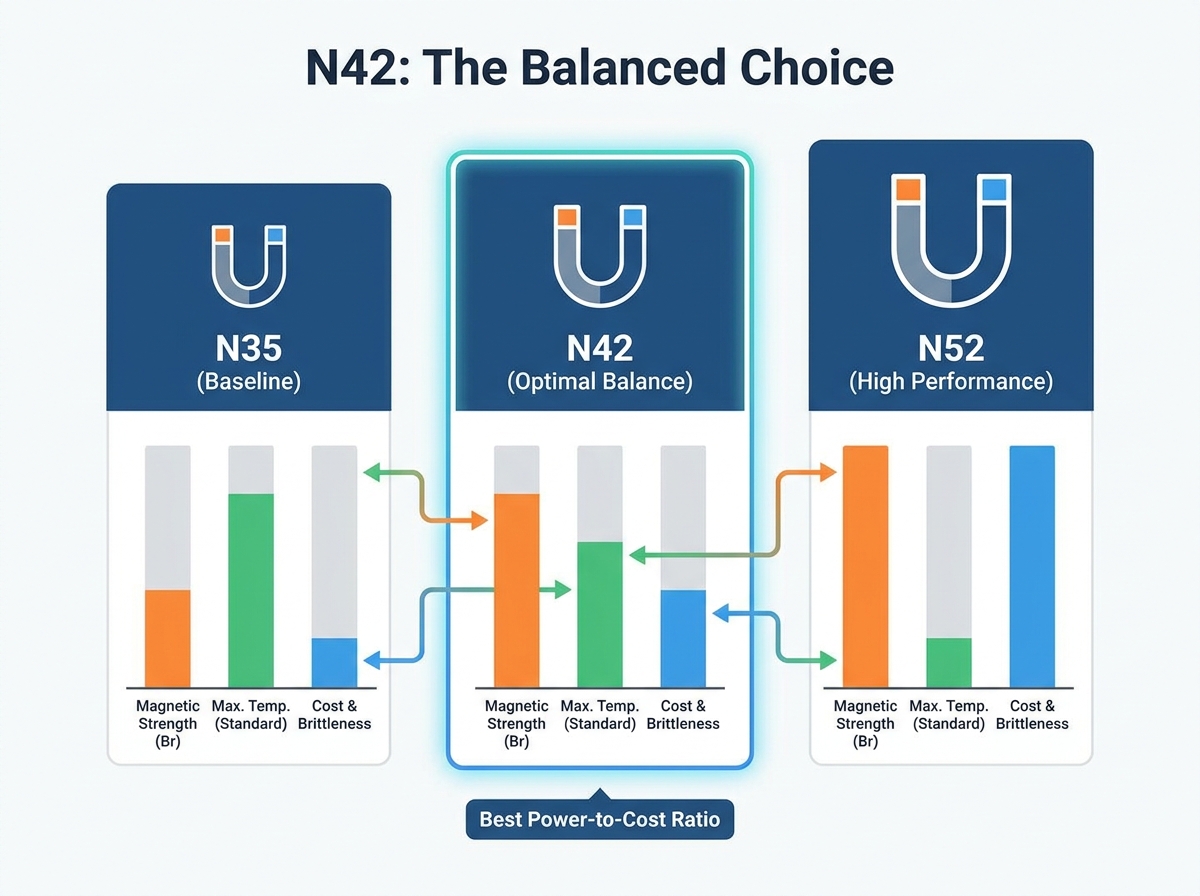
- Optimal Power-to-Cost Ratio: N42 magnets offer approximately 20% more magnetic pull than baseline N35 grades without the premium price tag of N52.
- Thermal Limitations Require Verification: Standard N42 degrades at 80°C (176°F); high-temperature applications require specific suffix grades (e.g., N42SH, N42UH).
- Coating is Non-Negotiable: Neodymium is highly susceptible to oxidation; selecting the right plating (Ni-Cu-Ni, Epoxy, Zinc) dictates the component's operational lifespan.
- Supplier Compliance Matters: Reliable sourcing demands verifiable tolerances (typically ±0.05mm to ±0.1mm) and strict adherence to RoHS/REACH standards.
Core Technical Specifications of the N42 Magnet
When evaluating magnetic components, engineers must look well beyond basic dimensions. You must scrutinize the data sheet to predict real-world performance accurately. The magnetic properties dictate how the material interacts within its environment. We will break down the essential metrics you need to monitor for quality control.
Magnetic Properties: The Data Sheet Focus
First, consider the Maximum Energy Product (BHmax). This metric ranges between 40 and 43 MGOe (Mega-Gauss Oersteds) for an N42 grade. It represents the maximum magnetic energy density stored within the material. A higher BHmax indicates greater overall strength for a given volume. It serves as the primary benchmark for grading neodymium.
Next is Remanence (Br), which typically sits around 12.8 to 13.2 KGs. Remanence measures the residual magnetic flux left in the magnet after initial magnetization. It directly influences the holding force you can expect in static applications. High remanence ensures a strong, steady grip across metal surfaces.
Finally, Coercivity (Hcb/Hcj) measures resistance to demagnetization. High coercivity is absolutely crucial for dynamic operational environments. Motors, generators, and moving assemblies constantly expose magnets to opposing fields. Without adequate coercivity, the component will gradually lose its operational strength over time.
Physical and Mechanical Characteristics
Sintered NdFeB magnets possess inherent brittleness due to their powder metallurgy origins. You must handle them carefully during assembly lines to prevent aggressive chipping. They behave more like industrial ceramics than tough, malleable metals. Dropping them on concrete floors will often result in shattering.
Machining realities dictate strict design workflows for procurement teams. Magnets must be fully formed, shaped, and coated prior to final assembly. Post-purchase machining instantly destroys the protective anti-corrosion coating. Furthermore, drilling or cutting generates extreme friction heat. This risks immediate structural shattering and dangerous factory fires. You must finalize all CAD dimensions before placing a purchase order.
Standard N42 Technical Parameters Summary
| Parameter | Typical Range | Unit | Application Impact |
| Maximum Energy Product (BHmax) | 40 - 43 | MGOe | Determines overall magnetic strength density. |
| Remanence (Br) | 12.8 - 13.2 | KGs | Dictates static holding force and flux density. |
| Max Operating Temperature | 80 (Standard) | °C | Limits application environment without special suffixes. |
| Density | ~7.4 - 7.5 | g/cm³ | Affects overall assembly weight constraints. |
N42 vs. N35 vs. N52: A Decision-Stage Framework
Choosing the right grade often overwhelms purchasing teams. You must weigh physical constraints against tight financial boundaries. Understanding when to scale up or down prevents costly engineering mistakes. This framework clarifies your core decision pathways.
When to Upgrade from N35
Volume constraints primarily drive the shift from baseline N35 to N42. Modern product designs often demand exceptionally compact form factors. If device real estate is strictly limited, you cannot simply use a larger magnet. A standard N42 Magnet delivers significantly higher Br in the exact same dimensional footprint. This allows engineers to increase holding force seamlessly. You avoid altering the surrounding mechanical housing. It solves spatial bottlenecks gracefully during prototyping.
When to Avoid Over-speccing to N52
Many buyers fall victim to the "strongest is best" misconception. Specifying N52 by default introduces severe mechanical drawbacks. N52 material is notoriously more brittle than mid-tier grades. It generally features lower maximum operating temperatures, making it unsuitable for warm environments. It degrades faster under moderate thermal stress.
Furthermore, N52 introduces a massive cost jump. The raw material extraction and refinement processes are intensive. We highly recommend framing N42 as the optimal sweet spot for modern design. It excels in consumer electronics, industrial sensors, and medium-torque motors. You achieve excellent performance without approving unnecessary premium expenditures.
Navigating Temperature Ratings (M, H, SH, UH, EH)
Thermal dynamics radically alter predictable magnetic behavior. A magnet might perform flawlessly at room temperature but fail miserably when heated. You must match the thermal suffix to your specific application environment carefully.
The Baseline Risk
Standard N42 loses reversible magnetization when exposed to 80°C (176°F). This means it weakens while hot but partially recovers upon cooling. However, if temperatures exceed this threshold significantly, permanent structural demagnetization occurs rapidly. Once it crosses its unique Curie temperature, the component becomes useless metal. Your motor will stall, and sensors will fail instantly.
Selecting High-Temp Variants
Manufacturers use specific suffixes to designate advanced thermal stability. You can easily source N42 alloys engineered for hostile industrial conditions.
- N42M and N42H: These suit moderate heat environments perfectly. They handle operational peaks up to 100°C and 120°C respectively. They fit nicely into standard automotive cabin sensors and lighting fixtures.
- N42SH and N42UH: These act as the industrial standard for highly demanding applications. Think EV motors, heavy machinery, or high-friction rotary assemblies. They maintain structural integrity up to 150°C and 180°C consistently.
Implementation Note on High-Temperature Grades
Buyers must understand the financial impact of thermal upgrades beforehand. Adding high-temperature resistance requires increasing Intrinsic Coercivity (Hcj) fundamentally. Manufacturers achieve this by adding heavy rare earth elements like Dysprosium (Dy) or Terbium (Tb). These specific elements are globally scarce and highly expensive. Consequently, an N42UH costs significantly more than a standard N42. This holds true even if the maximum pull force remains entirely identical.
Surface Treatments and Corrosion Mitigation
Neodymium contains highly reactive iron within its base alloy. Without proper plating, it will rust and crumble away rapidly. Selecting the right surface treatment dictates the component's operational lifespan.
Nickel-Copper-Nickel (Ni-Cu-Ni)
This trilayer plating serves as the undisputed industry standard. It provides a durable, shiny finish highly resistant to everyday scratching. We recommend it for indoor, dry applications and general assembly manufacturing. It perfectly balances cost, aesthetic appearance, and reliable everyday environmental protection.
Zinc (Zn)
Zinc acts as the economical budget alternative for large orders. It appears slightly duller than nickel but performs well in specific scenarios. It is notably better for chemical adhesive bonding. Glue adheres exceptionally well to porous zinc surfaces. However, it offers lower overall corrosion resistance than nickel plating. Use it only when prolonged moisture exposure is impossible.
Epoxy Coating
Harsh environments demand incredibly robust defense mechanisms. Epoxy coatings are the strict requirement for marine, high humidity, or outdoor applications. They form an impermeable plastic-like shell around the vulnerable metal. Note that epoxy creates a slight increase in overall dimensional thickness. You must carefully account for this extra volume in your CAD models. Failing to do so causes assembly interference.
Passivation and Phosphating
These represent temporary, short-term protection solutions. They do not provide long-term corrosion resistance for end users. Use them only for magnets that will be fully sealed. They also work well for components over-molded immediately upon factory arrival.
Evaluating B2B Neodymium Magnet Manufacturers
Sourcing a reliable N42 Magnet requires vetting the vendor's operational maturity. Not all factories adhere to strict international quality baselines. You must separate premium manufacturers from inconsistent, low-quality workshops.
Quality Assurance and Testing Rigor
Demand absolute transparency regarding internal testing protocols. Ask vendors how they validate their production batches. Top-tier suppliers use Helmholtz coil testing to confirm total magnetic moment. They run rigorous salt spray tests to ensure exterior coating durability. They also enforce strict Gauss meter validations systematically across active production lines.
Dimensional Tolerances and Scalability
Standard commercial tolerance usually sits at roughly ±0.1mm. This satisfies most general commercial manufacturing needs. However, tight aerospace or medical assemblies require substantially more precision. High-precision applications require vendors capable of holding ±0.05mm tolerances seamlessly. They must do this without producing excessive daily defect rates. Check their scalability to ensure they can maintain precision across high-volume runs.
Supply Chain and Compliance Security
Verify their institutional certifications before signing contracts. ISO 9001 proves basic facility management competency. IATF 16949 remains mandatory if you serve the global automotive sector. Furthermore, ensure verifiable compliance with European RoHS and REACH standards. Failing to verify these materials can trigger massive downstream regulatory bottlenecks. Your final product could face immediate customs rejections.
Shortlisting Next Steps
Never commit to bulk factory tooling blindly. Advise your procurement team to request physical engineering samples first. Ask for detailed Outgoing Quality Control (OQC) inspection reports. You should also demand a clearly defined demagnetization curve. This curve must be specifically generated for the N42 batch you plan to purchase.
Conclusion
Specifying an N42 neodymium component involves much more than selecting a physical shape. It requires precise technical alignment of the BHmax, the thermal suffix, and the protective coating. You must accurately map these variables to the exact environmental realities your final product will face. Missing one critical variable can compromise the entire mechanical assembly.
- Match your thermal suffix strictly to your peak operational temperatures to avoid demagnetization.
- Factor coating thickness into your initial CAD housing tolerances to prevent spatial bottlenecks.
- Prioritize vendors offering transparent testing data over those offering rock-bottom pricing alone.
- Verify all compliance certificates to protect your downstream distribution network.
Before committing to mass production, contact your vendor's engineering support directly. Request a custom quote, undergo a thorough dimensional review, and order physical samples. Validating the actual magnetic pull within your specific assembly prevents expensive redesigns down the road.
FAQ
Q: Can an N42 magnet be machined or drilled after purchase?
A: No. Sintered neodymium is extremely brittle. Machining destroys the anti-corrosion coating and creates a high fire risk from magnet dust. All sizing must be done by the manufacturer.
Q: How long does an N42 magnet retain its magnetic strength?
A: Under optimal conditions (no extreme heat, physical shock, or opposing magnetic fields), an N42 magnet loses only a fraction of a percent of its strength every 10 years.
Q: Are there shipping restrictions for bulk N42 magnets?
A: Yes. Air freight requires specific magnetic shielding and UN2807 compliance to ensure stray magnetic fields do not interfere with aircraft navigation systems.
Q: What is the maximum holding force of a standard N42 disc magnet?
A: Pull force depends entirely on the volume (diameter and thickness) and the material it is interacting with, rather than just the N42 grade itself.