Designing high-performance hardware often means navigating a complex maze of material trade-offs. Engineers constantly face the primary procurement challenge of balancing magnetic strength against component cost and long-term reliability. Selecting the wrong grade can lead to premature product failure or unnecessarily inflated manufacturing budgets.
Enter the neodymium magnet industry's frequent sweet spot for mid-to-high performance requirements: the N42 Magnet. It provides exceptional holding power without the extreme premium or fragility found in top-tier grades. This makes it a highly attractive option for countless design projects.
This article moves past basic definitions to give you a practical framework. We will evaluate how these components perform across commercial, industrial, and product design applications. You will learn exactly how to interpret specifications, shortlist the right materials, and avoid common implementation pitfalls in your upcoming builds.
Key Takeaways
- The Baseline Spec: The "42" represents a Maximum Energy Product (BHmax) of 42 MGOe, delivering approximately 10-15% more holding force than standard N35 grades.
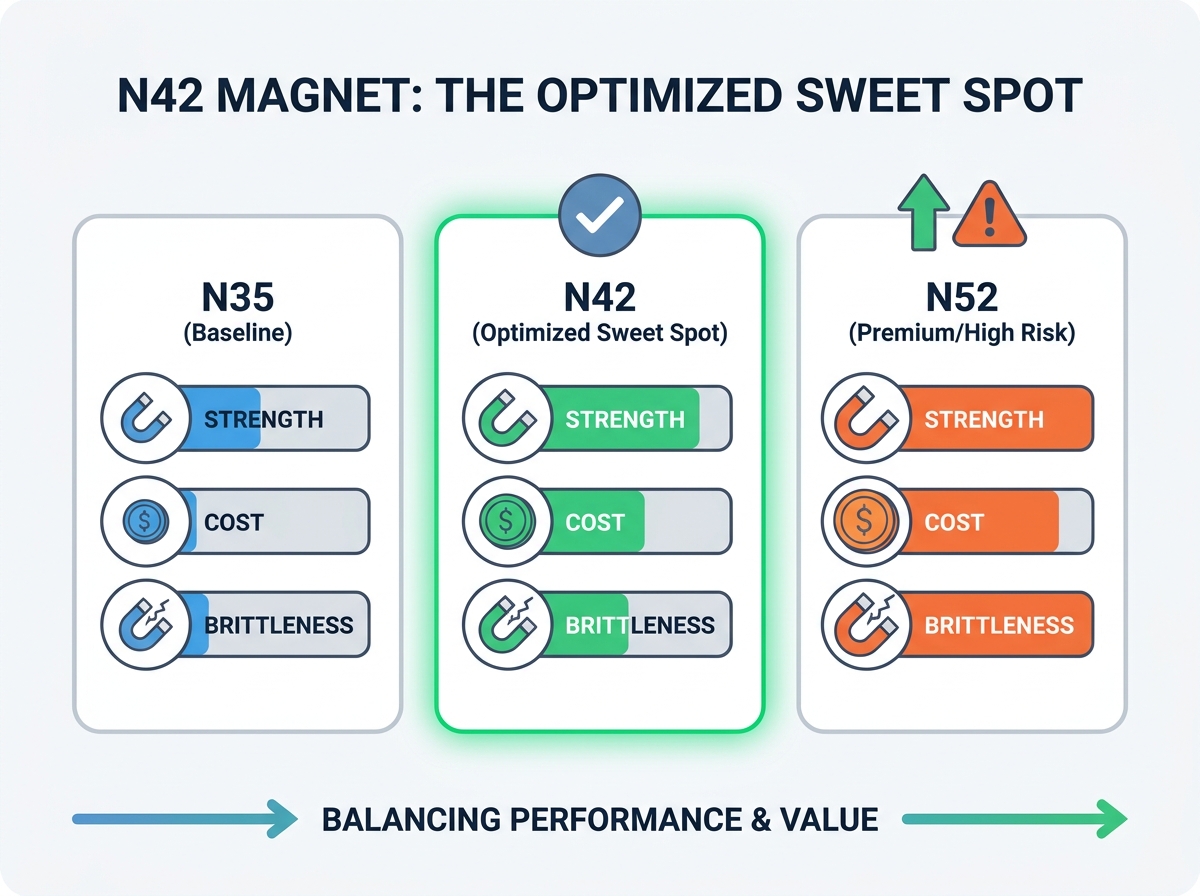
- Cost vs. Performance: N42 serves as an optimized middle ground, avoiding the premium pricing and increased brittleness associated with N52 magnets.
- Thermal Constraints: Standard N42 magnets lose performance above 80°C (176°F); high-temperature variants (like N42SH) are required for motor and engine applications.
- Implementation Reality: Real-world pull force is dictated not just by the N42 grade, but by the magnet's geometry, the mating material's thickness, and operational air gaps.
Decoding the N42 Specification: What the Numbers Actually Mean
Before evaluating performance limits, we must understand the foundational science behind these components. The neodymium framework relies on a specific chemical composition. We call it NdFeB, which stands for Neodymium Iron Boron. NdFeB dominates the permanent magnet market today. It delivers the highest known magnetic field per unit of volume. You can design smaller, lighter products because they pack immense power into tiny spaces.
Understanding "42 MGOe"
The number in the grade directly indicates the material's energy density. "42" refers to a Maximum Energy Product (BHmax) of 42 Mega-Gauss Oersteds (MGOe). BHmax serves as the core metric for measuring magnetic energy density. It tells you the total stored energy inside the material.
Higher numbers mean greater energy density. A smaller physical N42 Magnet can produce the exact same magnetic field as a larger, lower-grade N35 counterpart. This characteristic proves invaluable when your engineering team faces strict dimensional constraints. You save critical space inside consumer electronics or intricate sensor housings.
Surface Gauss vs. Pull Force
Many procurement teams confuse Surface Gauss and Pull Force. You must delineate between them to set realistic evaluation criteria.
Surface Gauss measures the magnetic field strength at a specific point on the surface. Manufacturers typically measure it using a Gauss meter. It represents flux density but does not directly equal lifting power. Pull force measures actual mechanical holding power. It defines how many pounds or kilograms the piece can hold against a steel plate. Always look at pull force if your application requires mechanical fastening or structural holding.
Evaluating N42 Magnet Strength: Real-World Performance Metrics
Understanding theoretical metrics is only the first step. You must contextualize this strength in real-world environments. When we compare it to common alternatives, the benefits become obvious. It is significantly stronger than traditional ceramic or ferrite options. It is marginally weaker than N52, but it offers far better structural stability and cost efficiency.
The Variables of Pull Force (Transparent Assumptions)
Supplier datasheets often advertise maximum possible pull forces. These numbers rely on perfect, idealized laboratory conditions. Real-world applications rarely match these conditions. Several variables drastically alter your actual holding power.
- Mating Material: Testing typically happens against a perfectly flat, thick, unpainted steel plate (usually 1018 cold-rolled steel). If your application uses thin sheet metal, the metal will reach magnetic saturation early. The holding force will drop dramatically.
- Air Gaps: Micro-gaps drastically reduce theoretical holding force. Even a layer of paint, a thin plastic housing, or accumulated dust creates an air gap. A gap of just 0.1mm can reduce holding power by a noticeable percentage.
- Shear Force: Never evaluate purely on direct pull force. Direct pull measures the effort needed to pull the object straight off a surface. Shear force measures the effort needed to slide it sideways. Shear force is typically only 20% to 25% of the direct pull force. You must account for this if your design mounts vertically on a wall.
Testing and Validation
We recommend specific prototyping steps to test strength in actual application conditions. Relying solely on supplier datasheets introduces unnecessary risk. Try these practical validation methods:
- Procure sample batches in your exact required dimensions.
- Test them using the actual mating materials from your production line.
- Introduce intentional air gaps matching your expected paint or coating thicknesses.
- Measure both direct pull and shear force using a digital force gauge.
- Cycle the components through your expected temperature ranges to observe flux degradation.
N42 vs. Other Grades: Shortlisting the Right Magnet
Choosing the correct grade dictates the success of your mechanical design. Engineers often debate between N35, N42, and N52. Each serves a distinct purpose.
N42 vs. N35 (The Baseline Upgrade)
N35 acts as the entry-level standard for neodymium. When should you upgrade? Upgrade when size constraints dictate a smaller form factor, but you require identical holding power. You can shrink your component footprint by shifting to the higher grade. The cost implications are manageable. You face a moderate cost increase, but the miniaturization benefits easily justify it.
N42 vs. N52 (The Overkill Trap)
Many designers fall into the common misconception that "stronger is always better." They immediately specify N52 for every project. This creates an overkill trap. N52 carries significant risks. It commands a higher raw material cost. It suffers from lower market availability. Furthermore, it exhibits increased susceptibility to cracking or chipping during automated assembly processes.
Use a simple rule of thumb: Default to the 42 grade. Only move up to N52 if specific, non-negotiable weight or space constraints absolutely mandate maximum possible energy density.
Table 1: Quick Comparison of Common Neodymium Grades
| Grade | Relative Strength | Cost Profile | Durability/Brittleness | Best Use Case |
| N35 | Baseline | Low | Moderate | Large assemblies where space is abundant. |
| N42 | +10% to 15% vs N35 | Medium | Moderate | Optimal middle ground for most designs. |
| N52 | Maximum | High | Highly Brittle | Extreme miniaturization projects. |
Implementation Risks: Temperature Ratings and Corrosion
Even the strongest materials fail if you ignore environmental factors. Successful integration requires you to manage thermal limits and prevent oxidation.
Thermal Degradation and Coercivity
Heat is the natural enemy of permanent magnetism. The standard operating limit is 80°C (176°F). If your application exceeds this limit, the component experiences thermal degradation. We must distinguish between reversible and irreversible demagnetization.
Reversible demagnetization occurs when the piece loses a small amount of strength while hot, but fully recovers upon cooling. Irreversible demagnetization happens when the temperature exceeds the material's maximum operating threshold. The atomic structure misaligns permanently. It will not recover its original strength when it cools down.
High-Temperature Variants (Solution Categories)
If your design generates significant heat, you need high-temperature variants. Manufacturers introduce suffix designations to indicate thermal resistance. Common suffixes include M, H, SH, UH, and EH.
You should specify N42SH for applications reaching up to 150°C. This specific variant incorporates heavier rare-earth elements. These additions boost intrinsic coercivity, preventing demagnetization in extreme heat. We frequently see SH grades deployed in electric vehicle motors, industrial actuators, and under-the-hood automotive sensors.
Corrosion and Coating Requirements
Raw NdFeB rusts rapidly. It contains high amounts of iron. If you expose an uncoated piece to ambient humidity, it will oxidize, flake apart, and eventually turn into magnetic dust. You must evaluate coating options based on your operating environment.
Table 2: Common Coating Specifications
| Coating Type | Characteristics | Ideal Environment |
| Ni-Cu-Ni (Nickel) | Standard, shiny, durable finish. Good wear resistance. | Indoor commercial, standard consumer electronics. |
| Zinc | Cost-effective, lower friction, slightly less durable than Nickel. | Internal mechanical parts, lower budget applications. |
| Epoxy | Excellent moisture barrier, black finish, resists salt. | Marine environments, high humidity, outdoor exposure. |
Commercial and Industrial Applications for N42 Magnets
Because it offers the optimal intersection of performance and price, this grade powers innovations across dozens of industries.
Motors and Generators
Electric motors rely heavily on consistent flux density. You will find these components embedded within rotors and stators. High-performance brushless DC motors frequently utilize H or SH variants. Reliable sourcing remains critical here, as slight variations in magnetic strength can cause motor cogging or efficiency drops.
Magnetic Fasteners and Closures
High-end consumer goods leverage these components for premium user experiences. They are ideal for tablet cases, luxury packaging, and industrial cabinetry. They deliver a strong, satisfying "snap" upon closure. You achieve this tactile feedback without paying extreme material costs.
Sensors and Instrumentation
Precision instrumentation demands predictable magnetic fields. Hall effect sensors and reed switches use these components to detect proximity, speed, or position. The stable energy output ensures the sensor triggers reliably over millions of cycles.
Sourcing Next Steps
Moving from a single prototype to volume manufacturing requires strict quality control. Follow these guidance steps when transitioning to mass production:
- Verify Supplier Capabilities: Ensure your manufacturing partner has in-house Gauss meters, fluxmeters, and hysteresis graph testers.
- Request Demagnetization Curves: Ask for B-H curve documentation at your specific operating temperatures to verify thermal stability.
- Set Tolerance Standards: Define strict physical dimensional tolerances (e.g., +/- 0.05mm) to prevent assembly issues.
- Establish Coating Specs: Demand salt spray test reports if you selected epoxy or heavy-duty coatings.
- Define Magnetization Direction: Clearly specify whether the item needs magnetization through the thickness, length, or diametrically.
Conclusion
The strategic value of this grade lies in its balanced profile. It represents the optimal intersection of price, mechanical holding force, and structural reliability. Upgrading from lower tiers provides noticeable miniaturization benefits, while avoiding the premium costs and assembly risks of the absolute highest tiers.
Successful integration always relies on accounting for the entire engineering ecosystem. You must account for ambient temperature, proper protective coatings, and exact mating geometry. Relying solely on the "42" rating without managing air gaps or shear forces will lead to underperforming designs.
Your next step involves practical validation. Encourage your procurement and engineering teams to request physical samples. Consult with a magnetic engineering specialist to review your specific CAD drawings and application environments. Prototyping physical parts remains the single best way to ensure your design functions perfectly in the real world.
FAQ
Q: Is an N42 magnet strong enough to pinch fingers?
A: Yes, absolutely. Even moderate-sized pieces generate immense attractive forces. If two pieces snap together unexpectedly, they can severely pinch or crush skin and bones. Always use extreme caution. Wear protective gloves and safety glasses when handling assemblies larger than a standard coin.
Q: What is the difference between N42 and N42SH?
A: The difference lies entirely in thermal resistance. A standard grade begins losing performance above 80°C (176°F). The SH variant handles temperatures up to 150°C (302°F). Manufacturers achieve this by adding heavier rare-earth elements like Dysprosium, which increases the material's coercivity.
Q: How long does an N42 neodymium magnet last?
A: Permanent magnets lose less than 1% of their total flux density over 10 years under normal conditions. They essentially last indefinitely unless you expose them to high heat exceeding their rating, severe physical shock, or aggressive corrosion that destroys the physical material.
Q: Can I machine or drill an N42 magnet?
A: No. You should never machine them post-purchase. NdFeB is highly brittle and will likely shatter. Furthermore, the dust generated from drilling is highly pyrophoric and creates an extreme fire hazard. Always direct your sizing requirements to a custom manufacturer prior to magnetization.