Engineers face a common dilemma when sourcing neodymium magnets for new product designs. They often default to the strongest available grade just to be safe. However, optimizing for cost and structural stability usually yields much better project outcomes. To make the right choice, you must first understand the baseline. An N35 Magnet serves as the industry standard for general use. It provides reliable, consistent performance for a massive variety of applications. Meanwhile, N52 represents the absolute upper limit of commercially available magnetic strength.
Specifying the wrong grade quickly inflates project budgets and causes unnecessary manufacturing delays. This guide provides a strictly objective, engineering-focused evaluation framework. We will help you prevent over-speccing and reduce your raw material procurement costs. You will learn exactly how to balance magnetic pull force against physical footprint constraints. We will also explore thermal stability risks and supply chain realities. By the end, you can confidently specify the right neodymium grade for your next mechanical assembly.
Key Takeaways
- Strength vs. Baseline: N52 magnets offer roughly 50% more magnetic pull than N35 equivalents of the same size, but this comes with a steep price premium.
- Volume constraint: N52 is mandatory when physical space is strictly limited and maximum force is required; otherwise, an N35 magnet is often the more efficient choice.
- Brittleness and Assembly: Higher grades like N52 are more prone to chipping and cracking during assembly, requiring stricter handling protocols.
- Cost-Efficiency: Defaulting to N52 can inflate project costs by 30-50% unnecessarily if an N35 magnet meets the required holding force parameters.
Understanding Neodymium Magnet Grades: What the Numbers Actually Mean
Let us demystify the complex nomenclature used for neodymium magnets. The "N" simply stands for Neodymium. It indicates you are working with an NdFeB (Neodymium Iron Boron) alloy rather than ferrite or alnico. The number following the letter ranges from 35 to 52. This number represents the Maximum Energy Product, known technically as BHmax. We measure this critical value in MegaGauss Oersteds (MGOe). Essentially, BHmax tells you the peak magnetic energy a specific material volume can store and output.
Many buyers and junior engineers fall victim to the "strongest" fallacy. People mistakenly assume a higher number strictly means a "better" product. This is rarely true in practical engineering. The grade only dictates the magnetic field density per unit of volume. It does not imply overall structural durability or thermal superiority. In fact, pushing a magnet to its maximum energy density often creates compromises in physical brittleness.
Think of the N35 Magnet as the commercial workhorse of the industry. It offers a highly stable magnetic field. Manufacturers produce it easily, keep it readily available in stock, and machine it with high consistency. For everyday applications ranging from premium cabinet closures to standard consumer electric motors, N35 delivers excellent results without breaking your budget. It strikes the perfect balance between raw power and manufacturing reliability.
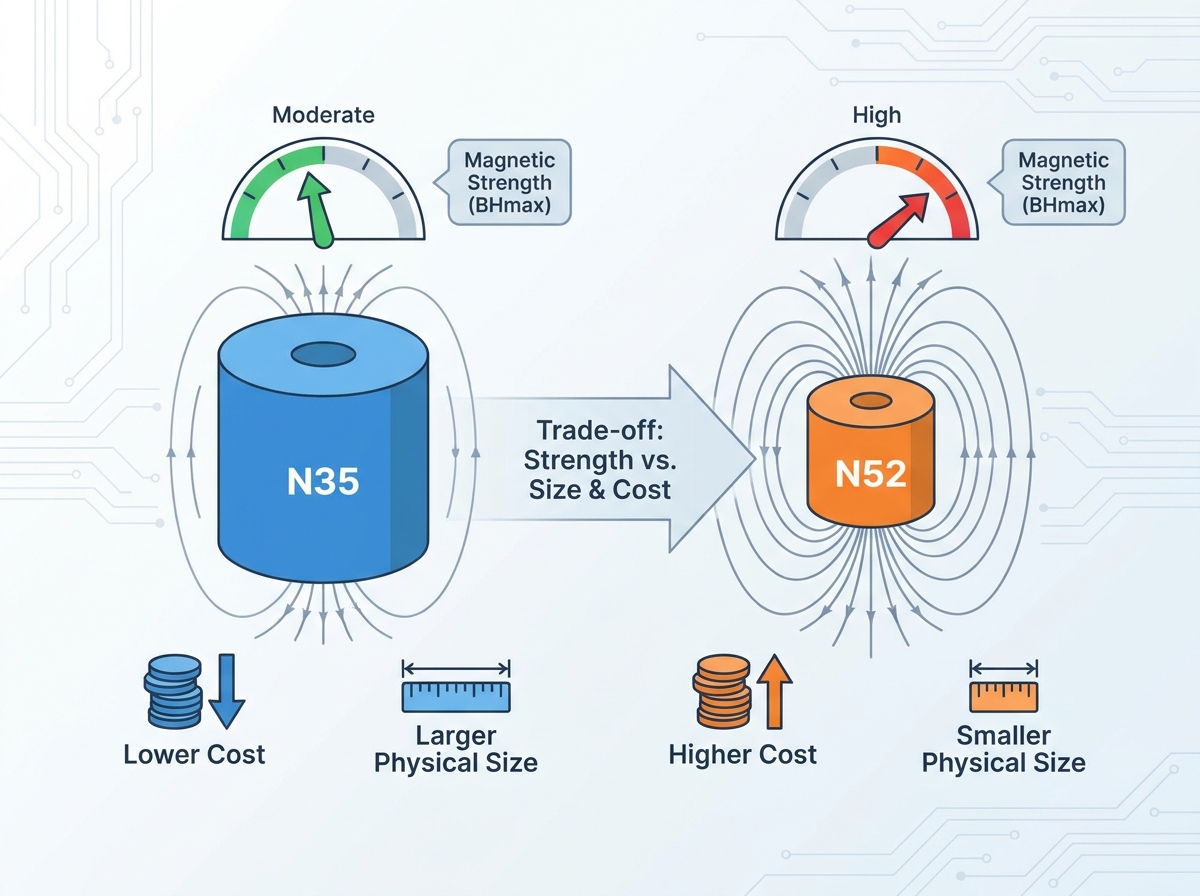
Magnetic Strength vs. Physical Footprint: The Core Trade-off
Let's explore the core trade-off between magnetic strength and physical footprint. Pull force and Gauss ratings behave differently, and you must understand both. Gauss measures the internal magnetic field density and the surface field. Pull force measures the actual holding power when the magnet touches a steel plate.
Consider a realistic scenario comparing a 1-inch by 0.25-inch disc magnet. If you test an N35 Magnet against an N52 version of the exact same physical size, you will see a stark difference in holding power. The N35 might yield roughly 12 pounds of pull force against a solid steel test plate. The N52 variant will push closer to 18 pounds of pull. You get nearly 50% more holding force from the identical physical volume.
This dynamic brings us to the miniaturization factor. Your specific spatial constraints will dictate the winner here.
- When N52 wins: Sometimes physical space is strictly limited by the product design. N52 allows engineers to achieve a specific pull force using a significantly smaller, lighter magnet. You absolutely need this high energy density for micro-electronics, quadcopter drones, and high-performance servo motors. Every single gram matters in these advanced mechanical designs.
- When N35 wins: What if your housing or structural assembly has ample empty space? Up-sizing an N35 Magnet becomes the smartest engineering move. You can achieve the exact same pull force as a smaller N52. You simply use a slightly wider or thicker N35 volume. Doing so achieves the required holding power at a fraction of the raw material cost, while also providing a less brittle component.
Thermal Stability, Coating, and Operational Risks
Operating environments severely impact how neodymium magnets perform over time. Temperature ceilings require careful evaluation before you finalize a design. Standard N35 and N52 grades both generally cap at a maximum operating temperature of 80°C (176°F). If you push them past this thermal limit in an engine block or hot industrial environment, they begin to lose magnetization permanently.
You can source high-temperature variants if your application runs hot. Options like N35H or N52M shift the coercivity curves. These special grades resist demagnetization at higher thermal loads by altering the alloy blend. However, they cost significantly more and require longer factory lead times.
Next, you must consider structural integrity. We must highlight the physical reality of handling high-grade rare-earth magnets. N52 magnets possess extreme internal magnetic stress. They are significantly more susceptible to mechanical fracturing. If two N52 magnets snap together unexpectedly across a metal workbench, they will likely shatter into dangerous shrapnel. An N35 Magnet remains brittle, but it withstands minor assembly impacts slightly better than its ultra-dense counterpart.
Both grades require robust surface plating. Neodymium oxidizes rapidly when exposed to ambient moisture. Standard factory coatings include Ni-Cu-Ni (Nickel-Copper-Nickel), basic Zinc, or heavy-duty Epoxy. A structural chip in an N52 magnet immediately exposes the raw, highly reactive iron alloy beneath. This instantly compounds the risk of widespread coating failure and rapid internal corrosion.
Let's look at a brief comparison matrix highlighting these operational risks.
Table 1: Operational Risk Comparison Between Grades | Risk Factor | Standard N35 Characteristics | Standard N52 Characteristics |
| Max Operating Temperature | 80°C (176°F) | 80°C (176°F) |
| Physical Brittleness Level | Moderate (Handles standard assembly) | Very High (Requires strict protocols) |
| Coating Dependence | High (Requires standard plating) | Critical (Chips lead to rapid failure) |
| Machining Tolerance | Standard Industry Norms | Strict Quality Control Required |
Cost-to-Performance Ratio: Is the N52 Premium Justified?
Procurement teams constantly ask if the steep N52 premium is truly justified. We must break down raw material and processing costs to understand the price gap. N52 requires purer rare-earth elements during the initial alloying process. It demands much tighter manufacturing tolerances in the factory. The ultra-high magnetic density also leads to higher rejection rates during factory quality control inspections. The supplier ultimately passes all these extra manufacturing expenses directly to you.
Supply chain availability plays a massive role in project pricing and timelines. N35 magnets are universally stocked by almost every vendor globally. Factories produce them at incredible scale every day. This massive production volume allows for much faster lead times. It also keeps Minimum Order Quantities (MOQs) incredibly low for small businesses. Conversely, N52 often requires custom batching. Finding large, off-the-shelf quantities of N52 can be difficult during peak production seasons.
We must strictly evaluate the return on investment regarding over-speccing. From a pure procurement perspective, specifying N52 "just to be safe" is a costly rookie mistake. Engineers sometimes blindly select the strongest grade without running empirical pull-tests. This lazy habit severely inflates project budgets. If an N35 Magnet meets the required holding force parameters, paying the 30% to 50% premium for N52 destroys your profit margins without adding any functional value.
Always match the magnetic grade to your actual mechanical needs. Do not pay extra capital for unused magnetic flux.
Engineering Decision Framework: Specifying the Right Grade
To avoid costly mistakes, follow this strict engineering decision framework. This structured process ensures you specify the correct magnet grade every single time.
- Step 1: Define the Spatial Constraints. Look closely at your CAD assembly. Is the pocket volume completely locked? If your space is rigidly constrained and you need maximum force, you must lean toward N52. If your housing is flexible, always lean toward an N35 Magnet. You can simply design a slightly larger pocket to fit a larger, cheaper component.
- Step 2: Calculate Exact Pull Requirements. Never guess the required holding force. Use standard Gauss calculators and Finite Element Analysis (FEA) software to find the absolute threshold. Determine exactly how many pounds of pull you need across your specified operational air gap.
- Step 3: Evaluate Operating Environment. Assess the ambient thermal loads your assembly will experience in the field. Review impact risks and required coatings. If the magnet will experience frequent physical shocks or vibrations, the extreme brittleness of N52 could cause catastrophic system failure.
- Step 4: Prototyping Strategy. Do not finalize your production Bill of Materials without physical testing. Always test physical prototypes of an up-sized N35 against a standard N52. Real-world friction, varying steel thicknesses, and physical air gaps often behave differently than pristine software simulations.
Conclusion
Choosing between neodymium grades requires careful, objective engineering analysis. While N52 boasts maximum magnetic strength, it is clearly not always the best solution. The N35 Magnet remains the optimal choice for over 70% of commercial applications. It offers an unbeatable balance of raw material cost, structural stability, and reliable supply chain availability. Specifying N52 is only strictly necessary when you face rigid spatial limitations and require extreme magnetic flux.
Before moving into mass production, take immediate action to validate your product design. We highly encourage buyers and engineers to request physical samples of both magnet grades. Run empirical pull-tests in your actual mechanical assemblies. You should also consult with a dedicated magnetics engineer to review your CAD designs. A quick professional review before large-scale procurement will prevent costly over-speccing, optimize your material budgets, and ensure long-term product reliability in the field.
FAQ
Q: Can I replace an N52 magnet with an N35 magnet?
A: Yes, you absolutely can replace an N52 with an N35. However, you will need to increase the physical dimensions of the N35 to match the original pull force of the N52. If your assembly housing has enough space to accommodate a slightly thicker or wider magnet, this substitution is a great way to save money.
Q: Is an N52 magnet more brittle than an N35 magnet?
A: Yes. The higher magnetic density inherently makes the physical structure more prone to chipping and fracturing. N52 magnets hold immense internal stress. If they are allowed to snap together abruptly or strike a steel surface without cushioning, they will likely shatter. Proper handling protocols are essential.
Q: What is the price difference between N35 and N52?
A: As a general industry estimate, N52 magnets are typically 30% to 50% more expensive than N35 equivalents. This premium depends heavily on the specific shape, size, machining tolerances, and current raw rare-earth market fluctuations. Up-sizing an N35 is usually much cheaper than buying a smaller N52.
Q: Do both N35 and N52 lose their magnetism over time?
A: Under normal operating conditions, neodymium magnets lose a negligible fraction of their strength over decades. As long as you keep them below their maximum temperature threshold (typically 80°C for standard grades) and protect them from severe corrosion, both N35 and N52 will retain their holding power indefinitely.