Engineers and product designers face a continuous struggle when sourcing permanent magnetic components. You need maximum holding force for your application. However, strict physical footprints and tight unit budgets constantly push back against your design goals. Balancing these competing demands is rarely straightforward.
This dilemma often comes down to a choice between two distinct grades. The N35 serves as the reliable, industry-standard baseline for neodymium magnets. Conversely, the N52 represents the highest widely available commercial grade. Selecting the wrong grade creates cascading problems. It either bloats your manufacturing costs unnecessarily or results in a weak, failing product.
This guide provides a strictly evidence-based framework for your evaluation process. You will learn how to analyze your specific mechanical requirements. Ultimately, we will help you determine whether the strength premium of an N52 Magnet truly justifies its higher cost and potential assembly risks.
Key Takeaways
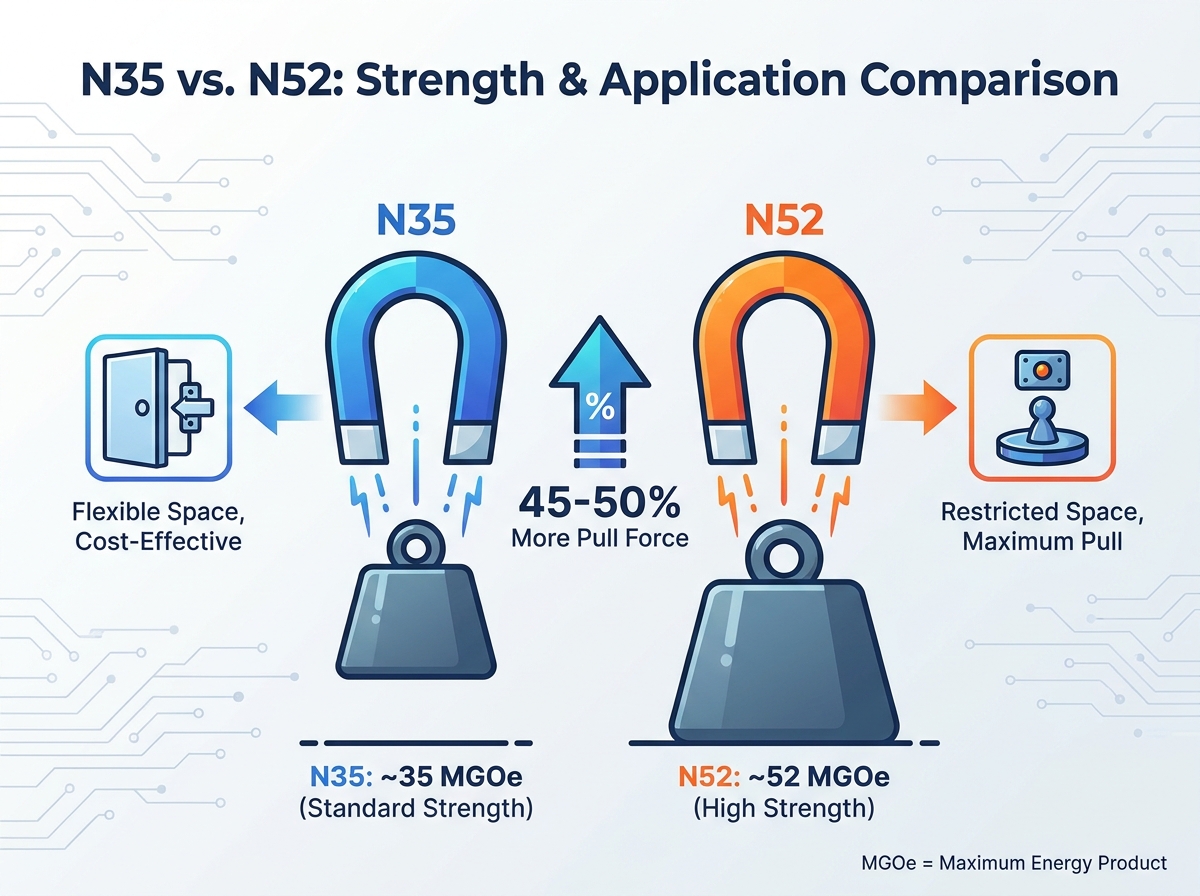
- Strength Differential: An N52 magnet typically offers 45–50% more magnetic pull force than an N35 magnet of the exact same dimensions.
- Space vs. Cost: N35 is highly cost-effective and ideal when design dimensions are flexible; N52 is mandatory for miniaturization or strict weight-restricted applications.
- Temperature Limits: Both standard N35 and N52 grades begin to lose magnetization at 80°C (176°F); higher magnetic strength does not equate to higher thermal resistance.
- Handling Risks: The extreme pull force of N52 magnets increases the risk of violent collision, making them significantly more prone to chipping or shattering during assembly than N35.
The Core Performance Difference: N52 vs. N35 Specifications
Understanding the exact physical differences between magnetic grades is crucial for accurate engineering. We must move past vague marketing terms and examine measurable physics. The performance gap between standard and premium neodymium relies entirely on their energy density.
Understanding the "N" Rating
The "N" in these classifications stands for Neodymium. The number following it represents the Maximum Energy Product, measured in Mega Gauss Oersteds (MGOe). This figure indicates the overall magnetic strength and energy stored within the material. An N35 yields roughly 33 to 35 MGOe. Meanwhile, an N52 yields an impressive 50 to 53 MGOe. This numerical difference directly translates into the force the magnet applies to a target material.
Dimensional Equivalence
Physics dictates how we apply these numbers to actual hardware design. Suppose your specific project requires exactly 10 pounds of pull force. Achieving this benchmark with an N35 material requires a physically larger or thicker component. If your design space is restricted, scaling up is impossible. In this scenario, integrating an N52 Magnet allows you to achieve that exact 10-pound pull force within a significantly smaller footprint.
Gauss and Surface Field
Surface field strength provides a verifiable metric for comparison. By examining identical geometries, we can clearly see the performance gap. The chart below illustrates the expected surface field and pull force for a standard 1/2" diameter by 1/8" thick disc.
Magnetic Performance Comparison Chart (1/2" x 1/8" Disc)
| Magnet Grade | Maximum Energy Product (MGOe) | Estimated Surface Field (Gauss) | Estimated Pull Force (lbs) |
| N35 | 33 - 35 | ~2,200 - 2,400 | ~3.2 |
| N52 | 50 - 53 | ~3,200 - 3,400 | ~4.8 |
Cost vs. Performance: When to Justify the N52 Premium
Procurement teams constantly evaluate raw component costs. Premium grades inherently cost more to produce. We must frame this business problem correctly to make sound financial decisions.
Business Problem Framing
Why do these higher grades carry a price premium? The answer lies in metallurgy and manufacturing processes. Formulating a higher MGOe rating requires a higher concentration of refined rare-earth elements. Manufacturers also implement much tighter production tolerances. This intense refinement process naturally increases the unit price of the final product.
Evaluation Dimension: Cost per Pound of Pull
A smart procurement strategy avoids looking solely at the unit cost. Instead, evaluate the financial impact based on the required holding force. Introduce the concept of "cost per pound of pull" to your engineering reviews. Sometimes buying a slightly more expensive, smaller magnet is more economical than modifying a product casing to fit a cheaper, larger magnet.
Scenario A: Unrestricted Space
Many mechanical applications feature generous spatial tolerances. Industrial clamps, large displays, or heavy cabinetry often have deep mounting channels. If your housing can comfortably accommodate a larger volume, scaling up an N35 component is almost always more budget-friendly. You achieve your target pull force by simply adding more mass.
Scenario B: Restricted Space
Modern engineering frequently demands extreme miniaturization. You might be designing pre-molded plastic housings, drones, or micro-sensors. In these fixed-design environments, physical expansion is impossible. You cannot bore a larger hole without compromising structural integrity. Here, paying the premium for an N52 Magnet becomes the only mathematically viable way to increase holding force.
Real-World Application Matrix: Matching Grade to Use Case
Theoretical numbers only go so far. Examining real-world application scenarios clarifies exactly when to specify each grade. Different industries prioritize different physical attributes.
Industrial & Engineering Applications
Heavy machinery and precision instruments demand strict operational parameters. Common use cases include precision servo motors, high-capacity magnetic separators, and critical aerospace sensors.
Verdict: Engineers often lean heavily toward the top grades for these applications. Maximizing the size-to-weight ratio is frequently non-negotiable in aerospace and automotive sectors. As long as operators carefully manage ambient operating temperatures, the maximum strength option remains superior.
Hobbyist, Miniature, & 3D Printing (e.g., Warhammer)
The maker and tabletop gaming communities rely on magnets for modular customization. Use cases include magnetizing miniature bases for safe transport, swapping weapon loadouts, and assembling modular 3D printed terrain parts.
Verdict: The highest grades are highly recommended here. A tiny 2x1mm N52 Magnet provides enough holding force to secure a heavy metal miniature firmly to a carrying tray. Conversely, an N35 of the exact same 2x1mm size frequently fails the standard "shake test," leading to broken models and frustrated users.
Consumer Electronics, Packaging, & Cabinetry
Everyday user experience dictates the engineering choices for consumer goods. Common use cases involve concealed magnetic closures for luxury boxes, auto-waking tablet cases, and standard cabinet doors.
Verdict: N35 is the definitive winner in this category. The extreme pull force of higher grades is generally massive overkill here. An overly strong closure can actually cause cardboard packaging to tear open. It might also cause wooden cabinet doors to snap shut too aggressively, creating unpleasant noise and potential pinch hazards.
Implementation Risks: Durability, Heat, and Assembly
Selecting a stronger component introduces new variables to your manufacturing floor. You must anticipate these implementation risks to avoid high defect rates. More pull force often translates to more volatile behavior during assembly.
The Brittleness Factor
Neodymium is inherently brittle. The assembly line risks multiply exponentially when you introduce stronger fields. Because premium magnets attract each other with significantly higher velocity, they close distances rapidly. They are far more likely to chip, crack, or shatter upon impact compared to standard N35 equivalents. Workers handling them must exercise extreme caution to prevent dangerous pinching and component loss.
Operating Temperature Constraints
A dangerous misconception persists among some designers. Many assume a stronger magnetic field survives higher heat. This is scientifically false. Standard grades across the board typically degrade at the same thermal threshold. Standard versions of both N35 and N52 begin losing their permanent magnetization at roughly 80°C (176°F). Exceeding this limit causes irreversible damage to the component.
Mitigation Strategies
You can engineer workarounds to solve these durability and heat issues. Consider these compliance-aware strategies:
- Thermal Suffixes: Specify 'H' (120°C), 'SH' (150°C), or 'UH' (180°C) suffixes if your environment exceeds 80°C. Note that high-temp variants may slightly reduce overall MGOe limits.
- Recessed Housings: Design your mechanical housings so the magnet sits flush or slightly recessed. This physical barrier prevents direct, violent magnet-to-magnet collisions.
- Assembly Tooling: Implement non-ferrous jigs and fixtures on the assembly line to prevent unexpected attraction during the manufacturing process.
Shortlisting Logic: A Step-by-Step Decision Framework
You can streamline your procurement choices by following a rigid evaluation framework. Eliminate the guesswork by answering fundamental mechanical questions in a specific sequence.
- Step 1: Define Physical Constraints. Determine if your magnet slot size is permanently locked. If you cannot expand the cavity, your strength requirements will automatically dictate the necessary grade.
- Step 2: Determine Minimum Viable Pull Force. Calculate the exact holding force required to achieve functionality. You must factor in the thickness of any intermediate materials. Plastic enclosures, steel plating, or even layers of paint sitting between the magnet and the target will drastically reduce the effective pull.
- Step 3: Assess Environmental Risks. Evaluate your actual assembly procedures for impact risks. Simultaneously, map out the absolute maximum operating temperature your product will face in the field.
Next-Step Actions
Theoretical calculations require physical validation. We highly recommend ordering a prototype batch containing both N35 and N52 variations in your targeted dimensions. Perform rigorous physical tolerance checks. Execute repeated drop tests. Assess the user experience manually before you commit to bulk procurement.
Conclusion
Choosing the correct magnetic component ensures optimal product performance and protected profit margins. To review, select an N35 grade to maximize cost-efficiency when your design allows for flexible dimensions. Choose an N52 material to guarantee maximum holding strength when working within rigid, space-constrained footprints.
Neither material is universally "better" than the other. Their value depends entirely on the context of your application's physical limits and economic boundaries. Over-engineering drives up costs, while under-engineering ruins user experience.
Do not guess at these critical specifications. Contact our specialized engineering team today for a custom pull-force calculation, or request a detailed sample testing kit to run real-world validation trials on your assembly line.
FAQ
Q: How much stronger is an N52 magnet than an N35?
A: An N52 provides approximately 45% to 50% more Maximum Energy Product (MGOe) than an N35 of the exact same size. However, the perceived pull force heavily depends on the mating surface, the presence of air gaps, and the thickness of the target metal.
Q: Can I directly replace an N35 magnet with an N52 magnet of the same size?
A: Yes, they are physically identical in size. However, you must anticipate unintended consequences. The extreme increase in pull force can make user-facing parts too difficult to separate, or it may cause structural damage to surrounding plastic housings upon impact.
Q: Do N52 magnets lose their magnetism faster than N35?
A: No, assuming standard operating conditions. Both are permanent neodymium materials. They will retain their magnetic fields indefinitely. They only lose magnetism if they are exposed to extreme heat above 80°C, placed inside strong opposing magnetic fields, or subjected to severe physical corrosion.