Neodymium Iron Boron magnets serve as the critical heartbeat of modern hardware. They power high-speed precision motors, sensitive automotive sensors, life-saving medical devices, and everyday consumer electronics. However, procuring these components presents a significant engineering challenge. Buyers must constantly balance maximum energy product against strict thermal stability, physical durability, and rigid dimensional tolerances. Over-specifying drains your budget, while under-specifying causes catastrophic system failures.
We designed this comprehensive guide to give you a skeptical, evidence-based framework for component selection. You will learn how to specify the exact NdFeB Ring Magnet you need without guessing. By understanding material properties, tolerance limitations, and proper surface treatments, you can secure reliable parts. This approach ensures you never overpay for unnecessary grades or risk failures in the field.
Key Takeaways
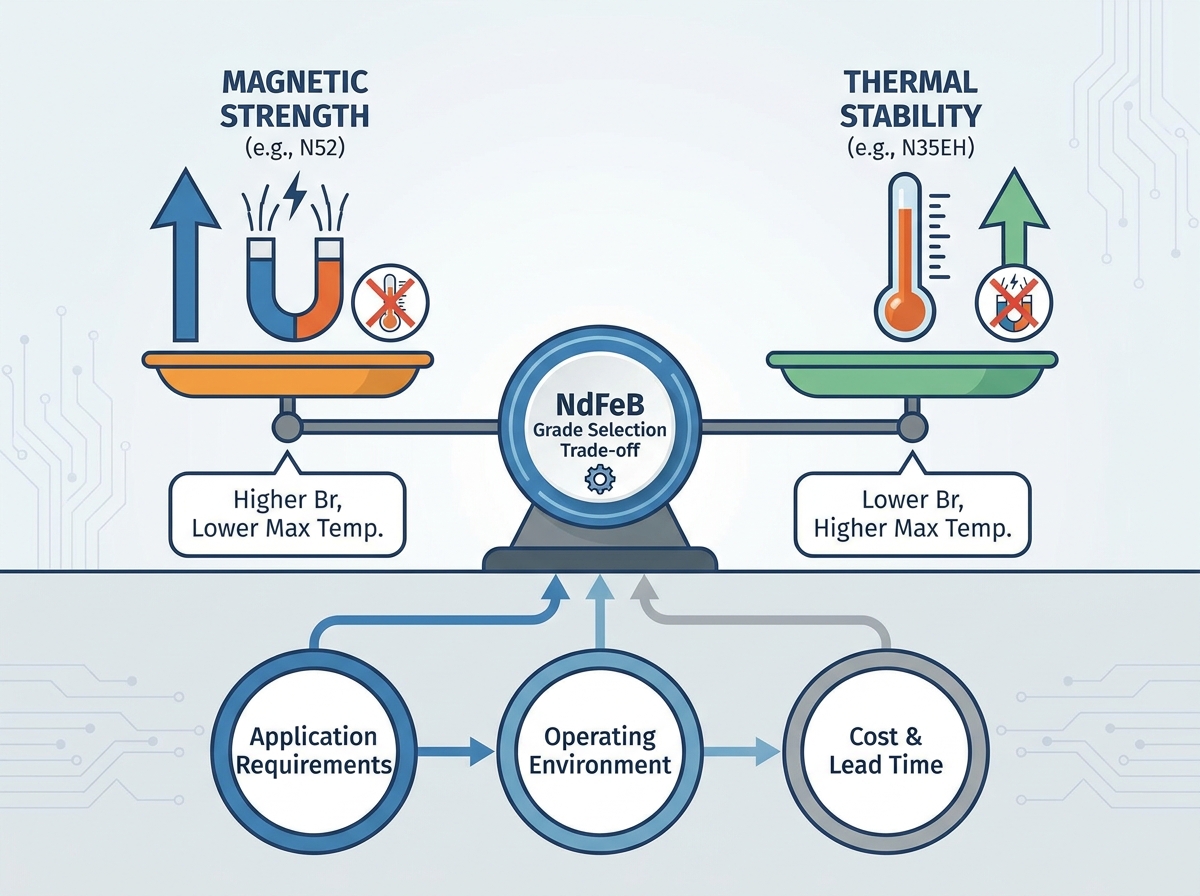
- Grade vs. Temperature: Specifying the highest magnetic strength (e.g., N52) often compromises high-temperature performance; intrinsic coercivity must match the application's thermal ceiling.
- Magnetization Orientation: The choice between axial, diametrical, and true radial magnetization directly impacts tooling costs, lead times, and magnetic efficiency.
- Coating is Non-Negotiable: Sintered NdFeB is highly susceptible to corrosion; selecting the correct surface treatment (Ni-Cu-Ni, Epoxy, Zinc) is as critical as the magnetic grade.
- Supply Chain Resilience: Geopolitical volatility in Rare Earth Elements (REE) necessitates vetting suppliers for traceability and exploring recycled material viability.
Framing the Requirement: Dimensional Tolerances and Magnetization
Specifying a magnetic component begins with its physical geometry. You must define the exact dimensions and understand how those dimensions affect manufacturability. Small design choices often create massive cost multipliers in production.
Defining the Geometry
Every ring magnet specification revolves around three critical dimensions: Outer Diameter (OD), Inner Diameter (ID), and Thickness or Length (T). These dimensions dictate the volume of magnetic material available. They also determine the physical fragility of the final piece.
Wall thickness plays a vital role in manufacturing success. The wall thickness is the difference between the OD and ID, divided by two. Thin walls drastically increase the fracture risk during the machining process. Sintered neodymium acts like a brittle ceramic. If your wall thickness drops below 1.5mm, manufacturers will face high scrap rates. They will pass those scrap costs directly to you. Always design the thickest wall your application can accommodate.
Standard vs. Custom Tolerances
Manufacturers produce raw magnet blocks before cutting them to final shapes. Baseline industry tolerances typically sit at ±0.1mm. Some premium suppliers offer ±0.05mm as a standard. Demanding tighter precision requires slow, custom precision grinding. This additional processing time significantly raises unit prices.
You should only specify ultra-tight tolerances on mating surfaces. If the OD sits in open air, standard tolerances work perfectly. Restrict your tightest tolerance requirements to the specific ID or OD interfacing with a shaft or housing.
Magnetization Directions (Evaluation Criteria)
The direction of magnetic flux determines how the component interacts with your system. We evaluate three primary orientations:
- Axial: The magnet is magnetized through its thickness. The north and south poles sit on the flat circular faces. This is the easiest orientation to manufacture. It requires standard pressing techniques and carries the lowest cost.
- Diametrical: The flux travels straight across the diameter. One side of the outer curve acts as the north pole, and the opposite side acts as the south. Engineers commonly use this in rotary sensors and magnetic encoders.
- Radial: True radial magnetization points the flux outward from the center like spokes on a wheel. It can be uni-pole or multi-pole. This setup delivers incredible magnetic efficiency for electric motors. However, it requires specialized, expensive magnetizing fixtures. It also demands complex pressing tooling. You must conduct a thorough return-on-investment (ROI) evaluation before specifying true radial parts.
Selecting the Right Grade and Thermal Classification
Choosing a magnetic grade requires balancing raw strength against environmental resistance. Many engineers make the mistake of defaulting to the strongest available grade. This decision often leads to field failures due to thermal degradation.
Decoding NdFeB Nomenclature
The standard naming convention tells you exactly what you are buying. A grade like "N42SH" breaks down into two distinct parts. The number (42) denotes the Maximum Energy Product, or BHmax. This represents the raw magnetic strength. A higher number indicates a stronger pull.
The trailing letters (SH) denote the temperature rating. These suffixes indicate the intrinsic coercivity class. If a grade lacks a trailing letter, it is a standard "N" grade with basic temperature resistance.
The Strength vs. Heat Trade-off
You cannot have infinite strength and infinite heat resistance simultaneously. There is an inverse relationship between residual induction (Br) and intrinsic coercivity (Hcj). Residual induction represents the magnetic flux density. Intrinsic coercivity measures the material's resistance to demagnetization.
To increase temperature resistance, manufacturers must add heavy rare earth elements like Dysprosium or Terbium. These additives increase Hcj but take up space in the crystal lattice. This slightly reduces the overall Br. Therefore, a high-temperature N42SH will cost significantly more than a standard N42, even though their room-temperature strengths are similar.
Operating Temperature Limits (Implementation Realities)
Temperature limits dictate survival in the field. You must match the grade suffix to your operational environment.
Standard Thermal Classifications for Neodymium Magnets
| Grade Suffix | Max Operating Temp (°C) | Typical Application Environment |
| None (N) | 80°C | Consumer electronics, ambient sensors |
| M | 100°C | Low-stress actuators, audio equipment |
| H | 120°C | Industrial sensors, mild automation |
| SH | 150°C | Standard electric motors, pumps |
| UH | 180°C | High-speed rotors, generators |
| EH / AH | 200°C - 240°C | Aerospace, heavy automotive traction |
Trust point: Operating temperature is not just ambient temperature. You must account for self-heating. A high-speed motor generating eddy currents will heat the rotor significantly above ambient air temperature. Specifying standard "N" grades in high-heat environments guarantees irreversible demagnetization. Always calculate your peak thermal load before selecting a grade.
Surface Treatments: Mitigating Corrosion and Wear Risks
Raw neodymium iron boron oxidizes rapidly. You cannot leave it exposed to ambient air. Protecting your NdFeB Ring Magnet requires a deliberate surface treatment strategy.
The Vulnerability of Sintered NdFeB
The iron content in sintered neodymium makes it highly susceptible to rust. Humidity, acidic environments, and simple finger oils trigger rapid oxidation. As the material rusts, it expands and flakes away. This physical degradation permanently ruins the magnetic field. You must treat coating selection with the same rigor as grade selection.
Evaluating Coating Options
Different applications demand different defensive layers. Review these options carefully:
- Ni-Cu-Ni (Nickel-Copper-Nickel): This serves as the baseline industry standard. It provides excellent physical durability and a shiny, clean finish. However, it is electrically conductive. In high-speed motor applications, conductive coatings create eddy currents. These currents generate unwanted heat and reduce motor efficiency.
- Epoxy: Epoxy resin offers superior salt-spray resistance. It excels in marine environments or outdoor industrial settings. Epoxy is non-conductive, solving the eddy current problem. Keep in mind that epoxy layers are slightly thicker than nickel. You must adjust your dimensional tolerances to accommodate this buildup.
- Zinc: Zinc plating provides a cost-effective solution for low-corrosion environments. It protects against basic ambient humidity. However, it offers lower physical durability than nickel. It scratches easily during handling.
- Passivation / Uncoated: You should only specify uncoated magnets if they will be hermetically sealed immediately. For example, if you slide the rings onto a rotor shaft and enclose them in a laser-welded stainless steel sleeve, you can skip the coating. This saves money but requires strict climate control during assembly.
Assembly, Handling, and Implementation Realities
Designing a system on a CAD screen is entirely different from building it on a factory floor. Neodymium ring components require specialized handling protocols to prevent damage and ensure worker safety.
Managing Brittleness
You must understand the mechanical reality of sintered NdFeB. These items are advanced ceramics, not resilient metals. They lack tensile strength. They possess almost zero elasticity. If you drop them onto a concrete floor, they will shatter. If you allow two pieces to snap together uncontrollably, they will chip and send sharp fragments flying into the air.
Train your assembly teams to handle these components with extreme care. Keep non-magnetic spacers between parts during transport. Use customized plastic trays to separate rings until the exact moment of installation.
Fastening and Retention Strategies
Securing a brittle ceramic ring to a metal shaft demands careful engineering. Many designers attempt press-fitting. This approach almost always fails.
- Avoid Press-Fitting: Forcing an oversize shaft into a ceramic ring generates immense hoop stress. The material cannot flex to accommodate the interference fit. It will crack instantly.
- Use Structural Adhesives: Implement a slip-fit design with a defined gap. Fill this gap with a high-strength structural epoxy. Industrial acrylics and epoxies distribute stress evenly across the inner diameter. They also absorb micro-vibrations during operation.
- Implement Mechanical Retention: For high-RPM motor applications, adhesives alone may not survive the centrifugal forces. You should back up the adhesive with mechanical retention. Use retaining rings, carbon fiber banding, or thin metallic sleeves to lock the component in place safely.
Health & Safety Compliance
Workplace hazards increase dramatically with larger components. Large rings carry severe pinch risks. They can crush fingers or cause blood blisters if handled improperly. Ensure operators wear proper safety gear and use non-magnetic jigs for assembly.
Furthermore, strictly prohibit traditional machining or drilling post-magnetization. Attempting to modify a finished piece destroys the protective coating. Worse, the friction generates heat that can ignite pyrophoric neodymium dust, causing severe factory fires.
Supply Chain Volatility and Vendor Vetting
The materials required to manufacture permanent magnets do not flow freely across global markets. Sourcing these components forces you to navigate complex international supply chains and fluctuating commodity prices.
Navigating Geopolitical Risks
The extraction and processing of rare earth elements remain highly concentrated in a few geographic regions. This concentration creates inherent supply chain vulnerabilities. Trade disputes, export quotas, and shifting tariffs directly impact your component costs. Price volatility remains a constant threat. You must build flexibility into your long-term production budgets to absorb sudden raw material price spikes.
Sustainability and E-Waste
Corporate sustainability mandates now influence procurement. The industry is seeing emerging commercial viability in recovering rare earth elements from electronic waste (e-waste). Urban mining offers a path toward a greener supply chain. We advise buyers to ask vendors about their specific recycling initiatives. Verify their Environmental, Social, and Governance (ESG) compliance. Sourcing from vendors who utilize recycled feedstocks can protect your brand reputation and align with global sustainability goals.
Shortlisting Logic
Do not select a magnet supplier based solely on the lowest quote. You need a partner capable of delivering consistent quality across thousands of units. Use this checklist to audit potential vendors:
- Demagnetization Curves: Do they provide precise demagnetization curves for specific manufacturing batches? You need empirical proof that the material meets temperature specs.
- Raw Material Traceability: Can they guarantee full traceability back to the mine or recycling facility? This ensures ethical sourcing and avoids counterfeit materials.
- In-House Capabilities: Do they possess in-house coating, machining, and magnetic testing facilities? Vendors outsourcing these steps often suffer from severe quality control blind spots.
Conclusion
Procuring an NdFeB Ring Magnet demands a careful balancing act. You must align performance metrics against harsh environmental realities and strict budget constraints. Success requires looking past the raw magnetic strength to evaluate thermal stability, protective coatings, and assembly mechanics.
We advise you to finalize your specifications only after rigorous physical prototyping. Consult directly with your manufacturing partner early in the design phase. They can provide vital insight into the tooling costs associated with complex magnetizations, such as true radial alignment.
Take action today by auditing your current magnet specifications. Compare your legacy drawings against actual operational requirements. You will likely uncover opportunities to downgrade to a more cost-effective temperature class, switch to a better coating, or improve your assembly retention strategy for greater long-term reliability.
FAQ
Q: Can an NdFeB ring magnet be machined or resized after purchase?
A: No. Attempting to machine, drill, or cut a finished magnet destroys the protective coating, exposing the raw material to rapid corrosion. The material is highly brittle and will fracture under machining stress. Furthermore, neodymium dust is pyrophoric and presents a severe fire hazard when exposed to friction heat.
Q: Why is radial magnetization so much more expensive than axial?
A: Radial magnetization requires custom-built magnetizing coils specifically sized for your component. The manufacturing process also demands complex pressing techniques to align the magnetic domains outward during the initial powder compaction. Axial magnetization uses simple, universal flat fixtures, making it much cheaper and faster to produce.
Q: What is the difference between bonded and sintered NdFeB ring magnets?
A: Sintered magnets offer the maximum possible magnetic strength but are limited to basic geometric shapes and require precision grinding for tight tolerances. Bonded magnets mix magnetic powder with a polymer binder. They are much weaker magnetically, but manufacturers can injection-mold them into complex net shapes without secondary machining.
Q: How does a change in inner diameter (ID) affect the magnet's strength?
A: Increasing the inner diameter reduces the total volume of magnetic material. This directly lowers the total magnetic flux available to your system. Because magnetic fields interact non-linearly with geometry, any change to the ID requires careful recalculation using finite element analysis (FEA) magnetic modeling software.