Neodymium Iron Boron magnets drive modern high-performance engineering. You find them powering BLDC motors, stabilizing magnetic bearings, and enabling precision Hall effect sensors. Without them, advanced acoustic arrays simply would not function. However, choosing the wrong specifications carries massive risks. Improper selection easily leads to premature demagnetization from excess heat. You might face catastrophic corrosion in harsh environments. Even slight physical misalignments can cause complete system failure.
To prevent these disasters, you need a highly structured selection process. We provide a no-nonsense, engineering-led framework here. It will help you specify the exact grade, magnetization direction, and protective coating required. You will learn how to balance peak magnetic performance against unit manufacturing costs. By following these guidelines, you ensure your next project operates flawlessly.
Key Takeaways
- Application Dictates Direction: The choice between axial, diametrical, and radial magnetization is the primary driver of both system function and tooling cost.
- Grade Isn't Just Strength: Specifying "N52" blindly is a common error; operating temperature dictates the necessity of high-coercivity grades (M, H, SH, UH) over sheer maximum energy product.
- Tolerances Impact Yield: Over-specifying internal diameter (ID) and outside diameter (OD) tolerances drastically increases manufacturing rejection rates and costs due to NdFeB's inherent brittleness.
- Coating is Mandatory: Raw Neodymium oxidizes rapidly; matching the coating (Ni-Cu-Ni, Epoxy, Zinc) to the operational environment is critical for longevity.
Defining Your Application's Success Criteria
Before contacting a supplier, you must define exactly what success looks like. Every engineering project demands unique magnetic behaviors. A vague specification always leads to underperforming components. Let us break down the critical parameters you must evaluate.
Load and Force Requirements
You must identify the primary function of the component. Are you using it for holding or repelling? These applications require maximizing raw pull force. You will likely prioritize maximum energy product. Conversely, sensing applications demand specific magnetic field geometries. A Hall effect sensor requires a precise trigger point. Raw strength matters less here. Instead, field consistency and shape dictate system accuracy.
Operating Environment Hard Specs
Environmental conditions destroy unprotected magnets quickly. You must define the maximum continuous operating temperature. Furthermore, identify any peak flash temperatures your system might experience during operation. Thermal stress degrades magnetic fields rapidly.
Moisture presents another severe threat. Evaluate potential exposure to ambient humidity. Consider whether the component will face chemical washdowns or saline environments. Saltwater destroys raw neodymium in days. Clear environmental specifications prevent catastrophic field failures.
Assembly Realities
Engineers often forget how the magnet integrates into the final product. Consider your assembly floor processes. Will automated machines press-fit the part? Will technicians glue it into a housing? Will you mechanically fasten it?
Remember, a NdFeB Ring Magnet acts like a brittle ceramic. It is not structural steel. Mechanical stress during assembly often causes micro-fractures. These fractures lead to eventual mechanical failure. Always account for component fragility during the design phase.
Best Practices for Assembly:
- Design mating housings slightly oversized to accommodate adhesive gaps.
- Avoid applying direct impact force during press-fitting operations.
- Specify chamfered edges to reduce chipping during handling.
Selecting the Correct Magnetization Direction
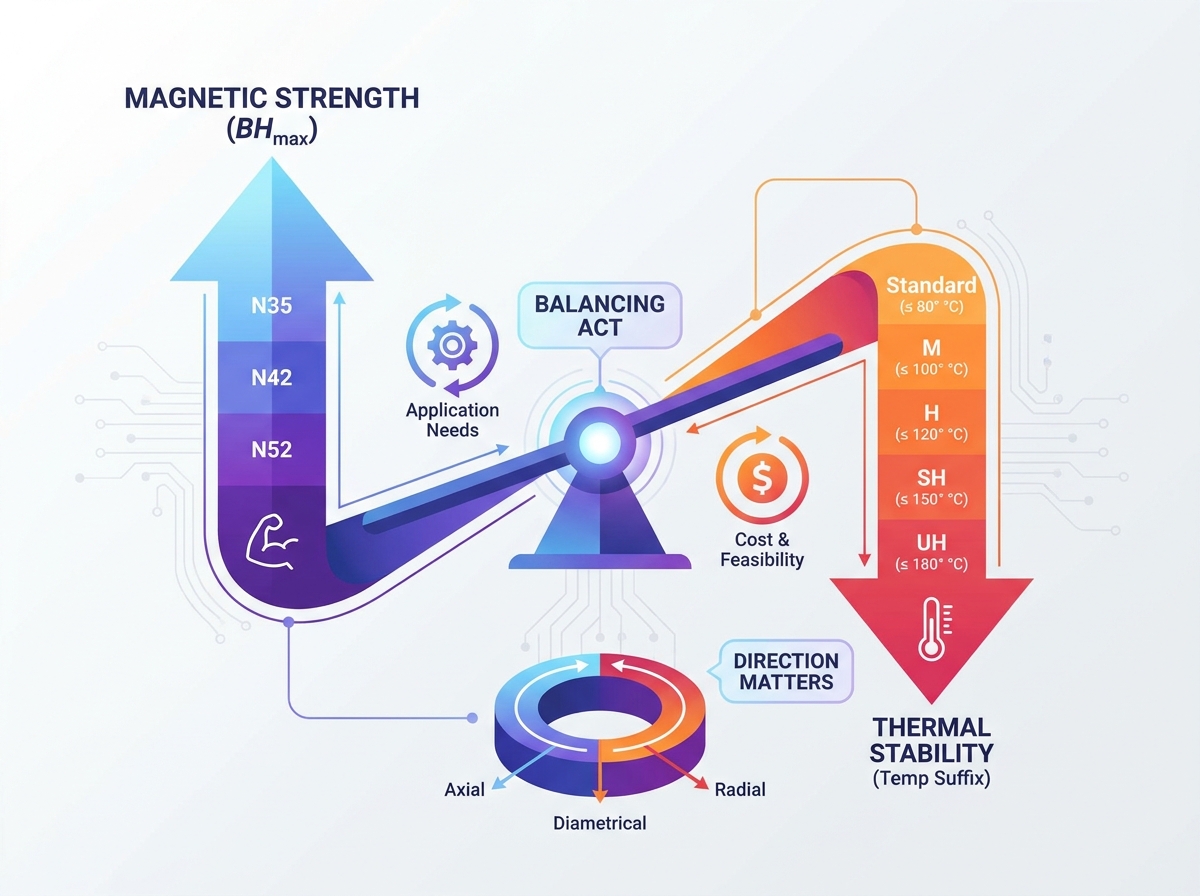
The direction of the magnetic field dictates system function. It also heavily influences your tooling budget. Suppliers can orient the internal magnetic domains differently. You must choose the orientation carefully.
Axial Magnetization
Axial orientation places the north and south poles on the flat faces. Imagine a coin where heads is North and tails is South. This setup suits standard holding applications perfectly. Designers use axial rings in loudspeakers and traditional magnetic couplings.
From a commercial standpoint, axial orientation reigns supreme. It utilizes standard pressing and sintering methods. Therefore, it remains highly cost-effective for mass production runs. You avoid expensive custom alignment coils.
Diametrical Magnetization
Diametrical orientation changes the game. Here, the material is magnetized across the diameter. The poles sit on opposite curved sides. If you view the ring from the top, the left half might be North. The right half becomes South.
Engineers specify diametrical orientation for dynamic motion. It triggers sensors in rotating shafts beautifully. Many specialized motor designs rely entirely on diametrically magnetized components for proper rotor function.
Radial and Multipole Magnetization
Radial orientation forces the field outward from the center. It acts like spokes on a bicycle wheel. Sometimes, engineers require alternating poles along the outer circumference. We call this multipole magnetization.
Implementation reality hits hard here. True radial anisotropic components require specialized magnetic field coils. The factory must use these coils during the powder pressing stage. This process limits manufacturing speed severely.
Buyer Warning: Expect exceptionally high custom tooling costs. Suppliers will demand higher minimum order quantities (MOQs). For prototyping, assess whether assembling a segmented Halbach cylinder works better. Building a ring out of individual arc segments often saves thousands of dollars in early development.
Balancing Grade, Strength, and Thermal Stability
Many novice engineers assume stronger is always better. They default to the highest grade available. This mistake ruins project budgets and compromises thermal stability. You must balance magnetic output against environmental realities.
The "N" Number (Maximum Energy Product)
Grades range from N35 to N52. This number defines the maximum energy product (BHmax). Higher numbers deliver stronger, more concentrated magnetic fields. However, this strength introduces physical drawbacks. High-N grades often exhibit greater physical brittleness. They chip and crack much easier than lower grades during assembly.
The Suffix (Temperature Rating)
The letters following the N-number dictate thermal resilience. A standard N52 magnet begins losing strength around 80 degrees Celsius. You must specify a suffix for higher temperatures.
NdFeB Temperature Ratings Table
| Suffix | Maximum Operating Temperature | Common Application |
| Standard (No Suffix) | $\le 80^\circ$C | Consumer electronics, indoor sensors |
| M (Medium) | $\le 100^\circ$C | Small electric motors, actuators |
| H (High) | $\le 120^\circ$C | Automotive components, power tools |
| SH (Super High) | $\le 150^\circ$C | Industrial servo motors, generators |
| UH (Ultra High) | $\le 180^\circ$C | Heavy machinery, aerospace parts |
| EH (Extreme High) | $\le 200^\circ$C | Extreme industrial environments |
Expertise Note: Understand the vital difference between Curie temperature and maximum operating temperature. Curie temperature is the point where permanent magnetism is totally lost. Maximum operating temperature is the threshold where irreversible, though partial, losses begin. Always keep continuous operating temperatures well below the maximum rating.
Cost-to-Performance Ratio
Thermal stability does not come free. High-temperature grades (SH, UH, EH) require heavy metal doping. Manufacturers add dysprosium (Dy) or terbium (Tb) to the alloy. These rare earth elements are scarce and expensive. Consequently, specifying an N42SH costs significantly more than a standard N42. Never over-specify your thermal requirements.
Mitigating Corrosion: Surface Treatment Evaluation
Raw neodymium oxidizes aggressively when exposed to ambient moisture. It literally turns to powder over time. You must apply a protective surface treatment. Matching the right coating to your operational environment ensures component longevity.
Nickel-Copper-Nickel (Ni-Cu-Ni)
This triple-layer plating serves as the industry standard. It provides excellent indoor durability. The finish looks shiny and aesthetically pleasing. It protects well against standard atmospheric moisture. However, the metallic plating can peel or flake under sharp mechanical impact. You must handle these components gently during production.
Epoxy Coating
Choose epoxy for genuinely harsh environments. It excels in marine applications, outdoor motors, or high-humidity zones. Epoxy provides superior corrosion resistance compared to metallic plating.
However, you must account for dimensional changes. Epoxy layers apply thicker than nickel plating. This added thickness impacts tight assembly tolerances. You must adjust your housing dimensions accordingly.
Zinc (Zn)
Zinc offers lower cost and moderate protection. It creates a dull, grey finish. Zinc works exceptionally well if the magnet remains fully sealed inside an enclosure. For example, if you overmold the component inside plastic, zinc provides adequate pre-assembly protection. It keeps costs down while preventing factory-floor oxidation.
Parylene / Teflon
Engineers use these specialty coatings for extreme conditions. Medical devices often require parylene for biocompatibility. Extreme chemical exposure demands Teflon. These coatings offer unmatched protection. Note they carry extremely high implementation costs. Reserve them only for specialized edge cases.
Dimensioning, Tolerances, and Machining Limitations
Precision dimensioning prevents costly manufacturing delays. A NdFeB Ring Magnet requires careful structural consideration. You cannot treat it like machined steel.
Standard Sizing (OD x ID x Thickness)
Always format your RFQ accurately to avoid supplier confusion. List the Outside Diameter (OD) first. Follow it with the Internal Diameter (ID). Conclude with the Thickness (T). Specify the unit of measurement clearly. Millimeters remain the global standard. Precise formatting accelerates the quoting process.
The Brittleness Factor
NdFeB behaves like a dense ceramic. Wall thickness represents a critical structural factor. You calculate wall thickness by subtracting the ID from the OD, then dividing by two. This dimension must be substantial enough to prevent cracking during the final pressing phase.
Thin-walled rings suffer from abysmal manufacturing yield rates. They shatter during shipping. They fracture during assembly. Always design the thickest wall your spatial envelope permits.
Tolerance Trade-offs
The standard industry tolerance sits at $\pm 0.1$mm. This covers most commercial applications. Some engineers push for $\pm 0.05$mm out of habit. Do not do this unless absolutely necessary.
Achieving $\pm 0.05$mm requires extensive secondary diamond-grinding. This labor-intensive process inflates the piece price drastically. A smart engineer acknowledges when to absorb dimensional variance. Often, loosening the magnet tolerance and tightening the plastic housing tolerance saves considerable money.
Supply Chain, Compliance, and Prototyping
Securing a reliable supply chain requires strict verification. Do not trust generic spec sheets blindly. You need documented proof of material performance and regulatory compliance.
Regulatory Compliance
Global markets demand strict environmental standards. Ensure your supplier provides current RoHS and REACH certifications. These documents prove the material contains no banned hazardous substances. They are strictly mandatory for consumer electronics and automotive supply chains globally. Missing these documents delays customs clearances indefinitely.
Traceability and Testing
How do you know you received N42SH instead of standard N42? You request demagnetization curves. Industry professionals call these B-H curves.
Demand B-H curves specific to your chosen grade and temperature profile. These charts validate the supplier's claims mathematically. Reputable factories supply these reports willingly. Treat any hesitation as a severe red flag.
Shortlisting Logic
Prototyping custom rings burns through capital rapidly. We recommend a phased approach.
- Source standard off-the-shelf axial rings first.
- Test these cheap variants to validate your mechanical envelope and basic magnetic circuit.
- Once the spatial design is locked, commit to custom tooling.
- Order your final radial or high-temperature variants only when you are ready for pre-production validation.
This logical sequence prevents wasting money on multiple custom tool iterations.
Conclusion
- Specifying an NdFeB ring magnet requires balancing magnetic strength, thermal stability, and basic manufacturability.
- Operating temperatures dictate your material grade far more than sheer pull force requirements.
- Over-specifying dimensional tolerances leads to unnecessary secondary machining costs.
- Under-specifying environmental coatings leads to guaranteed field failures.
- Always engage with a specialized magnetic engineering supplier early in your design phase. They will validate your magnetic circuit before you commit to expensive tooling.
FAQ
Q: What is the difference between a standard NdFeB ring magnet and a countersunk ring magnet?
A: Countersunk rings feature a tapered internal diameter (ID). This taper accommodates standard screw heads for easy mechanical mounting. Standard rings have a straight cylindrical ID from top to bottom. Use standard rings for press-fitting or gluing onto shafts.
Q: Why is my N52 ring magnet losing strength at $90^\circ$C?
A: You specified a grade lacking a high-temperature suffix. An N52 magnet utilizes standard temperature chemistry. It begins degrading permanently above $80^\circ$C. For a $90^\circ$C environment, you must upgrade to an N48M or N50M grade.
Q: Can I machine or drill an NdFeB ring magnet myself?
A: We strongly warn against this. The material is highly brittle and chips easily. Furthermore, standard machining generates immense friction heat. This heat quickly demagnetizes the component. Finally, raw neodymium dust is highly flammable and poses a severe fire hazard.
Q: Is it cheaper to buy one radially magnetized ring or assemble multiple arc magnets?
A: For low volumes and prototyping, arc magnets are vastly cheaper due to zero tooling costs. For mass production, a single radial ring becomes superior. It completely eliminates assembly labor and removes multiple mechanical failure points.