Engineers face a distinct physical reality today. Neodymium Iron Boron magnets offer the highest magnetic energy product available commercially. This makes them absolutely critical for industrial miniaturization. They drive massive improvements in mechanical efficiency. Yet, leveraging this power involves navigating significant specification challenges. Their size-to-strength ratio remains unmatched in the industry. However, improper specification poses severe system risks. Choosing the wrong magnetization direction often causes failure. Selecting incorrect thermal grades leads to sudden demagnetization. Poor surface treatments invite rapid corrosion. You must get these engineering details right. This article provides an evidence-based framework for these components. We will help you evaluate, specify, and source a reliable NdFeB Ring Magnet for high-stakes industrial applications. By the end of this guide, you will understand environmental vulnerabilities. You will also know exactly how to vet suppliers for tight geometric precision and consistent flux density.
Key Takeaways
- Application dominance: Primarily utilized in high-performance permanent magnet motors, hermetic magnetic couplings, and precision sensor systems.
- The radial vs. axial divide: Magnetization direction dictates the tooling cost and application suitability; radial offers superior motor efficiency but requires complex manufacturing.
- Operating vulnerabilities: NdFeB is highly susceptible to thermal demagnetization and corrosion, requiring strict grade selection (e.g., SH, UH, EH) and reliable plating (Ni-Cu-Ni or Epoxy).
- Supplier evaluation: Procurement success relies on assessing a manufacturer’s custom tooling capabilities, flux consistency, and adherence to tight geometric tolerances.
The Engineering Problem: Why Specify an NdFeB Ring Magnet?
Modern industrial design demands higher mechanical torque. Systems require greater sensor accuracy. Shrinking spatial footprints force designers to seek zero-leakage power transmission. These daily requirements present a tough business problem. Traditional magnetic components take up too much space. They add unnecessary weight to dynamic assemblies. You need a much more efficient solution to stay competitive.
This is where neodymium materials shine. They deliver maximum remanence ($B_r$). They also provide incredible coercivity ($H_{cj}$). These extreme magnetic properties allow you to rethink your assemblies. You can replace bulky ferrite rings. You can swap out heavy AlNiCo structures. A compact NdFeB Ring Magnet easily outperforms older technologies while saving valuable space.
What does a successful implementation look like? It reduces your overall assembly weight significantly. It improves mechanical energy efficiency. This efficiency proves crucial for battery-operated systems. Continuous-duty industrial machines also benefit immensely from lower power draw. Finally, a properly specified magnet maintains absolute magnetic stability over the intended product lifecycle.
Core Industrial Applications of NdFeB Ring Magnets
High-Speed Electric Motors and Generators
You will frequently find these magnets in advanced motor rotors. They power Brushless DC (BLDC) motors reliably. They also drive servo motors and precision stepper motors. The primary outcome is highly desirable. The magnet delivers smooth, continuous torque. It achieves this while ensuring minimal cogging during rotation. Using a single ring simplifies your rotor assembly process. It eliminates the need to glue multiple individual arc segments together. This consolidation reduces mechanical failure risks at extremely high RPMs.
Magnetic Couplings and Sealing Systems
Chemical processing relies heavily on magnetic couplings. Submerged drives and industrial agitators require perfect hermetic sealing. In these use cases, the magnet enables frictionless torque transmission. The magnetic field passes right across physical barriers. This clever design completely eliminates mechanical shaft seals. Traditional seals are highly prone to physical wear. They eventually fail and cause hazardous fluid leaks. Magnetic couplings prevent these dangerous environmental leaks entirely.
Precision Sensors and Actuators
Automation depends on accurate positional feedback. Robotics utilize Hall effect sensors extensively. They also rely on magnetic encoders and linear actuators. Neodymium rings provide the consistent magnetic fields necessary for these devices. They deliver uniform flux patterns across the sensing area. This uniformity guarantees highly accurate switching mechanisms. It also ensures reliable data collection in fast-moving automated environments.
Industrial Application Comparison Chart
| Application Category | Primary Use Case | Desired Engineering Outcome |
| Electric Motors | BLDC & Servo Motor Rotors | Smooth torque, reduced high-RPM mechanical failure |
| Sealing Systems | Chemical Pumps & Agitators | Frictionless transmission, zero hazardous fluid leaks |
| Precision Sensors | Encoders & Linear Actuators | Uniform fields, accurate positional feedback |
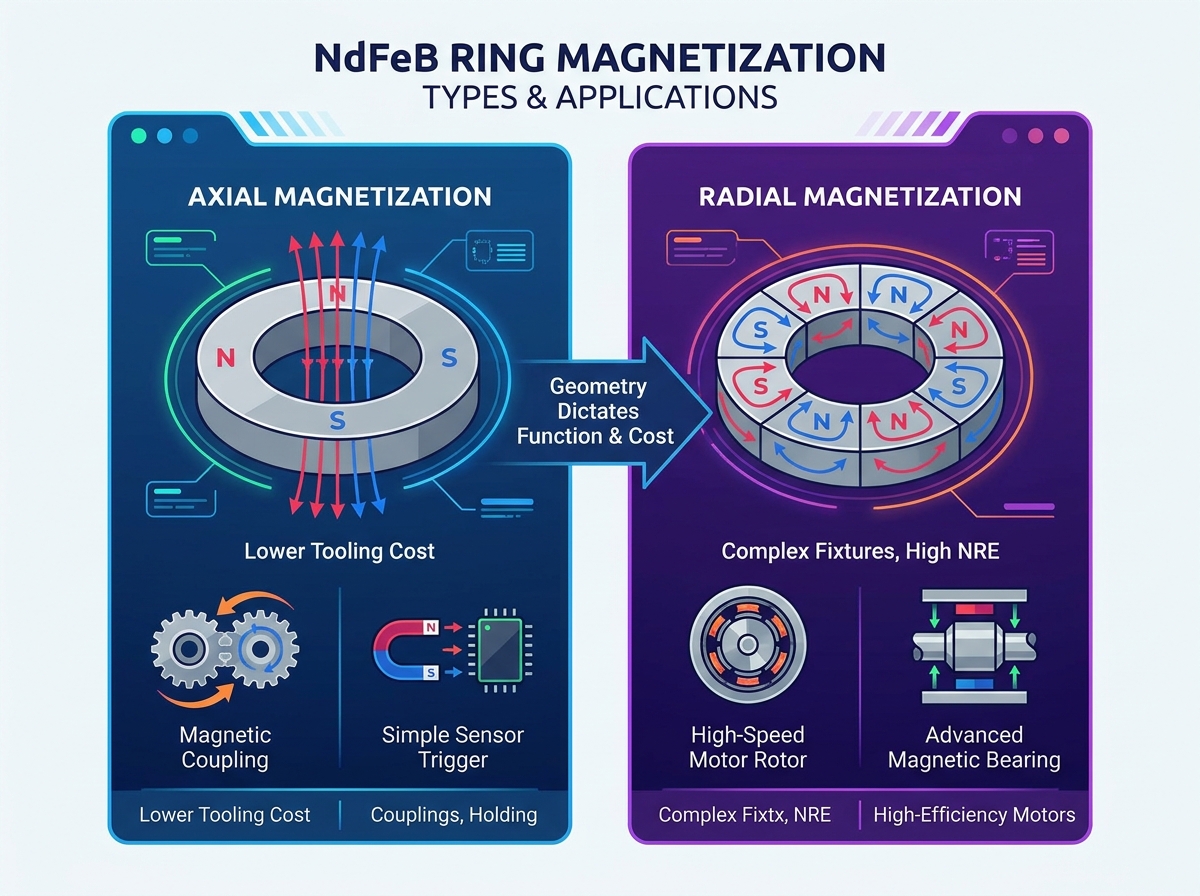
Axial vs. Radial Magnetization: Aligning Geometry with Function
Choosing the correct magnetization direction is critical. It directly dictates both application suitability and manufacturing costs. You generally must choose between two primary orientation methods.
Axial Magnetization (Standard)
Axial magnetization places the magnetic poles on the flat circular faces of the ring. Think of it like a traditional coin. One face acts as North. The opposite face acts as South. This orientation works best for magnetic couplings. It suits simple holding assemblies perfectly. It also triggers basic sensors reliably. The implementation reality here is straightforward. Axial rings feature much lower tooling costs. They allow faster production times. You will find them widely available across standard supplier catalogs.
Radial Magnetization (Advanced)
Radial magnetization is much more complex. The magnetic field runs directly across the diameter. The poles sit on the inner and outer radius. Furthermore, engineers can specify multi-poled configurations. You can place 4, 8, or 12 distinct poles on a single ring. This advanced orientation is best for high-efficiency motor rotors. It also powers advanced magnetic bearing systems. The implementation reality poses a hurdle. It requires custom magnetizing fixtures. These fixtures demand higher upfront Non-Recurring Engineering (NRE) costs. However, radial rings drastically reduce your factory assembly time. They also vastly improve overall motor performance.
Follow these steps to determine your optimal magnetization strategy:
- Analyze your strict spatial constraints and rotor size limits.
- Calculate the required pole count for your specific motor or sensor.
- Compare the upfront custom tooling costs against your projected assembly labor savings.
- Consult your supplier early to confirm their radial magnetization capabilities.
Key Evaluation Dimensions: Mitigating Environmental and Mechanical Risks
NdFeB materials offer immense strength. However, they carry distinct physical vulnerabilities. You must engineer specific mitigations into your product design. Failing to account for heat, moisture, or impact forces will cause system failure.
Thermal Constraints and Grade Selection
Temperature destroys magnetic fields quickly. Standard NdFeB (the N series) degrades rapidly above 80°C. You need a strict decision framework here. Specify high-coercivity grades based on your maximum operating temperature. Look into M, H, SH, UH, or EH grades for hot environments. Acknowledge the inevitable physical trade-off. Higher temperature resistance typically yields slightly lower overall magnetic strength. You must balance remanence against thermal stability carefully.
Corrosion Resistance and Surface Treatments
Neodymium is highly reactive by nature. The material will oxidize and flake rapidly if exposed to moisture. You must match your protective coating to the operating environment.
- Ni-Cu-Ni (Nickel-Copper-Nickel): This remains the industry standard for general mechanical durability.
- Epoxy Coating: This non-metallic option is highly preferred for harsh salt-spray resistance.
- Parylene: Engineers utilize this ultra-thin polymer for medical devices or ultra-clean room environments.
Mechanical Brittleness and Machining Reality
Sintered NdFeB feels incredibly solid. However, its structure is actually ceramic-like. It is highly prone to chipping and cracking upon impact. Your risk mitigation strategy must reflect this brittleness. Workers must press or glue the magnets into assemblies carefully. Never use neodymium as a structural, load-bearing component. Never attempt to thread a neodymium ring. Furthermore, all dimensional machining must occur before the magnetization process. Machining a fully magnetized ring generates excessive heat. It will destroy the coating and ruin the magnetic field.
Sourcing and Shortlisting: How to Evaluate a Magnet Manufacturer
Procurement success requires rigorous supplier evaluation. You cannot treat high-performance magnets as simple commodities. You must look closely at a manufacturer's internal processes and technical capabilities.
Custom Tooling and Prototyping
Evaluate their engineering department first. Does the supplier have in-house capabilities to design custom radial magnetizing fixtures? Can they build and test prototype coils quickly? A supplier lacking internal tooling design will inevitably delay your project launch.
Quality Control and Flux Consistency
Batch-to-batch consistency separates average suppliers from great ones. Look for manufacturers who provide comprehensive testing data proactively. They should supply detailed demagnetization curves. They should share Helmholtz coil testing results. They must offer accurate magnetic field mapping. This data proves they control their raw material mixing and sintering processes tightly.
Tolerance Stacking
Rotating assemblies demand absolute precision. Ring magnets require tight control over physical concentricity. Inner and outer diameter (ID/OD) tolerances must be exact. Poor tolerances cause severe rotor imbalance at high speeds. Verify the supplier's machining precision before placing orders. The industry standard for high-performance rings is typically ±0.05mm. Anything looser may introduce unacceptable vibration into your mechanical system.
Next-Step Actions
Move beyond standard online catalogs immediately. Request a deep technical consultation with their engineering team. Be prepared to review your specific CAD files. Discuss your sustained operating temperatures openly. Share your exact torque requirements. This transparency allows the manufacturer to provide an accurate, custom quote. It prevents costly redesigns later.
Conclusion
NdFeB ring magnets are clearly not off-the-shelf commodities for serious industrial applications. True engineering success requires careful balancing. You must weigh maximum magnetic strength against realistic thermal limits. You must choose the correct magnetization vector to optimize motor efficiency. You also have to apply robust surface coatings to prevent catastrophic oxidation.
We strongly recommend partnering with a qualified manufacturer very early in your design phase. Early collaboration helps you avoid costly over-specification. It also prevents catastrophic demagnetization failures in the field. Experienced suppliers will guide your geometric tolerances and grade selection expertly.
Take action today to secure your design. Submit your detailed application specifications to an engineering team. Request a thorough design review. Ask for a specialized prototype consultation or a custom manufacturing quote. Getting the details right now ensures decades of reliable performance later.
FAQ
Q: Can NdFeB ring magnets be machined or cut to size after purchase?
A: No. Sintered neodymium is highly brittle. Machining post-production will cause chipping, destroy the anti-corrosion coating, and generate heat that can demagnetize the material. All sizing must be done by the manufacturer prior to magnetization and plating.
Q: Why is a radially magnetized ring magnet more expensive than an axially magnetized one?
A: Radial magnetization requires complex, custom-built magnetizing coils specifically designed for the exact dimensions and pole count of your magnet, resulting in higher initial tooling and engineering costs.
Q: What is the maximum operating temperature for a neodymium ring magnet?
A: While standard "N" grades max out at 80°C, specialized high-coercivity grades (like AH or EH) can operate in environments up to 200°C–230°C before suffering irreversible flux loss.
Q: How do I choose between a ring magnet and assembling multiple arc magnets for a motor rotor?
A: Ring magnets offer simpler assembly, better physical integrity at high speeds, and smoother magnetic transitions. However, for very large motors, manufacturing a single massive ring becomes cost-prohibitive, making arc segments the practical choice.