Balancing magnetic strength and compact design against component cost and environmental durability remains a core dilemma for modern engineers. Procurement teams constantly face this challenge when designing new electromechanical assemblies. Both Neodymium and Ferrite materials can form highly precise ring shapes. However, selecting the wrong material often leads to catastrophic product failures in the field. You might see rapid demagnetization at high heat. You might also face unnecessary unit cost inflation if you over-specify a part. You need to get this choice right the first time.
We outline a strictly objective, technical evaluation framework below. It helps you navigate this complex component decision. You will learn how to select the correct ring magnet based on performance metrics, operating environments, and fundamental component costs. You can then confidently specify the right material for your next hardware project.
Key Takeaways
- NdFeB Ring Magnets deliver up to 10x the magnetic pull of Ferrite, making them mandatory for miniaturized, high-performance applications.
- Ferrite (Ceramic) Magnets offer superior corrosion resistance and cost stability, dominating cost-sensitive or high-temperature environments.
- The final decision rarely hinges on strength alone; operating temperature, assembly fragility, and rare-earth supply chain volatility must heavily influence the specification.
Magnetic Strength vs. Footprint: Defining Your Baseline Requirements
Engineers evaluate magnetic materials using two primary metrics. We look at Remanence (Br) and Coercivity (Hcj). Remanence measures the residual magnetic flux density. It dictates how strong the magnetic field will be. Intrinsic Coercivity measures the resistance to external demagnetization. It dictates how stable the field remains.
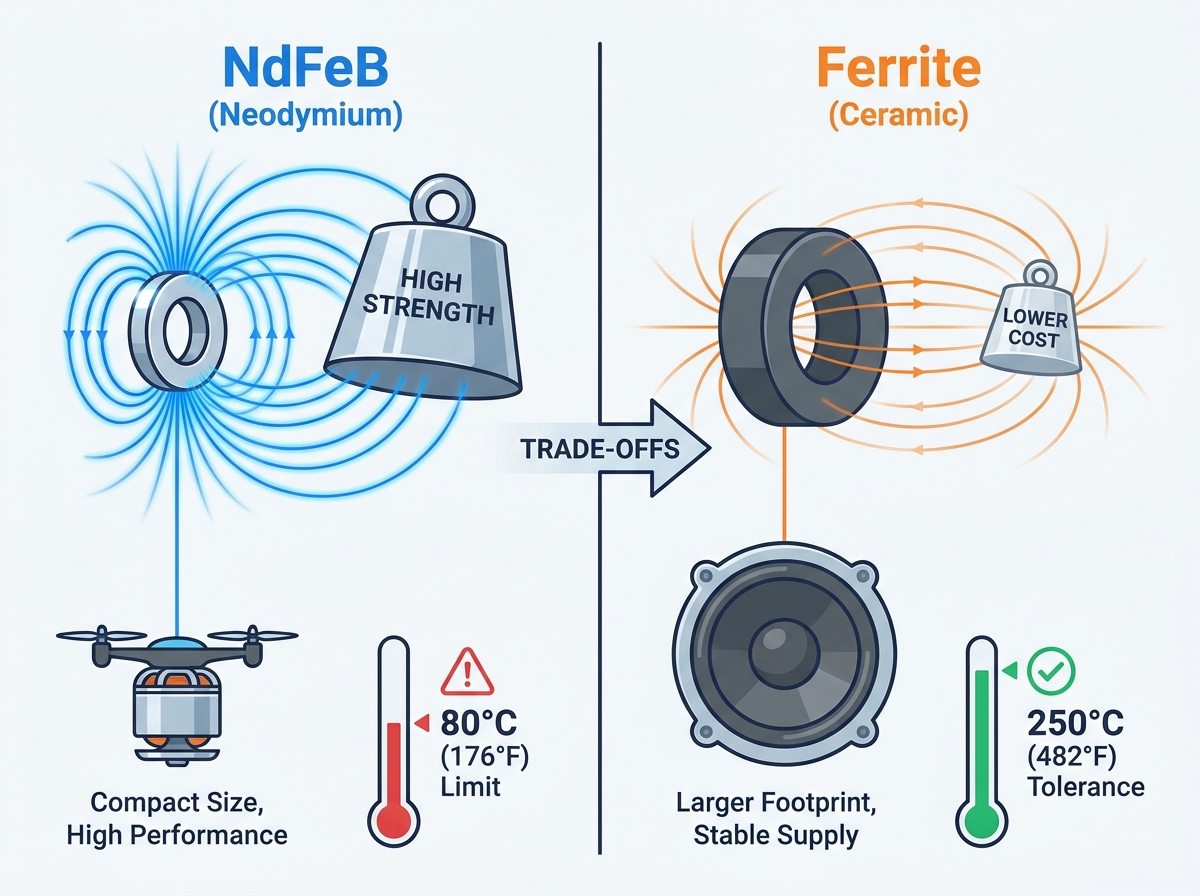
A standard NdFeB Ring Magnet offers a Remanence between 1.0 and 1.4 Tesla. Ferrite typically maxes out around 0.4 Tesla. This stark contrast changes your entire design approach. You can achieve the exact same magnetic field with a drastically smaller Neodymium component. You save massive amounts of volume and weight. This allows for a significantly smaller footprint overall.
We must translate these features into tangible design outcomes. We can look at this from two distinct angles:
- NdFeB Outcome: This material enables extreme product miniaturization. Engineers rely on it for compact drone motors. They use it heavily in wearable technology. You can pack immense power into tight spaces.
- Ferrite Outcome: This material requires larger product housings. The magnet itself is bulkier. However, it significantly reduces bill of materials (BOM) costs. You should choose this where physical space is not a strict constraint.
Implementation reality often surprises junior design teams. You cannot simply swap one material for the other. Swapping a Ferrite ring for an NdFeB Ring Magnet in an existing design causes problems. The vast difference in flux density requires a complete magnetic circuit redesign. The surrounding steel components might saturate. You must recalculate the entire flux path.
Table 1: Magnetic Properties and Operating Limits Comparison
| Performance Metric | NdFeB (Neodymium) | Ferrite (Ceramic) |
| Remanence (Br) | 1.0 - 1.4+ Tesla | 0.2 - 0.4 Tesla |
| Intrinsic Coercivity (Hcj) | High (Highly resistant) | Moderate |
| Standard Max Temp | 80°C (176°F) | 250°C (482°F) |
| Corrosion Resistance | Very Low (Coating Required) | Very High (Naturally Resistant) |
| Relative Component Cost | High | Very Low |
Operating Environment Risks: Temperature and Corrosion
Magnetic strength tells only half the story. The operating environment dictates the actual lifespan of your components. We must look closely at thermal limits, moisture exposure, and physical assembly hazards.
Thermal Tolerance Limits
Heat destroys magnetic fields. We monitor the Curie temperature (Tc) to understand absolute limits. However, the maximum operating temperature is a more practical metric. Ferrite magnets can safely operate up to 250°C (482°F). They suffer minimal permanent loss at these extremes. This makes them ideal for engine compartments.
Standard Neodymium grades degrade rapidly above 80°C. They lose intrinsic coercivity fast. You can specify higher temperature grades. Options like N-SH (up to 150°C) or N-UH (up to 180°C) exist. Unfortunately, these specialized grades increase component costs significantly. You must weigh this expense carefully during the design phase.
Corrosion and Coating Requirements
Neodymium iron boron contains high amounts of iron. It is highly vulnerable to rapid oxidation. A bare Neodymium magnet will literally rust into powder in humid air. This mandates surface treatments. You will typically see Ni-Cu-Ni (Nickel-Copper-Nickel), Zinc, or Epoxy coatings applied. These protective layers add manufacturing complexity. They also introduce potential failure points. If a technician scratches the coating during installation, the magnet will eventually fail.
Ferrite acts entirely differently. It is a ceramic compound. It provides inherently excellent corrosion resistance. You can expose it directly to the elements. It survives outdoors easily. It can even operate while fully submerged in many fluids. It achieves all this without any protective coatings.
Mechanical Fragility
We must also address physical assembly risks. Both materials belong to the ceramic family. They are inherently brittle. You cannot bend or machine them easily. However, their behaviors on the assembly line differ wildly.
The attractive force of an NdFeB Ring Magnet is incredibly high. If two unsecured rings get too close, they will leap together. The violent impact often causes chipping. It can even shatter the components entirely. This increases the risk of part rejection during automated assembly. It also creates dangerous pinch hazards for human workers. Ferrite exerts much lower pull forces. It is far easier and safer to handle during mass production.
Evaluating Industry-Specific Use Cases
Theoretical properties matter. But real-world application determines the ultimate winner. We see clear industry preferences based on these material differences. Let us contrast their roles across three major engineering sectors.
Loudspeakers and Audio Equipment
Acoustic engineering relies heavily on magnetic circuits. We compare the two materials constantly here. Neodymium is absolutely required for high-end, lightweight tweeters. It is also standard for premium car audio systems. Mounting depth is severely limited in car doors. A thin Neodymium ring provides massive sound pressure levels without bulk. Conversely, Ferrite remains the global standard for large subwoofers. Subwoofers usually live in large enclosures. Extra weight is acceptable. Component cost is paramount. Ferrite wins this category easily.
Electric Motors and Generators
The motor industry divides cleanly along performance lines. High-torque, compact servo motors demand Neodymium. Robotics and industrial automation rely on these tiny, powerful drives. The stator and rotor sizes must remain minimal. In contrast, look at standard industrial blowers. Look at legacy automotive wiper motors. These applications have generous space allowances. They run continuously at moderate loads. Manufacturers use Ferrite here to keep consumer prices low.
Sensors and Magnetic Couplings
Precision measurement systems require stable, concentrated magnetic flux lines. The precise, dense field of a Neodymium ring improves sensor accuracy greatly. High-resolution rotary encoders use them to track exact angular positions. Ferrite fields are weaker and broader. They serve perfectly well in low-resolution proximity triggers. If you only need to know whether a door is open or closed, Ferrite does the job cheaply.
Scalability, Cost, and Supply Chain Compliance
Engineering teams must think beyond the prototype stage. You must plan for mass production. This introduces raw material sourcing and global supply chain dynamics into your material selection process.
Raw Material Volatility
Neodymium relies entirely on rare-earth mining operations. This supply chain carries significant inherent risks. The mining and refinement processes are geographically concentrated. They are subject to sudden geopolitical export restrictions. They are also vulnerable to aggressive price spikes. A sudden surge in electric vehicle manufacturing can squeeze the global Neodymium supply overnight. This volatility makes long-term budget forecasting difficult.
Cost at Scale
Ferrite utilizes highly abundant earth materials. It relies primarily on basic iron oxide mixed with strontium or barium carbonate. These raw materials are cheap. They are available almost everywhere globally. This ensures highly stable, predictable pricing models. Procurement teams love Ferrite for mass manufacturing. You can forecast your production costs accurately years in advance.
Regulatory & Compliance Considerations
Global manufacturing faces increasing environmental scrutiny. Sustainability and origin-tracing requirements grow stricter every year. Regulations like RoHS (Restriction of Hazardous Substances) and REACH apply broadly. However, rare-earth sourcing mandates disproportionately affect Neodymium procurement. Buyers must often prove that their rare-earth elements originate from environmentally compliant, non-conflict sources. This adds an administrative burden. Ferrite sidesteps most of these complex origin-tracing headaches.
Shortlisting Framework: Specifying Your Ring Magnet
You now understand the fundamental differences. We can build a practical evaluation process. Follow this objective framework to select the correct component for your specific assembly.
- Step 1: Set Maximum Dimensions. Look strictly at your mechanical CAD drawings. Determine your absolute maximum volume for the magnetic circuit. If space is strictly limited, Neodymium is the default choice. You cannot force a large Ferrite block into a tiny wearable device.
- Step 2: Map the Environment. Analyze your expected operating conditions. Determine the peak ambient temperature. Identify any corrosive fluids or humid conditions. If your device operates above 150°C, pivot away from standard Neodymium immediately. If you cannot provide a sealed, dry housing, pivot to Ferrite. You might also evaluate Samarium Cobalt (SmCo) as an alternative high-temp rare-earth option.
- Step 3: Calculate Upfront and Assembly Costs. Compare the basic unit cost of a coated, high-temperature Neodymium magnet against a standard Ferrite magnet. Do not stop at the purchase price. You must factor in the cost of potential field failures. You must also calculate the expected assembly rejection rates caused by chipping. This gives you a true picture of component profitability.
Next-Step Action: We strongly recommend ordering physical prototypes. Select specific grades of both materials. Test them within your actual stator or product housing. You need empirical data to verify flux leakage. You must run thermal cycling tests to monitor high-temperature degradation firsthand.
Conclusion
Choosing between these two incredible materials requires careful thought. A standard Neodymium ring magnet is the undeniable choice for power-dense, compact designs. It dominates modern miniaturization. It pushes the boundaries of motor torque and acoustic fidelity. However, Ferrite wins decisively on long-term reliability, base component cost, and extreme high-temperature endurance.
We encourage procurement buyers and engineers to collaborate early. You should consult with a dedicated magnetic engineering specialist before finalizing your CAD designs. They can help you verify specific magnetic grades. They will run flux simulation software to ensure your circuit is optimized. Finally, request volume pricing quotes for both materials. This ensures your final decision perfectly balances technical performance with mass-production reality.
FAQ
Q: Can I replace a Ferrite ring magnet with an NdFeB ring magnet of the exact same size?
A: Yes physically, but the magnetic field will be drastically stronger. This massive increase in flux density can potentially saturate nearby sensors. It might also magnetize or damage adjacent steel components. You generally cannot swap materials without performing a complete magnetic circuit redesign.
Q: What is the best coating for an NdFeB ring magnet?
A: It depends entirely on your operating environment. A standard Ni-Cu-Ni (Nickel-Copper-Nickel) triple layer is the industry default for basic indoor protection. However, if your product faces severe moisture or salt-spray, an Epoxy coating is highly preferred for better resistance.
Q: Do Ferrite ring magnets lose their magnetism over time?
A: No, they do not degrade simply from age. They are highly resistant to demagnetization from external fields. They offer incredible stability over decades. However, they can suffer temporary magnetic loss if exposed to extreme cold temperatures, but they recover when warmed.
Q: Are NdFeB ring magnets mechanically stronger than Ferrite?
A: Both materials are ceramics and remain highly brittle. Neodymium is slightly less prone to crumbling at the edges. However, it is far more dangerous during handling. Its massive attractive force creates severe pinch hazards, causing components to slam together and shatter.