Sourcing bulk magnetic materials always demands a careful balance. Procurement teams must hit aggressive cost targets. Simultaneously, they cannot sacrifice strict performance tolerances. Sourcing agents face a difficult landscape today. The base cost of any NdFeB Ring Magnet relies heavily on fluctuating raw commodity markets. However, final unit pricing shifts dramatically based on manufacturing complexity. Specific magnetic grades and surface finishing also play major roles. Buying teams often struggle to isolate these hidden expenses during the quoting process. Navigating these pricing variables requires clear technical insight. This guide breaks down the exact cost drivers you will encounter. We explore structural pricing tiers and machining impacts in detail. You will also learn vital evaluation criteria. These metrics help you secure reliable bulk supplier contracts. By understanding these technical factors, you guarantee high magnetic performance. Furthermore, you will maintain total control over your procurement budget.
Key Takeaways
- Raw material index fluctuations (specifically Neodymium, Praseodymium, and Dysprosium) account for the majority of baseline cost volatility.
- Ring shapes inherently carry higher machining waste and tooling costs compared to standard block or disc magnets.
- Specifying high-temperature grades (e.g., SH, UH, EH) requires heavy rare earth additions, significantly increasing unit prices.
Base Cost Drivers: Raw Materials and Magnetic Grades
The pricing of rare earth oxides dictates base material costs. Neodymium and Praseodymium (NdPr) alloy forms the core element. This commodity market experiences frequent price shifts. Global mining quotas influence supply availability. Demand from the electric vehicle sector also drives prices upward. Because of this volatility, fixed pricing remains rare. Reputable manufacturers track current index rates closely. Bulk contracts often tie pricing directly to these indexes. A floating index clause protects both the buyer and the supplier.
Magnetic strength impacts pricing linearly. Engineers measure this strength using the Maximum Energy Product (MGOe). A standard N35 grade costs significantly less than a high-power N52 grade. Producing N52 requires exceptionally pure NdPr alloys. It also demands advanced pressing environments. Factories must utilize low-oxygen manufacturing techniques. These specialized processes increase overhead expenses. Therefore, you pay a premium for higher energy products.
Heat degrades magnetic performance rapidly. High-temperature environments require specialized magnet grades. Grades like SH, UH, and EH handle extreme heat. However, they carry substantial price premiums. Factories achieve high coercivity by adding heavy rare earths. They introduce Dysprosium (Dy) or Terbium (Tb) into the alloy. These heavy metals cost much more than standard NdPr.
Buyers must strictly audit application thermal requirements. Over-specifying temperature ratings wastes money. If an assembly operates at 70°C, a standard N-grade or M-grade suffices. Requesting an EH grade introduces unnecessary Dysprosium costs. Analyze operational environments carefully before requesting quotes.
Table 1: Impact of Magnetic Grades on Relative Cost
| Grade Series | Max Operating Temp | Heavy Rare Earth Additives | Relative Cost Impact |
| Standard (N) | 80°C | None / Minimal | Baseline |
| High (SH) | 150°C | Moderate Dy | +20% to +30% |
| Ultra High (UH) | 180°C | High Dy / Tb | +40% to +60% |
| Extreme High (EH) | 200°C | Maximum Tb | +70% or higher |
How Machining and Geometry Impact Ring Magnet Pricing
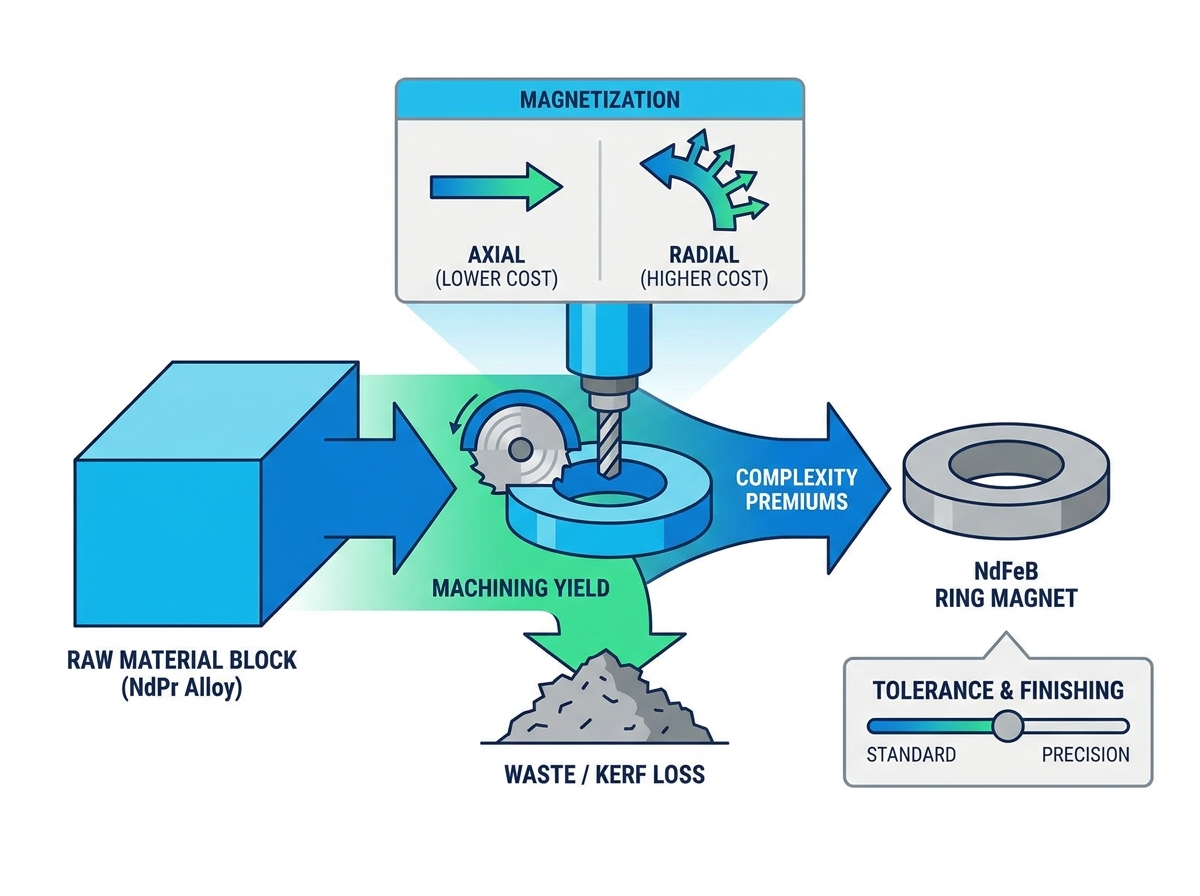
Geometry plays a massive role in unit pricing. An NdFeB Ring Magnet is rarely pressed into its final net shape. Instead, factories typically machine it from a larger sintered cylinder. Sometimes they use a large rectangular block. Boring out the center creates substantial material waste. Engineers refer to this as kerf loss. You inevitably pay for the rare earth material ground away.
Factories utilize distinct machining techniques based on your specifications. Each method impacts your final invoice:
- Slicing and Core Drilling: This represents the standard industry approach. It works perfectly for standard dimensional tolerances. The overall cost remains moderate. Production speed stays relatively high.
- Wire EDM (Electrical Discharge Machining): Certain designs require ultra-thin walls. Others demand extremely tight tolerances. Wire EDM handles these strict requirements. However, EDM cuts metal very slowly. It substantially increases production time. Consequently, it drives up the final unit cost.
The physical proportions of the ring affect production yields. Extreme outside diameter (OD) to inside diameter (ID) ratios cause manufacturing difficulties. Very thin walls fracture easily during the final grinding phase. Breakage disrupts the production line. High breakage risks force suppliers to assume higher scrap rates. They automatically price this anticipated waste into your quote. Engineers should design robust wall thicknesses whenever possible.
Specifications That Inflate Your Quote
How you magnetize the part changes the tooling required. Axial magnetization represents the standard configuration. It keeps manufacturing costs low. Diametrical magnetization requires specialized holding fixtures. It carries a moderate pricing premium. Radial magnetization for a monolithic NdFeB ring magnet is incredibly complex. It requires highly specialized pressing molds. Factories yield far fewer acceptable parts per batch. This makes radial magnetization the absolute most expensive choice.
Dimensional precision directly scales your quote. Standard industry tolerances usually sit at ±0.1mm. Accepting this standard keeps your costs at baseline levels. Specifying precision tolerances triggers extra work. Tolerances of ±0.05mm or tighter demand secondary grinding operations. Extra grinding consumes machine time. It also elevates the chance of operator error and material scrap.
Neodymium corrodes rapidly when exposed to moisture. Therefore, surface treatments are mandatory. Ni-Cu-Ni (Nickel-Copper-Nickel) acts as the industry standard. It provides highly cost-effective corrosion resistance. Specialized coatings fit niche applications. Epoxy suits environments containing harsh chemicals. Zinc provides basic moisture protection for internal assemblies. Parylene offers ultra-thin coverage for medical devices.
You must also factor in the cost of chamfering. Sharp magnet edges chip easily during transit. Chamfering rounds these edges mechanically. This vital step ensures proper coating adhesion. It prevents the plating from flaking off over time.
Bulk Order Economics: Tooling, MOQs, and Lead Times
Custom dimensions rarely match existing factory equipment. Custom OD/ID sizes require dedicated pressing molds. They also require specific cutting fixtures. You must assess how suppliers handle these upfront expenses. Some factories amortize tooling into the final unit price. Others charge a flat Non-Recurring Engineering (NRE) fee. Paying a flat NRE usually benefits long-term bulk buyers. It prevents you from paying hidden tooling premiums on future reorders.
Economies of scale apply heavily to magnet production. Batch processing rules the manufacturing floor. Sintering furnaces operate most efficiently when filled completely. Plating barrels also require minimum load volumes. You will see distinct price breaks based on order quantities. Typical discounts occur at 10,000, 50,000, and 100,000 units. Ordering 50,000 pieces often costs marginally more than ordering 40,000 pieces.
Global logistics impact your final landed cost. Export regulations frequently change regarding rare earth materials. Supply chain disruptions add unpredictable delays to lead times. Domestic stocking capabilities mitigate these risks effectively. Partnering with suppliers holding local inventory stabilizes your production lines. It ensures you receive parts even during global shipping bottlenecks.
Evaluating Supplier Quotes: A Procurement Framework
A trustworthy supplier quote provides complete visibility. Good manufacturers itemize their bids carefully. They separate the raw material baseline from the machining costs. They clearly list coating expenses and setup fees. This transparency allows you to compare bids accurately.
Procurement teams must remain vigilant against unrealistic offers. Warn your team against bids sitting 15-20% below the market average. These low quotes often indicate hidden quality compromises. Unreliable suppliers blend unauthorized recycled materials into the alloy. They apply inadequate, excessively thin plating layers. They also allow relaxed magnetic flux consistency. These shortcuts cause catastrophic failures in your final product.
Proper testing secures your engineering investment. Verify supplier testing protocols before signing contracts. Reliable partners include costs for Automated Optical Inspection (AOI). They perform rigorous flux density testing on every batch. They also supply vital compliance documentation. You should always demand RoHS, REACH, and conflict-free mineral certificates.
Establish a strict procurement process using these next steps:
- Request First-Article Inspection (FAI) samples for engineering approval.
- Audit the FAI dimensional reports against your original drawings.
- Negotiate raw-material index clauses for long-term stability.
- Lock in long-term blanket orders to secure production capacity.
Conclusion
Securing competitive pricing for a bulk NdFeB ring magnet order requires careful alignment. You must balance strict engineering specifications against actual manufacturing realities. Over-engineering your tolerances needlessly drains your budget. Likewise, specifying extreme temperature grades limits your cost efficiency.
Treat the initial RFQ process as a technical audit. Evaluate the supplier's transparency. Assess their yield management strategies thoroughly. Prioritize long-term stability over the absolute lowest initial unit price. A reliable partner delivering consistent quality always saves money in the long run. Follow these guidelines to build a robust, highly optimized magnet supply chain.
FAQ
Q: Why is a radially magnetized NdFeB ring magnet more expensive than an axially magnetized one?
A: Radial magnetization requires highly complex, custom-built magnetizing fixtures. It often demands specialized pressing techniques during early manufacturing stages. These strict requirements drastically reduce overall production yield. They also increase initial setup costs. Axially magnetized parts use standard fixtures, keeping production fast and affordable.
Q: How do raw material index prices affect my long-term contract?
A: Reputable manufacturers typically base long-term contracts on a floating index for rare earth metals. Raw materials like Neodymium and Praseodymium fluctuate frequently. If the cost of NdPr shifts beyond a set percentage, the unit price adjusts accordingly. This index clause protects both parties from sudden commodity market spikes.
Q: Are tooling fees required for standard-sized ring magnets?
A: If your required dimensions match the supplier's existing mold inventory, tooling fees are usually waived. Standard slicing fixtures also eliminate extra setup charges. However, custom inside and outside diameter combinations require new molds. These unique specifications will incur upfront tooling charges.
Q: How can I reduce the cost of my bulk order without losing magnetic strength?
A: Relax dimensional tolerances wherever possible to reduce grinding time. Avoid high-temperature grades like EH or AH if your application operates below 80°C. Finally, design your product for standard axial or diametrical magnetization instead of highly expensive radial configurations. These steps lower costs while maintaining core performance.