Engineers often face a harsh commercial reality when specifying magnetic materials. Defaulting to the strongest commercially available neodymium grade without evaluating environmental constraints often leads to wasted budget or catastrophic product failure. An N52 Magnet represents the pinnacle of standard magnetic power, boasting a Maximum Energy Product of approximately 52 MGOe. Moving from a rough prototype to scaled manufacturing requires precision. You need more than raw power to succeed. This guide provides a strictly technical, evidence-based framework for your evaluation process. We will help you determine if this grade fits your exact application. You will learn how to select the correct specifications, protect the material from degradation, and verify supplier quality before ordering in bulk.
Key Takeaways
- Strength isn't everything: Specifying N52 over N35 or N42 only makes sense when space/weight restrictions demand maximum magnetic output per cubic millimeter.
- Temperature limits dictate viability: Standard N52 degrades rapidly above 80°C (176°F); high-heat applications require specific grade suffixes (e.g., N52M, N52H).
- Corrosion is the enemy: Raw neodymium oxidizes quickly. Selection must factor in precise coating types (Ni-Cu-Ni, Epoxy) based on operating environments.
- Verification is mandatory: Purchasing requires strict QA tolerances, as lower grades are frequently mislabeled as N52 by unverified suppliers.
Problem Framing: Do You Actually Need an N52 Magnet?
You must define clear baseline success criteria early in your design phase. Grade 52 shines exclusively when volume is severely restricted. Aerospace engineers and micro-electronics designers rely heavily on this grade. They need maximum magnetic flux density within tiny spaces. High-performance electric motors also benefit immensely. These applications prioritize exceptional weight-to-power ratios. Standard industrial holding fixtures rarely require such extreme strength. Establish your baseline metrics now. Does your project fail if the assembly weighs ten grams more? If yes, you need the highest grade available.
Cost-to-performance realities matter significantly. Standard N35 or N45 materials cost considerably less. You pay a high premium for top-tier energy products. However, this cost becomes justified under specific conditions. Imagine redesigning a molded plastic housing. You might need to accommodate a larger, weaker block. This tooling change often costs thousands of dollars. Buying a smaller, stronger component saves money overall. The threshold calculation is straightforward. Compare tooling modification costs against the unit price premium over your total production volume.
You must rule out alternatives logically before committing. Samarium Cobalt (SmCo) outperforms neodymium in extreme conditions. SmCo resists corrosion naturally. It also handles temperatures exceeding 250°C without significant losses. Choose SmCo if your product operates inside hot engines. Conversely, high-volume consumer goods often face strict cost limits. Space constraints might be loose. In these cases, lower NdFeB grades easily suffice. Do not over-engineer your magnetic components.
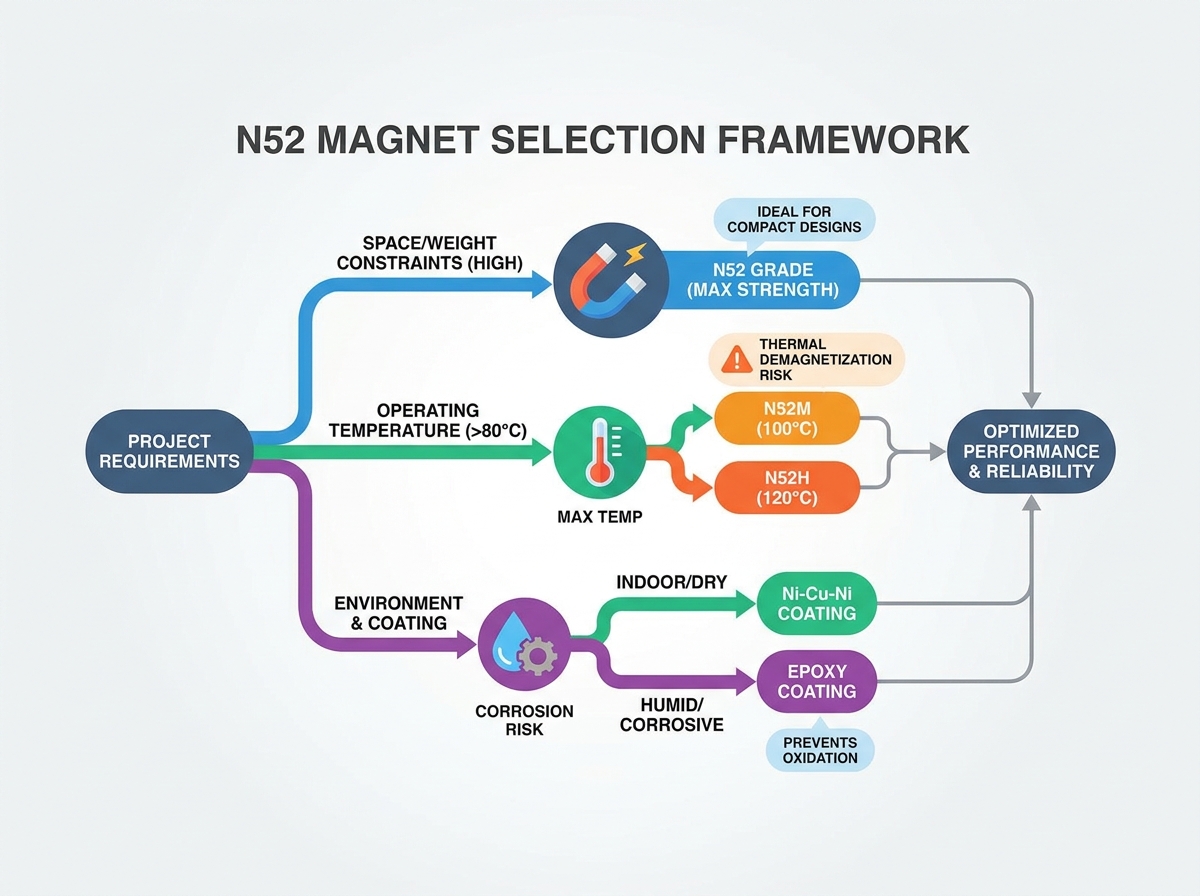
Critical Evaluation Dimensions for N52 Configurations
Operating Temperature and Thermal Demagnetization
Operating temperature strictly dictates your options. Baseline neodymium materials operate safely up to 80°C (176°F). Exceeding this limit causes irreversible demagnetization. Magnetic domains lose their alignment due to thermal agitation. You will not recover this lost strength upon cooling. Only remagnetization fixes it. High-heat environments demand specific grade suffixes. Manufacturers alter the alloy composition. They add heavy rare earth elements like Dysprosium. This increases heat resistance but slightly lowers raw magnetic output availability.
Neodymium Grade Temperature Tolerance Matrix
| Grade Suffix | Maximum Operating Temperature | Typical Application Scenario |
| Standard N52 | 80°C (176°F) | Consumer electronics, indoor fixtures |
| N52M (Medium) | 100°C (212°F) | Industrial machinery, warm environments |
| N52H (High) | 120°C (248°F) | Electric motors, automotive sensors |
Form Factor and Magnetic Circuit Design
Form factor alters the magnetic circuit drastically. Shape dictates how magnetic field lines distribute themselves. Cylinders concentrate flux efficiently at their poles. Blocks serve well in linear arrays or motor stators. Ring shapes accommodate shafts or central sensors. Countersunk variants allow simple mechanical fastening. You must also specify the magnetization direction. Axial magnetization works best for standard holding applications. Diametrical magnetization suits sensor triggering on rotating shafts. Multi-pole configurations optimize holding force on a single face. They require complex manufacturing techniques.
Coatings and Environmental Compliance
Coatings ensure environmental compliance. Raw neodymium oxidizes extremely rapidly. It will literally turn into powder if left exposed. Your operating environment dictates the protective layer.
- Ni-Cu-Ni (Nickel): This standard triple-layer plating proves durable. It works perfectly for indoor mechanical use.
- Epoxy: This coating provides superior moisture resistance. Engineers specify epoxy for humid, corrosive, or marine environments.
- Zinc: Zinc offers a cost-effective barrier. However, it provides lower friction and scratches easily.
- Uncoated: We rarely recommend uncoated materials. You only use them if potting the component in protective resin immediately upon delivery.
Raw Magnets vs. Magnetic Assemblies: Selecting the Right Approach
Raw blocks and discs emit flux in all directions. Magnetic assemblies harness and redirect this wasted energy. A steel cup or pot routes the magnetic field lines. It forces them toward a single active face. This simple trick dramatically increases the effective pull force. A smaller cup assembly easily outperforms a larger raw block. You gain mechanical protection and holding power simultaneously. Assemblies represent a smarter engineering choice for heavy-duty holding tasks.
Mounting strategies require careful consideration. Chemical bonding often proves safer than mechanical fastening. Structural adhesives distribute stress evenly across the surface. Mechanical fastening involves countersunk holes and threaded stems. A countersunk N52 Magnet risks cracking under screw torque. Neodymium is highly brittle. Overtightening a steel screw acts like a wedge. It will shatter the component easily. Always specify precise torque limits if using screws. Use nylon washers to buffer the mechanical load.
Implementation Risks: Handling, Safety, and Verification
Brittleness causes significant manufacturing headaches. These components look like solid metal. They actually behave more like technical ceramics. They chip or shatter upon impact. You must warn your assembly team. Never allow two pieces to snap together freely. Do not attempt post-purchase machining. You cannot drill them without specialized diamond tooling and continuous coolant. Machining also strips the protective plating away. It exposes the raw core to immediate oxidation.
Assembly safety hazards are severe. Large blocks pose extreme pinch hazards. A large piece can crush fingers instantly if it jumps toward a steel workbench. Manufacturing assembly lines need strict safety protocols. Workers should use non-magnetic tools. They must store bulk shipments in isolated, marked areas. We recommend using specialized jigs to guide strong pieces into place safely.
Quality verification prevents counterfeit disasters. Unverified suppliers frequently mislabel lower grades. They sell N42 or N45 disguised as premium material. You must verify incoming batches. Pull-force testing provides reliable mechanical data. You test the sample against standardized, thick steel plates. Gauss meters measure the surface field instead. Surface Gauss readings alone are often misleading. You must know the exact dimensions and testing distance. A smaller premium piece might show the same surface Gauss as a larger weak piece. Always correlate Gauss readings with a validated reference sample.
Shortlisting Logic: How to Vet an N52 Supplier
Vetting suppliers guarantees long-term success. Tolerance standards reveal manufacturing maturity. Standard dimensional tolerances hover around ±0.05mm. Tighter tolerances are possible. They will cost a significant premium. You should only request tighter tolerances if precision press-fits are strictly necessary for your assembly.
Batch consistency separates premium manufacturers from cheap vendors. Ask prospective manufacturers about their variance. How much do Remanence (Br) and Coercivity (Hcb) fluctuate between production runs? Reliable suppliers provide detailed hysteresis graphs for every batch. They prove their material remains consistent over time. You cannot afford field strength dropping 5% on your third order. Consistent coercivity ensures your product performs identically years down the line.
Certifications ensure a traceable supply chain. Always check for RoHS and REACH compliance. These certifications verify the absence of hazardous substances. ISO 9001 manufacturing standards are equally crucial. They indicate robust quality management systems. A certified supplier tracks raw material origins meticulously. They quarantine defective batches before shipment. You protect your brand reputation by insisting on documented compliance.
Conclusion
Choosing the right magnetic component requires a systematic approach. You must match the grade to your thermal limits first. Optimize the shape to maximize your magnetic circuit efficiency. Protect the material with the right coating for your environment. Do not default to the strongest grade unless space constraints demand it. A well-designed assembly often outperforms a larger raw block.
Take action before committing to bulk orders. Request a sample batch for internal pull-testing. Consult with a magnetic engineer to explore custom assemblies. Validating your design early prevents costly manufacturing failures later. Secure a reliable supplier, verify their tolerances, and build your product with confidence.
FAQ
Q: Why is my N52 magnet's pull force lower than the manufacturer's rating?
A: Advertised pull force is tested under ideal conditions. Manufacturers use thick, flat, unpainted steel plates. Real-world applications rarely match this. Air gaps, thin metal, paint, and lateral sliding forces drastically reduce holding power. Even a millimeter of space drops the pull force significantly.
Q: Can I cut or drill an N52 magnet to fit my prototype?
A: No, you should never machine these components. Machining destroys the protective coating. It causes sparking and severe fire hazards due to highly reactive neodymium dust. Furthermore, the heat buildup from drilling will permanently demagnetize the material.
Q: What is the difference between N52 and N52SH?
A: The difference lies in temperature thresholds. The "SH" designates Super High temperature tolerance. Standard grades degrade at 80°C. SH grades operate safely up to 150°C. Manufacturers achieve this by doping the alloy with heavy rare earth elements.
Q: How long will an N52 magnet hold its charge?
A: Permanent magnets lose a negligible amount of strength over time. You can expect less than a 1% loss per decade. They only lose charge if exposed to excessive heat, strong reverse magnetic fields, or severe physical trauma.