Modern industries face an unrelenting demand for maximum magnetic energy packed into minimal volumes. This demand positions the N52 Magnet as the absolute apex of commercially available neodymium grades. We see engineers pushing physical boundaries daily to achieve exceptional performance. You often face a core engineering challenge during product development. You must balance the need for extreme holding force or extreme miniaturization against strict budget constraints, thermal limits, and material brittleness. Solving this specific puzzle dictates the success or failure of a mechanical design.
This guide gives you a skeptical, evidence-based evaluation framework. You will discover exactly how to determine if the N52 grade fits your specific operational requirements. We will explore whether it represents the appropriate specification for your next manufacturing or engineering project.
Key Takeaways
- N52 represents the highest practical tier of neodymium magnets (52 MGOe), offering roughly 50% more magnetic strength than the standard N35 grade.
- The primary ROI of N52 lies in miniaturization: achieving the required magnetic field or pull force with a significantly smaller and lighter footprint.
- N52 magnets come with strict implementation trade-offs, notably low maximum operating temperatures (typically 80°C/176°F) and high physical brittleness.
- Procurement requires rigorous quality assurance; verifying true N52 performance requires hysteresis graph testing to avoid substandard substitutions.
The Physics of N52: Decoding the 52 MGOe Standard
Understanding magnetic terminology prevents costly over-specification. The designation "N52" denotes a Maximum Energy Product ($BH_{max}$) of 52 Megagauss-Oersteds (MGOe). This specific metric represents the peak magnetic energy density stored within the material. A higher number indicates a stronger magnetic field generated per unit of volume. You can think of it as the horsepower rating for permanent magnets.
Performance Metrics
We must break down the fundamental magnetic characteristics without over-promising capabilities. Two primary metrics define how a N52 Magnet performs in the real world.
- Residual Flux Density (Br): This measures the magnetic field strength remaining in the material after magnetization. N52 boasts exceptionally high Br values. This makes it highly suitable for high-torque applications.
- Coercive Force (Hc): This metric defines the material resistance to demagnetization under normal conditions. It tells you how well the magnet holds its charge when exposed to external opposing fields.
Evidence-Oriented Reality Check
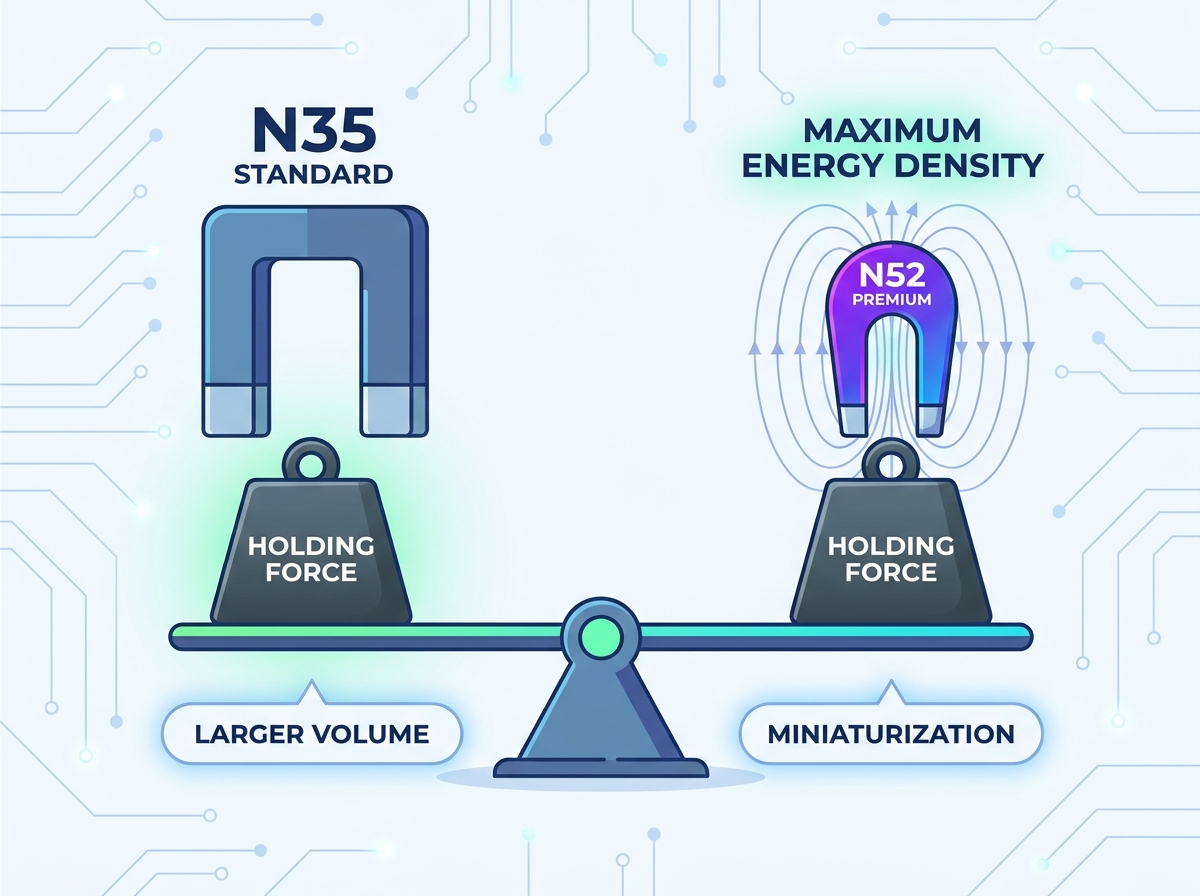
Many buyers falsely assume highest grade equals highest universal strength. We must clarify this misconception. While N52 is indeed the strongest material grade, actual "pull force" depends equally on the magnet volume, shape, and the mating material. It does not rely just on the grade itself. A massive N35 block will easily out-pull a tiny N52 disc. You must calculate the entire magnetic circuit to predict real-world strength accurately.
N52 vs. N35: A Cost-to-Performance Evaluation
Engineers often default to N35 because it serves as the universal industry standard. However, contrasting N52 directly against N35 provides a clear decision framework for your engineering team. This baseline comparison reveals exactly when the premium grade justifies its selection.
Magnet Grade Comparison: N35 vs. N52
| Specification | Standard N35 | High-Performance N52 | Primary Engineering Benefit |
| Maximum Energy Product ($BH_{max}$) | 33 - 35 MGOe | 49.5 - 52 MGOe | ~50% higher energy density in N52 |
| Residual Flux Density (Br) | 11,700 - 12,100 Gauss | 14,300 - 14,800 Gauss | Higher field strength for motors |
| Relative Unit Cost | Baseline (1x) | Premium (1.5x - 2x) | Cost savings favoring N35 |
| Optimal Application | Large, static assemblies | Micro-assemblies, aerospace | Dictates initial design direction |
Features-to-Outcomes
Upgrading to N52 allows engineers to reduce magnet mass by up to 30-40% while maintaining the exact same pull force. This volume and weight reduction drastically alters product design. You can design smaller motor housings. You can shrink sensor enclosures. You reduce the overall shipping weight of the final assembly.
We must transparently address the premium cost of N52. It costs significantly more than lower grades due to higher raw material purity requirements. It is only cost-effective when space and weight savings directly translate to higher product value. If your product has plenty of internal space, buying the premium grade wastes budget.
Shortlisting Logic
Provide your team a simple heuristic. Choose N35 for static, high-volume, space-abundant applications. Specify an N52 Magnet only when dimensional constraints are uncompromising. If you cannot fit a larger magnet into the CAD model, N52 becomes your mandatory solution.
Prime Industrial Applications Justifying the N52 Premium
Certain industries naturally align with the high-performance profile of premium neodymium. When you design for these sectors, the initial material premium pays immediate dividends in system performance.
Aerospace & Defense
Weight reduction remains critical in aerospace engineering. Every extra gram increases fuel consumption or launch costs. N52 provides maximum holding power and sensor power per gram. Drone manufacturers rely on them to shrink payload weights. Satellite designers use them to minimize orbital deployment mass.
High-Performance Motors & Generators
Electric vehicle manufacturers constantly seek better efficiency. We see N52 improving the torque-to-weight ratio in precision servos, drones, and electric vehicles. By using a stronger magnetic field, engineers can design smaller rotors. Smaller rotors reduce inertia. This allows faster acceleration and more responsive motor control systems.
Medical Devices
Medical hardware demands extreme miniaturization. We frame the need for these magnets in MRI components, pacemakers, and surgical tools where space is at an absolute premium. Surgeons require lightweight, balanced tools to prevent fatigue. Implantable devices must remain as small as physically possible to reduce patient trauma.
Magnetic Separators
Industrial processing facilities face strict purity standards. We highlight use cases in food processing and mining where maximum flux density is required. Magnetic grates must catch microscopic ferrous contaminants from fast-flowing powders or liquids. Standard grades often miss fine stainless steel dust. N52 generates the intense surface field needed to pull these tiny particles out of the product stream.
Implementation Risks: Shape, Size, and Thermal Limitations
You cannot specify maximum strength without accepting certain engineering compromises. Implementing an N52 Magnet introduces specific operational risks. You must mitigate these risks during the early design phases.
Thermal Constraints
Standard N52 possesses a severe Achilles' heel. It has a Maximum Operating Temperature of just 80°C (176°F). Exceeding this threshold causes irreversible demagnetization. If your motor runs hot, the magnet loses its strength permanently. You must engineer robust cooling systems or avoid N52 entirely for high-heat applications.
Material Brittleness & Machining
Higher energy products often correlate directly with increased physical fragility. Neodymium acts more like a ceramic than a metal. It shatters upon heavy impact.
- Avoid extremely thin profiles: Ratios of diameter to thickness exceeding 10:1 break easily.
- Eliminate sharp internal corners: These create severe stress risers during assembly.
- Control assembly impacts: Magnets snapping together from a distance will crack instantly.
These design limitations increase cracking rates during assembly if ignored. Workers must handle them carefully to prevent chip-outs and structural failures.
Corrosion Vulnerability
Neodymium rusts rapidly due to its high iron content. You must evaluate necessary coatings based on the operational environment. Humidity and chemical exposure dictate the surface protection required.
- Ni-Cu-Ni (Nickel): The standard triple-layer coating. Excellent for general indoor use.
- Epoxy: Superior salt spray resistance. Highly recommended for marine or outdoor exposure.
- Zinc: A low-cost alternative for environments requiring standard protection without heavy wear.
How to Source and Specify N52 Magnets for Production
Procurement departments face significant challenges when buying rare earth materials. The global market contains numerous bad actors. You must implement strict quality control standards before issuing a high-volume purchase order.
Avoiding Counterfeits
We warn buyers regularly about market deception. Many cheap "N52" magnets on the market are actually N48 or N50. Because the strength difference feels minimal to the bare hand, suppliers easily pass off lower grades. You will only notice the failure when your product underperforms in field testing.
Supplier Compliance & QA
You must outline specific documentation requirements. Demand these exact reports from manufacturers to ensure compliance:
- B-H Curve Reports: The demagnetization curve proves the actual magnetic properties of the batch.
- Salt Spray Test Results: This validates the integrity and thickness of the protective coatings.
- Dimensional Tolerance Guarantees: Request ±0.002" tolerances for precision mechanical needs. Standard ±0.004" may cause press-fit failures.
Next-Step Actions
Never rush into mass production based solely on a supplier specification sheet. We highly recommend ordering small batch prototypes first. Use these for empirical testing in the actual housing and assembly. Verify the pull force, check the glue adhesion, and measure the operating temperatures yourself before committing to a high-volume PO.
Conclusion
An N52 magnet operates as a highly specialized, high-performance component. It is definitively not a universal upgrade for every mechanical application. You achieve the best results when utilizing its extreme energy density to solve strict miniaturization and weight problems. However, you must carefully manage its thermal fragility and physical brittleness.
We encourage engineers to consult closely with a magnetics specialist early in the design phase. Review your CAD files, calculate thermal requirements, and assess coating needs together. Taking these proactive steps before finalizing your bill of materials guarantees a successful, cost-effective product launch.
FAQ
Q: Is an N52 magnet the strongest magnet in the world?
A: Yes, in terms of commercially available permanent magnets. While N55 exists theoretically and in limited laboratory settings, N52 remains the strongest practical grade for reliable mass manufacturing and industrial applications.
Q: How much weight can a standard N52 magnet hold?
A: It depends entirely on the magnet dimensions, the thickness of the steel it attracts, and the direction of the pull. Direct pull holds much more weight than shear pull. You must calculate pull force using specific application geometry rather than relying on a flat number.
Q: Can N52 magnets be used in high-temperature environments?
A: No. Standard N52 degrades permanently above 80°C (176°F). For higher temperatures, you must specify lower grades with high-temperature suffixes, such as N42SH or N38UH, which handle extreme heat without irreversible flux loss.
Q: Why are N52 magnets more expensive?
A: They require a significantly higher purity of rare earth elements, specifically Neodymium, Iron, and Boron. Furthermore, manufacturers must maintain much tighter environmental and thermal controls during the specialized sintering and magnetization processes.