Engineers and procurement teams face a constant dilemma. They must balance the demand for intense magnetic performance against strict budget limits and manufacturing scale. The N35 Magnet serves as the baseline commercial grade of Neodymium-Iron-Boron (NdFeB) magnets. It offers the lowest maximum energy product in the standard NdFeB family. Yet, it remains vastly stronger than traditional ceramic or alnico alternatives. You do not always need the absolute highest grade available to achieve superior product performance. This article provides a pragmatic, evidence-based framework. We will help you evaluate whether an N35 specification fits your specific application. You will learn how to assess thermal constraints, spatial requirements, and environmental risks before deciding if a higher, more expensive grade is truly necessary.
Key Takeaways
- Performance Baseline: N35 represents a Maximum Energy Product of 35 MGOe, offering a highly cost-effective magnetic field for non-extreme applications.
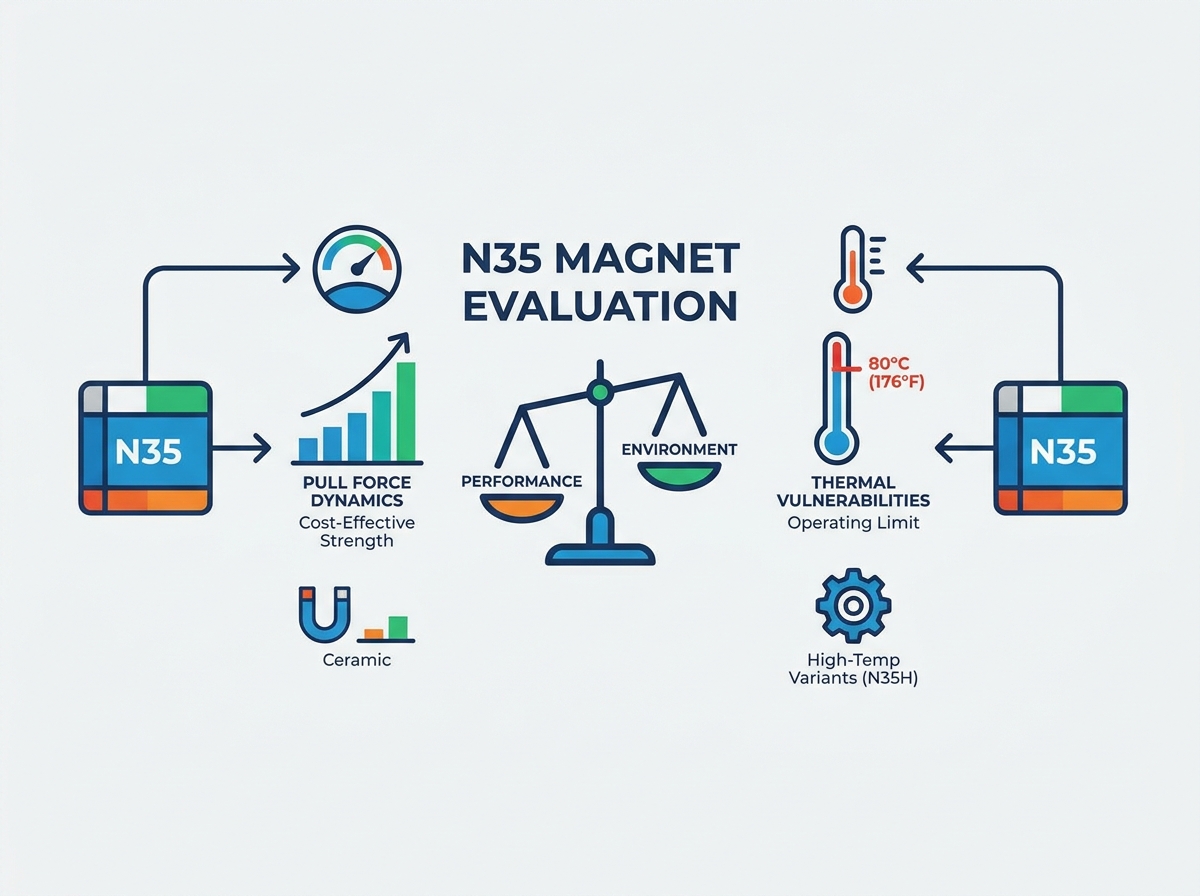
- Thermal Constraints: Standard N35 magnets degrade permanently at temperatures exceeding 80°C (176°F) unless a specialized high-temp variant (e.g., N35H, N35SH) is specified.
- Cost vs. Yield: For bulk manufacturing, N35 provides the best strength-to-cost ratio, provided the product design allows for slightly larger magnet volumes compared to using N52 grades.
- Corrosion Risks: Like all NdFeB magnets, N35 requires robust surface plating (typically Ni-Cu-Ni) to prevent rapid oxidation in humid environments.
Defining N35 Magnet Strength in Practical Terms
Engineers often over-spec magnet grades during the initial design phase. This habit drives up Bill of Materials (BOM) costs unnecessarily. Understanding exact strength capabilities prevents this financial drain and ensures efficient resource allocation.
The "35" Explained (MGOe)
The "35" in the name represents 35 Mega-Gauss Oersteds (MGOe). This metric indicates the maximum energy product of the material. It dictates the overall magnetic flux density and the maximum pull force you can achieve. To put this into perspective, the energy product measures how much magnetic energy is stored within a specific volume of the material. A rating of 35 MGOe provides a robust, reliable magnetic field suitable for the vast majority of commercial applications.
N35 vs. Ceramic/Ferrite
When we compare it against ceramic or ferrite magnets, the leap in power becomes obvious. Standard ceramic magnets typically offer an energy product of just 3 to 4 MGOe. You will typically find neodymium variants 5 to 10 times stronger by volume than standard ceramic magnets. This immense power density allows engineers to shrink product housings. You can replace a bulky ceramic block with a tiny neodymium disc while maintaining or exceeding the original holding power.
Volume-to-Strength Ratio
Consider the volume-to-strength ratio closely. An N35 Magnet can often achieve the exact same pull force as an N52 magnet. You simply need a product design accommodating a slightly larger physical footprint. Adding a few millimeters to the diameter or thickness bridges the performance gap perfectly. If your product enclosure has empty space, filling it with a larger baseline magnet costs significantly less than buying a smaller, premium-grade N52 magnet.
Core Evaluation Dimensions: Performance vs. Environment
Laboratory ratings rarely translate directly to field performance. You must evaluate specific environmental factors to predict how the magnet will behave in the real world.
Pull Force Dynamics
Several variables heavily impact real-world magnetic strength. The distance between the magnet and the mating surface creates an air gap. Magnetic force drops off exponentially as the air gap increases. Even a single millimeter of plastic housing, adhesive, or paint drastically reduces holding power.
Furthermore, the steel thickness of the mating surface matters. Thin sheet metal saturates quickly. If the steel is too thin, it cannot contain the full magnetic flux, and excess magnetic energy passes right through the metal, wasting potential holding power. Finally, assess sheer versus direct pull. Sliding a magnet sideways (sheer force) requires much less effort than pulling it straight off a surface. If your application mounts vertically, you must account for this sheer force reduction.
Thermal Vulnerabilities
Heat acts as the primary enemy of neodymium. Standard grades feature a strict 80°C (176°F) operational limit. Pushing the material past this ceiling causes reversible demagnetization at first. If the temperature cools, the magnet recovers. However, if temperatures climb even higher, the structural magnetic domains shift permanently. This causes irreversible demagnetization. You will permanently lose field strength, and the magnet will never recover its original 35 MGOe rating.
High-Temperature N35 Variants
To combat heat, manufacturers created high-temperature variants. You can specify N35M, N35H, or N35SH for demanding environments. These variants introduce higher coercivity. Coercivity measures the material's inherent resistance to demagnetization under thermal stress or opposing magnetic fields.
N35 Operating Temperature Variants
| Grade Designation | Maximum Operating Temperature | Primary Application Environment |
| Standard N35 | 80°C (176°F) | Room temperature consumer goods, packaging |
| N35M (Medium) | 100°C (212°F) | Enclosed electronics running warm |
| N35H (High) | 120°C (248°F) | Industrial machinery, automotive cabins |
| N35SH (Super High) | 150°C (302°F) | Low-RPM motors, engine bay sensors |
Application Suitability: Where N35 Excels (and Fails)
Different industries extract value from baseline neodymium differently. Understanding these categories helps you make smarter sourcing choices and prevents catastrophic product failures.
Ideal Solution Categories (High ROI)
These applications perfectly match the performance profile of baseline grades. They offer the highest return on investment by keeping component costs low.
- Consumer electronics packaging and magnetic closures: Tablet covers, premium presentation boxes, and smartphone car mounts do not require extreme holding forces. A baseline grade provides the perfect tactile "snap" without making the product too difficult to open.
- Standard point-of-purchase (POP) displays and signage: Retail displays need reliable hold but face no thermal stress. They operate in climate-controlled stores.
- Basic sensors and switches: Reed switches operating at room temperature perform flawlessly here. The magnetic field is more than sufficient to trigger internal mechanisms.
- Cabinetry and architectural hardware: Hidden cabinet catches rely on total magnet volume rather than maximum flux density. Designers easily hide slightly larger magnets inside wooden door frames.
High-Risk Use Cases (Where to Avoid N35)
Certain environments guarantee premature failure for baseline grades. You must avoid using them in these specific scenarios:
- High-RPM electric motors: Rapid spinning generates significant eddy current heat. This heat quickly exceeds the 80°C threshold, leading to permanent demagnetization and motor failure.
- Micro-electronics: Smartwatches, hearing aids, and tiny medical devices impose severe spatial constraints. You must extract maximum flux density from microscopic volumes, strictly requiring premium N48-N52 grades.
- Heavy-duty industrial lifting: Cranes and magnetic chucks require extreme safety margins to protect human life. Baseline grades simply cannot provide the necessary fail-safes for hoisting multi-ton steel plates.
Implementation Risks: Sourcing, Tolerances, and Longevity
Specifying the right grade covers only half the battle. You must actively manage physical handling protocols and navigate supply chain variables to ensure a successful product launch.
Material Brittleness
Address material brittleness immediately. Sintered neodymium acts more like a delicate ceramic coffee mug than a solid piece of steel. It is physically fragile. Automated assembly lines pose severe handling risks. Two strong magnets snapping together violently across a workbench will likely chip, crack, or shatter entirely. You must design assembly jigs that control the attraction speed, preventing violent impacts during production.
Corrosion & Compliance
Corrosion presents another massive hurdle. The iron content within the NdFeB alloy oxidizes rapidly when exposed to humidity. Proper surface coatings remain non-negotiable. Standard industry practice dictates a three-layer Nickel-Copper-Nickel (Ni-Cu-Ni) plating. The soft copper layer acts as a shock absorber between the two hard nickel layers.
Some specialized applications might require Zinc or heavy-duty Epoxy coatings instead, especially in marine environments. Always verify compliance considerations. Select plating providers strictly adhering to RoHS (Restriction of Hazardous Substances) and REACH environmental regulations to ensure your products can clear international customs.
Supply Chain Scalability
Evaluate supply chain scalability carefully. Raw materials for baseline neodymium are highly abundant globally. Producing higher grades requires expensive, scarce heavy rare earth elements like Dysprosium and Terbium. Because baseline materials remain plentiful, you enjoy much more stable pricing. You will also experience shorter, more predictable lead times during large-scale production runs, protecting your manufacturing schedule from sudden geopolitical supply shocks.
Decision Framework: Should You Spec an N35 Magnet?
We developed a sequential evaluation checklist. Buyers and engineers can use this logic to shortlist their materials effectively without getting lost in spec sheets.
Shortlisting Logic
- Is the operating environment strictly below 80°C? Monitor the ambient temperature and any heat generated by nearby electronics. If temperatures exceed this limit, you must upgrade to high-coercivity variants.
- Do physical space constraints allow for an N35 footprint? Check your CAD models. If your housing can accommodate an extra millimeter or two of material, you can hit the required gauss or pull force without purchasing expensive N52 magnets.
- Is the application shielded from severe impact and moisture? If your product faces outdoor weather, saltwater, or repeated physical strikes, you must redesign the housing to seal the magnet completely or select specialized thick epoxy coatings.
Next-Step Actions
Never finalize a mass-production order based solely on software simulations. We strongly recommend physical prototyping. Request samples of both baseline grades and a mid-tier grade like N42. Run comprehensive A/B bench testing in the actual product housing. Use a digital force gauge to measure the exact breakaway pull force. This hands-on approach guarantees optimal performance and perfect budget alignment.
Magnetic Grade Comparison Chart
| Material Grade | Average MGOe | Relative Cost | Best Use Case |
| Ceramic (Ferrite) | 3 - 4 | Very Low | Large speakers, fridge magnets |
| N35 (Baseline NdFeB) | 35 | Moderate | Consumer electronics, hardware, POP displays |
| N42 (Mid-Tier NdFeB) | 42 | High | Moderate space constraints, premium goods |
| N52 (Premium NdFeB) | 52 | Very High | Micro-electronics, extreme miniaturization |
Conclusion
We must discard the notion that an N35 rating implies weakness. It confidently stands as the baseline of the world's strongest class of permanent magnets. It delivers tremendous holding power for everyday applications, outperforming older technologies by massive margins.
Smart procurement involves matching the exact grade to the application's true threshold. Defaulting to the highest available number simply wastes your budget. By evaluating temperature limits, air gaps, and spatial allowances, you unlock massive manufacturing efficiencies. A slightly larger N35 Magnet often performs identical to a smaller, cost-prohibitive premium grade.
Take the next step today. Consult directly with a magnetics engineer or supplier. Validate your pull force calculations and request a batch of test samples. Hands-on testing remains the ultimate proof of concept, ensuring your final product achieves the perfect balance of strength and scalability.
FAQ
Q: Is an N35 magnet strong enough for consumer products?
A: Yes, it is the industry standard for closures, mounts, and everyday electronics. Its 35 MGOe energy product provides a powerful, tactile snap that easily secures tablet covers, premium packaging, and cabinetry hardware without driving up production costs.
Q: What is the practical strength difference between N35 and N52?
A: N52 is roughly 45-50% stronger by volume, but costs significantly more. If your product enclosure has strict spatial limitations, N52 is required. However, N35 easily matches N52's total pull force if you use a slightly larger physical magnet.
Q: How much weight can an N35 neodymium magnet hold?
A: Weight capacity depends entirely on the magnet's size, shape, and the mating surface, not just the "N35" designation. A massive N35 block can lift hundreds of pounds, while a tiny N35 disc might hold just a few ounces. Steel thickness and air gaps also dictate holding capacity.
Q: Does an N35 magnet lose its strength over time?
A: Barring extreme heat over 80°C, physical damage, corrosion, or severe opposing magnetic fields, N35 retains its magnetism indefinitely. The natural degradation rate is a fraction of a percent every century, meaning it effectively lasts forever in normal conditions.