Procurement teams face a constant challenge in today's demanding market. They must carefully balance strict magnetic performance requirements against unit cost and supply chain reliability. Finding the perfect neodymium material takes thorough evaluation and extensive planning. Often, engineers over-specify their materials out of caution. Defaulting to an N52 grade severely inflates manufacturing costs over time. On the flip side, under-specifying your components leads to mechanical failures and highly damaging product recalls. You desperately need a reliable baseline. This guide provides an evidence-based framework for evaluating your core design parameters. It will actively help you determine whether the N35 Magnet is the optimal starting point for your specific industrial application. We outline crucial technical trade-offs, identify daily operating risks, and detail strict supplier verification methods. By following these foundational principles, you will engineer better physical products while successfully avoiding unnecessary premium raw material expenses.
Key Takeaways
- Cost-to-Performance Baseline: N35 offers the most cost-effective magnetic energy (approx. 35 MGOe) for standard industrial applications where size and weight are not severely constrained.
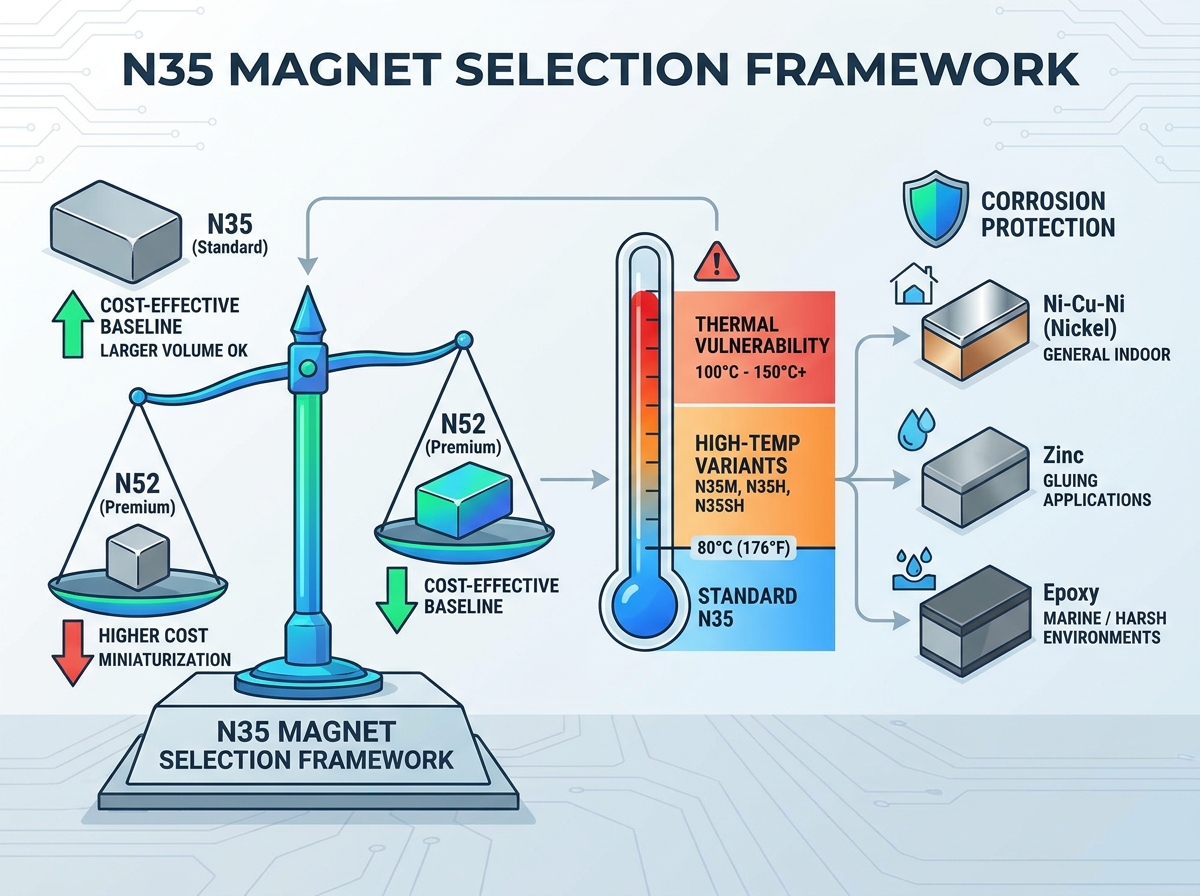
- Thermal Vulnerability: Standard N35 degrades at temperatures above 80°C (176°F); high-temperature variants (N35M, N35H, N35SH) are strictly required for demanding thermal environments.
- Coating is Critical: Because NdFeB material is highly susceptible to corrosion, selecting the right surface treatment (Ni-Cu-Ni, Zinc, Epoxy) is as important as the magnetic grade.
- Verification is Mandatory: Mitigate supply chain risks by requiring hysteresis graphs and batch-testing documentation to ensure you are receiving true N35 performance, not downgraded material.
Defining the N35 Magnet Baseline for Industrial Applications
Selecting the right magnetic grade requires a fundamental understanding of energy metrics. The most critical measurement for any neodymium block, disc, or ring is its Maximum Energy Product (BHmax). This specific value dictates the overall magnetic density of the material.
The "35" Metric Explained
When you see the number "35," it directly corresponds to a BHmax yielding approximately 33 to 35 MegaGauss-Oersteds (MGOe). This specific energy density forms the absolute bedrock of modern commercial magnetic applications. It provides a robust, predictable magnetic field. It does so without requiring the expensive heavy rare earth element doping necessary for higher grades like N50 or N52.
Primary Industrial Use Cases
Because it offers such an excellent balance of raw strength and affordability, engineers deploy this baseline grade across countless industries. You will frequently find it utilized in the following primary applications:
- Magnetic Separators: Processing facilities use large arrays to extract ferrous contaminants from bulk grain, plastics, and liquid food lines.
- Standard DC Motors: Mid-tier consumer appliances and industrial blowers rely on them to maintain consistent torque without overheating.
- Sensor Triggers: Automated manufacturing lines use them as dependable proximity triggers for Hall-effect sensors.
- Heavy-Duty Packaging: High-end retail enclosures and reusable transit cases depend on them for secure, repeatable closures.
- Acoustic Equipment: Commercial speakers and public address systems utilize them to drive heavy voice coils efficiently.
Business Problem Framing
Why should you always start your design process at this baseline? The answer lies in strict production scalability. Standardizing on the lowest viable grade actively stabilizes high-volume production costs. Premium grades suffer from extreme price volatility. They rely heavily on scarce elements like Dysprosium to achieve their high performance. By engineering your product to accept a baseline N35 Magnet, you shield your procurement budget from wild commodity market swings.
Evaluating Performance: When N35 is Sufficient vs. When to Upgrade
Many novice designers mistakenly believe they must purchase the strongest magnet available. This is a costly misconception. Magnetic strength does not rely on grade alone. It relies heavily on the physical volume and shape of the component.
Force vs. Volume Trade-offs
Magnetic pull force correlates directly with magnet volume. If your physical application footprint allows for a slightly thicker or wider magnet, you hold a massive design advantage. You can achieve the exact same pull force as a smaller N52 component simply by increasing the physical dimensions of your baseline component. For example, adding just a few millimeters to the diameter of a disc can offset the need for a premium grade entirely. You achieve your mechanical holding requirement at a mere fraction of the unit cost.
N35 vs. N42 and N52 (Decision Matrix)
Knowing when to stick with the baseline and when to invest in an upgrade requires careful environmental analysis. Use the matrix below to guide your engineering choices.
Magnetic Grade Decision Matrix
| Application Scenario | Recommended Grade | Primary Constraint | Typical Environment |
| Standard Industrial Fastening | N35 | Unit Cost | Controlled indoor, flexible space |
| Mid-Size Servo Motors | N42 | Balance of size & power | Moderate heat, moderate space |
| Aerospace Actuators | N52 | Absolute Miniaturization | Extremely confined, weight-critical |
| Consumer Electronics | N52 | Micro-footprint | Phones, earbuds, laptops |
Choose N35 when: Unit cost dictates the project budget. Physical space inside the assembly is relatively flexible. The operating environment remains stable and climate-controlled.
Upgrade to N42/N52 when: Absolute miniaturization is mandatory. Micro-electronics and aerospace applications demand massive energy in tiny footprints. You must maximize rotational torque inside a highly confined motor stator.
Environmental Constraints and Mitigation Strategies
Neodymium is incredibly powerful. However, it remains highly vulnerable to specific environmental threats. You must protect it from extreme heat and corrosive chemicals to ensure long-term functionality.
Managing Thermal Demagnetization
Heat destroys magnetic flux. You must outline the standard maximum operating temperature for your application. A base N35 Magnet functions perfectly up to 80°C. Beyond this exact point, the material experiences irreversible flux loss. It will not recover its strength once it cools down.
Engineers track this vulnerability using the temperature coefficient of Br (Remanence) and Hcj (Intrinsic Coercivity). These metrics measure exactly how much magnetic strength bleeds away per degree Celsius. If your machinery runs hot, you must follow a strict suffix decision path:
- Standard (No suffix): Safe for operations strictly up to 80°C.
- M Variant (N35M): Handles moderate heat up to 100°C.
- H Variant (N35H): Designed for warmer enclosures up to 120°C.
- SH, UH, EH Variants: Explicitly engineered for extreme industrial motors operating continuously between 150°C and 200°C.
Solving for Corrosion and Chemical Exposure
Sintered neodymium consists largely of iron. If you expose raw NdFeB to atmospheric moisture, it rusts rapidly. The material will literally turn to powder over time. You must select an appropriate surface plating.
- Ni-Cu-Ni (Nickel-Copper-Nickel): This represents the standard industrial baseline. It provides excellent protection for general indoor applications and protected mechanical assemblies.
- Zinc: A highly cost-effective alternative. It offers slightly lower overall corrosion resistance. However, it provides superior surface adhesion for industrial gluing applications.
- Epoxy: Absolutely essential for harsh environments. You must specify black epoxy for marine applications, high-humidity zones, or direct fluid exposure environments.
Implementation Risks and Assembly Realities
Designing the component perfectly on paper solves only half the problem. You must physically assemble the product. Sintered rare earth materials introduce unique manufacturing hazards.
Mechanical Brittleness
You must understand the structural reality of sintered NdFeB. The manufacturing process relies on pressing and baking metallic powder. Therefore, the final product behaves much like a brittle ceramic. It possesses incredibly high compressive strength but almost zero tensile strength. These magnets are highly prone to chipping and cracking under high-impact assembly. If two blocks snap together violently across a workbench, they will likely shatter.
Handling and Safety
Large components pose severe bodily pinch hazards. Two medium-sized blocks can easily crush fingers if they attract unexpectedly. You must outline the need for specialized assembly jigs on your production floor. Workers must handle them carefully. You should mandate the use of non-magnetic handling tools made from brass or titanium. Safety glasses are strictly required to protect against flying metallic shrapnel in the event of a high-velocity impact.
Machining Limitations
Never attempt to conventionally machine a neodymium block post-magnetization. You cannot drill, mill, or tap them on a standard shop floor. The intense friction generates massive heat. This heat instantly demagnetizes the surrounding material. Furthermore, the metallic dust poses a significant fire hazard. All dimensional tolerances, chamfers, and counter-sinks must be finalized during the initial ordering phase before the factory sinters the raw material.
Procurement Strategy: Shortlisting Suppliers and Verifying Quality
Finding a trustworthy manufacturing partner requires intense scrutiny. The global supply chain contains numerous pitfalls for unprepared buyers.
The Risk of Grade Substitution
You must address the common industry issue of material substitution. Shady suppliers frequently mix lower-grade scrap material into their powder batches. You might pay for a genuine product but actually receive an N33 or N30 grade masquerading as your requested specification. This downgraded material will pass a quick factory-floor pull test, but it will suffer rapid demagnetization in the field. This substitution severely compromises your final product quality.
Required Documentation
You can effectively stop material substitution by demanding strict factory documentation. Instruct your procurement buyers to demand the following items before releasing payment:
- Demagnetization Curves (B-H curves): Require these specific graphs for your exact production batch. They prove the intrinsic coercivity of the material.
- Salt Spray Test Reports: These documents verify coating integrity. They ensure your nickel or epoxy plating will withstand long-term environmental exposure.
- REACH and RoHS Certificates: These guarantee the material complies with global environmental and safety standards.
Prototyping Next Steps
Never sign a massive high-volume purchase agreement blindly. We strongly recommend ordering a small, dimensionally accurate sample batch first. Use these physical samples for extensive pull-testing and aggressive thermal cycling in your lab. Once the samples survive your harshest real-world simulations, you can confidently authorize mass production.
Conclusion
Understanding the strategic value of standard magnetic grades revolutionizes your engineering approach. The baseline N35 Magnet remains the undisputed workhorse of industrial manufacturing. It achieves this status entirely through its unmatched balance of affordable cost and dependable magnetic output.
Do not simply default to higher grades out of raw caution. Instead, intelligently engineer your housing volumes and environmental controls to utilize standard components safely. Maximize your physical space, manage your thermal outputs, and demand rigorous documentation from your supply partners.
Consult closely with a dedicated magnetics engineer today. Request a comprehensive material data sheet for your intended grade. Order sample prototypes immediately to begin your physical application testing and secure your production line.
FAQ
Q: What is the maximum holding force of an N35 magnet?
A: It depends entirely on the magnet's physical volume, shape, and the precise thickness of the mating steel. A thick steel plate maximizes the magnetic circuit. You must use dedicated magnetic simulation software to calculate exact holding force. A large block will easily hold hundreds of pounds, while a tiny disc may hold only a few ounces.
Q: Can an N35 magnet lose its strength over time?
A: Under normal operating conditions, standard degradation remains negligible. If you keep the environment strictly below 80°C, avoid strong opposing magnetic fields, and prevent severe surface corrosion, you will experience less than 1% flux loss over a 10-year period.
Q: How does N35 compare to ceramic (ferrite) magnets?
A: N35 is roughly 5 to 7 times stronger than standard ceramic magnets by volume. This allows for drastic product miniaturization. However, neodymium costs significantly more and always requires protective plating. Ferrite is inherently rust-proof and highly affordable for low-tech applications.
Q: Is N35 strong enough for magnetic separation equipment?
A: Yes. When engineers arrange these magnets in specialized Halbach arrays or highly dense grid structures, they perform exceptionally well. They provide highly effective tramp iron separation for demanding food processing, bulk grain handling, and plastic recycling operations.