The NdFeB family heavily dominates modern industrial design. Among these powerful materials, the N35 grade serves as the ultimate industry workhorse. It offers an optimal balance between magnetic strength and reliable manufacturing scalability. You will find it across countless everyday mechanical assemblies.
However, engineers and buyers frequently face a common procurement challenge. They often over-specify material grades early in the design phase. Defaulting immediately to N52 is a widespread habit. This reflex drives up unit prices significantly without delivering proportional performance gains for the application.
You need a rigorous approach to material selection. Our guide provides a stringent, evidence-based evaluation framework. We will help you specify standard neodymium components correctly. You will learn to assess implementation risks, evaluate environmental constraints, and validate supplier quality effectively.
Key Takeaways
- Cost-Efficiency: N35 offers the lowest cost-per-joule of magnetic energy among neodymium grades, making it ideal for high-volume manufacturing where extreme miniaturization is not strictly required.
- Thermal Ceilings: The "N" designation restricts operating temperatures to 80°C (176°F); exceeding this risks irreversible demagnetization.
- Coating is Mandatory: Raw N35 material is highly susceptible to oxidation; selecting the right plating (Ni-Cu-Ni, Epoxy, or Zinc) is critical to application lifespan.
- Supplier Verification: Sourcing reliable N35 requires verifiable demagnetization curves, tight dimensional tolerances, and RoHS/REACH compliance documentation.
1. Framing the Choice: When is an N35 Magnet the Right Specification?
Decoding the N35 Spec
Understanding the exact specifications prevents costly engineering mistakes. The "N" stands for Neodymium, and the "35" represents the Maximum Energy Product (BHmax). This value typically ranges between 33 and 36 MGOe (Mega Gauss Oersteds). BHmax measures the overall magnetic energy density of the material. In practical terms, this determines the maximum holding force and flux density a specific volume can generate. While N52 boasts a BHmax around 52 MGOe, the 35 MGOe range is incredibly potent. A standard N35 Magnet easily outperforms equivalent volumes of ceramic or alnico materials by a factor of ten. You get an exceptionally strong magnetic field from a relatively small package.
N35 vs. Higher Grades (N42, N52)
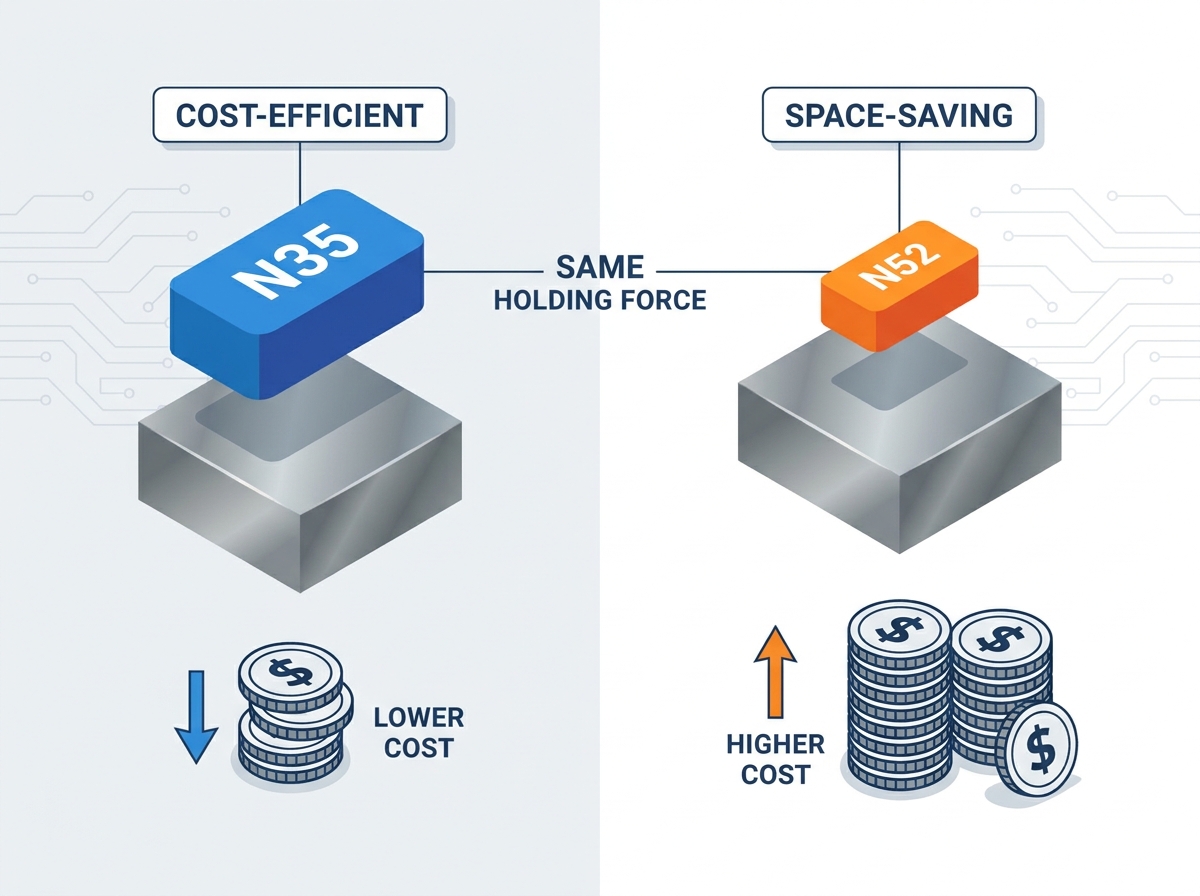
You must map the material choice directly to your business problem. Space constraints usually dictate grade selection. If your physical design allows for a slightly larger component, a larger N35 will easily achieve the exact same holding force as a smaller N52. However, it will do so at a significantly lower raw material cost. High-grade materials require complex manufacturing techniques and higher concentrations of specific rare earth elements. This inflates their market price. If your product does not demand extreme miniaturization—like an ultra-thin smartphone speaker—specifying N52 wastes your budget. Smart engineering leverages the available volume to use lower-grade, highly cost-effective materials.
Primary Industrial Use Cases
Industry leaders deploy this grade across diverse sectors. It excels in applications prioritizing steady performance over microscopic size.
- Magnetic Separation Equipment: Large arrays extract ferrous contaminants from food processing lines or grain silos.
- Packaging Closures: Hidden discs provide a premium "snap" feel for luxury boxes and consumer electronics packaging.
- Standard DC Motors: Brushless motors in home appliances and power tools rely heavily on this material.
- Sensors: Hall effect sensors use them for reliable positional tracking in automotive components.
- Acoustic Components: Heavy-duty loudspeakers and studio monitors utilize them to drive massive voice coils efficiently.
2. Evaluating Performance Parameters and Environmental Constraints
Thermal Realities and Demagnetization Risks
Temperature dictates neodymium performance profoundly. The baseline "N" designation carries a strict maximum operating temperature of 80°C (176°F). Operating continuously near this ceiling degrades the magnetic field temporarily. Exceeding this limit causes irreversible demagnetization. Once irreversible loss occurs, cooling the component will not restore its original strength. You must remagnetize it entirely. Intrinsic coercivity (Hcj) measures the material's resistance to demagnetization. Ambient industrial heat, proximity to combustion engines, or friction-heavy environments can severely impact long-term magnetic retention. You must measure ambient temperatures accurately during your prototyping phase. If your application spikes to 100°C, you must shift your specification to an N35M (Medium) grade to survive the environment.
Dimensional Tolerances and Assembly
Precision matters deeply in automated assembly lines. Standard manufacturing tolerances sit around ±0.1mm. This works perfectly for simple glue-in recesses or packaging. However, high-speed automated machinery or tight motor housings may require precision tolerances of ±0.05mm. Tighter tolerances increase machining time and scrap rates, raising your component price. Furthermore, you must account for the mechanical realities of sintered neodymium. The material acts like a dense ceramic. It is incredibly brittle. If two pieces snap together across a workbench, they will likely shatter. You must design assembly fixtures carefully. Workers should never hammer these components into place. Press-fitting requires specialized plastic sleeves to absorb mechanical shock.
Magnetization Direction
You must define the orientation early in the design cycle. The direction fundamentally alters manufacturing tooling and subsequent costs. Sintered materials align their crystalline structure during the pressing phase. You cannot change this later.
- Axial: Magnetized through the thickness. This is the most common and cost-effective orientation.
- Diametrical: Magnetized across the diameter. Often used in specific sensor applications.
- Multi-pole: Multiple alternating poles on a single face. This requires custom magnetizing fixtures and substantially increases initial setup fees.
3. Surface Treatment Solutions: Mitigating Corrosion Risks
The Vulnerability of NdFeB
You cannot use a raw neodymium block in most environments. NdFeB is an iron-rich alloy. It will corrode rapidly if exposed to ambient moisture, salt, or harsh industrial chemicals. Oxidation begins at the surface and penetrates deeply over time. As rust expands, it forces the brittle material to crack and turn into powder. This completely destroys the magnetic field. Consequently, applying a surface treatment is a non-negotiable step in the manufacturing process. You must match the coating specifically to the environmental outcome you expect.
Evaluating Plating Options (Features to Outcomes)
Selecting the right barrier saves you from catastrophic field failures. We summarize the standard industry options below.
Table: Surface Treatment Comparison for Neodymium Materials
| Coating Type | Composition | Ideal Environment | Key Advantages & Trade-offs |
| Ni-Cu-Ni | Nickel-Copper-Nickel | Indoor / Dry industrial | Industry standard. Excellent durability and clean aesthetic. Not suited for marine environments. |
| Zinc (Zn) | Pure Zinc | Low-corrosion / Internal | Lower cost. Great for applications requiring glues and adhesives. Lower scratch resistance. |
| Epoxy Resin | Black Epoxy | High moisture / Outdoors | Best for salt-spray resistance. Excellent durability in harsh industrial exposure. Slightly thicker tolerance. |
| Parylene | Polymer vapor deposition | Medical / High-friction | Pinhole-free specialized coating. Biocompatible. Carries a significant cost premium. |
Best Practice: Always specify epoxy resin if your product operates near saltwater or faces heavy condensation. Ni-Cu-Ni looks excellent but will eventually fail under prolonged high-humidity stress.
4. Supply Chain, Scalability, and Quality Control
Navigating Raw Material Volatility
The global rare earth market experiences frequent pricing fluctuations. Neodymium and Praseodymium base prices shift based on mining quotas and international trade policies. However, selecting a standard grade helps minimize this financial exposure. High-temperature grades (like SH, UH, or EH) rely heavily on expensive heavy rare earth elements like Dysprosium and Terbium. These additives stabilize the magnetic field at extreme heats but suffer from massive price volatility. An N35 Magnet requires little to no Dysprosium. By designing your system around standard temperature constraints, you shield your supply chain from sudden heavy rare earth price spikes.
Quality Assurance & Testing Standards
You must demand rigorous testing from your manufacturing partners. Visual inspections alone cannot guarantee performance.
- Helmholtz Coil Testing: This equipment measures the total magnetic moment. It verifies the batch actually meets the advertised BHmax rather than just checking surface gauss.
- Salt Spray Reports: Laboratories subject coated samples to highly corrosive mists for 24 to 72 hours. This ensures the plating has no microscopic pinholes.
- 3D Coordinate Measuring (CMM): Precision optical scanners verify that tight dimensional tolerances are met perfectly across high-volume production runs.
Watch out for immediate red flags during initial shipments. Inconsistent pull forces across a single batch indicate poor pressing or uneven sintering. Pitting or tiny bubbles in the nickel plating forecast rapid corrosion failures.
Compliance and Sustainability
Your supply chain must align tightly with global regulatory standards. Industrial buyers cannot ignore compliance documentation. You must ensure all shipments include valid RoHS (Restriction of Hazardous Substances) and REACH declarations. These documents verify the absence of restricted heavy metals like lead or cadmium in the plating layers. Furthermore, modern enterprises increasingly demand conflict-free sourcing policies. Ask your vendor to map their raw material origins to legitimate, regulated mining operations.
5. Shortlisting Suppliers and Next-Step Actions
Supplier Evaluation Matrix
Do not select a partner based on unit price alone. You must qualify the manufacturer's operational maturity. Use this checklist when vetting facilities:
- In-house Machining Capabilities: Do they slice, grind, and plate in-house? Outsourcing these steps increases lead times and dilutes quality control.
- Raw Material Quota Access: Legitimate suppliers have direct access to stable rare earth quotas, ensuring they will not stall your production during market shortages.
- Transparent QA Reporting: They should willingly provide material certificates and test data for every shipped batch.
Prototyping Strategy
Never commit to high-volume production without physical testing. Order a small sample batch first. Subject these prototypes to actual thermal and mechanical loads within your specific assembly. Run motors to their maximum operating temperatures. Submerge sensor housings in water if applicable. Measure the magnetic field before and after these stress tests. This real-world validation highlights hidden design flaws early.
Requesting the Right Documentation
Many buyers accept generic spec sheets blindly. This is a common mistake. You must instruct buyers to demand specific demagnetization curves (B-H curves) tailored to your exact operating temperature. A curve mapped at standard room temperature (20°C) looks vastly different from one mapped at 75°C. Understanding the knee of the demagnetization curve at high temperatures tells you exactly when the material will fail. Secure this documentation before signing massive purchase orders.
Conclusion
Standard N35 neodymium magnets remain the most optimal choice for a vast majority of industrial applications. They prioritize excellent cost-at-scale without sacrificing formidable magnetic strength. By avoiding unnecessary over-specification, you protect your procurement budgets against raw material inflation. We strongly recommend evaluating your spatial constraints carefully before demanding an N52.
Successful deployment hinges entirely on accurate environmental evaluation. You must respect the 80°C thermal ceiling and choose appropriate surface treatments to block moisture. Rigorous supplier vetting ensures your components meet strict dimensional and performance standards consistently across massive production runs.
Your next step is practical action. Review your current engineering drawings. Request comprehensive technical datasheets from your shortlisted suppliers. Initiate a specialized prototype sample run to validate your thermal assumptions. Finally, consult directly with a magnetic engineer to finalize your tolerances and lock in your ideal specifications today.
FAQ
Q: What is the difference between an N35 and an N52 magnet?
A: The primary difference lies in maximum energy density. An N52 generates a significantly stronger magnetic field from the exact same physical volume. However, N52 carries a much higher raw material cost. If you have enough physical space in your design, a slightly larger N35 will match the holding force of a smaller N52 at a fraction of the price.
Q: Can an N35 magnet withstand outdoor conditions?
A: Not without heavy protection. Raw neodymium contains iron and oxidizes rapidly. To survive outdoors, the component requires a specialized epoxy resin coating. Additionally, you should enclose the material inside a sealed mechanical housing to protect the brittle plating from scratching, which would invite moisture.
Q: How do I verify I am actually receiving N35 and not a lesser grade?
A: Visual inspection cannot determine grades. You must use a gauss meter to check surface fields and perform controlled pull tests. More importantly, require your supplier to provide official Helmholtz coil test results and certified B-H (demagnetization) curve documentation for your specific batch.
Q: Does machining an N35 magnet post-purchase ruin it?
A: Yes. You should never attempt to conventionally machine sintered neodymium. Drilling or milling generates excessive heat, which quickly pushes the material past its 80°C limit, causing irreversible demagnetization. Furthermore, neodymium dust is highly flammable and poses a severe fire hazard. All shaping must occur before the final magnetization phase.
Q: What happens if my application exceeds 80°C?
A: Minor, temporary temperature bumps may cause reversible flux loss, meaning strength returns upon cooling. However, continuously exceeding 80°C pushes the material past its coercivity threshold, causing irreversible demagnetization. If your environment runs hotter, you must upgrade to high-temperature grades like N35M (100°C) or N35H (120°C).