Choosing a neodymium magnet often feels like walking a tightrope. You need immense holding power, but you cannot blow the project budget. Here, the N40 magnet emerges as the strategic middle-ground. It delivers a notably higher energy product than baseline N35 grades. Simultaneously, it avoids the premium cost and extreme brittleness found in top-tier N52 options. Specifying the wrong magnet grade carries severe consequences for your production line. If you go too weak, you risk mechanical failure through demagnetization in the field. If you go too strong, you waste capital on unnecessary over-engineering. We see these errors frequently in consumer electronics and industrial motor design. This guide provides a pragmatic, engineering-focused framework for evaluating your options. You will learn to evaluate and source N40 magnets based on specific thermal, environmental, and geometric requirements. By following these steps, you can secure reliable magnetic performance while keeping manufacturing costs firmly under control.
Key Takeaways
- Performance Balance: N40 magnets provide an optimal Br (Remanence) to cost ratio for high-volume manufacturing.
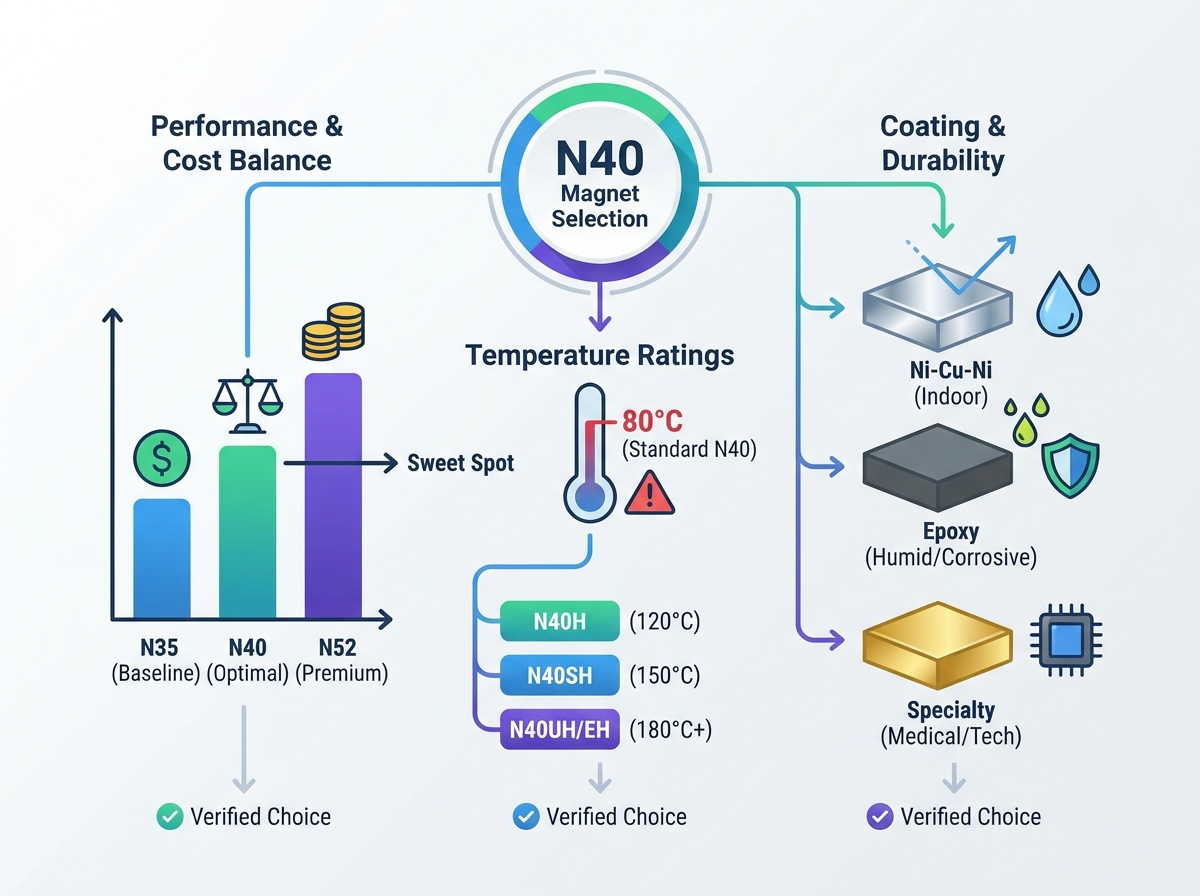
- Thermal Limits: Standard N40 magnets degrade above 80°C; applications exceeding this require high-temp variants (N40H, N40SH).
- Environmental Durability: Raw neodymium corrodes rapidly; selecting the correct plating (Ni-Cu-Ni, Epoxy, Zinc) is as critical as the magnetic grade.
- Supplier Verification: Credible suppliers provide BH curve reports and consistency guarantees to prevent batch-to-batch variance.
The Business Case for N40: Framing Your Success Criteria
Engineers face a constant battle between performance and unit cost. Baseline N35 magnets are highly affordable. However, they often require too much physical volume to generate strong magnetic fields. At the other end of the spectrum sits the N52. These magnets offer maximum magnetic strength. Yet, they command a steep price premium. They are also noticeably more brittle. This makes them highly prone to chipping during automated assembly processes.
An N40 Magnet perfectly bridges this gap. It provides roughly 14% more magnetic energy than an N35. You gain this extra pull force without paying N52 prices. This makes it the optimal choice for precision motors. It works beautifully in magnetic sensors and high-end consumer goods where weight reduction matters.
Replacing an N52 with an N40 can slash component budgets rapidly. Many designers over-specify their assemblies out of pure caution. They choose N52 when a standard N40 handles the mechanical load easily. By scaling down appropriately, you protect your profit margins significantly. Below is a simple comparison chart illustrating this dynamic.
Chart: Magnetic Grade Performance Comparison
| Magnet Grade | Relative Strength | Cost Profile | Brittleness Risk |
| N35 | Baseline (Lowest) | Low | Moderate |
| N40 | Optimal Mid-Tier | Moderate | Moderate |
| N52 | Maximum (Highest) | High | High |
However, implementation requires care. You must avoid designing tightly constrained assemblies based solely on mathematical models. Always leave margin for dimensional tolerances. Real-world environmental variables alter magnetic performance slightly. Ignoring these tolerances often leads to expensive manufacturing bottlenecks.
Common Mistake: Do not order high-grade magnets automatically. Test an N40 first. It usually meets the mechanical threshold and saves considerable capital during scale-up.
Evaluating Temperature Ratings: Standard vs. High-Temp N40
Standard neodymium magnets share a critical vulnerability. They struggle immensely in hot environments. A standard N40 Magnet operates reliably only up to 80°C (176°F). If your application exceeds this threshold, the magnet suffers irreversible magnetic loss. It will not recover its full strength once it cools down. This permanent demagnetization destroys product functionality instantly.
Engineers must decode the thermal suffix attached to the magnet grade. These letters indicate the maximum safe operating temperature before structural degradation begins.
- N40H: Operates safely up to 120°C.
- N40SH: Operates safely up to 150°C.
- N40UH and N40EH: Designed for extreme industrial applications. They withstand 180°C and 200°C respectively.
Table: Thermal Suffix Guide for N40 Magnets
| Grade Designation | Max Operating Temp (°C) | Common Applications |
| Standard N40 | 80°C | Indoor sensors, consumer electronics |
| N40H | 120°C | Automotive interiors, small motors |
| N40SH | 150°C | Power tools, industrial generators |
| N40UH / N40EH | 180°C - 200°C | High-heat industrial machinery |
You must base your design on peak localized temperatures. Avoid using average ambient room temperatures for your calculations. For example, a motor housing might sit in a comfortably air-conditioned 25°C room. Yet, the internal coil temperature could easily spike to 95°C under heavy mechanical load. A standard N40 would fail quickly here. You would need an N40H to ensure long-term reliability.
Selecting the Right Coating for Durability and Compliance
Raw neodymium contains iron. It oxidizes and corrodes rapidly when exposed to ambient moisture. Choosing the correct protective plating ensures long-term functionality. Your magnetic grade means nothing if the magnet turns to dust.
The industry standard is Ni-Cu-Ni (Nickel-Copper-Nickel). This triple-layer plating serves as an excellent baseline. We recommend it for most indoor, non-corrosive B2B applications. It provides a shiny metallic finish. It also offers moderate scratch resistance during physical handling and assembly.
However, standard nickel plating fails in harsh environments. For humid, maritime, or highly acidic conditions, epoxy coatings perform much better. Epoxy forms a durable, waterproof barrier around the neodymium core. You must consider the trade-offs carefully. Epoxy coatings slightly increase the final dimensional thickness. They also possess lower impact resistance compared to metallic platings.
For niche applications, you have several specialized options. Zinc plating offers a low-cost solution for low-corrosion environments. Conversely, Gold or Parylene coatings dominate the medical device industry. They provide exceptional biocompatibility for specialized tech applications.
Follow these steps to select your coating correctly:
- Assess moisture exposure: Determine if the magnet will face direct water contact or high humidity.
- Check impact risk: Evaluate whether the magnet will suffer repeated physical strikes during operation.
- Verify compliance: Ensure all chosen coatings meet RoHS and REACH standards. This guarantees your final product remains legal for international distribution.
Sizing, Geometry, and Pull Force Requirements
Shape dictates function in magnetic design. You cannot divorce the physical geometry from the magnetic grade. Selecting the correct form factor determines how efficiently the magnetic flux fields interact with your components.
Consider this standard shape-to-function mapping:
- Discs and Cylinders: Ideal for sensors, magnetic latches, and recessed holding applications. They focus magnetic pull efficiently.
- Blocks: The industry standard for linear motors, magnetic separation equipment, and mounting channels.
- Rings: Used heavily in rotating machinery, consumer acoustics, and custom spindle applications.
Many buyers misunderstand the complex relationship between physical size and magnetic grade. A thicker N35 magnet might yield the exact same pull force as a thinner N40. If your product design offers ample physical space, a larger N35 might save money. If space is incredibly tight, upgrading to a slim N40 Magnet solves the constraint. You must constantly balance physical space limitations against the magnetic grade.
Finally, you must specify the magnetization direction. Axial magnetization runs through the flat faces of a disc. Diametrical magnetization runs across the diameter. Failing to define this during the Request for Quote (RFQ) process ruins production runs entirely. Always state the polarity orientation clearly on your technical drawings.
Vetting Your N40 Magnet Supplier: Consistency and Verification
The global magnet market contains many inconsistent suppliers. Buyers often experience a frustrating B2B pain point here. The first prototype batch performs flawlessly. However, magnetic performance drops significantly in later mass-production runs. This batch-to-batch inconsistency destroys product reliability and damages your brand reputation.
You must demand rigorous testing and documentation. Ask your supplier for demagnetization curves (BH Curves). These reports prove the magnetic grade is genuine. Furthermore, request standard ASTM B117 salt-spray test reports to validate the coating quality. A reliable, ISO 9001-certified supplier provides these documents willingly.
We strongly recommend ordering minimum viable quantities (MVQ) first. Use these initial units for rigorous physical prototype testing. Never commit to high-volume purchase orders until the prototypes pass real-world stress tests on your assembly line.
Watch out for common red flags during procurement. Be highly suspicious of suppliers offering N40 magnets at N35 prices. If a deal seems too good to be true, they are likely shipping inferior, downgraded materials. Additionally, avoid manufacturers who cannot explain their quality control (QC) procedures. If they lack dedicated flux testing equipment, find a new manufacturing partner immediately.
Conclusion
Choosing the right N40 magnet demands careful alignment of multiple technical specifications. You must balance thermal limits, environmental exposure, and precise geometric requirements simultaneously. Skipping any of these critical evaluation steps leads to field failure or bloated manufacturing budgets. When engineered correctly, an N40 grade delivers unparalleled efficiency.
Your next steps require detailed technical documentation. Write down your exact application parameters today. Note the maximum peak operating temperature. Calculate the required pull force precisely. Define the environmental exposure your product will face. Armed with this data, reach out to short-listed manufacturers. Request verified technical data sheets for their N40 products. Comparing these spec sheets guarantees you make an informed, engineering-backed decision for your next assembly.
FAQ
Q: What does the "40" in an N40 magnet stand for?
A: The number "40" represents the Maximum Energy Product of the magnet, measured in MegaGauss-Oersteds (MGOe). It indicates the overall strength of the magnetic field. An N40 magnet has a maximum energy product of roughly 40 MGOe. This serves as a standardized metric for comparing different neodymium grades globally.
Q: Is an N40 magnet stronger than an N35?
A: Yes. Assuming both magnets share the exact same physical dimensions and geometry, an N40 is approximately 14% stronger than an N35. It provides a noticeably higher pull force and surface gauss. This makes it ideal for applications requiring more power within a highly restricted physical space.
Q: Can an N40 magnet be machined or drilled?
A: No. Neodymium magnets are extremely brittle by nature. Attempting to machine, drill, or modify them post-sintering usually shatters the material. Furthermore, the dust generated during machining is highly flammable and poses a severe fire hazard. All shaping and drilling must occur before the magnetization and coating processes.
Q: How long will an N40 magnet retain its magnetism?
A: Neodymium magnets are highly stable. Absent excessive heat, radiation, or opposing magnetic fields, they lose less than 1% of their strength every 10 years. For all practical engineering purposes, an N40 magnet will last the lifetime of the application if kept within its specified operating parameters.