Fabrication often hits a major operational bottleneck. You frequently need three hands to hold materials plumb, align complex joints, and operate a welder simultaneously. This physical limitation drastically reduces daily output. Traditional clamping and layout methods defined the industry for decades. Now, many fabricators transition to magnetic fixturing to speed up assembly. This guide evaluates the operational realities, trade-offs, and efficiency gains of adding a Magnetic Square to your toolkit. We compare these modern tools directly against traditional manual squares. You will learn how to optimize your daily workflow. You will also discover how to identify the right tool for every distinct fabrication phase.
Key Takeaways
- Primary function distinction: Traditional squares are optimized for precision layout and measurement; magnetic squares are optimized for hands-free fixturing and material holding.
- The "Swarf" factor: Non-switchable magnetic squares attract metal shavings, requiring dedicated cleanup protocols that traditional squares do not.
- Optimal workflow: Most professional setups require both—traditional squares for initial layout and calibration, and magnetic squares for temporary hold during tacking or assembly.
- Investment trigger: Upgrading to a switchable magnetic square is justified when daily setup time (fixturing) limits production throughput.
The Setup Dilemma: Framing the Fabrication Bottleneck
Shop owners constantly battle the high cost of manual fixturing. Time slips away quickly when you manually clamp multi-axis joints. Fabricators often spend eighty percent of their time setting up a joint and only twenty percent actually welding. Fighting gravity during complex assemblies requires excessive external clamping. This process drains energy and kills production momentum.
Single operators feel this setup dilemma most acutely. They cannot simply ask a coworker to hold a heavy piece of steel tubing. Instead, they rely on complex clamp configurations. These clamp networks often block the necessary welding path. This forces the operator to compromise on weld placement or joint accessibility.
Decision-makers must evaluate specific success criteria when selecting layout and fixturing tools. Every shop needs reliable equipment to guarantee structural integrity.
- True 90/45-Degree Accuracy: The tool must reliably establish dead-square and forty-five-degree angles.
- Holding Force: The tool must support heavy stock against gravity without slipping.
- Ease of Clean-Up: The tool should resist debris accumulation to maintain surface flatness.
- Durability Under Heat: The tool must withstand close proximity to high-amperage welding operations.
No single tool perfectly masters all four criteria. This reality forces professionals to understand the inherent trade-offs between absolute precision and holding convenience.
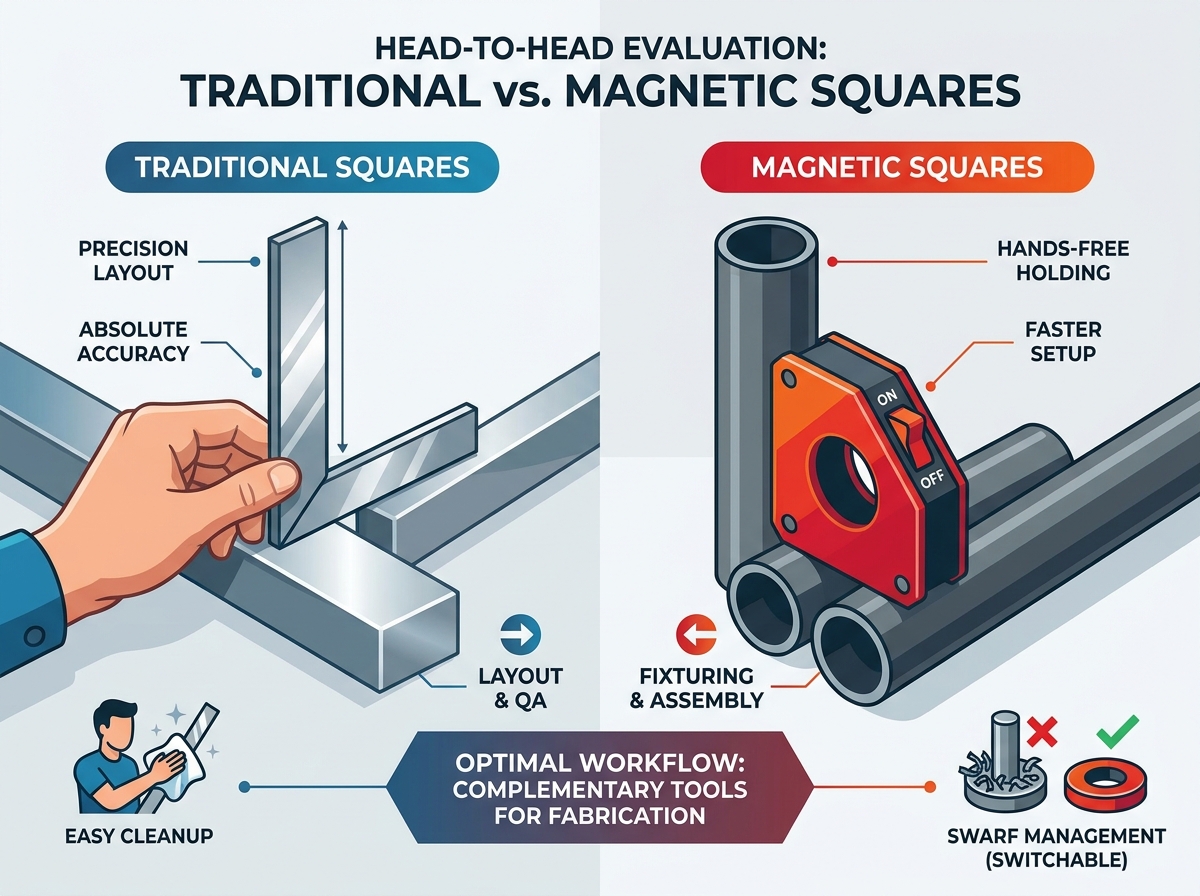
Traditional Squares: The Baseline for Absolute Precision
Traditional squares remain the undisputed champions of precision measurement. This broad category includes framing squares, try squares, and highly engineered machinist squares. Carpenters and metalworkers have relied on these tools for centuries. They establish the foundational geometry for any critical build.
The core strength of a traditional square lies in its uncompromised layout accuracy. High-end machinist squares adhere strictly to DIN 875 standards. These tools offer micro-millimeter tolerances. You can trust them implicitly when calibrating machinery or scribing initial cut lines. Solid steel models also provide complete immunity to heat distortion. You can place them near hot welds without degrading their physical structure.
Furthermore, traditional squares offer zero magnetic interference. They do not attract grinding dust or sharp metal shavings. You never have to scrape a traditional square clean before referencing a flat edge.
However, traditional squares present significant operational limitations. They demand manual holding. You must physically press the square against the workpiece while marking or tacking. If you need both hands for a tool, you must introduce complex external clamping. Traditional squares are highly susceptible to sudden movement. The vibration of a fastener drive or the thermal shock of a first tack weld easily shifts them out of alignment. This movement forces you to restart the setup process.
The Magnetic Square Advantage: Hands-Free Holding
Magnetic fixtures solve the immediate problem of gravity. This category primarily splits into fixed permanent magnets and switchable magnetic models. Fixed models maintain a constant magnetic field. Switchable models allow you to turn the magnetic force on and off. They achieve this by rotating an internal magnetic cylinder.
These tools deliver specific features tied directly to production outcomes. Multi-angle fixturing is a massive advantage. Standard blocks offer pre-set 45-degree, 90-degree, and 135-degree holding faces. You achieve rigid fixturing without needing C-clamps or F-clamps. This capability drastically reduces overall setup time. Faster setups mean higher throughput speed for repetitive joint assemblies.
Despite these benefits, you must consider the implementation realities and risks. Heat degradation poses a serious threat. Proximity to high-amperage welding can permanently demagnetize cheaper ferrite magnets over time. Most magnets lose their pull force when they exceed their specific Curie temperature. You must keep them away from direct heat-affected zones.
The grounding issue also requires attention. Strong magnetic fields can occasionally interfere with TIG and MIG arc stability. This phenomenon is known as arc blow. The magnetic field deflects the welding arc, causing erratic bead profiles and spatter. Experienced welders know to tack the joint quickly and remove the magnet before executing the final structural weld.
Head-to-Head Evaluation: Core Decision Dimensions
Evaluating these tools requires looking at real-world shop conditions. We must analyze precision, maintenance burdens, and overall workflow integration.
| Decision Dimension | Traditional Square | Magnetic Fixture |
| Primary Function | Measurement and layout | Temporary material holding |
| Accuracy Level | Micro-millimeter (DIN standards) | Functional (Good enough for fab) |
| Heat Resistance | Excellent (Solid steel construction) | Variable (Vulnerable above Curie temp) |
| Debris Management | Passive (No attraction) | Active (Requires regular cleaning) |
Precision vs. Holding Power
You must contrast the micro-millimeter tolerance of a machinist square against the standard tolerance of a magnetic block. Machinist squares undergo rigorous grinding to achieve absolute perpendicularity. They dictate the exact geometry of the final product. Conversely, magnetic blocks offer tolerances considered "good enough for fabrication." They hold steel firmly in place. However, surface debris or slight manufacturing variances can throw them off by a fraction of a degree. Use traditional tools to measure the part. Use magnetic tools to hold the part.
Cleanup and Maintenance (The Swarf Reality)
You cannot ignore the maintenance burden of fixed magnets. They constantly attract grinding dust, mill scale, and sharp metal shavings. This debris is commonly known as swarf. Swarf builds up on the magnetic faces. This buildup creates an uneven surface. An uneven surface guarantees an out-of-square joint. Cleaning a fixed magnet requires vigorous wiping or compressed air. Switchable magnets beautifully mitigate this issue. You simply turn the magnet off, and the swarf falls away instantly.
Scalability and Workflow Integration
Integrating these magnetic tools directly scales production. They act as a dedicated assistant for single operators who lack a second pair of hands. You can sequence your workflow far more efficiently. You measure once using a manual square. You place the magnetic blocks to lock the geometry. You tack the entire assembly rapidly. This streamlined integration reduces operator fatigue and accelerates project turnaround times.
Core Magnetic Square Applications by Industry
Different trades leverage these holding tools in distinct ways. The breadth of Magnetic square applications spans from heavy fabrication to delicate machining.
Magnetic square for welding and metal fabrication
The primary use case remains heavy structural work. A Magnetic square for welding is ideal for holding heavy stock rigid during tacking. Fabricators use them daily on square tubing, thick steel plate, and heavy angle iron. You must actively evaluate heat zones when placing the blocks. Keep the magnet at least two inches away from the puddle. This distance minimizes thermal shock. It also prevents the arc blow phenomenon from ruining your root pass.
Machining and Heavy Equipment Maintenance
Machinists utilize smaller switchable blocks for distinct setup tasks. These tools excel at dialing in workpieces on a milling table. Machinists use them as temporary stops or modular fixtures. They also provide excellent bases for holding dial indicators. You can snap a magnetic indicator base onto a lathe carriage instantly. This allows you to check runout without bolting down heavy external brackets.
Woodworking and Non-Ferrous Applications
We must address a fundamental physical limitation. These tools are entirely useless on wood, aluminum, or stainless steel alloys. They require ferromagnetic material to function. In a woodworking shop, you might use a heavy magnetic block merely as a dead-weight bench block. Because they cannot clamp to timber, traditional try squares remain the default requirement here. Woodworkers rely on manual squares and mechanical clamps to secure their cabinetry joints.
Buying Criteria: How to Shortlist a Magnetic Square
You need a structured approach when purchasing these tools. The market floods buyers with cheap, imported options. Understanding key specifications helps you avoid frustrating purchasing mistakes.
Professionals should almost exclusively shortlist switchable models. The on/off capability is not a luxury. It is a critical operational requirement. Fixed magnets waste too much time during the cleanup phase. Swarf buildup ruins joint accuracy. Switchable blocks guarantee a clean mating surface every single time you engage them.
You must carefully evaluate holding force. Manufacturers rate pull capacity under ideal conditions. They assume a perfectly flat, clean, thick steel plate. Real-world holding force drops significantly on thin sheet metal or painted surfaces. You must match the rated weight capacity to the stock you typically handle. A fifty-pound pull rating works fine for light sheet metal. However, you need at least a one-hundred-and-fifty-pound pull rating when fixturing half-inch structural plate.
Finally, evaluate the housing design. Choose enclosed housings over open rivet designs. Enclosed housings protect the internal magnetic cylinder from fine metallic dust. Open designs eventually pack full of grinding debris. This internal debris jams the switching mechanism. An enclosed, sealed unit ensures long-term compliance and durability in harsh, dusty environments.
Conclusion
You should never replace your traditional square entirely. The best shops supplement their precise layout tools with magnetic fixturing blocks. You need to use traditional tools strictly for the layout and quality assurance phases. Once you verify the measurements, deploy magnetic squares for the fixturing and final assembly phases. This hybrid approach guarantees both precision and speed.
Your next step requires an honest shop audit. Assess your current scrap rate and daily setup times. Monitor a standard assembly project this week. If fixturing a joint takes longer than the actual welding process, you have a bottleneck. You should immediately evaluate and purchase a switchable magnetic block sized appropriately for your average material weight. This single addition will streamline your workflow and drastically reduce daily frustration.
FAQ
Q: Do magnetic squares lose their magnetism over time?
A: Yes, they can degrade under specific conditions. Exposing them to temperatures above their specific Curie limit permanently weakens the magnetic field. Severe physical shock, like dropping them onto concrete, also disrupts their internal alignment. Store them properly and keep them away from direct welding heat to prolong their lifespan.
Q: Are magnetic squares accurate enough for precision layout?
A: They are highly accurate for general fixturing, but they fall short for true precision layout. They generally do not meet the strict DIN or machinist standards of a high-end traditional square. Surface debris easily alters their resting angle. Always use a traditional solid square to verify your final angles.
Q: What is the difference between a fixed and a switchable magnetic square?
A: A fixed model projects a constant, permanent magnetic field. It always attracts metal. A switchable model features an internal cylinder. Turning a dial rotates this cylinder, directing the magnetic field either outward into the workpiece or inward to neutralize the pull. This allows for easy removal and fast debris cleaning.