Specifying the wrong magnetic material in product design or manufacturing often leads to unforeseen performance failures. You risk severe thermal degradation, mechanical breakdown, or unnecessary expenses if the wrong component is selected. Making an uninformed choice here ultimately compromises your entire engineering baseline. This vital material choice dictates a system's ongoing energy dependency and its overall operational lifespan. It also directly restricts or expands the mechanical footprint of your final industrial assembly.
We designed this article to provide a clear, evidence-based comparison of hard and soft magnetic properties. We cut through theoretical basic science to deliver decision-stage evaluation criteria for commercial and industrial applications. You will learn exactly how to match the optimal magnetic behavior to your specific project constraints. Read on to discover how to balance material performance against thermal realities and operational demands.
Key Takeaways
- Permanent magnets (hard magnetic materials) retain their magnetic flux independently and are essential for continuous, unpowered magnetic fields (e.g., motors, sensors).
- Temporary magnets (soft magnetic materials) require an external magnetic field to exhibit magnetism and are critical for applications requiring rapid magnetization and demagnetization cycles.
- The decision matrix relies on three strict dimensions: operating environment (temperature/corrosion), required magnetic field persistence, and mechanical constraints.
- High-grade permanent magnets (like N50 Neodymium) offer extreme holding force but require strict thermal management, whereas temporary magnets offer variable control without rare-earth material costs.
Defining Magnetic Behavior: Hard vs. Soft Materials
Understanding the fundamental distinction between magnetic materials begins with two core metrics. We measure a material's magnetic capability through coercivity and remanence. These properties dictate how a material behaves once exposed to an initial magnetizing force.
The Permanent Magnet (Hard Magnetic Materials)
A hard magnetic material boasts incredibly high coercivity. Coercivity measures a material's resistance to demagnetization. Once you expose these materials to a strong magnetizing field, they align their internal atomic structure. They then lock this alignment into place. They also feature high remanence, meaning they retain a massive amount of residual magnetism. A permanent magnet provides a continuous, unpowered magnetic field. It resists external forces that attempt to scramble its magnetic domains.
Industry relies heavily on several common manmade examples of hard magnetic materials. You will frequently encounter Neodymium (NdFeB), which offers the highest magnetic strength available. Samarium Cobalt (SmCo) provides excellent thermal stability for high-heat environments. Ferrite (ceramic) magnets offer a highly cost-effective, corrosion-resistant alternative for lower-strength requirements. Finally, Alnico alloys deliver exceptional temperature resistance, though they possess lower coercivity than modern rare-earth options.
The Temporary Magnet (Soft Magnetic Materials)
In stark contrast, soft magnetic materials function entirely differently. We define their functionality by their exceptionally low coercivity. They act as excellent conduits for magnetic lines of force. They eagerly channel and amplify magnetic fields from external sources. However, they lose almost all their magnetization the instant you remove that external field.
Engineers must understand the distinction between the temporary magnetic material itself and the system driving it. A temporary magnet is simply the reactive material, like a soft iron core. An electromagnet is the complete active system, usually involving electrical coils, that creates the temporary field. Common industrial examples of soft magnetic materials include soft iron, silicon steel, and various nickel-iron alloys. These materials excel in environments where you need magnetic flux to change direction or intensity rapidly without energy loss.
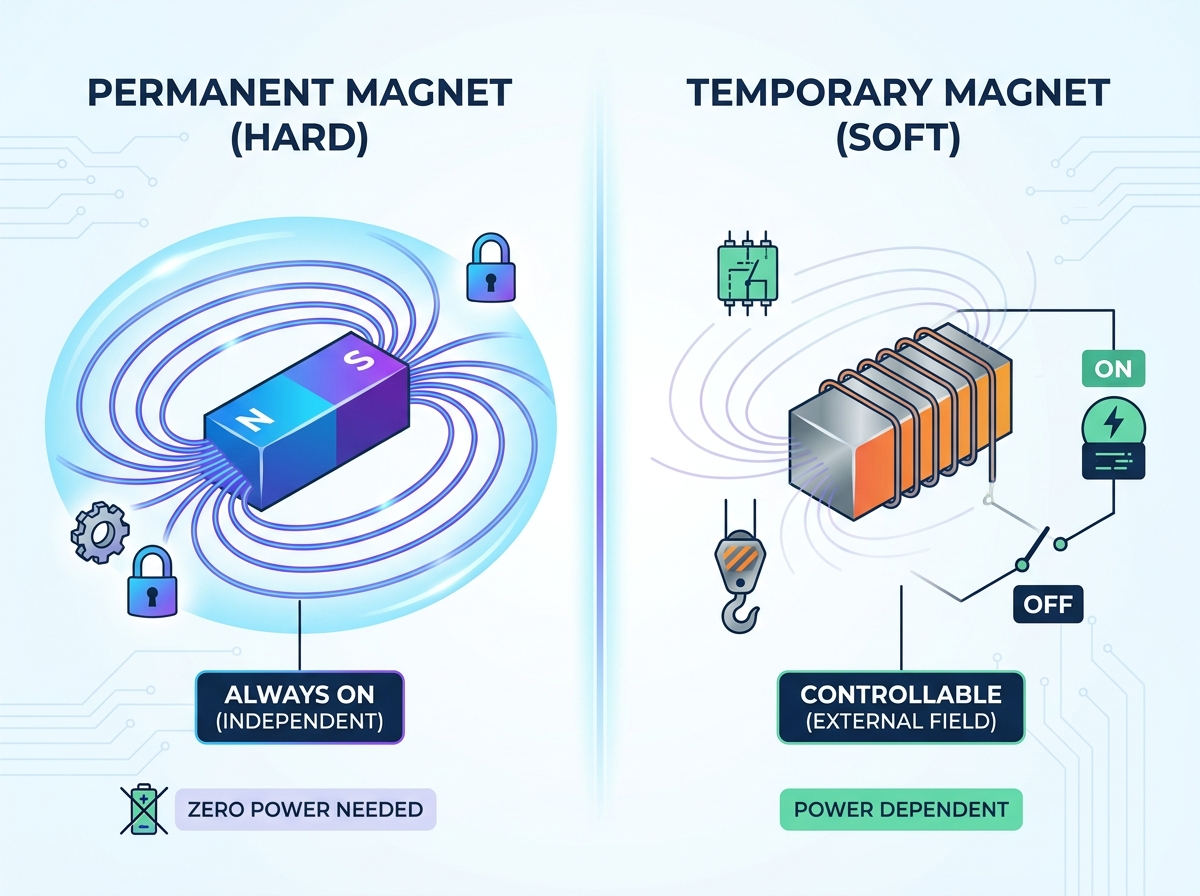
Core Differences: Permanent Magnet vs. Temporary Magnet
To specify the correct material, you must evaluate how these magnets function in active environments. The differences extend far beyond basic attraction. They influence every aspect of your product's design, from control mechanisms to supply chain logistics.
Field Dependency and Control
Field control represents the most obvious operational divide. A permanent magnetic setup is always "on." You cannot easily modulate its strength or switch it off. If you need to stop its magnetic pull, you must physically separate it from the target object. Alternatively, you must install complex mechanical shielding to redirect the flux. This constant active state makes it perfect for fail-safe holds but challenging for dynamic release mechanisms.
Temporary magnetic materials are highly controllable. Their magnetism drops to near-zero instantly when you remove the external magnetizing force. If you pair a soft iron core with an active electromagnet coil, you gain precise control. You can adjust the current to increase the hold, decrease it, or shut it off completely. This rapid response enables modern digital and industrial switching systems.
Material Composition and Cost Variability
Supply chain realities heavily influence material selection. Hard magnetic materials often rely on rare-earth elements. Neodymium and Dysprosium are critical for high-grade magnets. These specific elements are subject to intense market volatility, geopolitical export restrictions, and complex mining processes. Consequently, their pricing fluctuates wildly.
Temporary magnetic materials primarily utilize highly available resources. Iron and steel alloys are globally abundant. Their supply chains are stable, predictable, and heavily commoditized. When you design around soft magnetic materials, you generally face much lower initial material costs. You also shield your production line from rare-earth supply shocks.
Energy Consumption Baseline
You must evaluate operational energy requirements early in the design phase. Permanent setups require zero operational power. They maintain their magnetic field indefinitely without any electrical input. This passive holding capability is unmatched for energy efficiency.
Conversely, temporary magnetic systems incur ongoing power costs. Because they require an external force to exhibit magnetism, you must constantly feed electrical current to the surrounding coils. Over a long operational lifespan, this continuous power draw becomes a significant factor in your system's overall efficiency.
The following chart illustrates the operational differences across key engineering parameters.
| Evaluation Parameter | Hard Magnetic Materials | Soft Magnetic Materials |
| Field Control | Static, always active | Dynamic, easily adjustable |
| Energy Required | Zero operational power | Continuous power required |
| Material Availability | Volatile rare-earth supply | Abundant iron/steel supply |
| Remanence | Extremely High | Near Zero |
Evaluation Dimensions: Choosing the Right Magnet for Your Project
Selecting the right magnetic solution requires a structured evaluation. You cannot simply choose the strongest option available. You must weigh your application criteria against thermal limitations and industry compliance standards.
Application and Success Criteria
You should specify hard magnetic materials when your application demands a static holding force. They excel in scenarios requiring fail-safe performance without power. We routinely see them in compact motor designs, wind turbine generators, and passive sensing equipment. If your device must maintain a magnetic field during a power outage, you must use a hard material.
You should specify soft magnetic materials when applications require rapid switching. They are indispensable for variable magnetic strength. Engineers rely on them for safe-release mechanisms in industrial lifting equipment. You will also find them at the heart of transformers, relays, and induction coils. If your system requires cyclical magnetization, soft materials prevent dangerous heat buildup and energy loss.
Thermal and Environmental Tolerance
Temperature dictates magnetic performance. You must thoroughly understand the Curie temperature limitations of hard magnets. The Curie temperature is the point where a material permanently loses its magnetic properties. Standard Neodymium grades begin losing strength at temperatures just above 80°C. If your application runs hot, you must specify specialized, higher-temperature grades. Alternatively, you might need to switch to Samarium Cobalt, which withstands much higher heat but costs significantly more.
Temporary materials generally maintain their structural and magnetic channeling properties at much higher temperatures. Soft iron and silicon steel perform reliably in high-heat industrial environments. They do not suffer from the same low-threshold thermal degradation as rare-earth elements. This makes them ideal for engine compartments and heavy manufacturing environments.
Compliance and Industry Standards
Global manufacturing requires strict adherence to regulatory standards. When utilizing rare-earth materials, you must ensure RoHS and REACH compliance. Many of these strong magnets are highly susceptible to corrosion. They require specialized chemical coatings, such as nickel-copper-nickel plating. You must verify that your chosen coating process meets international environmental safety guidelines.
You must also adhere to strict testing protocols. Industry ISO standards govern how we verify magnetic flux density and pull-force ratings. You cannot rely on theoretical calculations alone. Proper documentation ensures your final assembly meets safety regulations, particularly in automotive and aerospace applications.
Implementation Risks and Real-World Trade-Offs
Every engineering choice carries inherent risks. Anticipating the physical limitations of your chosen material prevents costly field failures. Let us examine the specific trade-offs associated with these materials.
Demagnetization Risks
Hard magnets face significant demagnetization risks in the real world. They are incredibly strong, but they are not invincible. Exposure to strong reverse magnetic fields can strip their alignment. Extreme heat will irreversibly damage their flux density. Furthermore, severe mechanical shock or blunt impact can permanently weaken them. You must design protective housing to shield these components from environmental trauma.
Mechanical Fragility vs. Machinability
We must transparently address material fragility. Sintered rare-earth magnets are extremely brittle. The manufacturing process creates a material more akin to ceramics than steel. They are highly prone to chipping, cracking, or shattering during assembly. You cannot drill, tap, or conventionally machine a finished sintered component without specialized diamond tooling.
We contrast this with temporary magnetic materials. Soft iron and steel alloys are highly machinable. You can stamp, mill, lathe, and form them using standard metalworking processes. This ease of manufacturing drastically reduces production timelines. It allows for complex geometric designs that would be impossible or prohibitively expensive with brittle sintered materials.
Safety and Handling Protocols
Industrial safety protocols vary wildly between these two categories. Handling high-grade permanent components poses serious safety hazards. Large Neodymium blocks can snap together violently from several feet away. This creates severe pinch risks that can crush fingers or shatter the material, sending shrapnel into the air. They also pose critical risks to employees with pacemakers or implanted medical devices.
Un-magnetized temporary materials are entirely inert during assembly. Workers can handle, store, and transport them like any other standard metal component. You do not need specialized non-magnetic tooling or isolated assembly zones. This dramatically simplifies the manufacturing process and lowers workplace liability.
Shortlisting Logic and Next Steps
Moving from theory to specification requires a clear decision framework. We recommend applying the following logical steps to isolate the correct material for your assembly.
- Step 1: Does the system require a continuous field without power? If your answer is yes, you must select a hard magnetic material. Proceed to evaluate specific grades based on holding force requirements.
- Step 2: Does the system require varying strength or release capabilities? If your system needs to cycle on and off rapidly, you must choose a temporary material paired with an electromagnetic driver.
- Step 3: Assess environmental constraints. Carefully document peak operating temperatures and corrosive exposures. Use this data to determine if you need specialized coatings or high-heat material grades like SmCo or specialized NdFeB.
Once you navigate this framework, take action. We strongly recommend consulting with a magnetic engineering specialist. You should validate your theoretical pull-force requirements through physical testing. Ask your engineering partner to run finite element analysis (FEA) on your design. Finally, request material prototypes to test real-world performance against your initial calculations.
Conclusion
Navigating the complex landscape of magnetic materials is vital for successful product design. Neither magnet type is inherently superior to the other. They serve fundamentally different operational models. Hard magnetic materials deliver unparalleled, passive holding force. Soft magnetic materials provide the reactive agility needed for modern electrical switching.
Your final selection should strictly balance your initial material acquisition cost against ongoing operational power needs. You must also confront the thermal realities of your application environment. By evaluating coercivity, heat tolerance, and machinability, you protect your system from premature failure. Apply these criteria rigorously to ensure your next engineering project operates exactly as designed.
FAQ
Q: What is an N50 permanent magnet, and when should it be used?
A: An N50 magnet is a specific, high-tier grade of Neodymium (NdFeB). The "50" indicates a very high maximum energy product, meaning it delivers immense magnetic strength relative to its volume. You should use N50 grades in size-constrained applications where you need maximum holding force but have very limited physical space.
Q: Can a temporary magnet be turned into a permanent magnet?
A: You can expose soft magnetic materials to incredibly strong fields, but the physics prevents success. Soft materials have low coercivity. While they might retain a faint trace of residual magnetism after exposure, they will never retain a commercially useful or reliable charge for industrial applications.
Q: What are natural vs. manmade examples of these magnets?
A: Lodestone is the most famous natural permanent magnet, naturally magnetized by lightning strikes. Commercially sintered NdFeB is the most common manmade permanent magnet. Soft iron is a manmade material acting as a temporary magnet, only exhibiting a field when influenced by an external magnetic source.
Q: Do permanent magnets eventually lose their strength?
A: Yes, but the degradation is extremely minimal. Under normal operating conditions, they lose only a microscopic fraction of their strength over decades. However, they will lose strength rapidly and permanently if subjected to extreme thermal trauma, severe physical shock, or powerful reverse magnetic fields.