Neodymium N52 magnets are the gold standard for commercially available magnetic strength. They offer the absolute highest performance-to-size ratio in modern industrial and consumer design. Engineers and procurement managers constantly face a strict dilemma. You must balance the premium cost of N52 against the absolute necessity for extreme magnetic performance. If your application demands massive holding force in a microscopic footprint, standard grades often fail.
This article unpacks the technical realities, physical limitations, and exact use cases where specifying N52 is a justified business decision. You will learn how to optimize your mechanical designs without over-engineering or wasting resources. We will explore material constraints, demagnetization risks, and real-world performance variables. By the end of this guide, you will know precisely when to deploy this extreme material and when to rely on lower-grade alternatives.
Key Takeaways
- Peak Commercial Strength: "52" represents the Maximum Energy Product (MGOe); N52 is the highest grade reliably produced at scale.
- Size Optimization: N52 allows for extreme miniaturization, delivering the highest magnetic flux in tight design footprints.
- Thermal Constraints: Standard N52 degrades rapidly above 80°C (176°F); high-heat applications require modified grades (e.g., N52M, N52H).
- Cost vs. ROI: Choosing N52 over N35 or N45 should be driven by strict weight or space constraints, not just the desire for "the strongest magnet."
The Anatomy of an N52 Magnet: What Do the Specs Actually Mean?
To understand why these components perform so well, you must look at their elemental composition. We categorize them as permanent rare-earth magnets. Their unique atomic structure provides their immense power.
The Material Profile
The core material is an advanced NdFeB alloy. This stands for Neodymium, Iron, and Boron. Manufacturers combine these raw elements and sinter them into a precise tetragonal crystalline structure ($Nd_2Fe_{14}B$). Neodymium provides the massive magnetic moment necessary for high strength. Iron ensures high magnetization levels across the material volume. Boron acts as the crucial stabilizing agent. It locks the crystal lattice into place. This specific structural layout holds maximum magnetic energy. It prevents the magnetic domains from shifting easily, ensuring a long-lasting permanent magnetic field.
Decoding the Nomenclature
Industry standards use a specific alphanumeric code to classify rare-earth magnets. Understanding this code prevents critical design failures.
- "N": Indicates a standard maximum operating temperature of 80°C (176°F). "N" stands for Normal. If your ambient environment exceeds this threshold, the magnet will lose strength permanently.
- "52": Stands for 52 MGOe (Mega Gauss Oersteds). This number is the magnet’s Maximum Energy Product ($BH_{max}$). It calculates the maximum amount of magnetic energy stored in the material. Mega means millions. Gauss measures magnetic induction. Oersted measures magnetic field strength. A higher number equals a stronger magnetic field per unit of volume.
The Physical Limits of E-E-A-T
You might wonder why grades stop in the low fifties. Theoretical physics dictates a strict ceiling. The absolute maximum theoretical energy product for the NdFeB crystalline structure hovers around 64 MGOe. Pushing the material closer to this physical limit causes severe stability issues.
You may encounter suppliers advertising N55 grades. While N55 exists in controlled laboratory settings, it is highly brittle. Manufacturers struggle to produce N55 reliably at a massive scale. The atomic structure becomes too fragile for normal machining, coating, or handling. For real-world engineering, N52 remains the absolute practical ceiling for commercial reliability.
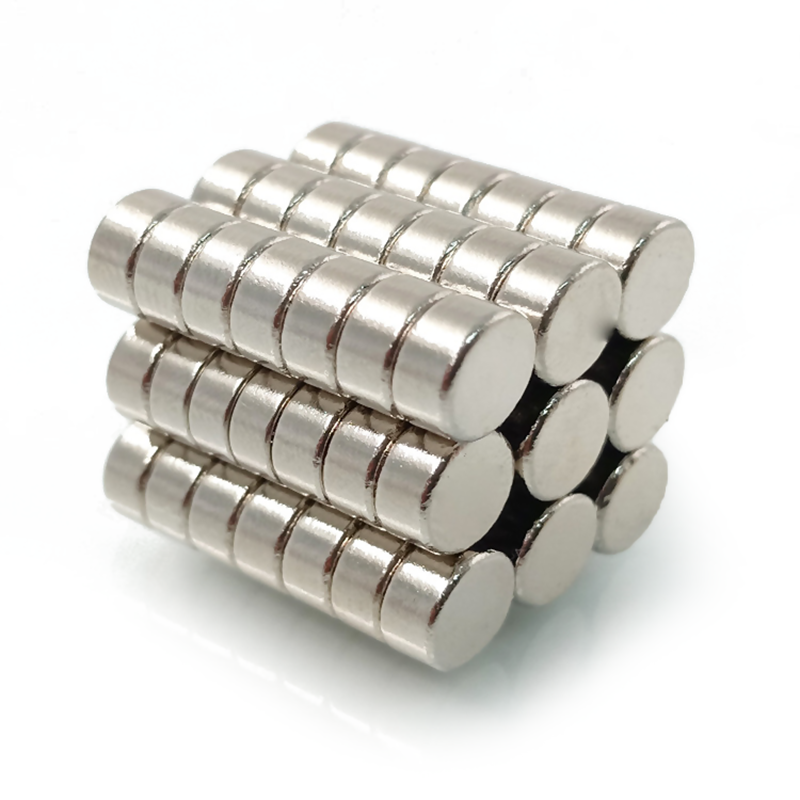
Quantifying the Strength: How Strong is N52 in Practice?
Engineers often specify N52 purely for its unparalleled strength-to-weight ratio. A small disc weighing just a few grams can hold several kilograms of steel. However, laboratory ratings rarely match real-world factory floor conditions.
Pull Force vs. Weight
Under ideal conditions, an N52 magnet is capable of lifting thousands of times its own weight. A block magnet the size of a matchbox can easily generate over 100 pounds of direct pull force. This extraordinary metric enables extreme miniaturization in modern technology. Drone motors, robotic joints, and miniature acoustic drivers rely entirely on this massive energy density.
Real-World Variables
Rated pull force relies on flawless, ideal conditions. Manufacturers test magnets against a perfectly flat, thick piece of solid steel. Real-world applications are inherently flawed. Performance degrades rapidly due to several environmental and mechanical variables.
- Air Gaps: Magnetic flux hates traveling through air. Even a one-millimeter gap severely drops flux density. Paint, plastic housings, or adhesive layers act as air gaps. A magnet rated for 50 lbs might only hold 10 lbs through a thin plastic shell.
- Mating Steel Thickness: Thin sheet metal saturates quickly. Once the metal absorbs all the magnetic flux it can hold, the excess flux is wasted. A massive N52 magnet placed against thin aluminum or thin steel will perform poorly. You need adequate steel thickness to fully utilize a 52 MGOe rating.
- Direction of Applied Load: Magnets resist direct pull forces incredibly well. They perform terribly against shear forces. If you slide a magnet sideways along a steel wall, it requires significantly less force to move it. Shear resistance is typically only 15% to 25% of the direct pull force.
Performance Drop-Off Chart (Simulated Values)
| Variable Applied | Ideal Pull Force (lbs) | Real-World Pull Force (lbs) | Percentage Retained |
| Direct Contact (Thick Steel) | 100.0 | 100.0 | 100% |
| 1mm Air Gap (Plastic Layer) | 100.0 | 35.0 | 35% |
| Thin Steel Plate (Saturation) | 100.0 | 45.0 | 45% |
| Shear Force (Sliding Down Wall) | 100.0 | 20.0 | 20% |
N52 vs. Alternative Grades (N35 and N45): A Procurement Matrix
Every engineering project demands strict resource management. You should not default to the strongest grade available. Comparing Neodymium N52 magnets against common alternatives helps clarify procurement strategies.
N52 vs. N35 (The Baseline Comparison)
Grade N35 acts as the universal baseline for the rare-earth magnet industry. It offers excellent performance for general applications.
Performance: N52 is approximately 50% stronger than N35 by volume. If you have an N35 cylinder, an N52 cylinder of the exact same dimensions will pull 50% harder.
Business Case: Use N35 for static, large-footprint applications where upfront budget is the primary driver. If your design has ample physical space, a larger N35 magnet works perfectly. Use N52 when extreme miniaturization is absolutely mandatory. Medical catheter tracking devices, high-end consumer electronics, and lightweight aerospace components cannot accommodate bulky N35 materials.
N52 vs. N45 (The Incremental Choice)
N45 represents a powerful mid-tier option. It balances high strength with easier manufacturing tolerances.
Performance: This is a marginal step up. N52 offers roughly 10% to 15% more strength than N45. The difference is subtle but critical in edge cases.
Business Case: Evaluate this comparison when N45 fails to meet a strict holding threshold by a narrow margin. If a robotic gripper drops a payload during high-speed testing while using N45, upgrading to N52 justifies the premium. It provides that final push over the failure line without redesigning the entire mechanical housing.
Grade Selection Matrix
| Grade | Relative Strength | Best Application Scenario | Miniaturization Potential |
| N35 | Baseline (1.0x) | Large volume, low spatial constraints | Low |
| N45 | High (1.3x) | General robotics, industrial motors | Medium |
| N52 | Maximum (1.5x) | Aerospace, micro-electronics, precise sensors | Extreme |
Implementation Realities: Risks, Hazards, and Trade-offs
Deploying extreme magnetic strength introduces unique mechanical and environmental challenges. You must mitigate these risks during the early design phases.
Thermal Instability
Heat acts as the ultimate enemy of the NdFeB alloy. You must differentiate between Curie temperature and Maximum Operating Temperature. Standard N52 magnets risk irreversible flux loss if the ambient environment exceeds 80°C (176°F). Once the internal lattice absorbs too much thermal energy, the magnetic domains scatter randomly. Cooling the magnet down will not restore the lost strength. For high-heat motors or engine bays, you must source modified grades like N52M (100°C limit) or N52H (120°C limit). These modifications introduce Dysprosium to increase heat resistance, though they often slightly lower overall pull force.
Brittleness and Mechanical Failure
A higher energy product usually indicates a more fragile crystal lattice. N52 materials are notoriously prone to chipping, cracking, or shattering upon impact. You must treat them like fragile ceramic glass.
Common Mistake: Do not use N52 components as structural load-bearing elements. If two raw N52 magnets slam together across a workbench, the impact force will likely shatter them into sharp shrapnel. Always design mechanical stops or rubber bumpers into your assemblies.
Corrosion Vulnerability
Iron makes up the bulk of the NdFeB alloy. Uncoated iron rusts rapidly when exposed to humidity or oxygen. Corrosion causes the magnet to expand, flake, and lose volume, destroying its magnetic field.
Best Practices for Surface Treatments:
- Ni-Cu-Ni (Nickel-Copper-Nickel): The universal standard. It provides a shiny, durable finish suitable for most dry indoor applications.
- Epoxy: Essential for highly corrosive environments, marine applications, or exposure to harsh industrial solvents.
- Zinc: A cheaper alternative to Nickel. It works well for internal mechanical parts shielded from direct moisture.
Assembly and Safety Hazards
Manufacturing lines face significant risks when handling large 52 MGOe components. The pinch hazards are extreme. A pair of large N52 blocks can effortlessly crush fingers or hands trapped between them. Furthermore, strong magnetic fields interfere with pacemakers and sensitive medical equipment. Your factory floor requires specialized handling protocols, non-magnetic tools, and rigorous safety training during final assembly procedures.
Sourcing N52 Magnets: How to Verify and Specify
Procuring extreme-grade materials requires precise documentation. A vague purchase order leaves your project vulnerable to counterfeit materials.
Defining the Requirements
Guide your engineering team to clearly define dimensions and mechanical tolerances. Standard tolerances sit around +/- 0.004 inches, but precision assemblies might require +/- 0.002 inches. You must explicitly define the magnetization direction. Specify whether the cylinder is magnetized axially (through the length) or diametrically (across the diameter). An incorrect magnetization direction renders the component useless.
Supplier Verification
The global market suffers from sub-spec materials. Many suppliers ship N45 or N48 grades stamped as N52. Visual inspection cannot identify the difference. Advise your buyers to request rigorous technical documentation.
- Hysteresis Graphs: Demand full B-H curve graphs. These show exactly how the material behaves under stress.
- Demagnetization Curves: These prove the material's Intrinsic Coercivity (Hci). They show at what point the magnet will permanently lose strength.
- Fluxmeter Test Reports: Request batch-specific testing data to prove you are receiving genuine 52 MGOe material.
Next Steps in Sourcing
Never commit to massive production tooling based on theoretical math. Recommend prototyping with low-volume samples first. Build a physical rig. Test the magnets inside your actual housing. Apply your specific air gaps and measure the real-world hold force. Once the prototype passes mechanical drop testing and thermal cycling, you can safely proceed to mass production.
Conclusion
Neodymium N52 magnets remain a highly specialized, premium component designed strictly to solve complex spatial and weight limitations in advanced engineering. They offer unparalleled magnetic flux but require rigorous thermal, mechanical, and safety management.
To ensure project success, keep these final action steps in mind:
- Calculate your exact pull force requirements against your real-world air gaps before specifying N52.
- Verify ambient operating temperatures; switch to N52M or N52H if your assembly exceeds 80°C.
- Demand strict B-H curves and fluxmeter test reports from your supplier to prevent counterfeits.
- Consult with a dedicated magnetics engineer to download a pull-force calculator and request a sample quote for your specific prototype.
FAQ
Q: Are N52 magnets close to the physical limit of magnetic strength? (Why is there no N100?)
A: Yes. The theoretical physical limit of the NdFeB crystalline structure is roughly 64 MGOe. At the atomic level, the material cannot hold more magnetic energy without breaking apart. N100 is physically impossible with current materials. Grades like N55 exist in labs but are too brittle for reliable commercial use.
Q: Can I achieve N52 strength by just using a larger N35 magnet?
A: Yes. Total magnetic volume dictates holding force. A significantly larger N35 magnet can perfectly match the holding force of a tiny N52 magnet. You should choose this route if your application easily allows for the increased size and weight, saving considerable material expenses.
Q: Do N52 magnets lose their strength over time?
A: Under optimal conditions, N52 magnets lose only a tiny fraction of a percent of their strength every decade. As long as you protect them from extreme heat above 80°C, heavy physical impacts, radiation, or strong opposing magnetic fields, they will remain permanently magnetized for your lifetime.