Engineers and procurement managers constantly face a delicate balancing act when specifying rare-earth materials. You need exact performance specifications, clear operational limitations, and a solid cost-benefit ratio. Failing to grasp these metrics often leads to catastrophic failures.
The Industrial N40 Neodymium Magnet (NdFeB) emerges as a highly efficient mid-to-high tier solution. It perfectly balances intense magnetic flux density with highly scalable production capabilities. Yet, over-specifying a component by defaulting to an N52 grade severely wastes project budgets. Conversely, under-specifying your grade risks sudden, irreversible demagnetization in the field.
We will explore the critical properties and commercial application ranges of the N40 grade. You will learn how to evaluate thermal thresholds and select durable protective coatings. Furthermore, we will define strict procurement criteria necessary for your next engineering project.
Key Takeaways
- Performance Tier: N40 offers an optimal Maximum Energy Product (BHmax of ~38-41 MGOe), sitting in the "sweet spot" for industrial motors and sensors where N35 is too weak and N52 is unnecessarily expensive.
- Thermal Vulnerability: Standard N40 degrades at 80°C (176°F). High-temperature variants (N40M, N40H, N40SH) are strictly required for high-friction or enclosed applications.
- Protection is Mandatory: NdFeB oxidizes rapidly; selecting the correct coating (Ni-Cu-Ni, Epoxy, or Zinc) is as critical as selecting the magnetic grade.
- Sourcing Criterion: Verifying raw material purity and testing for precise magnetization direction are the two most critical steps in the procurement evaluation phase.
The N40 Value Proposition: Why Choose N40 Over N35 or N52?
Engineers often face a difficult dilemma during the initial component design phase. They routinely select magnetic grades based purely on theoretical pull-force calculations. This isolated metric ignores crucial factors like operational stability and budget limits. Over-specifying strength often ruins project budgets entirely. You need a balanced, analytical approach.
Compare the baseline N35 and N38 grades against the N40 tier. An Industrial N40 Neodymium Magnet typically provides 10-15% more magnetic yield. This performance increase occurs without a proportionate jump in rare-earth raw material costs. You get significantly stronger flux density for compact spaces. Meanwhile, manufacturing budget impacts remain highly manageable.
Premium grades like N50 and N52 present a completely different manufacturing challenge. These top-tier materials follow an exponential, unforgiving cost curve. Furthermore, they exhibit increased brittleness during the physical assembly process. High-volume manufacturing lines require absolute reliability and consistent handling. N40 remains the more reliable choice for mass production. It resists chipping and cracking far better than N52 counterparts.
Establish clear success criteria early in your design phase. N40 proves to be the ideal choice when spatial constraints demand a strong field. Compact electro-mechanical assemblies require high energy density. However, standard commercial budgets simply cannot accommodate top-tier aerospace grades. N40 effectively bridges this gap between technical capability and financial feasibility.
Common Mistakes in Grade Selection
- Defaulting to the highest available grade just to guarantee sufficient holding force.
- Ignoring the increased brittleness of N52 magnets during automated assembly routines.
- Failing to account for the actual operating temperature when comparing N35 to N40.
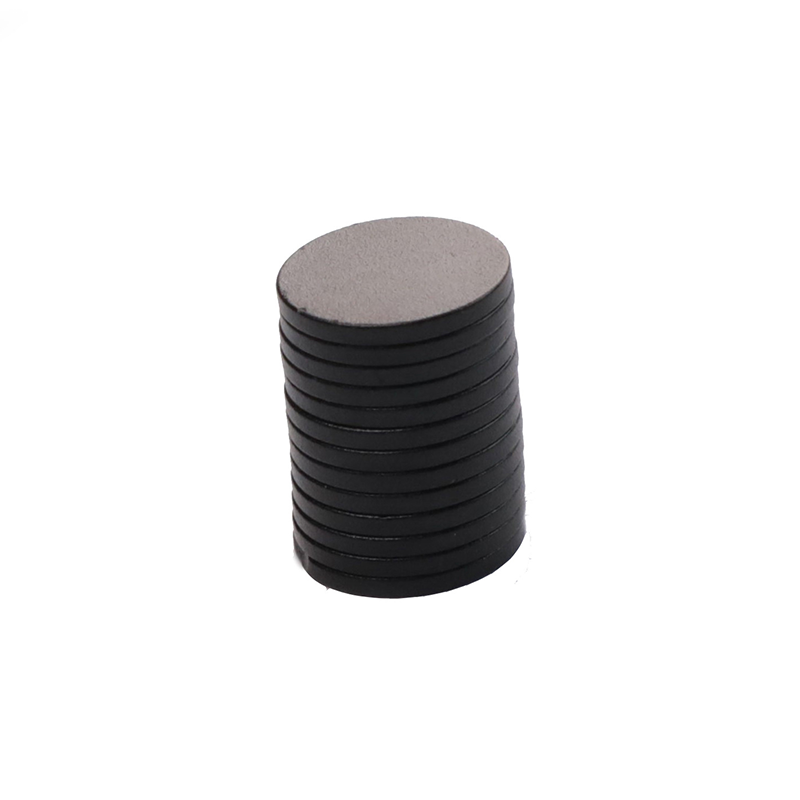
Core Magnetic and Physical Properties of N40
Standardized evaluation dimensions form the foundation of proper material selection. You must thoroughly understand four critical metrics. These values drive product data sheets and validate complex CAD simulations. Proper magnetic modeling requires highly accurate material inputs.
First, we measure Remanence (Br). This metric dictates how much magnetic field remains after initial magnetization. You can expect a strict range of 12.5 to 12.8 kGs. Second, Coercivity (Hcb) indicates the inherent resistance to demagnetization. N40 requires an Hcb of ≥ 11.4 kOe. Third, Intrinsic Coercivity (Hcj) sits at ≥ 12.0 kOe. This specific rating is crucial for opposing external magnetic fields.
Finally, the Maximum Energy Product (BHmax) defines the overall power metric. It ranges strictly between 38 and 41 MGOe. This number essentially quantifies the maximum magnetic energy stored within the material volume. Higher BHmax allows engineers to design smaller, more efficient magnetic circuits.
Physical characteristics also directly dictate your available assembly methods. The material density measures approximately 7.4 to 7.5 g/cm³. Vickers hardness ratings confirm extreme inherent brittleness. Never attempt to machine or drill an Industrial N40 Neodymium Magnet post-magnetization. Conventional machining shatters the material instantly. You must finalize all dimensions before the magnetization process.
Comparative Parameter Table
| Grade | Remanence (Br) | Coercivity (Hcb) | Intrinsic Coercivity (Hcj) | Max Energy (BHmax) |
| N35 | 11.7 - 12.1 kGs | ≥ 10.9 kOe | ≥ 12.0 kOe | 33 - 35 MGOe |
| N40 | 12.5 - 12.8 kGs | ≥ 11.4 kOe | ≥ 12.0 kOe | 38 - 41 MGOe |
| N52 | 14.3 - 14.8 kGs | ≥ 10.5 kOe | ≥ 11.0 kOe | 49.5 - 52 MGOe |
Thermal Stability and the N40 Suffix Designations
Thermal degradation poses a severe demagnetization risk for rare-earth metals. Neodymium materials have an absolute physical limitation regarding ambient heat. We track the Curie temperature and the maximum operating temperature (Max OpTemp). Exceeding these thermal thresholds causes permanent, irreversible flux loss.
Decoding the specific suffixes translates physical features into practical outcomes. The standard N40 handles a Max OpTemp of 80°C. We strongly recommend this for ambient IoT sensors, consumer electronics, and standard holding applications. The N40M (Medium) variant safely pushes the limit to 100°C. This specific trait makes it highly suitable for industrial actuators and stepper motors.
Heavy-duty environments strictly demand the N40H (High) specification. It sustains magnetic properties up to 120°C consistently. You require this exact grade for automotive sensors and enclosed heavy-machinery environments. Finally, the N40SH (Super High) and N40UH variants survive 150°C to 180°C environments. These are entirely mandatory for high-RPM brushless DC (BLDC) motors and magnetic couplings.
Procurement teams must follow specific technical evaluation advice. Calculate the peak localized temperatures deep within your assembly. Do not rely solely on external ambient operating temperatures. Friction and enclosed copper coils generate intense localized heat spikes. Predicting these specific thermal spikes helps avoid sudden magnetic loss.
N40 Thermal Variant Chart
| Suffix Designation | Max Operating Temp (°C) | Curie Temperature (°C) | Ideal Application |
| Standard N40 (No Suffix) | 80°C (176°F) | 310°C | Consumer electronics, ambient sensors |
| N40M (Medium) | 100°C (212°F) | 340°C | Actuators, standard stepper motors |
| N40H (High) | 120°C (248°F) | 340°C | Automotive sensors, machinery |
| N40SH (Super High) | 150°C (302°F) | 340°C | High-RPM BLDC motors |
Coatings, Corrosion, and Environmental Compliance
Implementation realities often surprise inexperienced component designers. Raw NdFeB contains exceptionally high levels of iron content. This chemical makeup makes any unprotected industrial N40 highly susceptible to rapid oxidation. Structural degradation always follows surface rust formation quickly. The material will literally crumble into highly magnetic powder.
Evaluating specialized coating solutions ensures long-term operational success. Ni-Cu-Ni (Nickel-Copper-Nickel) serves as the trusted industry standard. It provides exceptional durability and remains highly conductive. Note its exact dimensional impact during CAD modeling. This tri-layer coating adds roughly 10-20 microns to the overall structural geometry.
Epoxy coatings offer the ultimate protection for incredibly harsh sectors. Use them extensively for marine, chemical, or outdoor environments. They provide excellent salt-spray resistance over long periods. However, epoxy surfaces are relatively soft and scratch easily during mechanical assembly. Zinc provides a cost-effective alternative for controlled, low-humidity environments. Keep in mind it imposes a slightly lower operating temperature limit.
Compliance considerations remain paramount for global product distribution. Remind your procurement teams to verify all supplied materials carefully. Coatings and base metals must meet strict RoHS and REACH compliance guidelines. This regulatory documentation is completely mandatory, especially for European distribution markets.
Best Practices for Coating Specification
- Account for the 10-20 micron coating thickness when calculating press-fit tolerances.
- Avoid epoxy coatings in assemblies where high friction forces scrape the magnet surface.
- Request salt-spray test certificates from suppliers when ordering Ni-Cu-Ni batches.
Industrial Applications and Procurement Shortlisting Criteria
Proven use cases demonstrate exactly where N40 excels commercially. Magnetic separation equipment relies heavily on this specific grade. Food and chemical processing plants need extremely strong fields to capture tramp iron. High-efficiency electric motors and generators represent another massive global market. Wind turbines utilize these components for reliable energy conversion.
Magnetic bearings and couplings also benefit immensely from this material. They seamlessly transfer massive torque without any physical contact. Precision robotics and automation sensors demand absolute magnetic consistency. N40 provides the exact flux density required for highly accurate Hall-effect sensor readings.
Drafting a comprehensive Request for Quote (RFQ) requires strict attention to detail. Use a robust, predefined checklist for engaging overseas suppliers. Specify the exact shape, size, and strict dimensional tolerances. Tolerances of ±0.05mm are entirely typical for precision aerospace and automotive assemblies.
Define the precise magnetization direction clearly on your blueprints. State whether you need Axial, Diametrical, or complex Multipole configurations. Request official demagnetization curves and batch-testing reports immediately. B-H curves verify supplier expertise and manufacturing reliability. They confirm material consistency long before mass production begins.
Essential RFQ Checklist
- Define exact geometric dimensions including acceptable ±0.05mm tolerance bands.
- Specify the precise coating type and required micron thickness.
- Declare the mandatory temperature suffix (e.g., N40H vs standard N40).
- Request third-party RoHS and REACH compliance certificates.
- Demand a B-H curve chart specifically tested for your requested batch.
Conclusion
An industrial N40 rare-earth magnet represents the most commercially viable intersection of supreme strength and cost control. High magnetic output does not have to break your engineering budget. Success depends entirely on specifying the absolutely correct temperature suffix. You must also select the optimal environmental coating to prevent catastrophic oxidation.
By understanding remanence, intrinsic coercivity, and precise dimensional tolerances, engineers can confidently design highly efficient systems. Avoid the common pitfall of defaulting to N52. N40 delivers a powerful, highly stable magnetic field for demanding applications.
Consult with a dedicated magnetics engineer early in your design cycle. Request a comprehensive B-H curve chart specifically for N40 materials. Submit your detailed CAD models for custom quoting and strict tolerance verification to guarantee manufacturing success.
FAQ
Q: Can an N40 neodymium magnet be machined or altered after purchase?
A: No. They are extremely brittle and highly flammable dust is created during cutting. They must be manufactured to their exact net shape before magnetization and coating.
Q: How much stronger is N40 compared to standard ceramic (ferrite) magnets?
A: Roughly 10 times stronger by volume. This immense power allows engineers to drastically reduce the size and overall weight of their electro-mechanical assemblies.
Q: Will an N40 magnet lose its strength over time?
A: Under normal conditions, neodymium magnets lose merely a fraction of a percent of their strength every 10 years. Extreme heat is the primary degrader, not time.
Q: How do I verify I actually received N40 and not a lower grade like N35?
A: Demand official material certification and hysteresis graph testing from the supplier. Alternatively, verify the parts using a Gauss meter against the expected surface field for the magnet's specific geometry.