Finding the perfect spherical magnet demands careful technical consideration and strategic planning. Sourcing the right components requires balancing magnetic pull force against environmental constraints, structural fragility, and strict safety regulations. Unfortunately, many engineers assume higher grades guarantee better performance. Over-specifying a default N52 grade often wastes project budgets unnecessarily. Conversely, under-specifying essential protective coatings inevitably leads to rapid corrosion or catastrophic mechanical failure during active operation. Avoiding these extremes ensures long-term reliability and safe deployment.
This guide provides a detailed technical evaluation framework to help you navigate these common industry challenges. You will discover practical methods to evaluate materials, compare coating durability, and manage crucial safety standards. We give engineers, product designers, and buyers the actionable knowledge needed to shortlist the correct Ball Magnet for any specific application.
Key Takeaways
- Material dictates capability: Neodymium ball magnets offer the highest pull-force-to-volume ratio but require protective coatings; ferrite spheres are weaker but inherently corrosion-resistant and cost-effective.
- Grade isn't everything: Environmental factors like maximum operating temperature (Max Op Temp) and moisture exposure should drive your coating and material choices before magnetic grade.
- Safety compliance is non-negotiable: Sourcing magnetic spheres for consumer products requires strict adherence to CPSC guidelines due to severe ingestion hazards.
- Handling limits lifespan: Spherical magnets have small point-of-contact surface areas, making them highly susceptible to shattering if allowed to impact one another freely.
Defining Your Ball Magnet Application and Success Criteria
Engineers must define specific operational requirements before comparing magnetic grades. A successful deployment relies on understanding exact environmental stressors and geometrical limitations. You should assess these factors early to avoid systemic design failures.
Holding Force vs. Point of Contact
Assess your actual holding requirements carefully. Spherical magnets possess unique geometrical challenges compared to traditional shapes. They only make contact at a single microscopic point when placed against flat surfaces. Consequently, their effective holding force is significantly lower than disc or block magnets of the same volume. The magnetic flux concentrates entirely at this tangent point. You must account for this reduction when calculating necessary grip strength. Designers often mistakenly assume a 10mm sphere will hold the same weight as a 10mm cylinder. This common mistake leads to underperforming assemblies. Always over-index your required pull force when transitioning from flat to spherical designs.
Operating Environment Triage
Your operating environment dictates structural and chemical requirements. Identify any expected exposure to moisture, corrosive chemicals, or harsh outdoor elements. These conditions strictly dictate your coating requirements. Bare magnetic materials degrade rapidly when exposed to humidity. Furthermore, you must determine your peak operating temperatures. Standard neodymium loses its magnetism completely above 80°C (176°F). You will need specialized high-temperature grades if your application involves industrial heat. Heat demagnetization represents a permanent loss of performance. We recommend mapping out a thermal profile of your operational environment before making any material selections.
End-User Identification
You must differentiate between industrial and consumer use cases. Industrial applications often include robotic sensors, structural joints, or fluid agitation mechanisms. These mechanical environments prioritize raw performance and thermal stability. Consumer applications usually encompass educational models, jewelry, or retail displays. Consumer goods require strict regulatory adherence to establish safety baselines. A product destined for a factory floor faces vastly different legal scrutiny than one sold in a toy store. Identifying your end-user guarantees you meet the correct legal safety frameworks.
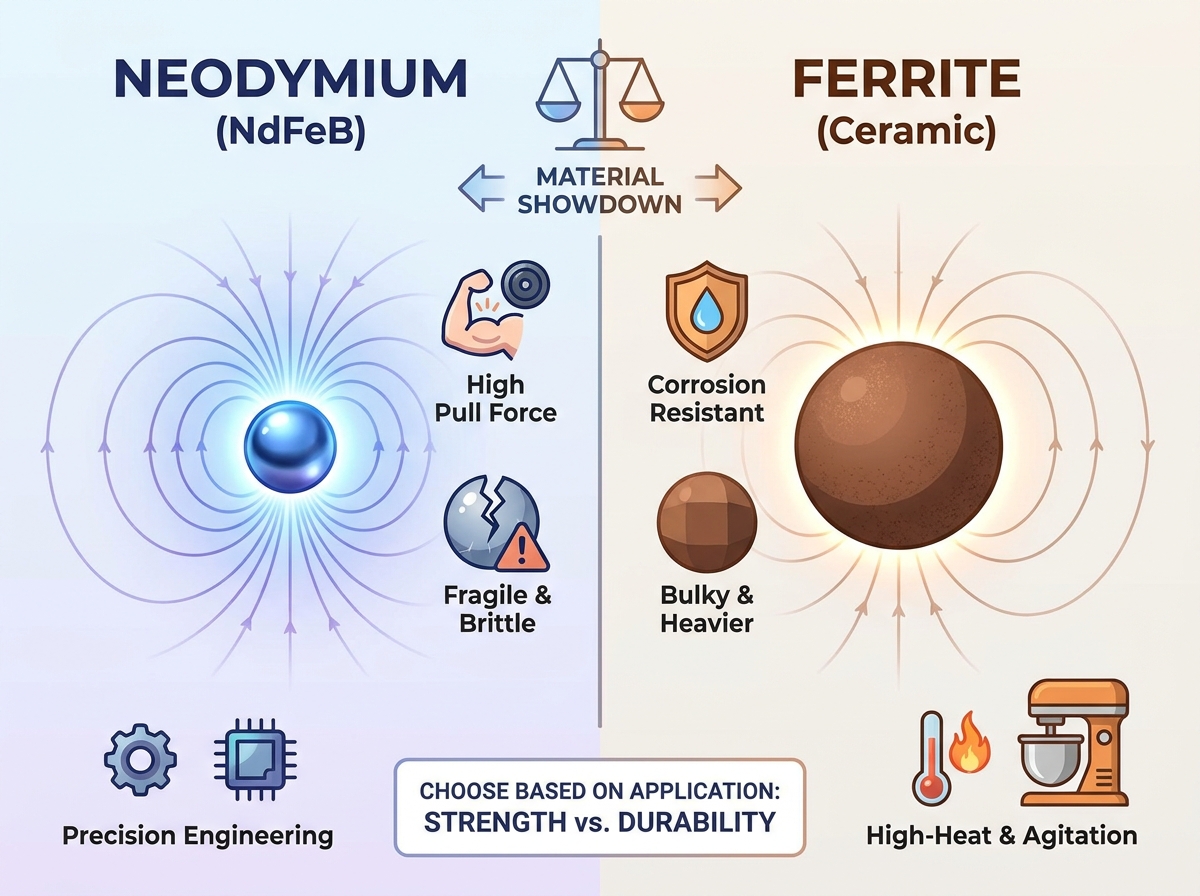
Neodymium vs. Ferrite: The Core Material Showdown
The core material dictates every physical characteristic of your finished product. Two dominant materials control the market: Neodymium and Ferrite. Each presents distinct advantages and compromises. Understanding these profiles helps you match the exact material to your performance needs.
Neodymium (NdFeB) Ball Magnets
Neodymium delivers unmatched magnetic strength. It remains the ideal choice for miniaturized designs requiring intense holding force inside a small footprint. Engineers rely on neodymium for precision applications where space is extremely limited. However, this material harbors significant vulnerabilities. The iron-rich composition makes it highly prone to rapid oxidation and corrosion. Moreover, the crystalline structure creates a very brittle component. Neodymium spheres are highly vulnerable to chipping upon sudden impact. Despite these drawbacks, they remain best suited for precision engineering, magnetic joints, and premium commercial products.
Ferrite (Ceramic) Ball Magnets
Ferrite components provide moderate to low magnetic pull. Manufacturers can produce them significantly cheaper at scale using abundant iron oxides. These ceramic spheres boast inherent resistance to rust and corrosion without needing external plating. Their primary vulnerability lies in their bulky nature. You require a much larger diameter to match the pull force of a tiny neodymium sphere. This adds unwanted weight to delicate assemblies. Ferrite remains best for high-heat environments, underwater applications, low-cost educational tools, and heavy-duty industrial agitation processes.
Material Comparison Matrix
| Feature / Specification | Neodymium (NdFeB) | Ferrite (Ceramic) |
| Magnetic Strength | Extremely High (N35 to N52) | Low to Moderate (C1 to C8) |
| Corrosion Resistance | Very Poor (Requires Coating) | Excellent (Inherently Rust-Proof) |
| Maximum Temperature | 80°C standard (up to 200°C custom) | Up to 250°C standard |
| Mechanical Durability | Brittle, prone to shattering | Hard, prone to chipping |
| Primary Use Cases | Precision joints, miniaturization | High heat, wet environments |
Evaluating Coatings, Tolerances, and Specifications
Raw magnetic material rarely survives real-world deployment unprotected. You must specify appropriate external finishes and dimensional strictness to ensure component longevity. Careful specification prevents assembly line failures and premature field degradation.
Choosing the Right Coating (For Neodymium)
Neodymium demands protection from atmospheric moisture. The right coating preserves both performance and visual aesthetics.
- Ni-Cu-Ni (Nickel): This acts as the reliable industry standard. It provides a shiny, durable finish suitable for most indoor, low-abrasion applications. It resists general ambient humidity well.
- Epoxy / Rubber: You will find this essential for humid environments or direct outdoor use. Rubberized coatings also excel at mitigating impact shock. They act like microscopic bumpers during sudden collisions.
- Gold / Silver: Designers primarily choose these for high-end aesthetic applications like jewelry or executive desk toys. They also serve specific electrical conductivity requirements in medical devices.
Dimensional Tolerances
Sizing accuracy directly impacts automated assembly lines. You must understand manufacturing limits. Standard manufacturing tolerances for ball magnets typically hover around ±0.05mm. Centerless grinding machines achieve this baseline efficiently. However, high-precision mechanical applications require tighter control. Mechanisms like fluid magnetic ball joints may require custom machining to achieve ±0.02mm. This increased precision heavily impacts production lead times and unit pricing. A common mistake is ordering hyper-precise tolerances for static holding applications. You only need tight tolerances for active, moving mechanical joints.
Critical Safety, Compliance, and Handling Risks
High-powered spherical components introduce unique physical and regulatory dangers. Ignorance of these factors frequently leads to product recalls and severe injuries. Safe integration requires rigorous planning throughout the entire product lifecycle.
Regulatory Compliance
You must review specific regional legislation regarding small, high-powered magnetic spheres. The US Consumer Product Safety Commission (CPSC) enforces strict rules governing these components. Magnets fitting within a standard small parts cylinder face intense scrutiny. This testing cylinder measures roughly 31.7mm in diameter. If a sphere fits inside and possesses a flux index greater than 50 kG² mm², regulators ban it in consumer toys. These bans exist due to catastrophic internal injuries caused by ingestion. Always verify your target market's safety parameters before authorizing mass production.
Mechanical Failure Risks
Engineers must proactively address the physical "shatter factor." High-grade neodymium spheres will accelerate toward magnetic metals rapidly. The magnetic pull force increases exponentially as the distance decreases. The resulting high-speed point-impact concentrates immense kinetic energy. This sudden shock can cause the magnet to chip, flake its coating, or completely shatter. Shattered neodymium releases hazardous, razor-sharp shards into the immediate environment. You must design housing constraints to prevent free-flight collisions between raw magnets.
Assembly Considerations
Manufacturing floors require adapted procedures. You should plan for specialized handling protocols during early manufacturing stages.
- Operators must use non-magnetic beryllium copper or titanium tools to prevent accidental attraction.
- Workstations require heavily padded assembly zones to prevent inventory loss through impact damage.
- Workers should maintain strict spatial separation between bulk batches to prevent chain-reaction collisions.
- Implement visual counting trays to ensure no stray spheres remain hidden in the workspace.
How to Shortlist and Specify Your Order
Procuring a Ball Magnet requires a structured approach. Haphazard ordering leads to incompatible components and wasted engineering hours. Follow this sequential framework to specify your ideal configuration.
- Step 1: Size and Geometry. Lock in your required diameter in exact millimeters. Remember a crucial physical law: doubling the diameter exponentially increases the magnetic volume and resulting pull force. Do not guess your sizing requirements.
- Step 2: Material and Grade Matrix. Select Ferrite for budget-conscious or high-heat durability. Select Neodymium for maximum strength. If choosing Neodymium, align the exact grade (N35 to N52) with your specific holding force requirement. Opt for lower grades like N35 to save costs if maximum strength isn't strictly necessary.
- Step 3: Customization and Lead Times. Decide if standard off-the-shelf sizes work for your prototype. Determine if you need custom diameters, specific magnetization directions, or non-standard coatings. Axial versus diametrical magnetization drastically alters how spheres interact. Custom requests always extend standard lead times.
- Step 4: Vendor Vetting. Always request sample batches first. Use these samples to test coating durability and pull force consistency in your real-world assembly process. Never commit to high-volume purchase orders before completing rigorous physical testing.
Conclusion
Sourcing the ideal spherical magnet involves far more than simply picking the highest grade available. Your final selection hinges entirely on balancing required pull force against harsh environmental realities and strict safety standards. By systematically evaluating materials, appropriate coatings, and mechanical tolerances, you protect your product from premature failure.
To ensure a successful procurement process, follow these actionable next steps:
- Document your precise required diameter, maximum environmental temperature, and specific coating needs based on humidity exposure.
- Evaluate your end-user demographic to ensure strict compliance with regional CPSC ingestion regulations.
- Calculate your true holding force requirements by factoring in the limiting point-of-contact geometry of spheres.
- Reach out to a certified magnet manufacturer to request physical test samples and secure bulk pricing data.
FAQ
Q: What is the strongest type of ball magnet available?
A: Neodymium N52 grade represents the strongest commercially available option. It offers exceptional pull-force relative to its volume. However, specific application requirements involving high heat or corrosion may make lower grades or ferrite alternatives more practical for long-term use.
Q: Why do spherical magnets have less pull force than disc magnets of the same size?
A: Spherical shapes only make contact at a single microscopic tangent point on flat surfaces. Disc magnets utilize their entire flat surface area. This point-contact dynamic severely limits the amount of magnetic flux transferring into the target material, reducing effective grip strength.
Q: Can ball magnets be used outdoors or in water?
A: Yes, you can use them outdoors. However, they must be either naturally rust-proof Ferrite or Neodymium protected by specialized, completely sealed epoxy or rubber coatings. Standard nickel coatings will eventually fail and allow rapid corrosion in wet environments.
Q: Are magnetic spheres legal to use in commercial products?
A: Yes, they remain legal for industrial and B2B applications. However, regulators strictly ban high-powered small spheres in children's toys and certain consumer goods due to severe internal ingestion risks. Always consult current regional CPSC guidelines before launching consumer products.
Q: How do you determine the poles on a ball magnet?
A: Because spheres are visually symmetrical, poles are indistinguishable by eye. You can identify the exact poles using magnetic viewing film, which visually reacts to flux lines. Alternatively, a marked magnetic compass will reliably align itself with the sphere's north and south poles.