Moving from a prototype to bulk manufacturing requires precise component decisions. Engineers and procurement managers constantly seek the ideal balance between performance and budget. An N40 Magnet often provides this strategic middle-ground in the neodymium family. It delivers a higher magnetic output than a baseline N35. It also avoids the steep premium pricing of an N52.
Misunderstanding these specifications can lead to costly manufacturing delays. Buyers need a clear framework for defining magnetic properties. You also need accurate ways to forecast pricing based on volume and machining complexity. This guide explores essential technical specifications and cost drivers. You will learn how to structure a foolproof Request for Quote (RFQ). We will also show you how to verify shipments to prevent supplier bait-and-switch tactics.
Key Takeaways
- Performance Sweet Spot: An N40 magnet delivers roughly 10-14% more magnetic strength than an N35, offering necessary pull force for motors and sensors without the premium markup of N52.
- Pricing Drivers: Cost is dictated less by the raw grade and more by volume (MOQ), machining complexity, and rare-earth commodity market fluctuations.
- Specification Vulnerabilities: Merely requesting "N40" is insufficient; buyers must define tolerances, magnetization direction, and thermal thresholds (e.g., standard vs. N40H) to ensure component viability.
- Verification is Mandatory: Visual inspection cannot differentiate N40 from N35; buyers must implement Gauss meter or pull-force testing protocols upon receiving samples.
Demystifying N40 Magnet Specifications
Misunderstanding core magnetic properties often leads to procurement mistakes. Over-engineering wastes your project budget unnecessarily. Conversely, under-engineering causes premature product failure in the field. You must look beyond the basic grade name. Specifying an N40 Magnet requires documenting exact technical metrics to ensure reliability.
Engineers and buyers must define three core metrics on every drawing. These values dictate how the magnet will perform inside your final assembly.
- Maximum Energy Product (BHmax): This ranges from 38 to 41 MGOe (MegaGauss Oersteds). This metric defines the "40" in the grade name. It represents the overall magnetic energy density of the material.
- Residual Flux Density (Br): This typically measures between 12.5 and 12.8 kGs. It indicates the absolute strength of the magnetic field. High Br values ensure your sensors trigger accurately at specified distances.
- Coercive Force (Hcb/Hcj): This measures the material's resistance to demagnetization. High coercivity ensures the magnet maintains its field when exposed to opposing external forces.
You must also pay close attention to thermal limitations. The standard "N" prefix carries strict temperature boundaries. Standard N40 magnets degrade permanently if operating temperatures exceed 80°C (176°F). This permanent loss of magnetic strength causes catastrophic motor or sensor failures.
If your application generates heat exceeding 80°C, you must pivot immediately to high-temperature variants. You can specify N40M for 100°C environments. You can upgrade to N40H for 120°C thresholds. For extreme applications, N40SH withstands up to 150°C. These high-heat variations cost more but guarantee long-term component survival.
N40 vs. N35 and N52: Decision-Stage Comparison
Selecting the right grade requires a structured evaluation framework. You must justify the N40 grade against the most common industrial alternatives. Understanding these differences helps procurement teams defend their purchasing decisions.
N40 vs. N35 (The Baseline)
The N35 grade serves as the industry baseline for neodymium magnets. However, many modern applications require more power. You should upgrade to an N40 when space constraints dictate a slightly smaller magnet footprint. If you cannot sacrifice pull force but need a compact design, N40 is the logical choice.
The cost impact of upgrading from N35 to N40 remains relatively marginal. You receive a substantially better strength-to-volume ratio. This small price bump easily justifies itself when designing miniaturized consumer electronics or compact industrial sensors.
N40 vs. N52 (The Premium)
N52 represents the peak of standard neodymium performance. Yet, you do not always need this premium power. You should stick with N40 when maximum absolute pull force is not critical. Budget restrictions often prevent using the highly-priced N52 grade for high-volume consumer goods.
Durability also plays a major role in factory environments. N52 magnets tend to be more brittle due to their specific material density. An N40 Magnet offers slightly better structural stability. It survives automated assembly lines and pick-and-place machines with fewer chipping incidents.
Neodymium Grade Evaluation Chart
| Grade | Relative Cost | Max Temp (Standard) | Best Use Case |
| N35 | Lowest | 80°C | Large assemblies where space is unlimited. |
| N40 | Medium | 80°C | Space-constrained designs needing reliable pull force. |
| N52 | Highest | 80°C | Miniaturized devices requiring maximum possible strength. |
Cost Analysis: What Drives N40 Magnet Prices?
We avoid listing absolute dollar amounts in magnet purchasing guides. Neodymium prices fluctuate heavily based on global rare-earth mining outputs and commodity markets. Instead, buyers must understand the transparent pricing model. Knowing what drives the cost helps you negotiate better contracts.
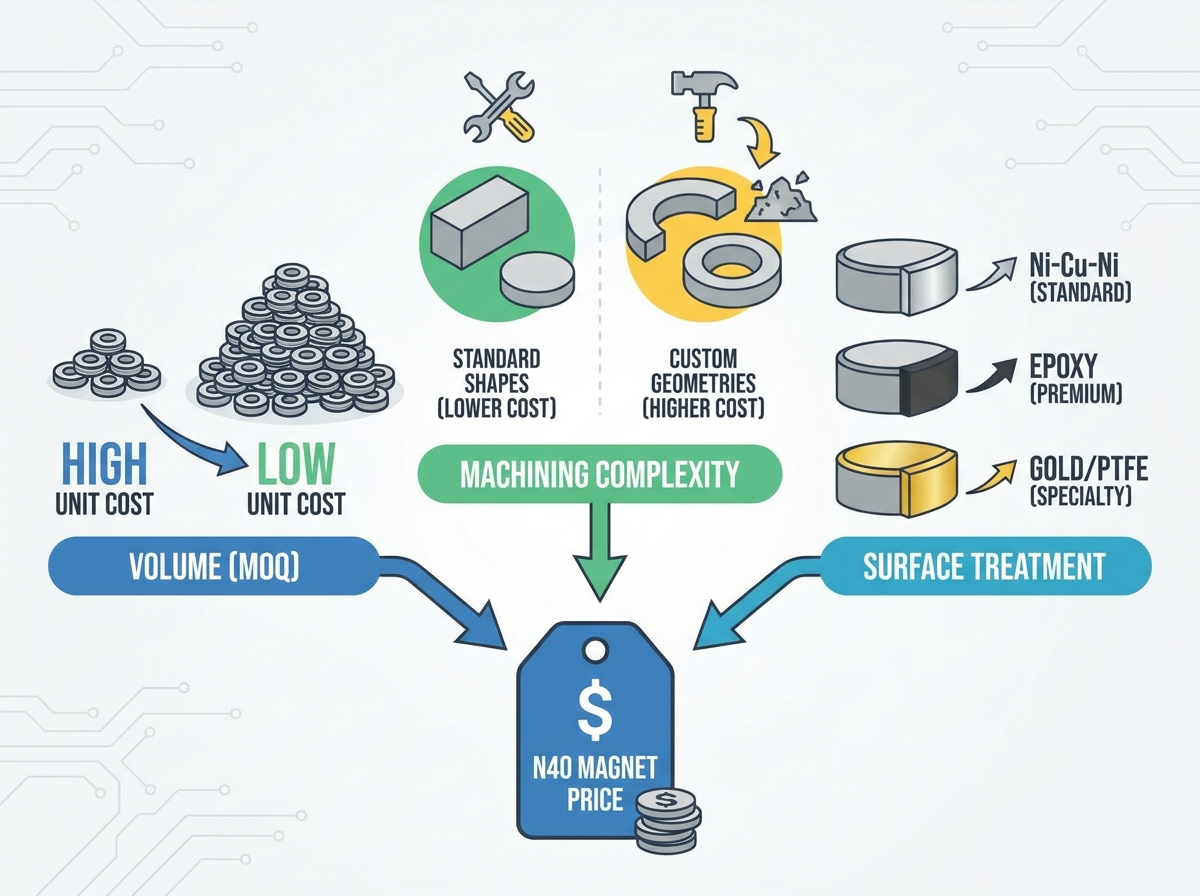
Volume and economies of scale dictate your final unit price. Setup costs for custom molds and specialized slicing machines are high. Small production batches carry heavy premium charges. Suppliers typically establish clear MOQ (Minimum Order Quantity) tiers. A quote for 1,000 units will look vastly different from a 10,000+ unit order.
Shape and machining complexity also drive up expenses rapidly. Standard blocks and discs represent the lowest cost format. Manufacturers slice them directly from large raw magnetic blocks with minimal effort. However, countersunk rings, specialized arcs, and custom geometric shapes require significantly more machining time. They also generate substantial material waste during production.
Surface treatment requirements further impact pricing. Raw neodymium rusts almost immediately in normal atmospheres. Standard Ni-Cu-Ni (Nickel-Copper-Nickel) plating remains highly cost-effective and suits most indoor applications. Upgrading to Epoxy, Gold, or Teflon (PTFE) coatings increases your unit cost. You must choose these premium coatings for harsh marine environments or chemical exposure to prevent premature oxidation failure.
How to Structure an RFQ for N40 Magnets
Implementation realities show that vague inquiries always lead to inaccurate quotes. When you leave details open, suppliers make assumptions to win your business. These assumptions often compromise component quality. You need a structured approach to sourcing.
Use this rigorous 6-point specification checklist when building your next Request for Quote (RFQ):
- Exact Grade & Temp Rating: Clearly state if you need standard N40 (80°C limit) or a high-temperature variant like N40SH (150°C limit). Do not just write "N40".
- Dimensions & Tolerances: The industry standard tolerance sits at ±0.1mm. Precision applications, like tight motor housings, require ±0.05mm. Tighter tolerances always increase the unit price.
- Magnetization Direction: Specify if the material should be magnetized axially, diametrically, or in a multi-pole configuration. Always include a detailed CAD drawing indicating the poles.
- Coating/Plating: Specify the exact coating layers required. If your product faces outdoor conditions, define the expected salt-spray test survival hours.
- Pull Force Requirements: Define the expected holding force. You must state the specific steel thickness the magnet will test against. Pull force varies based on the target material.
- Packaging Requirements: Specify if your shipment requires plastic spacers between magnets to prevent shattering during unpacking. State clearly if you need shielded shipping boxes for air freight compliance under IATA regulations.
Quality Assurance: Verifying Your N40 Shipment
Risk mitigation forms the backbone of any robust supply chain. A common industry fear involves receiving "up-badged" materials. Unscrupulous suppliers might ship cheaper N35 magnets masquerading as an N40 Magnet. Visual inspection cannot differentiate between these grades. You must establish strict verification procedures.
Implementing in-house testing protocols protects your production line. First, utilize Gauss meter testing. You measure the surface magnetic field at a specific distance. You then compare your findings against the supplier's theoretical demagnetization curve. This quickly flags substandard materials.
Next, perform standardized pull force testing. You should use a calibrated pull-tester pulling away from a standardized mild steel plate. Pull force varies greatly based on the air gap and steel thickness. Testing conditions must remain perfectly standardized across all sample batches to yield accurate comparisons.
Finally, mandate comprehensive supplier certifications. Buyers should demand demagnetization curves and Material Data Sheets (MDS) upfront. You must also collect RoHS and REACH compliance certificates before authorizing bulk production. These documents prove the supplier uses pure raw materials and compliant manufacturing processes.
Conclusion
Specifying an industrial magnet requires looking beyond just the grade name. You must define thermal limits, surface coatings, and strict dimensional tolerances to ensure reliability. Proper documentation prevents manufacturing delays and protects your assembly from premature field failures.
Your next steps should focus on solidifying your documentation. Finalize your CAD drawings and explicitly define your acceptable tolerances. Then, request a small sample batch from two to three vetted suppliers. Ensure they provide accompanying demagnetization curves. Test these samples thoroughly in-house before committing to any master purchase agreement.
FAQ
Q: Is an N40 magnet strong enough for my application?
A: It depends on the size and shape, but N40 offers a very strong magnetic field suitable for most industrial sensors, medium-duty motors, and premium consumer electronics. Pull force is a function of both grade and volume.
Q: Can N40 magnets be used outdoors or in water?
A: Not without a specialized coating. Raw neodymium rusts rapidly. For outdoor use, an N40 magnet must be sealed in plastic, coated in thick epoxy, or heavily plated (e.g., Ni-Cu-Ni + Epoxy).
Q: Why is my N40 magnet losing its strength?
A: The most common culprit is heat. Standard N40 magnets suffer irreversible demagnetization if exposed to temperatures above 80°C (176°F). Mechanical shock or exposure to stronger opposing magnetic fields can also degrade performance.
Q: What is the difference between N40 and N40H?
A: "H" indicates a higher intrinsic coercivity, meaning it is formulated to withstand higher operating temperatures (up to 120°C / 248°F) without losing its magnetization, compared to the 80°C limit of standard N40.