Metalworking requires absolute precision. Reliable alignment tools remain indispensable on any modern shop floor. Fabricators depend heavily on these holding devices to secure exact angles during critical fit-up and assembly tasks. While they successfully reduce manual clamping time, standard units frequently succumb to harsh environmental hazards. Severe heat degradation, continuous metallic debris buildup, and unpredictable weak holds routinely ruin alignment accuracy. When a holding tool fails mid-weld, it ruins materials and creates significant safety hazards.
This guide breaks down exactly how to diagnose these standard failures. We will help you protect your essential equipment effectively. We provide a grounded, technical approach to establishing strict evaluation criteria for purchasing industrial-grade tools. You will learn practical methods to troubleshoot slipping parts, prevent magnetic interference, and maximize holding efficiency immediately. Understanding these core principles transforms a frustrating consumable tool into a reliable long-term asset.
Key Takeaways
- Heat limits matter: Continuous exposure to welding temperatures can permanently degrade magnetic force (passing the Curie temperature); distance and material selection are critical.
- Spatter is preventable: Unprotected magnetic squares attract metallic dust and weld spatter, compromising 90-degree accuracy; switchable magnets or dedicated covers mitigate this.
- Arc blow requires isolation: Proximity to the weld pool can disrupt the arc; strategic grounding and placement solve magnetic interference.
- Match the magnet to the application: Holding force is relative to material thickness and surface condition—evaluating your specific magnetic square applications prevents over- or under-specifying equipment.
Heat-Induced Demagnetization in High-Temperature Environments
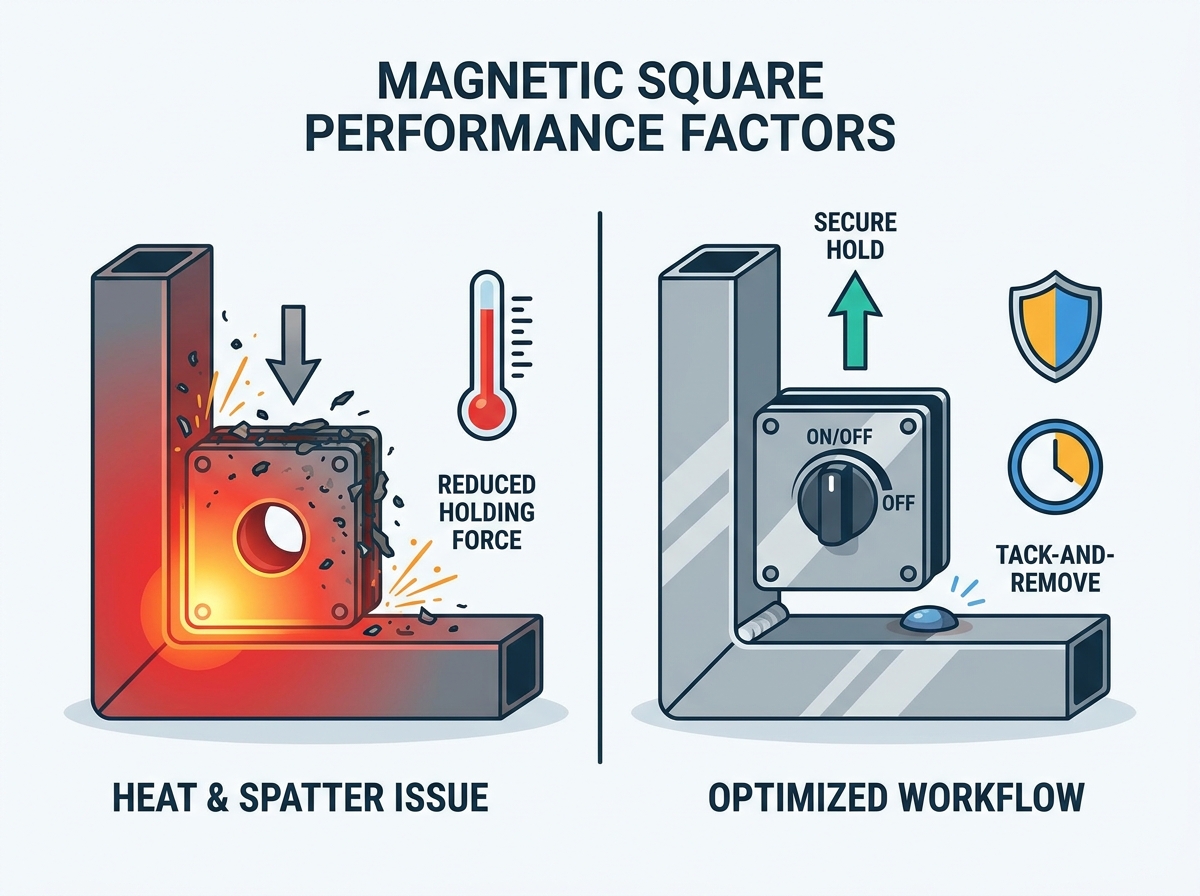
Fabrication shops frequently replace alignment tools due to permanent loss of holding power. This rapid turnover directly impacts fabrication ROI. Many operators assume the tool simply wore out over time. In reality, high heat destroys the internal magnetic structure. A standard Magnetic Square often uses Neodymium magnets. These provide incredible holding strength but suffer from poor thermal resistance.
Every magnetic material has a specific Curie temperature. Once a magnet reaches this thermal threshold, it loses its magnetization permanently. Neodymium begins degrading around 80°C (176°F). Standard welding applications easily exceed this temperature in the immediate heat-affected zone (HAZ). If you leave the tool clamped near the joint during a continuous weld, you will ruin it.
Implementation Solutions
Distance Management: You must keep the tool outside the immediate HAZ. A good rule involves maintaining at least six inches of clearance from heavy structural welds. The exact distance depends heavily on your amperage and material thickness.
Tack-and-Remove Workflow: Implement a strict shop-floor standard. Operators should use the holding tool strictly for initial fit-up. You tack the joint securely, then remove the tool entirely. Only after removing the tool should you proceed to continuous welding. This single habit extends tool life dramatically.
Material Selection: Heavy-duty applications require different internal materials. Samarium Cobalt (SmCo) magnets withstand much higher temperatures without losing strength. Ferrite or ceramic options also tolerate high heat, though they offer lower overall pull forces.
Magnet Material Temperature Tolerances
| Material Type | Max Operating Temp | Relative Strength | Ideal Use Case |
| Neodymium (NdFeB) | 80°C - 150°C | Very High | Cold fit-up, light tacking |
| Ferrite / Ceramic | 250°C | Low to Medium | General welding, high heat |
| Samarium Cobalt (SmCo) | 300°C - 350°C | High | Heavy industrial welding |
Debris Accumulation and Weld Spatter Interference
Metallic dust, grinding shavings, and weld spatter naturally stick to magnetized surfaces. This accumulation creates a severe business problem for fabricators. Debris forms physical air gaps between the tool and the workpiece. Even a one-millimeter gap ruins your 90-degree or 45-degree alignment accuracy. An out-of-square joint forces you to grind down the weld and restart.
A common mistake involves ignoring minor dust buildup. Operators might wipe the surface quickly, leaving small, hardened spatter droplets behind. These droplets act as pivot points, causing the workpiece to rock slightly out of alignment. Evaluating specific Magnetic square applications helps you determine the best mitigation strategy.
Evaluation Criteria and Solutions
- Switchable Magnetic Squares: Investing in On/Off functionality delivers excellent ROI. These tools mechanically disrupt the internal magnetic field. When you turn the switch off, the tool loses its magnetism entirely. Accumulated debris simply falls away. You wipe it clean in seconds without fighting the magnetic pull.
- Protective Shielding: Harsh environments demand creative barriers. You can insert thin, non-magnetic shims (like brass or aluminum) between the tool and the workpiece. Some fabricators apply anti-spatter sprays to the tool casing. You must apply these sprays carefully to avoid contaminating the weld zone. Copper or aluminum shielding wraps also work well for heavy spatter environments.
- Maintenance Protocol: Proper mechanical cleaning extends usability. Avoid grinding the tool's face to remove stuck spatter. Grinding degrades the casing and ruins the factory-machined flat edge. Instead, use a dedicated brass scraper to safely dislodge hardened debris.
Magnetic Arc Blow When Using a Magnetic Square for Welding
Welders frequently encounter poor weld quality, excessive porosity, and erratic arcs during complex fit-ups. Many operators incorrectly blame their shielding gas or wire feed speed. Often, the real culprit is the holding tool itself. This phenomenon is known as magnetic arc blow. It happens frequently when using a Magnetic square for welding near the active joint.
Arc blow occurs because the magnetic field of the tool interacts directly with the electromagnetic field of the welding arc. The tool's field forces the ionized gas of the arc to deflect wildly. The arc wanders away from the intended joint. This deflection causes lack of fusion and traps atmospheric gases in the weld pool. DC welding processes suffer the most from this interference.
Technical Troubleshooting
You can isolate and eliminate arc blow by adjusting your setup. Follow these practical troubleshooting steps:
- Assess the Distance: Move the holding tool further away from the weld joint. Increasing the physical distance weakens the interfering magnetic field exponentially.
- Reposition the Ground Clamp: The flow of electrical current creates its own magnetic pull. If you place the ground clamp directly across from the holding tool, you compound the interference. Move the ground clamp to balance the current flow away from the joint.
- Switch Current Types: Consider switching to AC welding if your process allows it. AC welding alternates current polarity continuously. This rapid alternation breaks the steady magnetic deflection cycle, negating arc blow effectively.
- Tack and Remove: As mentioned earlier, securing the joint with strong tacks and removing the tool entirely remains the most foolproof solution.
Inadequate Holding Force and Slippage
Parts slipping during fit-up lead to dangerous safety hazards and out-of-square assemblies. A sudden slip can pinch fingers or drop heavy steel onto an operator. Many buyers feel frustrated when a newly purchased tool fails to hold a standard workpiece securely. They blame the tool's quality, but the root cause usually involves misunderstanding magnetic pull force ratings.
Features-to-Outcomes Analysis
Myth vs. Reality: Manufacturers typically advertise a specific pull force, such as a "100 lb rating." They test this rating under ideal, laboratory conditions. The test utilizes a thick, perfectly flat, freshly machined block of low-carbon steel. Real-world fabrication environments look vastly different. Real-world performance on thin gauge metal, painted surfaces, or rusty steel drops substantially. You might only achieve 20 to 30 pounds of actual holding force on a rusty tube.
Surface Contact: Magnetic fields require mass to travel through. Thin sheet metal saturates quickly, meaning the magnetic field passes straight through the metal into the air. This limits holding power severely. Furthermore, any air gap exponentially decreases the magnetic hold. Mill scale, heavy rust, and uneven plasma-cut edges all act as air gaps. You must clean the contact points on your workpiece to maximize holding power.
Leverage and Gravity: Holding force is not a magical glue. It resists a straight pull well but resists leverage poorly. Evaluating the size of your workpiece matters immensely. If you clamp a tall, heavy steel beam using a small magnetic base, gravity works against you. The tall beam acts as a lever. Even a slight bump at the top of the beam easily breaks the magnetic hold at the base. You must match the physical footprint of the tool to the leverage dynamics of your assembly.
Decision Framework: Upgrading Your Magnetic Square Inventory
Treating alignment tools as cheap, disposable items harms your bottom line over time. Upgrading your inventory requires a structured approach. Guide your purchasing decisions by evaluating suppliers and product lines based on your actual shop floor realities. Avoid buying on pull-force marketing alone. Look for features supporting long-term accuracy and durability.
Fixed vs. Switchable Magnets
Fixed magnets cost less upfront. They consist of a solid magnetic block inside a metal housing. However, they constantly attract debris, making them incredibly frustrating to clean. You lose valuable production time scraping spatter off fixed blocks.
Switchable units cost more initially. Yet, the time saved in cleaning and positioning pays for the upgrade quickly. You place the unit exactly where you need it, align your workpiece, and turn the switch on. If you misalign a part, you turn it off, adjust, and re-engage. This precision prevents frustrating fights against constant magnetic pull during complex setups.
Multi-Angle Capabilities
Some tools offer a simple 90-degree inside and outside holding edge. Heavy-duty fabrication often requires only this basic geometry. These single-purpose blocks provide massive holding power for large structural members.
Conversely, complex fabrications benefit from multi-angle capabilities. Tools featuring machined edges for 30°, 45°, 60°, and 90° angles offer excellent versatility for tubing and frame work. Evaluate your typical weldments. If you build roll cages or custom frames, multi-angle tools reduce the number of unique jigs you need on hand.
Enclosure and Build Quality
The external casing protects the fragile internal magnets from impact and heat. Cheap tools often feature thin plastic sides or tack-welded sheet metal housings. Plastic melts rapidly near welding arcs. Tack-welded housings warp under thermal stress, permanently destroying the 90-degree reference edge.
Industrial environments demand robust construction. Riveted or bolted steel casings outperform cheaper alternatives. A thick steel casing acts as a physical heat sink. It absorbs and dissipates thermal energy before it reaches the internal core. Furthermore, precision-machined steel edges maintain their flatness even after minor drops or impacts on the concrete floor.
Conclusion
Standard alignment devices function as consumable tools only if you treat them poorly. They become highly reliable, long-term assets when you select and maintain them correctly. Misunderstanding heat limits, ignoring debris buildup, and falling for pull-force marketing myths cost fabricators significant time and money.
- Audit your current fabrication scrap rates immediately to identify alignment failures.
- Implement a strict tack-and-remove workflow to protect your holding tools from extreme heat.
- Consult your supplier to upgrade to switchable, high-heat rated models for heavy industrial use.
- Clean all workpieces down to bare metal at the contact points to maximize holding efficiency.
Taking these actionable steps reduces frustrating fit-up errors. You will see immediate improvements in joint accuracy, safety, and overall production speed.
FAQ
Q: How long should a magnetic square for welding last?
A: It can last for years. You must keep it below its maximum operating temperature and clean it regularly. Heat remains the primary killer of longevity. Avoid dropping it on hard surfaces, as physical shocks can crack the internal brittle magnets.
Q: Can a magnetic square magnetize my workpiece permanently?
A: Mild residual magnetism sometimes occurs in carbon steel workpieces. However, this residual field is rarely strong enough to cause issues post-fabrication. It only becomes a concern if your final part requires highly sensitive precision machining or operates near delicate electronics.
Q: Are switchable magnetic squares worth the extra cost?
A: Yes. They are highly recommended for high-volume fabrication. The time you save cleaning spatter pays off rapidly. Furthermore, the accuracy gained by avoiding debris-induced air gaps usually pays for the tool within a few weeks of active use.