Selecting the right magnetic component is a delicate balancing act. You must weigh magnetic performance against thermal stability and unit cost. An over-specified design wastes your project budget. An under-specified one risks catastrophic failure in the field. Moving from concept to production demands deeper scrutiny. Engineers and procurement teams cannot just look at raw magnetic strength. They need to evaluate environmental resilience, mechanical tolerances, and supply chain realities. This guide breaks down the critical material types, baseline specifications, and evaluation frameworks. We will help you confidently specify a permanent magnet for your application. You will learn how to balance competing requirements and avoid common assembly pitfalls.
Key Takeaways
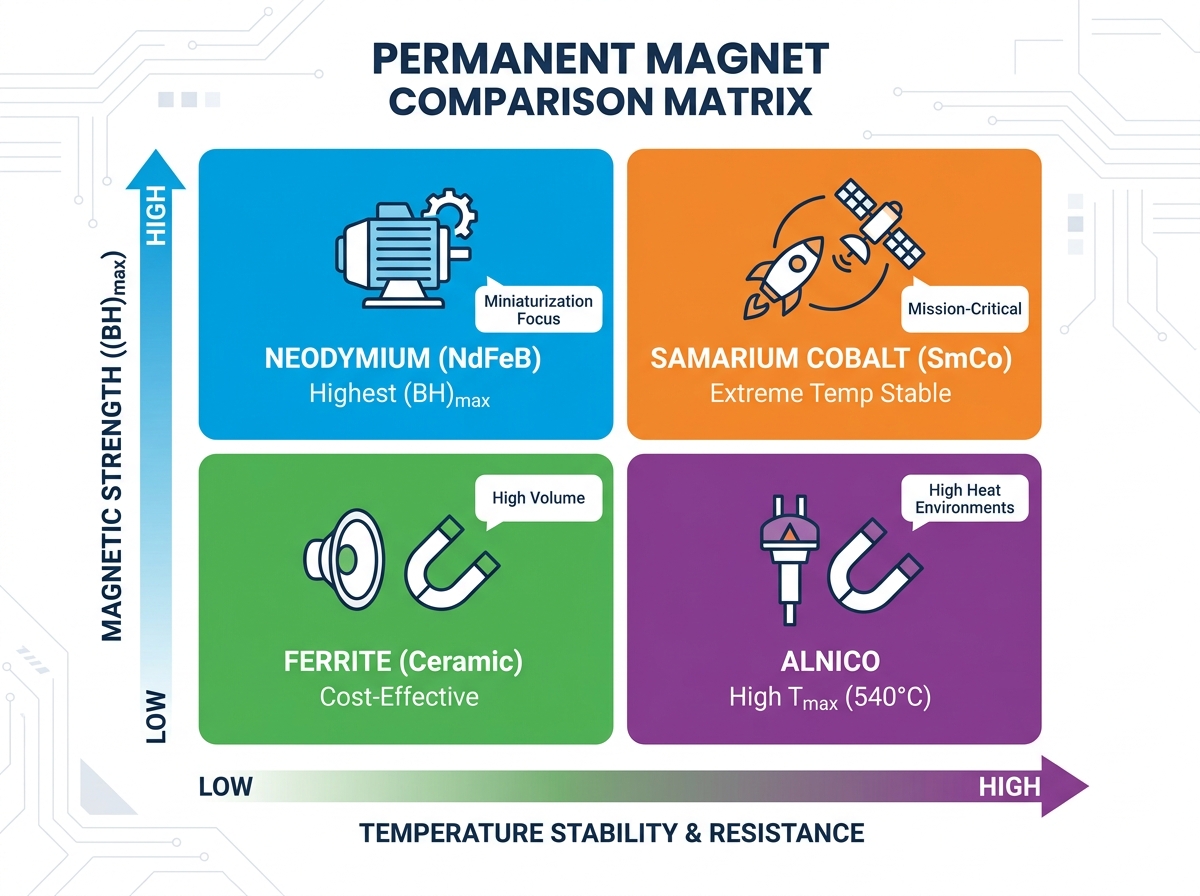
- Neodymium (NdFeB) dominates in raw strength and miniaturization but requires robust surface protection and thermal management.
- Samarium Cobalt (SmCo) provides the highest stability in extreme temperatures and corrosive environments, justifying its premium cost in aerospace and medical applications.
- Alnico excels in high-temperature environments (up to 540°C) but requires specific design geometries due to low coercivity.
- Ferrite (Ceramic) remains the most cost-effective solution for high-volume applications where size and weight are not primary constraints.
- Evaluating a magnet requires aligning three metrics: Maximum Energy Product ((BH)max), Intrinsic Coercivity (Hcj), and Maximum Operating Temperature (Tmax).
Defining the Baseline: Why Choose a Permanent Magnet?
Let us establish the boundary between permanent solutions and electromagnets first. Electromagnets require a continuous electrical current to generate a magnetic field. They need complex wiring infrastructure. They also generate significant heat during operation. A permanent magnet provides a persistent magnetic field naturally. It consumes zero power. It generates zero heat during operation. You do not need any external energy source to maintain its inherent properties.
Why does this matter for your business? This passive operation unlocks massive value. It makes these materials ideal for applications requiring extreme miniaturization. You see them frequently in compact sensors and secure holding mechanisms. They also enable highly energy-efficient motor designs. By removing the need for internal power supplies, you reduce product weight. You also eliminate potential electrical failure points. This creates a more reliable end product.
The 4 Core Types of Permanent Magnets: A Comparative Analysis
Engineers generally choose between four main material families. Each category presents transparent trade-offs. You must align these traits against your specific product requirements.
Neodymium Iron Boron (NdFeB)
Neodymium stands as the most powerful magnetic material available today. It drives innovation across multiple industries.
Primary Advantage: It boasts the highest Maximum Energy Product ((BH)max). This incredible density enables extreme miniaturization. You can design smaller, lighter motors and sensors without sacrificing performance.
Vulnerabilities: NdFeB is highly susceptible to oxidation. It rusts rapidly in humid environments. You must protect it using robust plating or coating. Common solutions include Ni-Cu-Ni (Nickel-Copper-Nickel) layers or epoxy coatings. It also features lower maximum operating temperatures compared to alternatives. High heat can cause irreversible strength loss.
Cost Profile: The cost remains moderate to high. Prices fluctuate based on rare-earth market volatility. You must plan for potential supply chain cost shifts.
Samarium Cobalt (SmCo)
SmCo offers a unique blend of strength and extreme environmental resilience.
Primary Advantage: It delivers exceptional thermal stability. It also provides natural corrosion resistance. You rarely need to apply protective coatings. It performs reliably in the harshest environments imaginable.
Vulnerabilities: This material is highly brittle. It is prone to chipping and cracking during assembly. You must handle it very carefully. It also carries the highest material cost among all standard options.
Cost Profile: SmCo commands a premium price. You typically reserve it for mission-critical applications. Aerospace and defense sectors rely on it because failure is simply not an option.
Alnico (Aluminum Nickel Cobalt)
Alnico is one of the oldest commercial magnetic materials. It still holds distinct advantages for highly specific use cases.
Primary Advantage: It possesses an excellent temperature coefficient. It remains remarkably stable in extreme heat. You can operate Alnico up to 540°C without significant degradation. It is also mechanically stronger than most rare-earth options.
Vulnerabilities: Alnico has very low coercivity. It is easily demagnetized if exposed to repelling magnetic fields. You must use careful magnetic circuit design. Engineers often use higher length-to-diameter ratios to prevent self-demagnetization.
Cost Profile: Alnico sits at a moderate price point. It successfully balances specialty performance against reasonable material costs.
Ferrite (Ceramic)
Ferrite magnets dominate global volume production. They provide the backbone for countless everyday consumer products.
Primary Advantage: The raw materials are incredibly abundant. This makes Ferrite highly cost-effective. The material is inherently resistant to corrosion. It does not rust, even in constantly wet environments.
Vulnerabilities: It offers very low magnetic strength. The material is quite brittle. Ferrite components are heavy and bulky compared to rare-earth equivalents.
Cost Profile: The cost is very low. Ferrite remains the standard choice for consumer electronics and standard automotive accessories.
Key Specifications to Evaluate: Beyond Magnetic Strength
You cannot specify a material based on generic categories alone. Engineers rely on strict quantitative metrics. These dimensions dictate how a component performs under highly specific conditions.
Magnetic Properties Comparison Chart
| Material Type | Strength ((BH)max) | Corrosion Resistance | Max Temp (Tmax) |
| Neodymium (NdFeB) | Very High | Low (Needs Coating) | Up to 230°C |
| Samarium Cobalt (SmCo) | High | High | Up to 350°C |
| Alnico | Low-Medium | High | Up to 540°C |
| Ferrite (Ceramic) | Low | Very High | Up to 250°C |
Maximum Energy Product ((BH)max): This metric represents the overall strength and efficiency. It determines how small the component can be while still delivering the required field. Higher (BH)max means you can shrink your overall design footprint.
Remanence (Br): This measures the residual magnetic flux density. It represents the magnetic field remaining in a closed circuit. This metric is critical for applications needing a strong static magnetic field. Speakers and MRI machines rely heavily on high Br values.
Coercivity (Hc) & Intrinsic Coercivity (Hcj): Coercivity defines the material's resistance to demagnetization. Intrinsic coercivity measures this resistance at a molecular level. It is essential to review Hcj if your design will face opposing magnetic fields. It is equally important for high-heat environments. A high Hcj prevents accidental field loss.
Temperature Coefficients & Tmax: Magnets lose strength as they heat up. The temperature coefficient reveals how much output degrades per degree of temperature increase. Tmax indicates the absolute maximum operating threshold. If you cross Tmax, irreversible magnetic loss occurs. You must re-magnetize the part to restore its function.
Aligning Material to Application: Industry Use Cases
Different industries prioritize different performance metrics. Mapping these material features to desired outcomes streamlines your selection process.
- Electric Motors & Automotive: The EV sector relies heavily on high-grade NdFeB for traction motors. These designs prioritize a high torque-to-weight ratio. They need massive power in tight spaces. Conversely, automakers use Ferrite for window wipers and seat motors. These components prioritize low unit costs at a massive scale.
- Aerospace & Defense: Aerospace engineers specify SmCo for critical sensors and actuators. They also use it in traveling-wave tubes for radar systems. These applications experience extreme temperature fluctuations. Zero-failure tolerance is completely mandatory here. SmCo delivers this specific reliability.
- Medical Devices: The medical field utilizes NdFeB for large MRI machines and precision surgical tools. These tools require intense, concentrated magnetic fields. For implantable devices, manufacturers pivot to SmCo. Biocompatibility and long-term chemical stability are prioritized over absolute peak strength.
- Manufacturing & Magnetic Separation: Industrial facilities process bulk materials at high temperatures. They use Alnico and Ceramic configurations for high-heat sorting applications. These components separate ferrous contaminants from production lines reliably without degrading.
Implementation Risks and Design Considerations
Selecting the right material on paper is only half the battle. You must anticipate what goes wrong during adoption and assembly. Real-world rollouts expose several common risks you must mitigate.
Environmental Degradation: You must factor in humidity, salt spray, and chemical exposure. A bare NdFeB part will rust and structurally crumble in high humidity. Selecting the right coating prevents this. Common mistakes include ignoring micro-scratches on protective plating. These tiny scratches allow moisture to penetrate and destroy the core over time.
Mechanical & Machining Limits: You cannot machine these materials like standard metals. Components are generally machined in an unmagnetized state. Manufacturers use specialized diamond grinding tools. The materials are incredibly brittle. Designing complex geometries drastically increases waste and material expenses. Keep shapes simple whenever possible.
Assembly Challenges: Handling magnetized rare-earth materials requires strict safety protocols. Strong components attract each other violently from a distance. This creates a severe risk of pinch injuries for line workers. The violent impacts also cause chipping during automated assembly. You should design custom jigs to guide parts safely into their final place.
Supply Chain & Sustainability: Navigating the rare-earth supply chain requires strategic planning. Neodymium and Dysprosium frequently face geopolitical supply risks. Smart procurement teams arrange secondary sourcing options early. You should also consider end-of-life recycling. Designing products for easy disassembly helps recover valuable magnetic alloys for future use.
Shortlisting Logic: How to Specify Your Magnet
Decision-makers need a repeatable, logical framework. Use this actionable sequence to specify your next permanent magnet accurately and confidently.
- Step 1: Define the Environmental Envelope. Establish your maximum operating temperatures first. Next, identify any direct exposure to corrosive agents. This step immediately eliminates incompatible materials. For example, operating temperatures above 300°C instantly rule out NdFeB.
- Step 2: Determine Space Constraints. Calculate the exact available volume inside your assembly. Evaluate your strict weight limits. If physical space is tightly constrained, rare-earth solutions are completely necessary. If space is abundant, cheaper Ferrite might easily suffice.
- Step 3: Model the Magnetic Circuit. Do not guess the required strength. Use FEA (Finite Element Analysis) software. You can simulate coercivity needs under various opposing loads. This simulation prevents accidental demagnetization over the entire product lifecycle.
- Step 4: Request Prototypes. Order small sample batches first. Specify your requested protective coatings and strict dimensional tolerances. Test these samples in real-world assemblies. Do this before committing budget to expensive high-volume production tooling.
Conclusion
Choosing a reliable magnetic component requires a pragmatic, data-driven assessment. You must evaluate the operating environment, physical spatial constraints, and your project budget carefully. While Neodymium offers unmatched raw strength, it is not always the best fit. Materials like SmCo, Alnico, and Ferrite remain entirely indispensable for specialized thermal and cost requirements. Focus on aligning the material’s inherent strengths with your product’s primary performance goals.
Take action early in your product development cycle. Engage with a dedicated magnetic design engineer before locking in your housing dimensions. Contact our technical team today to review your exact specifications. We can help model your magnetic circuit, recommend optimal protective coatings, or provide a custom quote for your next manufacturing project.
FAQ
Q: What is the strongest type of permanent magnet available?
A: Neodymium (NdFeB) is currently the strongest material commercially available. It boasts the highest Maximum Energy Product ((BH)max), allowing for incredible strength in small sizes. However, you must account for its temperature limits. Extreme heat can permanently weaken Neodymium, requiring you to switch to Samarium Cobalt for high-temp applications.
Q: What is the difference between a magnet's grade and its material type?
A: The material type dictates the baseline chemistry, such as NdFeB or Ferrite. The grade dictates the specific performance tuning within that family. For example, N42 and N52 are both Neodymium, but N52 is engineered for higher maximum strength. The grade often includes letters indicating temperature tolerance.
Q: Do permanent magnets lose their strength over time?
A: They experience minimal natural degradation. You might see fractional percentage losses over a decade under normal conditions. However, rapid demagnetization occurs if you expose them to excessive heat, severe physical shock, or strong opposing magnetic fields. Proper circuit design prevents this rapid loss.
Q: Can permanent magnets be machined or drilled?
A: They are extremely brittle and cannot be drilled with standard metalworking bits. Attempting to drill them will cause shattering and dangerous sparks. They must be machined before magnetization using specialized diamond grinding tools. Always finalize your dimensional requirements before the parts undergo final magnetization.