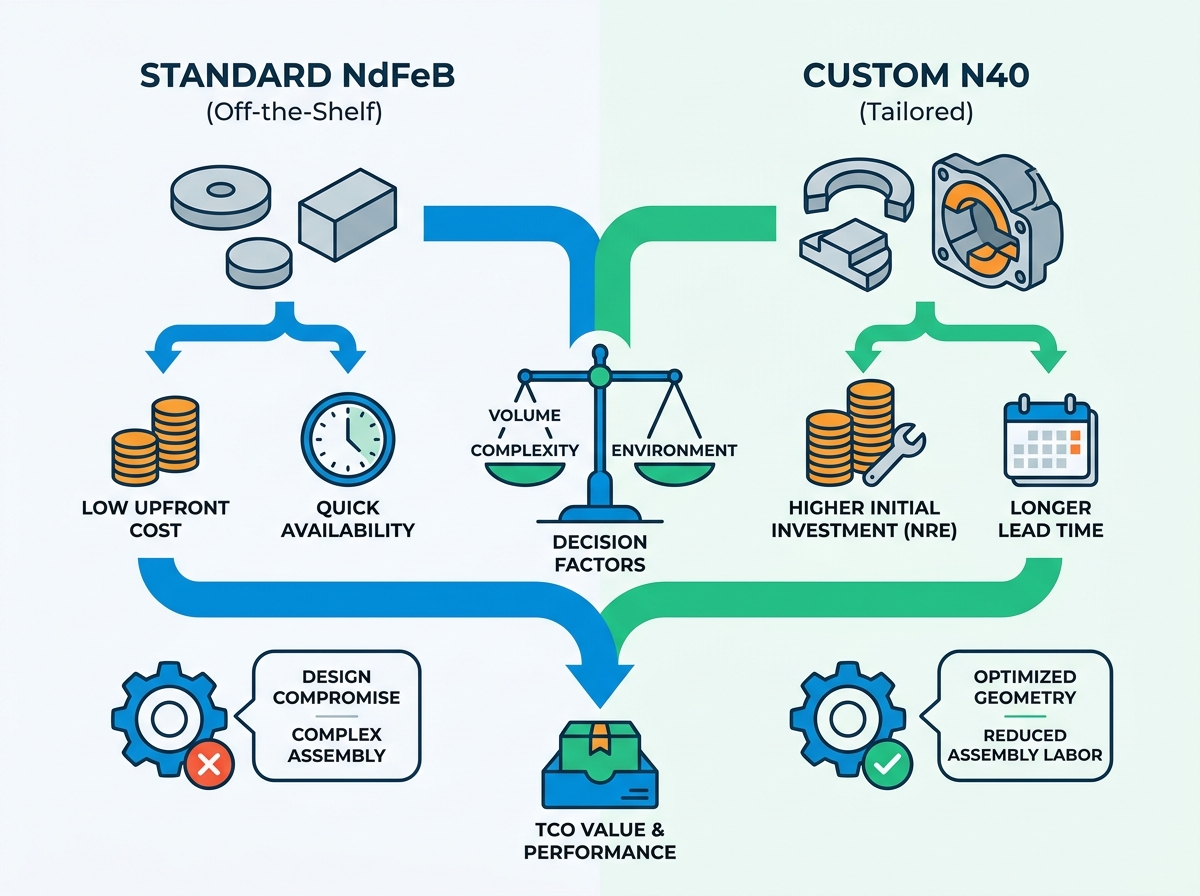
Engineers often face a frustrating dilemma when designing modern hardware. You must decide whether to adjust product enclosures to fit off-the-shelf neodymium sizes or invest in purpose-built geometries. Standard inventory might seem faster initially. However, retrofitting existing designs around generic magnetic shapes frequently introduces hidden assembly challenges.
This is where the N40 grade emerges as a true sweet spot. It offers a highly favorable balance of magnetic strength, thermal stability, and cost-efficiency. This balance only works if the physical and environmental parameters align perfectly. Choosing the wrong specification can lead to catastrophic demagnetization or expensive product failures.
This article provides a realistic evaluation framework for your next project. You will learn how to weigh the benefits of standard inventory against engineered solutions. Ultimately, we will help you decide if standard stock or a custom approach delivers the best return on investment for your specific production run.
Key Takeaways
- Standard neodymium magnets minimize upfront costs and lead times but often require design compromises and complex secondary assembly steps.
- A custom N40 magnet optimizes geometry, magnetization direction, and surface protection, directly reducing mechanical wear and assembly labor.
- The crossover point for custom viability depends on production volume, spatial constraints, and extreme operational environments (e.g., high heat or corrosive exposure).
- Partnering early with a qualified custom magnet manufacturer ensures strict tolerance control and verifiable batch-to-batch consistency.
Baseline Comparison: Off-the-Shelf NdFeB vs. Custom N40 Magnets
Defining Standard Neodymium
Standard neodymium inventory dominates the market for simple applications. Distributors typically stock grades like N35, N42, or N52. These come in basic shapes. You will find simple discs, rectangular blocks, and standard rings. Manufacturers optimize these off-the-shelf items for mass production. They prioritize volume over specific application efficiency.
Standard magnets almost universally feature a basic Ni-Cu-Ni (Nickel-Copper-Nickel) plating. This default coating works well for generic indoor environments. However, it falls short under harsh chemical exposure or high humidity. Generic shapes also force design engineers to adapt surrounding components. You often have to design your product around the magnet, rather than designing the magnet for your product.
The Custom N40 Advantage
Engineering a purpose-built solution changes the entire design paradigm. When you specify a Custom N40 Magnet, you gain absolute control over the geometry. You can request precise dimensions to fit a microscopic cavity. You can dictate specific tolerances to eliminate rattle in a moving assembly.
Customization allows for non-standard shapes. Your application might need arc segments for a rotor or stepped blocks for a locking mechanism. You can also tailor the magnetic field itself. Custom manufacturing allows you to dictate exactly how the flux lines interact with your sensors or opposing metal plates.
Business Problem Framing
Consider the costs associated with modifying parts. Machining an aluminum housing to fit a generic square block requires expensive CNC machine time. Altering a 3D-printed enclosure often weakens the structural integrity of the part.
Contrast this against the upfront tooling cost of a custom shape. We call this a Non-Recurring Engineering (NRE) expense. A custom magnet fits your exact housing seamlessly. This eliminates secondary machining. It also removes the need for messy adhesives or extra retaining clips. The initial tooling fee quickly pays for itself through streamlined assembly.
Evaluating the N40 Grade: Performance and Realities
Strength-to-Cost Ratio
Engineers frequently select N40 over other standard grades for good reason. N40 provides a Nominal Max Energy Product of 38-41 MGOe. This measurement defines the overall magnetic strength. It strikes an ideal balance.
Standard N35 is cheaper, but it is noticeably weaker. It often fails to provide enough holding force for compact devices. Conversely, N52 is incredibly strong. However, N52 is highly brittle and extremely sensitive to temperature fluctuations. N52 magnets frequently chip during handling. N40 provides enough pull force for demanding applications while remaining highly cost-efficient and structurally robust.
Thermal Constraints and Coercivity
Heat is the natural enemy of neodymium. Standard N40 possesses an operational temperature limit of roughly 80°C (176°F). If your device exceeds this threshold, the magnet will permanently lose a portion of its strength.
Customization solves this thermal limitation. By working directly with a manufacturer, engineers can specify high-coercivity variants. You can order N40M, N40H, or N40SH grades. The "SH" variant, for example, pushes the maximum operating temperature up to 150°C. This specific adjustment prevents demagnetization in high-heat environments. Typical applications include high-speed motors and heated 3D printing beds.
Compliance and Integrity
You cannot determine a magnet's grade simply by looking at it. Grade authenticity requires rigorous scientific verification. You must evaluate the demagnetization curves and hysteresis loop data.
These charts plot how the magnet behaves under external magnetic stress and thermal loads. They prove the material will maintain its flux density over time. A reliable supplier provides these testing reports. Without this data, you risk installing subpar materials. This degrades product lifespan and damages brand reputation.
When to Specify a Custom N40 Magnet (Decision Matrix)
Complex Geometries & Tight Tolerances
Standard magnets typically ship with a dimensional tolerance of ±0.1mm. This is perfectly fine for basic latches or refrigerator magnets. However, precision micro-assemblies demand much tighter control.
If you build medical devices or aerospace sensors, a ±0.1mm deviation causes severe tolerance stack-up. The parts simply will not fit together. Custom manufacturing employs precision grinding techniques. This reduces tolerances to ±0.05mm or better. Exact sizing guarantees a flawless press-fit every single time.
Unique Magnetization Directions
Off-the-shelf magnets usually feature axial or diametrical magnetization. The magnetic poles sit on the flat faces or across the diameter. Many advanced electronics require complex alternatives.
You might need radial magnetization for a specialized motor rotor. Hall-effect sensors frequently require multi-pole magnetization across a single surface. Skewed magnetization can smooth out the "cogging" torque in precision motors. Only a custom production run can accommodate these advanced magnetizing fixtures.
Harsh Environment Coatings
The standard nickel plating fails quickly in demanding environments. It chips under impact and corrodes in saltwater. Upgrading the coating is a primary reason to order Custom magnets.
Medical devices often require Parylene coatings to achieve biocompatibility. Marine applications rely on thick Epoxy coatings to seal out corrosive salt spray. If your magnets slide against other components, a Teflon (PTFE) coating drastically reduces friction wear. Customizing the surface protection ensures the magnet survives its intended operating environment.
Grade and Coating Comparison Chart
| Feature | Standard Inventory (N35) | Standard High-Strength (N52) | Custom N40 Engineered |
| Magnetic Strength | Low (33-35 MGOe) | Maximum (50-53 MGOe) | Optimal (38-41 MGOe) |
| Max Temp Limit | 80°C | 60°C - 80°C | Up to 150°C (SH variant) |
| Available Coatings | Ni-Cu-Ni Only | Ni-Cu-Ni Only | Epoxy, Parylene, PTFE, Gold |
| Tolerance Control | ±0.1mm | ±0.1mm | ±0.05mm (Precision Grinding) |
Cost-to-Outcome, Scalability, and Supply Chain
Evaluating Return on Investment
We must move past the simple unit-price comparison. An off-the-shelf magnet might cost ten cents less per unit. However, you must calculate the broader financial impact on your production line. Frame the ROI of custom components by looking at manufacturing outcomes.
Custom geometries directly reduce scrap rates. If the magnet fits perfectly, workers do not force parts together. This eliminates cracked housings. Furthermore, you completely eliminate the need to machine surrounding components. Faster assembly times significantly lower your labor costs. The slight increase in unit price for a custom part yields massive savings on the factory floor.
Tooling and Prototyping Timelines
Ordering custom parts requires realistic schedule management. You cannot get a bespoke magnet shipped overnight. Typically, the timeline ranges from three to six weeks.
This period covers CAD design approval, creating the physical tooling, and producing the first articles. You must evaluate these prototypes before authorizing full production. To mitigate supply chain delays, finalize your magnetic requirements early in the product design phase. Do not treat the magnet as an afterthought.
Volume Thresholds
When should you transition from standard to custom? The decision relies heavily on your Estimated Annual Usage (EAU). Here is a practical framework.
If you build fewer than 500 units a year, standard magnets make sense. The NRE tooling costs might outweigh the assembly savings. However, once your EAU crosses 5,000 units, the dynamic changes. At high volumes, the labor savings from faster assembly easily justify the tooling investment. Scalability demands predictable, repeatable components.
Implementation Risks and Vetting a Custom Magnet Manufacturer
Quality Control Bottlenecks
Unregulated batch orders present massive risks. When buying generic stock from unverified sources, magnetic flux variations are common. One batch might hold firmly, while the next batch drops parts.
Dimensional deviations also plague cheap orders. A magnet that measures 0.2mm too wide will jam automated assembly machines. These inconsistencies cause unpredictable product performance. Strict quality control prevents these expensive bottlenecks.
Testing and Validation Requirements
You must validate incoming materials before they hit your assembly line. Do not rely on visual inspections alone. Implement a robust testing protocol.
- Gauss Meter Testing: This maps the surface field density. It ensures the magnetic field matches your sensor requirements.
- Pull-Force Validation: This simulates real-world usage. It verifies the magnet can hold the required physical weight.
- Salt Spray Testing: This validates the coating. It ensures the plating will not peel or rust under environmental stress.
Vendor Selection Criteria
Choosing the right partner dictates the success of your project. You need a vendor capable of executing complex engineering demands. Use the following criteria when vetting a Custom magnet manufacturer.
- ISO 9001 Certification: This guarantees the facility follows standardized, documented quality management systems.
- In-House Magnetic Modeling: The manufacturer should offer Finite Element Analysis (FEA). They must simulate how the magnetic field behaves inside your specific assembly.
- Compliance Documentation: They must provide verifiable RoHS and REACH certificates. This proves the materials are safe and legally compliant for global markets.
Conclusion
Your choice between generic inventory and purpose-built magnets dictates assembly efficiency and product lifespan. Default to standard magnets only for rapid prototyping and low-constraint environments. You should pivot to a custom N40 grade when spatial integration, thermal stability, or assembly speed dictates your product's success.
A custom approach eliminates tolerance stack-up and provides tailored magnetic fields. It ultimately streamlines your factory floor operations. By optimizing geometries and coatings, you significantly decrease long-term manufacturing headaches.
Take proactive steps today. Request a magnetic simulation from an engineering team to visualize the flux lines in your design. Order first-article prototypes to test the physical fit. Solidify your specifications early to ensure seamless high-volume production.
FAQ
Q: What is the price difference between standard neodymium and custom N40 magnets?
A: Standard magnets have a lower unit cost because they require no upfront tooling. Custom magnets involve a one-time Non-Recurring Engineering (NRE) fee for molds and fixtures. However, at higher volumes, custom magnets become highly cost-effective. They drastically reduce assembly time and eliminate secondary machining, offsetting the initial tooling investment.
Q: Can a custom N40 magnet withstand higher temperatures than standard stock?
A: Yes. Standard N40 magnets begin losing strength around 80°C. Custom manufacturing allows you to specify high-coercivity variants. You can transition to N40H, N40SH, or N40UH grades. These specialized modifications push the maximum operating temperature up to 120°C, 150°C, or even 180°C without permanent demagnetization.
Q: What is the typical lead time for manufacturing custom magnets?
A: A realistic lead time ranges from three to six weeks. This timeframe includes finalizing CAD approvals, manufacturing the custom tooling, and producing the first-article prototypes. After you approve the prototypes, high-volume production runs generally follow predictable, optimized delivery schedules.
Q: How do I verify the magnetic grade and consistency of my custom order?
A: You should request comprehensive testing reports from your manufacturer. Ask for BH curves (demagnetization curves) to prove the grade's authenticity. Demand CMM dimension reports to verify strict physical tolerances. Finally, request flux density metrics to ensure the surface magnetic field remains consistent across every batch.