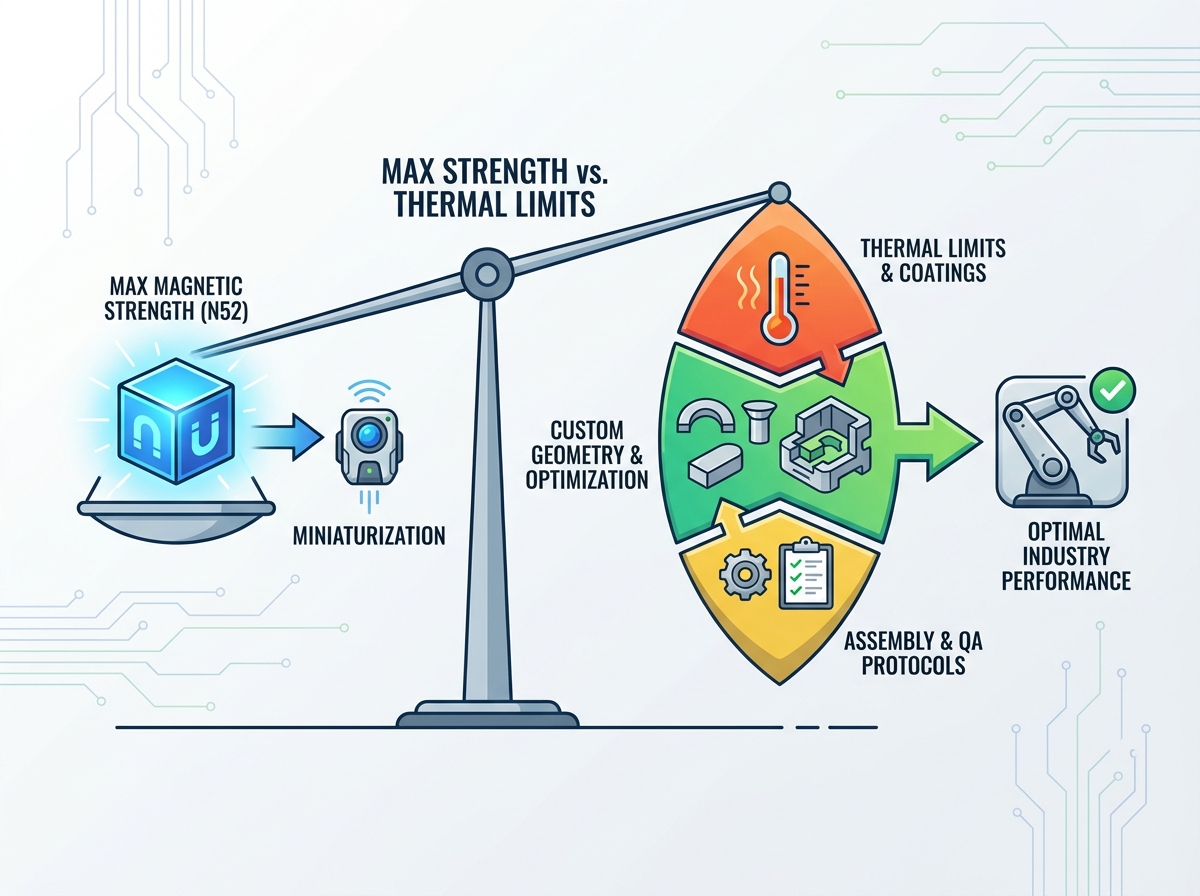
Sourcing components at the design stage carries incredibly high stakes. You must maximize magnetic strength within exceptionally tight spatial constraints. Neodymium N52 represents the absolute commercial peak for this crucial task. However, mis-specifying these powerful elements often leads to premature mechanical failure. You must bridge the wide gap between rigid off-the-shelf constraints and precise custom engineering. Specifying Custom N52 Magnets requires carefully balancing maximum energy product against strict thermal limits. You also need to heavily factor in environmental degradation risks and daily assembly realities. Standard stock blocks simply cannot solve complex modern integration challenges. This guide outlines a comprehensive evaluation framework. We will explore how to design and procure units perfectly aligning with strict industry tolerances. You will learn to navigate harsh lifecycle demands, mitigate dangerous thermal risks, and ultimately secure reliable manufacturing partners.
Key Takeaways
- Custom N52 magnets offer the highest commercial magnetic energy (approx. 52 MGOe), ideal for miniaturization in aerospace, medical, and advanced electronics.
- The primary operational risk for N52 is thermal demagnetization; precise environmental mapping is required before selecting coatings or thermal grades.
- Custom geometry (shapes, tolerances, and magnetization direction) directly impacts both assembly line handling and final magnetic circuit efficiency.
- Evaluating a manufacturing partner requires looking beyond unit cost to verify QA protocols, traceability, and engineering support for prototyping.
Why Specify Custom N52 Magnets Over Standard Grades?
You might wonder why you should invest heavily in custom geometries over standard blocks. The core business case revolves entirely around the miniaturization advantage. Neodymium N52 boasts an exceptionally high maximum energy product. It achieves the greatest holding force available on the commercial market today. It provides a vastly superior magnetic field in the smallest possible footprint. When you compare it directly to lower N35 or N45 grades, the size difference is staggering. You can reduce the overall weight of your mechanical assembly significantly.
Off-the-shelf options almost always force unwanted design compromises. You might have to drastically modify your housing fit to accommodate a stock size. This leads directly to suboptimal magnetic throw and wasted internal space. In sharp contrast, Custom magnets are machined exactly to your specific dimensions. They integrate seamlessly into your complex CAD models. This tailored precision delivers immense efficiency gains. You eliminate dead zones entirely and maximize the magnetic circuit perfectly.
Industry applications rely heavily on this exact matching process. Let us map out where these high-strength components shine the brightest:
- Medical Devices: Precision sensors and MRI components demand absolutely uncompromised strength. Custom shaping ensures highly uniform magnetic fields. This uniformity is vital for accurate diagnostic readings and patient safety.
- Aerospace & EV Motors: Electric vehicle rotors and aerospace actuators require massive rotational torque. Yet, every extra gram costs money. Custom N52 elements reliably reduce motor weight without sacrificing operational reliability.
- Consumer Electronics: Smart devices rely on hidden haptic feedback engines and compact closures. Space is always at a premium here. Custom sizing allows engineers to embed powerful holding forces inside millimeter-thin smartphone enclosures.
Navigating the Thermal and Environmental Limitations of N52
Despite their immense power, these specific materials have a critical vulnerability. You must confront the heat constraint reality very early in your design phase. Standard N52 material typically features a maximum operating temperature of only 80°C (176°F). Exceeding this thermal threshold causes severe operational problems. It triggers irreversible demagnetization instantly. Your component will permanently lose a significant fraction of its holding force. You cannot restore this lost magnetic energy by simply cooling the part back down to room temperature.
Therefore, extensive environmental profiling remains an absolute necessity. You must frame a precise decision tree for evaluating different application environments. Will the magnet face high humidity consistently? Do chemical exposure risks exist in your daily factory operations? What about galvanic corrosion? When bare neodymium touches dissimilar metals, corrosion accelerates rapidly. You must accurately map all these variables before finalizing your purchase order.
To effectively combat these environmental threats, you must select appropriate protective layers. Uncoated neodymium oxidizes almost immediately in open air. Below is a comprehensive coating and plating solution chart comparing standard industry options:
| Coating Type | Best Application Environment | Moisture Resistance | Key Benefit |
| Ni-Cu-Ni (Nickel) | Standard indoor / Enclosed machinery | Moderate | Provides a highly durable, scratch-resistant finish for general use. |
| Epoxy (Black) | Marine / Exposed industrial use | Excellent | Delivers superior salt-spray resistance and reliable moisture blocking. |
| Zinc | Low-cost indoor applications | Low to Moderate | Offers highly cost-effective protection for benign, dry environments. |
| Gold / Parylene | Medical / Advanced electronics | Very High | Ensures biocompatibility and solves minimal thickness constraints. |
Defining Custom Geometry: Shapes, Tolerances, and Orientation
Shape selection logic must move far beyond basic generic blocks and standard cylinders. You must ask how specific custom geometries solve your unique mechanical integration problems. Countersunk rings naturally allow for perfectly flush screw mounting. Arc segments fit tightly into circular motor stators. Breadloaf shapes dramatically reduce cogging torque in advanced electric motors. Each custom profile directly enhances the final mechanical assembly. It purposely minimizes air gaps and exponentially improves magnetic efficiency.
Precision tolerances serve as another crucial performance factor. Standard industry manufacturing tolerances usually sit at ±0.1mm. This variance might be perfectly acceptable for a simple cabinet latch. However, it is completely insufficient for advanced high-speed micro-sensors. Fast-spinning rotors require absolute perfect balance to prevent destructive high-frequency vibration. Specifying ±0.05mm or tighter creates a much better cost-to-benefit ratio here. You pay slightly more upfront for advanced machining. Yet, you save thousands in reduced wear and tear on your delicate bearings.
Finally, you must clearly dictate the exact magnetization direction. You must perfectly align the magnetic axis with your application needs. Common orientations include diametrical, axial, and multi-pole radial configurations. An axial orientation pulls flat straight across the faces. A diametrical orientation pulls forcefully across the curved outer sides. Specifying this incorrectly ruins the component entirely. Proper orientation optimizes the internal magnetic circuit. It also significantly reduces unwanted flux leakage into sensitive nearby electronics.
Assembly Risks and Handling Complexities
You must transparently address the tough physical realities of handling raw neodymium. These materials are incredibly strong magnetically. However, they are surprisingly fragile mechanically. The specialized powder sintering process leaves them highly susceptible to brittleness and severe chipping. Machining these parts requires highly specialized diamond tooling. You cannot simply drill or saw them on a standard metal workbench.
Handling these potent elements on an active assembly line introduces serious safety hazards. Two large N52 blocks can jump together aggressively from several inches away. The resulting high-speed collision will shatter the protective exterior coating. Worse, it can cause severe pinch injuries to your assembly line workers. Safety and tooling protocols must remain incredibly strict. You must design specialized, non-magnetic assembly fixtures. Aluminum, solid brass, or robust industrial plastics work best here. These fixtures securely hold the elements apart. They prevent sudden collision impacts and dangerous pinch hazards during the final manufacturing stages.
Integration methods also require very careful evaluation. You must consciously choose between chemical adhesive and direct mechanical fastening. This crucial decision depends heavily on your custom shape and specific operating environment. Ask yourself about the primary physical forces constantly at play. Will the mounted magnet face high sideways shear stress? Or will it experience direct repeated pull force? Cyanoacrylate or industrial epoxies work extremely well for shear loads. However, mechanically fastening a countersunk magnet is far superior for resisting direct, repeated outward pull forces.
Vetting Manufacturers for Custom Magnet Production
Finding a true engineering partner is absolutely essential for your project's overall success. Evaluating a prospective manufacturer requires looking very closely at their internal testing and QA standards. Do not just blindly accept their lowest initial bid. You must demand minimum viable proof of true technical competence. Ask for their detailed Helmholtz coil testing data. Request complete hysteresis graphs clearly showing remanence and coercivity. Review their rigorous salt spray testing logs. These important documents prove they actually understand the complex material science behind the product.
Strict compliance and detailed traceability protect your entire global supply chain. High-quality production demands continuous adherence to strict international standards. Ensure your chosen fabrication facility holds active ISO 9001 certifications. Carefully verify their RoHS and REACH compliance documentation. Counterfeit or severely degraded raw materials constantly flood the global market. Deep traceability guarantees you receive authentic, high-grade neodymium. It actively prevents sudden catastrophic assembly failures in the field.
Finally, accurately assess their true ability to scale your project. Shortlist capable suppliers who eagerly offer rapid prototyping alongside their high-volume capabilities. The very best partners proactively provide localized engineering support. They will deeply review your CAD models before cutting any raw material. They actively help you optimize the final design for smooth manufacturability. You want a dedicated team that smoothly transitions your design from a single prototype to a massive production run. Relying on verified experts ensures your final product hits the market without expensive manufacturing delays.
Conclusion
Sourcing specialized high-performance magnetic components is a highly dedicated engineering partnership. It is never a simple bulk commodity transaction. Long-term success relies on perfectly balancing extreme magnetic strength with careful environmental protections. You must accurately define exact tolerances to ensure optimal daily performance. Keep these highly practical takeaways in mind as you move forward:
- Always explicitly match your outer coating choice to real-world environmental data to prevent rapid corrosion.
- Never intentionally exceed the strict 80°C threshold without directly specifying a specialized high-heat material grade.
- Design highly dedicated, non-magnetic assembly fixtures to aggressively protect both your fragile materials and your workers.
- Demand comprehensive QA documentation, including detailed hysteresis graphs, before signing any large volume contract.
Take the crucial next step today. Consult directly with an experienced engineering team for a comprehensive technical design review. Let them optimize your complex CAD integration and immediately request a fully customized prototype quote. Proper robust planning right now guarantees exceptional, reliable performance in your final mechanical assembly.
FAQ
Q: What is the difference in performance between N45 and N52 magnets?
A: N52 offers approximately a 15% increase in maximum energy product over standard N45. This translates directly to a significantly stronger pull force and a denser magnetic field within the exact same physical volume. The premium cost of N52 is highly justified when your design specifically requires aggressive miniaturization. It is ideal when you absolutely cannot increase the component footprint but urgently need far more holding power.
Q: Can N52 magnets be customized for high-temperature applications?
A: Yes, but with notable trade-offs. Standard N52 degrades rapidly above 80°C. Advanced manufacturers can subtly modify the alloy to create robust grades like N52H or N52SH. These distinct modifications push the safe temperature limits significantly higher. However, they strictly require intense material validation. Adding heavy rare earth elements like dysprosium increases heat tolerance safely but dramatically raises the raw material cost.
Q: How does coating thickness affect the magnetic pull force of custom magnets?
A: Every protective coating naturally acts as a physical barrier. This barrier constantly creates a tiny air gap between the neodymium and the targeted metal surface. Even a microscopic air gap measurably reduces the effective magnetic pull force. Thicker coatings like heavy black epoxy provide vastly superior corrosion resistance. However, they introduce a noticeably larger air gap compared to ultra-thin nickel or light parylene plating.
Q: What is the typical lead time for manufacturing custom N52 geometries?
A: Expected lead times vary widely based on geometric complexity. Standard custom prototypes often take three to five weeks to deliver. This timeline safely accounts for custom tooling, the raw powder sintering process, precise diamond machining, and the final coating application. High-volume mass production runs heavily require additional rigorous QA testing phases. You should realistically expect mass production to take six to eight full weeks after prototype approval.