Sourcing spherical magnets often seems deceptively simple at first glance. You might assume it primarily involves securing enough raw pulling force for your specific project. However, commercial procurement demands much more than basic attraction. It relies heavily on strict manufacturing tolerances, batch consistency, and long-term supply chain reliability. Poor procurement decisions carry heavy risks across your entire production line.
Coating failures, premature magnetic degradation, and severe compliance breaches can instantly destroy product lifecycles. These hidden failures also expose your brand to massive liability issues, particularly in consumer-facing markets. Procurement teams frequently struggle to align theoretical engineering needs with actual factory capabilities.
We built this comprehensive resource to bridge the frustrating gap between rigid engineering requirements and fast-paced procurement realities. You will discover exactly how to evaluate technical parameters, choose optimal surface coatings, and streamline your vendor vetting process. This guide provides actionable frameworks to secure reliable, high-quality components for your exact operational environment.
Key Takeaways
- Selecting the right magnetic balls requires aligning N-grades, coercivity, and thermal resistance with exact end-use environments.
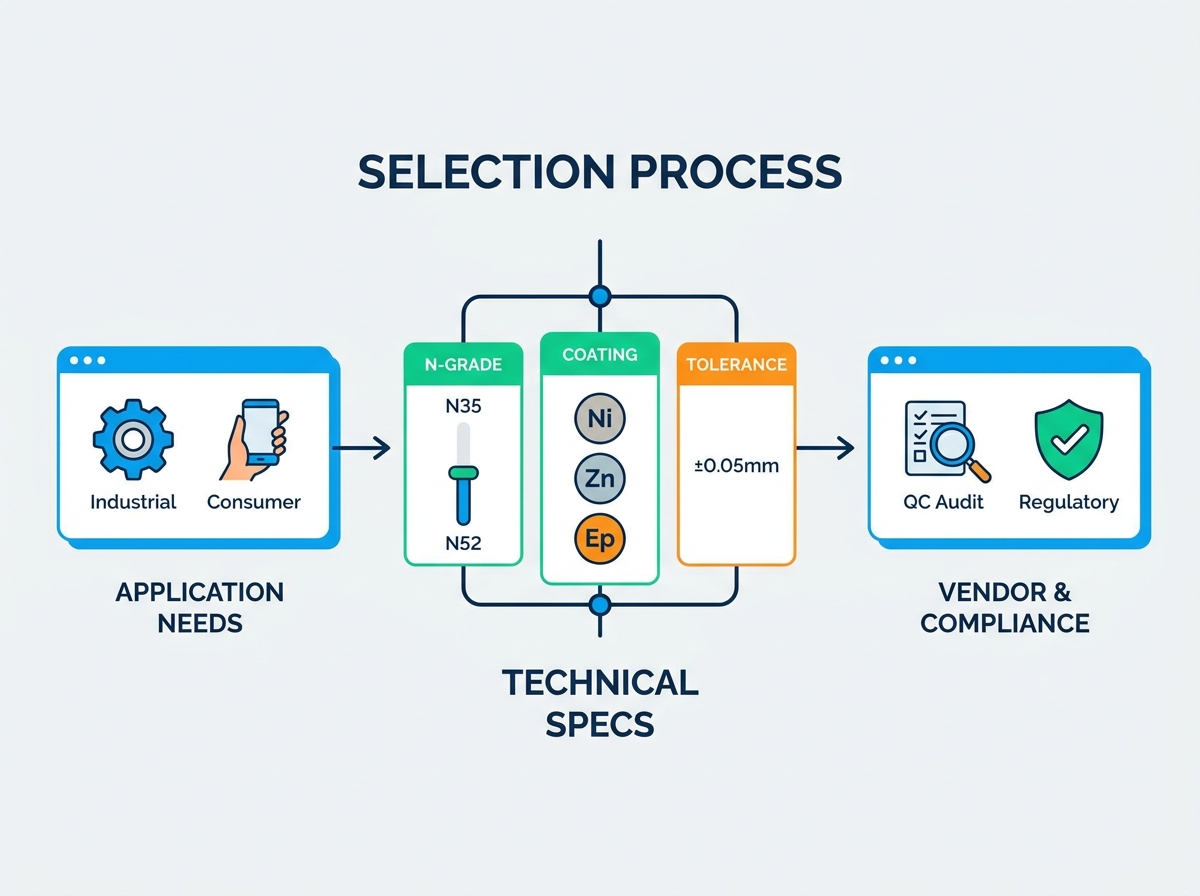
- Coating selection (Nickel, Zinc, Epoxy) is a critical failure point that dictates lifespan in humid or abrasive conditions.
- Precision manufacturing tolerances (often ±0.05mm) separate industrial-grade suppliers from consumer-grade novelty vendors.
- Purchasing magnetic balls in bulk requires strict vendor audits for quality control (QC) and regulatory compliance, especially regarding consumer safety laws.
Evaluating Magnetic Balls Applications Against Core Business Objectives
Before ordering inventory, we must rigorously evaluate diverse magnetic balls applications against specific business goals. A mismatch here guarantees premature product failure.
Engineering vs. Consumer Applications
Industrial environments demand extreme reliability. Engineers use spherical magnets in precision magnetic bearings. They also integrate them into complex automotive assemblies and sensitive sensor triggers. These demanding applications require flawless performance over millions of operational cycles. A single micro-fracture can halt an entire automated assembly line.
Consumer goods present entirely different design challenges. High-end retail displays and educational tools rely heavily on visual appeal. They also require strict safety considerations to protect end-users. You must prioritize smooth surface finishes and non-toxic coatings for consumer products.
Load and Interaction Dynamics
Next, assess your specific load and interaction dynamics. Does your application require static holding power? Or does it involve dynamic physical interaction? Dynamic systems face constant friction. They endure sudden physical impacts and aggressive rotational wear. Spheres rotating within a magnetic joint undergo continuous grinding. This relentless friction rapidly degrades inferior surface treatments.
A common mistake involves assuming static load specifications apply seamlessly to dynamic environments. You must calculate the peak impact force your product will sustain. This helps you avoid specifying overly brittle material grades.
Operating Environment
Finally, define your baseline operating environment clearly. Establish firm assumptions regarding ambient temperature ranges. Calculate the expected humidity levels your product will naturally encounter. Identify any potential chemical exposure during normal operation. A sensor trigger submerged in industrial oil requires vastly different protection than an indoor desk toy. Outline these environmental constraints early to narrow down your material choices effectively.
Decoding Magnetic Balls Specifications for Technical Match
Properly decoding magnetic balls specifications guarantees a precise technical match for your assembly line.
Understanding N-Grades (N35 to N52)
Most buyers immediately look at N-grades, ranging from N35 to N52. Higher numbers indicate a significantly stronger magnetic field. However, maximizing this strength involves a hidden trade-off. N52 spheres possess immense pulling force but suffer from drastically increased brittleness. They easily chip or shatter upon hard impact.
Therefore, the highest grade rarely represents the most commercially viable choice. A lower grade, like N35 or N38, often provides better physical durability. Best practice dictates choosing the lowest N-grade that still meets your minimum holding force requirement.
Coercivity and Demagnetization
Coercivity measures a magnet's inherent resistance to demagnetization. External magnetic fields naturally degrade magnetization over extended periods. Repeated physical impacts also accelerate this hidden flux loss. You must specify appropriate intrinsic coercivity ratings for your components.
This technical parameter prevents sudden performance drops in magnetically noisy environments. Motors and heavy electrical equipment generate stray fields. If your product operates near them, you need a high-coercivity specification to maintain long-term stability.
Thermal Constraints (Max Operating Temperature)
Thermal constraints dictate long-term survivability. Standard Neodymium loses its magnetic flux when overheated. You must closely align your maximum operating temperature with the correct material suffix. An N35 magnet operates safely up to 80°C. Conversely, an N35UH variant withstands up to 180°C without permanent flux loss.
Always map the Curie temperature against your harshest expected operational environment. Surpassing the maximum operating temperature causes irreversible demagnetization. Once cooled, the magnet will never regain its original strength.
Navigating Material and Coating Trade-offs
Understanding base material properties helps you protect your long-term investment in Magnetic Balls.
Base Material Realities
Neodymium (NdFeB) completely dominates the spherical magnet market today. Manufacturers produce it using advanced powder metallurgy techniques. It offers an unmatched strength-to-size ratio. However, NdFeB contains a remarkably high iron content.
This chemical composition makes it incredibly vulnerable to rapid oxidation. Without adequate surface protection, these raw spheres quickly rust, flake, and fail completely. You cannot deploy uncoated Neodymium in virtually any commercial application.
Coating Decision Matrix
Choosing the optimal surface treatment is a critical engineering decision. A poor coating choice leads to catastrophic field failures. We summarize the most common commercial trade-offs below.
| Coating Type | Durability | Corrosion Resistance | Best Commercial Use Case |
| Ni-Cu-Ni (Nickel) | High | Moderate | Standard indoor applications, consumer retail displays. |
| Zinc | Moderate | Moderate | Adhesive bonding applications, budget-sensitive projects. |
| Epoxy | Excellent | High | Outdoor environments, high-friction dynamic movement. |
| Gold/Silver | Low | Low to Moderate | Specialized conductivity needs, premium luxury aesthetics. |
Triple-layer Nickel (Ni-Cu-Ni) provides excellent standard durability. It looks highly professional but remains electrically conductive. Zinc offers lower upfront manufacturing costs. It creates a highly textured surface for superior adhesive bonding.
Epoxy delivers maximum moisture protection. It excels in outdoor locations or high-friction joints due to its resilient shell. Gold and silver serve very narrow niche applications. They focus primarily on luxury aesthetics or highly unique electrical conductivity requirements.
Risk Mitigation: Tolerances, Quality Control, and Compliance
Procurement teams must actively mitigate both manufacturing inconsistencies and severe legal risks when sourcing rare-earth materials.
Dimensional Accuracy
Dimensional accuracy serves as your first line of mechanical defense. Tight manufacturing tolerances are absolutely non-negotiable for modern production. Industrial vendors typically maintain a precision of ±0.05mm or better.
Automated assembly lines jam instantly if sphere diameters fluctuate across batches. Precision mechanics require highly predictable spacing to function properly. Even a fraction of a millimeter deviation can misalign a critical sensor trigger. Always demand explicit tolerance guarantees on your purchase orders.
Consistency Across Batches
Consistency across different production batches ensures reliable product lifecycles. You must thoroughly evaluate a supplier's internal quality control procedures before signing contracts.
Look for these specific QC indicators when auditing a new factory:
- Automated surface Gauss testing data provided for every individual batch.
- Comprehensive demagnetization curve reports verifying raw material integrity.
- Documented salt spray test certificates for all coated variants.
- Strict sampling protocols based on recognized ISO 9001 standards.
Regulatory Compliance
Regulatory compliance presents a massive commercial hurdle. Small rare-earth magnets face an increasingly strict legal landscape globally. The US Consumer Product Safety Commission (CPSC) heavily regulates their distribution.
High-powered spheres pose severe ingestion hazards to children. Ignoring these mandatory safety laws creates catastrophic corporate liability. You must ensure consumer-facing applications either enclose the magnets permanently or meet strict local size-and-strength safety thresholds. Consult specialized compliance attorneys before launching consumer magnet products.
A Strategic Buying Guide for Magnetic Balls in Bulk
Following a structured buying guide for magnetic balls streamlines your entire supply chain and prevents costly delays.
Vetting Suppliers
Purchasing magnetic balls in bulk demands rigorous upfront vendor vetting. Do not rely solely on slick internet marketing claims or exceptionally low initial quotes. Dig deeper into their actual manufacturing infrastructure.
Ask potential suppliers these critical questions immediately:
- Where exactly do you source your raw rare-earth materials?
- Do you apply surface coatings in-house or outsource them to third-party facilities?
- Which specific ISO quality certifications does your manufacturing facility currently hold?
In-house coating capabilities often indicate vastly superior quality control. Outsourced surface treatments frequently lead to highly inconsistent batch yields and unexpected delays.
Prototyping to Production
Moving from initial prototyping to full production requires careful stepping stones. Never commit immediately to massive minimum order quantities (MOQs). Always request localized sample batches first.
Test these prototypes aggressively inside your actual end-use environment. Subject them to your specific temperature fluctuations and humidity conditions. This real-world validation prevents ordering thousands of fundamentally incompatible units. Only scale up to bulk purchasing once the sample batch survives your harshest internal stress tests.
Conclusion
Successful procurement balances raw magnetic performance against environmental resilience and supplier reliability. Navigating these complex technical variables correctly protects your final product and brand reputation. Engineering needs and procurement realities must align perfectly to achieve long-term commercial success.
Here are your immediate next steps:
- Draft a formal specification sheet detailing your required N-grade, exact operating temperatures, and acceptable dimensional tolerances.
- Identify the most abrasive or humid condition your product will face, then specify your coating accordingly.
- Demand physical prototypes for rigorous internal stress testing before signing off on bulk manufacturing contracts.
- Verify your design against local consumer safety regulations regarding high-powered magnet sizes.
Take control of your sourcing process today. Equip your engineering and purchasing teams with these technical benchmarks to guarantee resilient manufacturing outcomes.
FAQ
Q: How long do Neodymium magnetic balls retain their magnetism?
A: Neodymium spheres possess an incredibly slow natural degradation rate. They typically lose less than 1% of their total magnetic flux every ten years. This impressive longevity assumes they operate strictly within their specified temperature limits. It also requires keeping them isolated from massive opposing magnetic fields that might force premature demagnetization.
Q: Can we customize the magnetization direction of magnetic balls?
A: Yes, you can specify different magnetization directions. Most commercial spheres feature diametric magnetization, meaning the opposing poles sit on opposite curved sides. Alternatively, axial magnetization aligns the poles differently, though it remains less common for perfect spheres. Your chosen direction heavily dictates how the balls naturally align and stack during automated assembly.
Q: What is the standard lead time when ordering magnetic balls in bulk?
A: Standard bulk lead times typically range between three to six weeks. Custom epoxy coatings or highly specific high-temperature grades often push this timeline closer to the six-week mark. We strongly advise procurement teams to build adequate inventory buffers. Unpredictable raw rare-earth material shortages can occasionally extend these manufacturing timelines further.
Q: How do we verify the magnetic specifications provided by a supplier?
A: Always implement a multi-layered verification approach. Conduct in-house surface Gauss meter readings immediately upon delivery. Additionally, you should request formal hysteresis graphs and demagnetization curve reports for every single batch. For highly critical applications, hire an independent third-party testing laboratory to audit the supplier's initial material claims.