Inefficient fixturing carries steep hidden costs in industrial fabrication. You lose valuable time to endless rework, inaccurate tacking, and cumbersome setup procedures. Positioning a Magnetic Square involves much more than simply holding two pieces of metal together. It requires establishing repeatable precision, mitigating thermal distortion, and dramatically speeding up your overall workflow. When operators struggle using clunky traditional clamps, shop productivity suffers immensely. Poorly aligned joints lead to weak welds and rejected parts.
This guide breaks down the essential technical variables and operational realities you need to evaluate. We will help you select the correct magnetic tooling for your high-stakes fabrication projects. You will learn how material thickness impacts holding force in real-world scenarios. We explore why switchable technology matters for modern shops. Finally, we show you how to protect sensitive magnets from extreme heat environments.
Key Takeaways
- Material thickness dictates force: A magnet’s rated holding force requires adequate material thickness to achieve full saturation; thin gauge steel dramatically reduces actual grip.
- Switchable technology improves ROI: On/off magnetic squares eliminate the pain point of metal shaving accumulation and allow for precise pre-alignment before engagement.
- Heat is the primary risk factor: Operating near high-amperage weld zones risks permanent demagnetization if thermal thresholds (particularly for Neodymium magnets) are exceeded.
- Surface conditions matter: Rust, mill scale, and air gaps invalidate manufacturer "ideal condition" holding force ratings, requiring a mandatory 2x–3x safety factor in purchasing decisions.
Assessing Your Fixturing Bottlenecks: Framing the Problem
Start by identifying your primary workflow disruptions. You must map out exactly where current fabrication delays happen. Do they stem from consistent alignment inaccuracy during the fit-up stage? Do you suffer from agonizingly slow tool changeovers between different production runs? Or maybe your operators waste countless hours on post-weld cleanup.
Removing spatter and grinding away sharp metal shavings drains productivity. Pinpointing these specific bottlenecks helps you justify new tooling investments. We often see shops lose more money on inefficient setup than on actual welding time.
Next, define your success criteria for the upgrade. Establish clear baseline requirements for your specific applications. You must determine the acceptable tolerance limits for your shop. For example, demand true 90° or 45° retention without any joint slippage. Calculate the maximum payload weight your operators routinely handle. Set a firm target for acceptable setup and tear-down time.
Finally, evaluate the true cost of failure. Highlight the exact material and labor costs incurred when parts shift unexpectedly during tacking. Inadequate holding force ruins delicate tack welds instantly. It forces skilled workers to grind out their mistakes and start the alignment over. These compounding delays quickly eat into your operational profit margins.
Solution Categories: Fixed vs. Switchable Magnetic Squares
You generally choose between two core solution categories for shop holding tools. Standard fixed models offer straightforward simplicity. Switchable models provide advanced mechanical control.
Standard Fixed Magnetic Squares
These traditional tools remain magnetically active constantly. They are best suited for low-budget, light-duty applications. You might also use them effectively in dedicated, permanent jigs. In these specialized jigs, operators rarely need to remove or reposition the magnet.
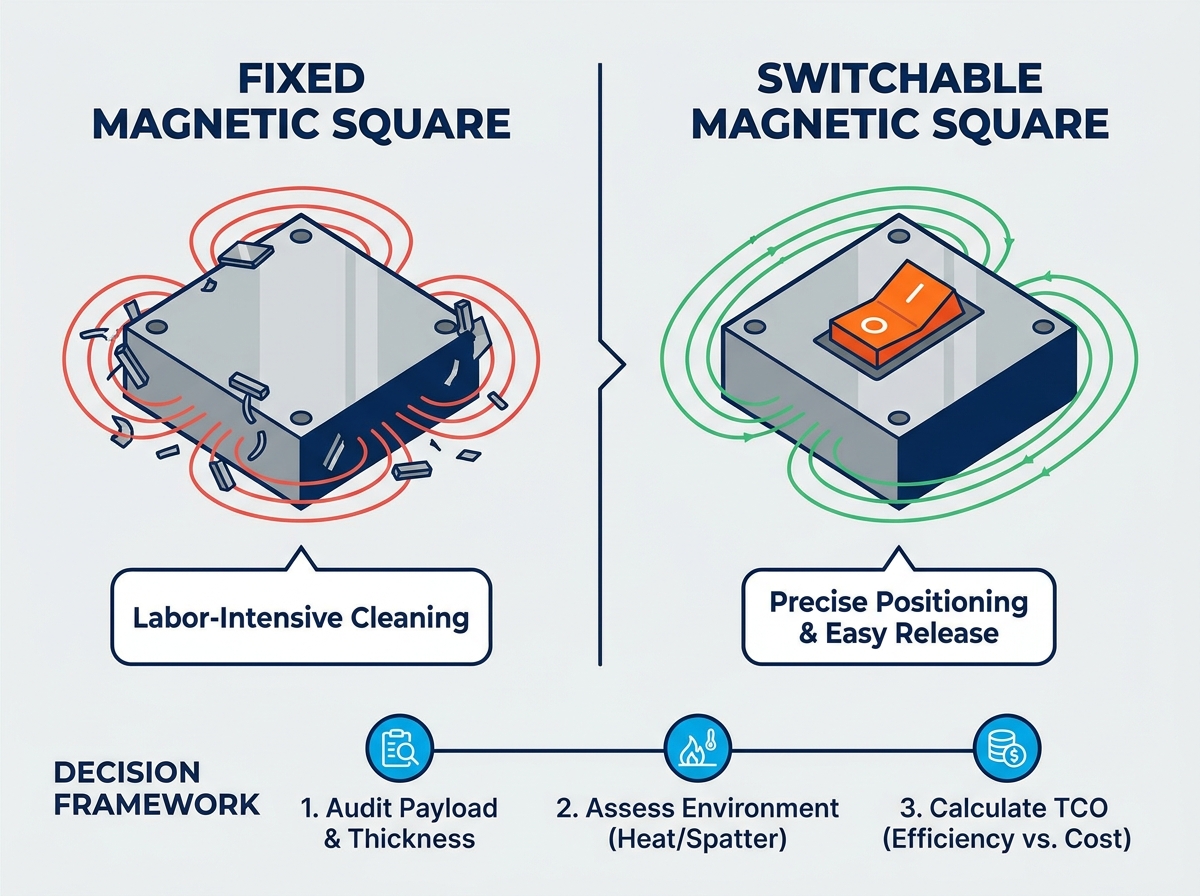
However, they carry significant daily drawbacks. The constant magnetic field continuously attracts surrounding ferrous debris. Airborne grinding dust easily clings to the surfaces. This reality makes cleaning incredibly labor-intensive. It also causes slight but critical alignment errors. If a tiny piece of debris sits on the contact edge, it ruins a perfect 90-degree corner. Operators must wipe the tool obsessively before every single use.
Switchable (On/Off) Magnetic Squares
Switchable units solve the annoying debris problem entirely. They use internal diametrically polarized magnets. These powerful internal magnets align or misalign via a simple mechanical turn-switch.
Their primary advantage lies in total precision control. Operators can perfectly position heavy joints first. They align the metal pieces perfectly before applying any holding force. Once turned off, the tool instantly releases any accumulated metal shavings. They simply wipe clean with a bare hand.
The business case remains incredibly strong. They carry a higher initial procurement cost than fixed models. However, they offset this expense through significantly faster setup routines. You save valuable labor money every single time an operator moves the fixture.
Core Evaluation Dimensions for Magnetic Square Applications
When evaluating various Magnetic square applications, you must look far beyond basic marketing claims. Actual shop floor conditions dictate real performance.
Holding Force vs. Working Reality
Tool manufacturers almost always advertise a breakaway force metric. They measure this specific metric on exceptionally thick, flat, pristine steel plates. In everyday reality, actual shear force matters much more. Shear force resists materials sliding downward against gravity. It is typically only a small fraction of the advertised breakaway force.
You must also account for the severe air gap penalty. Paint, rust, and heavy scale act as physical barriers. They drastically reduce deep magnetic flux penetration. A thin layer of tough mill scale can drop your effective holding power by half. Thin sheet metal poses another challenge. It simply cannot absorb the full magnetic field. This saturation limit significantly reduces the actual grip you achieve.
Geometric Versatility
Assess the required holding angles for your daily fabrication tasks. Standard models typically offer standard 45° and 90° holding options. Multi-angle models provide much greater geometry flexibility. They often include specialized 30°, 60°, and 75° angles.
Evaluate the physical footprint carefully during your selection. Ensure the square isn't overly bulky for your specific workspaces. It should never obstruct the delicate welding torch path. You need adequate physical clearance to strike an arc comfortably. Massive clamps often block access to tight internal corners.
Magnetic Material Constraints
The internal raw material dictates the tool's maximum capabilities. You will encounter two primary magnet types.
- Ferrite/Ceramic: These traditional magnets offer excellent heat resistance. They cost significantly less to manufacture. However, they are naturally bulkier. They also deliver comparatively lower holding force.
- Neodymium (Rare Earth): These advanced magnets boast an exceptional strength-to-size ratio. They hold massive weights in a tiny footprint. However, they are highly susceptible to thermal degradation. You must ensure they are specifically rated for high-temp shop environments.
| Internal Material Type | Strength-to-Size Ratio | Thermal Heat Resistance | General Cost Profile |
| Ferrite/Ceramic | Low to Moderate | Excellent (Up to 300°C) | Highly Economical |
| Neodymium (Rare Earth) | Exceptionally High | Low (Unless specially rated) | Premium Investment |
Mitigating Risks When Using a Magnetic Square for Welding
Using a Magnetic square for welding introduces unique operational hazards. You must actively manage extreme localized temperatures and electromagnetic interference.
Thermal Degradation
Intense heat destroys permanent magnets rapidly. Every magnet features a strict Curie temperature limit. Once a magnet exceeds this physical threshold, it loses its magnetism permanently. Neodymium magnets are especially vulnerable near high-amperage weld zones. Standard Neodymium grades start losing power around 80°C.
Always maintain a safe physical distance between the hot weld puddle and the fixture. We advise users to tack the corners quickly. Then, remove the magnet completely before applying heavy, continuous heat. Do not let the tool absorb residual heat from the workpiece.
Arc Blow Interference
Strong magnetic fields can aggressively deflect the welding arc. This frustrating phenomenon is commonly known as arc blow. It happens frequently during direct current (DC) welding operations. The magnetic field pushes or pulls the arc plasma unpredictably. It causes erratic spatter and poor weld penetration.
You can mitigate this frustrating issue quite easily. Simply use the fixture exclusively for initial joint tacking. Once the joint is secured mechanically by the tacks, remove the magnet entirely. Complete your final root pass without any magnetic interference present.
Safety and Ergonomics
High-capacity rare earth squares pose severe pinch-hazard risks. Some heavy-duty models exert over 400 pounds of holding force. If an operator's finger gets caught between the magnet and a steel beam, serious injury occurs instantly.
This distinct danger makes switchable models an absolute safety necessity. You can position them completely safely while turned off. They remain entirely inert during the handling phase. Only engage the power switch once your hands are completely clear of the pinch points. Always wear heavy leather gloves when handling industrial-strength magnetic tooling.
Shortlisting and Decision Framework: Next Steps
Creating a reliable procurement framework ensures you buy the right tool. Follow these actionable steps to simplify your selection process today.
- Step 1: Audit the payload. Determine the absolute maximum weight you handle daily. Measure the minimum thickness of your routine shop materials. Remember that thin steel cannot absorb full magnetic flux. Apply a 2x to 3x safety multiplier to calculate your required holding force rating. If you need to hold 50 pounds, buy a tool rated for at least 150 pounds.
- Step 2: Assess the environment. Evaluate your shop floor conditions thoroughly. Are you operating in high-heat or heavy spatter zones? If so, prioritize traditional ceramic magnets. Alternatively, choose fully enclosed, heavy-duty switchable models. These premium models come equipped with specialized exterior heat shielding.
- Step 3: Execute actionable testing. Review specific technical data sheets for your shortlisted models. Request a physical demo directly from your supplier. Consult directly with a tooling specialist. They will help perfectly match specific unit capabilities to your daily workflow demands. Do not buy based purely on marketing brochures.
Conclusion
Choosing the right magnetic tooling requires careful engineering evaluation. It is never just a basic price-point purchase. You must base your final decision on material thickness, your thermal environment, and overall operational efficiency.
We highly recommend prioritizing switchable functionality for professional environments. The daily time saved during setup easily justifies the initial procurement cost. Furthermore, always apply strict safety factors to manufacturer holding force ratings. Real-world surface conditions rarely match perfect laboratory tests. By anticipating air gaps and shear forces, you guarantee reliable, safe performance on your busy shop floor.
FAQ
Q: Do magnetic squares lose their strength over time?
A: Permanent magnets retain their strength indefinitely under normal conditions. They do not have a defined shelf life. However, they can lose their magnetism if subjected to extreme heat above their Curie temperature. Severe physical shock or exposure to highly opposing electrical fields can also permanently degrade their holding power over time.
Q: How do you clean metal shavings off a fixed magnetic square?
A: Cleaning fixed magnets requires manual physical effort. You can blow off loose dust with heavy compressed air. For stubborn metal shavings, wipe the surface aggressively with a thick rag. Alternatively, place the magnet inside a thin plastic bag before use. Simply remove the bag to discard the shavings easily.
Q: Why is my magnetic square sliding when the holding force rating is so high?
A: Manufacturers rate holding force based on direct pull tests on thick, pristine steel. Sliding involves shear force, which is significantly weaker than direct pull force. Additionally, thin gauge materials, rust, paint, and basic surface friction drastically reduce the magnet's actual grip in real-world shop conditions.
Q: Can magnetic squares be used on aluminum or stainless steel?
A: No. Magnets only function properly on ferromagnetic materials like carbon steel and iron. Aluminum is completely non-magnetic. Most austenitic stainless steels also lack required magnetic properties. For these non-ferrous materials, you must rely entirely on traditional mechanical clamping solutions to secure your fabricated joints.