Buyers often default to the N52 Magnet because it holds the title of the strongest commercially available neodymium grade. We naturally gravitate toward maximum power. Many product designers assume the highest possible rating automatically guarantees the best mechanical results.
However, maximum magnetic pull does not equal universal applicability. High physical strength frequently brings severe thermal vulnerability. It also carries noticeable cost premiums during manufacturing. Over-engineering leads to wasted project budgets. Conversely, under-specifying causes catastrophic product failure during field deployment. You must strike a precise balance.
This comprehensive guide offers an evidence-based evaluation framework. We will help you decide if this specific grade matches your exact project requirements. You will learn whether a lower tier makes better business sense. You might also discover an alternative temperature rating works best for your specific engineering environment.
Key Takeaways
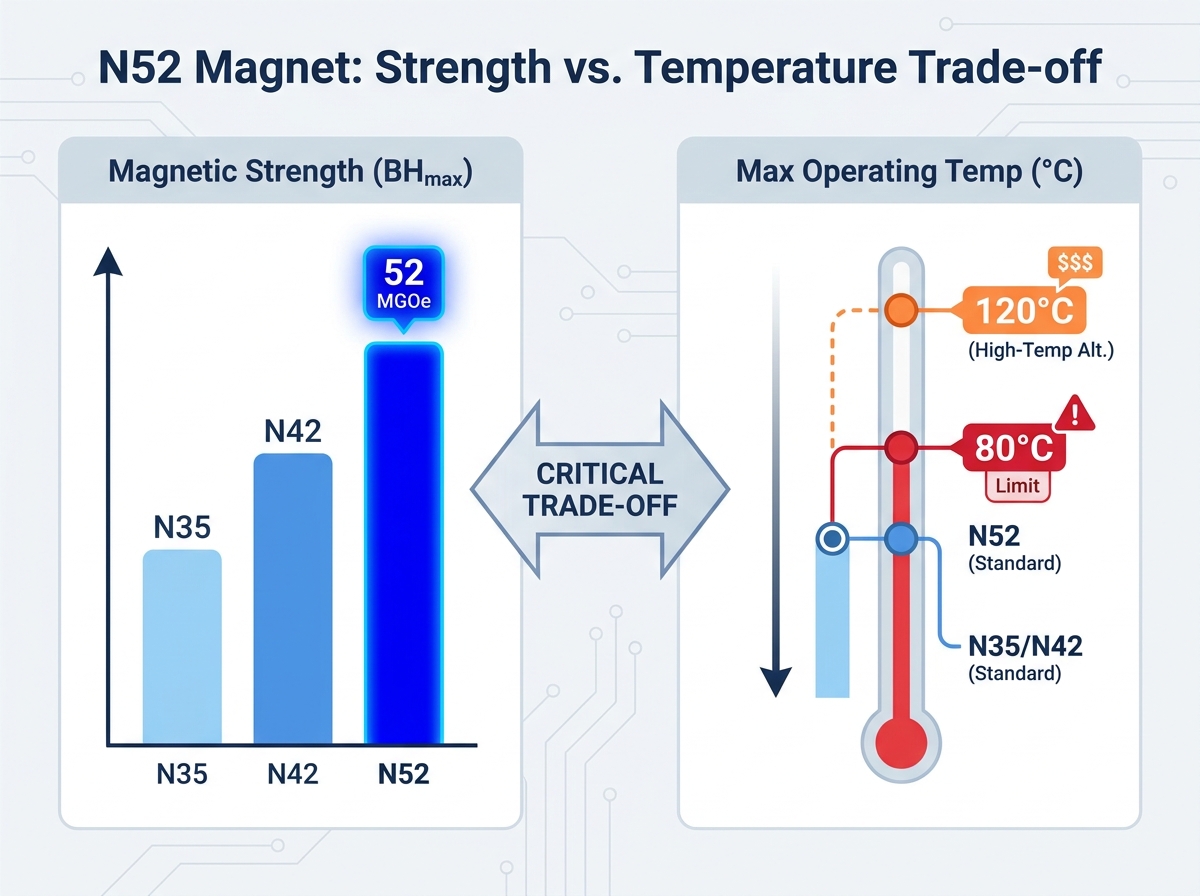
- Maximum Strength vs. Trade-offs: An N52 magnet yields a Maximum Energy Product (BHmax) of 50-53 MGOe, but typically caps at an 80°C (176°F) maximum operating temperature.
- Cost-to-Performance Ratio: Downgrading to an N42 or N35 often reduces material costs by 15-30% while remaining completely viable for less demanding magnetic circuits.
- Thermal Realities: High-heat applications require temperature-modified grades (e.g., N52M, N52H) or entirely different compositions (Samarium Cobalt) to prevent irreversible demagnetization.
- Verification is Critical: True N52 performance requires strict supply-chain compliance, proper coating selection, and rigorous pull-force testing to avoid counterfeit grades.
Defining the Baseline: What Makes the N52 Magnet the Commercial Benchmark?
Engineers and industrial designers constantly seek optimal magnetic performance. They frequently specify the N52 Magnet for highly demanding applications. We must first define this benchmark objectively. We need to completely understand the underlying science behind the specification.
Understanding the "N52" Rating
The alphanumeric nomenclature provides clear scientific data. The "N" stands for Neodymium. This denotes the primary rare-earth element inside the alloy matrix. The number "52" represents the Maximum Energy Product. We measure this specific value in MegaGauss-Oersteds (MGOe).
A 52 MGOe rating indicates massive stored magnetic energy. It reflects how much magnetic flux the material generates per unit volume. Higher numbers indicate denser magnetic energy fields. This vital metric ultimately dictates the overall efficiency of your closed magnetic circuit. It tells you exactly how much raw power the alloy contains.
Physical Capabilities
This premium grade offers truly exceptional physical capabilities. It delivers unparalleled baseline pull force against ferromagnetic materials. You get massive surface Gauss readings from incredibly small volumes. Its holding power relative to its total mass is absolutely staggering.
This exceptional strength-to-weight ratio actively drives modern product miniaturization. Tiny wireless earbud speakers rely entirely on this grade. Miniature medical sensors utilize its compact power for accurate readings. A small metallic cube can securely lift hundreds of times its own physical weight. This advantage enables engineers to shrink product housings drastically.
The Limits of "Strongest"
You will often hear suppliers call this the "strongest" magnet available. We must clarify an important engineering caveat. It represents the highest widely commercialized grade on the global market. Factories produce it reliably at a massive industrial scale.
Experimental grades like N54 and N55 certainly exist in advanced laboratories. However, they remain highly fragile in practical field applications. They cost significantly more to manufacture due to extreme purity requirements. Yield rates plummet terribly during standard production cycles. Therefore, 52 remains the practical ceiling for reliable volume manufacturing. We standardize our commercial expectations around this hard reality.
N52 vs. N35 and N42: Is the Premium Justified?
Evaluating different grades requires objective analytical comparison. You must strictly justify the financial premium attached to peak physical performance. More power is not always better for your final product assembly.
Assessing the Cost-to-Performance Gap
We must compare magnetic output across different pricing tiers. N35 serves as the reliable industry workhorse for standard industrial projects. N42 acts as the ideal middle-tier compromise for modern consumer electronics. An N52 Magnet offers roughly 45% to 50% more total magnetic energy than an N35 baseline. It yields about 20% more sheer power than an N42 specification.
Pricing deltas tell a very different story. The raw material scarcity heavily impacts bulk unit pricing. Dysprosium and Terbium trace additions increase production costs exponentially. Manufacturers require pristine base materials to achieve 52 MGOe consistently. Consequently, you pay a steep financial premium for those final few energy units.
Magnetic Grade Comparison Summary
| Grade Classification | Max Energy Product (MGOe) | Relative Cost Premium | Typical Application Profile |
| N35 | 33 - 35 | Baseline Level (Lowest) | General fastening, large industrial motors |
| N42 | 40 - 42 | Moderate Tier (+10-15%) | Consumer electronics, standard audio |
| N52 | 50 - 53 | Premium Tier (+25-40%) | Aerospace components, micro-sensors |
When to Down-Specify (Shortlisting Logic)
Engineers often over-specify magnetic requirements during early prototyping. Downgrading is sometimes the smartest structural design choice. We highly recommend evaluating two critical application conditions before finalizing your purchase order.
- Oversaturation Risk: This phenomenon occurs when you use a very thin ferrous target. Thin sheet metal simply cannot absorb massive magnetic flux. The extra strength bleeds out into the surrounding empty air. An N35 will hold just as firmly against thin steel as a premium grade. The extra magnetic energy becomes entirely redundant and financially wasteful.
- Tolerance for Larger Footprints: Spatial constraints heavily dictate your grade selection. Loose constraints offer excellent design flexibility. You can simply use a slightly larger N35 block to achieve identical pull force. This approach often proves much more cost-effective. A tiny premium-grade cube costs substantially more than a larger baseline block.
The Achilles Heel: Temperature Limits and Demagnetization Risks
Thermal dynamics quickly destroy magnetic performance. Peak strength introduces severe thermal vulnerabilities into your assembly. We must address these material limitations directly to prevent disastrous field failures.
Thermal Constraints of Standard N52
This standard commercial grade enforces a strict 80°C (176°F) maximum operating temperature. Exceeding this critical threshold causes immediate operational problems. You must thoroughly understand two distinct thermal failure modes.
Reversible loss involves a temporary strength reduction under mild heat. The material gradually weakens while it remains hot. It fully recovers its pull force once it returns to normal room temperature.
Irreversible demagnetization represents an entirely different structural problem. Intense heat permanently destroys the internal structural magnetic alignment. The unit never recovers its original manufactured strength. It becomes permanently weakened. You must avoid crossing this critical temperature line at all costs.
Navigating High-Temperature Alternatives
High-heat applications demand highly specific metallic solutions. Manufacturers cleverly use temperature-rated suffixes to indicate increased thermal resistance.
- M-Series (N52M): This variant safely withstands up to 100°C operating environments.
- H-Series (N52H): This heavy-duty series is engineered for applications reaching 120°C thresholds.
These chemical modifications introduce a brutal engineering trade-off. Achieving a true 52 MGOe rating becomes exponentially more difficult under high thermal demands. Heavy reliance on expensive rare-earth additives drives unit prices skyward. A high-temperature N52 Magnet pushes the absolute known limits of current material science. Only specify these high-heat variants when absolutely necessary.
Application Context: Will an N52 Magnet Work for Your Specific Use Case?
Every technical application demands unique magnetic properties. We must perfectly match the grade to the specific environmental reality. One size never fits all in magnetic engineering.
High-Viability Applications (Where N52 Excels)
Certain industries desperately require maximum energy density. Spatial real estate and payload weight carry immense financial premiums here.
- Miniaturized Electronics & Sensors: Modern mobile devices pack hundreds of micro-components into tiny outer shells. Precision medical instruments require microscopic yet powerful magnetic fields. High-end audio equipment needs massive flux concentration in tight acoustic spaces. Every single millimeter matters deeply in these demanding designs.
- High-Torque Motors & Actuators: Brushless DC motors demand extreme operational efficiency. They require maximum flux density tightly packed within a confined stator-rotor gap. Stronger fields generate significantly more torque per input watt. This impressive efficiency heavily extends battery life in modern drones and industrial robotics.
- Magnetic Fasteners & Couplings: Heavy industrial applications often require extreme holding force. Sometimes you must successfully bridge large air gaps. You might need to project invisible force through non-magnetic physical barriers. Heavy durable plastics and thick glass enclosures require maximum flux penetration to maintain structural coupling.
High-Risk Applications (Where N52 Fails)
Peak physical strength cannot overcome deeply harsh environments. These problematic scenarios usually demand entirely different chemical compositions.
Under-the-Hood Automotive: Internal engine bays routinely exceed 120°C during standard operation. A standard N52 Magnet will permanently demagnetize here within minutes. Automotive engineers strongly prefer Samarium Cobalt (SmCo) instead. High-heat NdFeB variants also work well, but they strictly require lower MGOe ratings to survive.
Corrosive Environments: Neodymium material contains very heavy iron concentrations. Iron oxidizes rapidly without proper protective sealing. Harsh industrial chemicals destroy raw magnets almost instantly. Humid marine environments cause aggressive, deep-seated corrosion. You must specify specialized plating like Ni-Cu-Ni or apply thick epoxy resins to ensure operational longevity.
Sourcing and Compliance: Ensuring Genuine N52 Performance
The global supply chain hides many undocumented risks. You must verify every incoming batch rigorously. Counterfeits routinely plague the global magnetic industry.
The Counterfeit Risk
Unverified discount suppliers frequently substitute weaker metallic materials. They slyly use N48 or N50 blocks instead. They confidently label them as premium grades. Standard hand-held Gauss meters often fail entirely to prove this discrepancy. Surface readings fluctuate wildly based on geometry and precise probe placement. This makes fast field verification incredibly difficult for most receiving departments.
Evaluation Criteria for Suppliers
You must firmly demand comprehensive engineering documentation. Do not blindly accept simple certificates of conformity. Ask for actual demand hysteresis graph documentation. Request specific BH curve test reports for your exact batch. Ensure strict dimensional tolerance compliance across all axes. Even a microscopic 0.1mm variance heavily alters the total available magnetic volume.
Coating & Longevity
Protective outer layers preserve the internal magnetic structure. Common industry options include triple-layer Nickel (Ni-Cu-Ni), Zinc, and black Epoxy. You must accurately factor these metallic coatings into your final gap calculations. Coatings slightly increase the physical distance between the active magnetic core and your steel target. A standard 20-micron epoxy layer alters the effective working air gap. This seemingly microscopic physical change noticeably impacts your total mechanical holding force.
Conclusion
The N52 Magnet clearly serves as a tremendously powerful tool. It allows dramatic physical footprint reduction. It delivers absolute maximum flux density for highly critical assemblies. However, it demands highly precise thermal management. You must meticulously control environmental exposure to prevent failure.
We strongly encourage a methodical, step-by-step validation approach. Always request multiple physical samples early in your conceptual design phase. Consult directly with an experienced magnetics engineer. They will help correctly model your specific magnetic circuit. Conduct extensive, real-world prototype testing under mechanical load. You must thoroughly verify thermal stability before committing to any high-volume production runs.
FAQ
Q: How much stronger is an N52 magnet compared to an N35?
A: It provides approximately 45-50% higher maximum magnetic energy (BHmax). However, this does not directly mean 50% more pull force. Actual pulling power depends heavily on your steel target's thickness and surface area. Thin steel will oversaturate quickly, negating the extra energy completely.
Q: Can an N52 magnet lose its strength over time?
A: Under normal operating conditions, neodymium magnets remain incredibly stable. They lose less than 1% of their total strength every 10 years. You only risk rapid demagnetization if you expose them to extreme heat, heavy radiation, or strong opposing magnetic fields.
Q: Are there magnets stronger than N52?
A: Yes, N54 and N55 grades exist today. However, they remain highly fragile and extremely expensive. They lack wide commercial availability. Manufacturers struggle to produce them consistently at scale. Most standard manufacturing facilities consider 52 MGOe the practical ceiling for reliable commercial production.
Q: How do I measure if the magnet I received is actually N52?
A: Do not rely solely on a basic surface Gauss reading. You need a controlled pull-force test using standardized steel plates. For definitive proof, an engineering lab must conduct a permeameter test. This generates a precise BH curve to verify the exact structural grade.