For B2B procurement and engineering teams, selecting the right neodymium magnet grade often comes down to a fine balance between magnetic performance and unit cost. Over-speccing wastes your budget, while under-speccing risks catastrophic application failure. While N52 frequently gets attention for maximum strength, the mid-tier grades—specifically the N40 Magnet and its N45 counterpart—are the true workhorses of industrial manufacturing. They offer reliable power without the extreme price premiums of top-tier grades.
This guide provides a direct, technical evaluation of N40 and N45 magnets. We detail their physical properties, cost-to-performance ratios, and environmental limitations to streamline your procurement decision. You will discover exactly when to upgrade your specifications and when to safely stick to the reliable baseline.
Key Takeaways
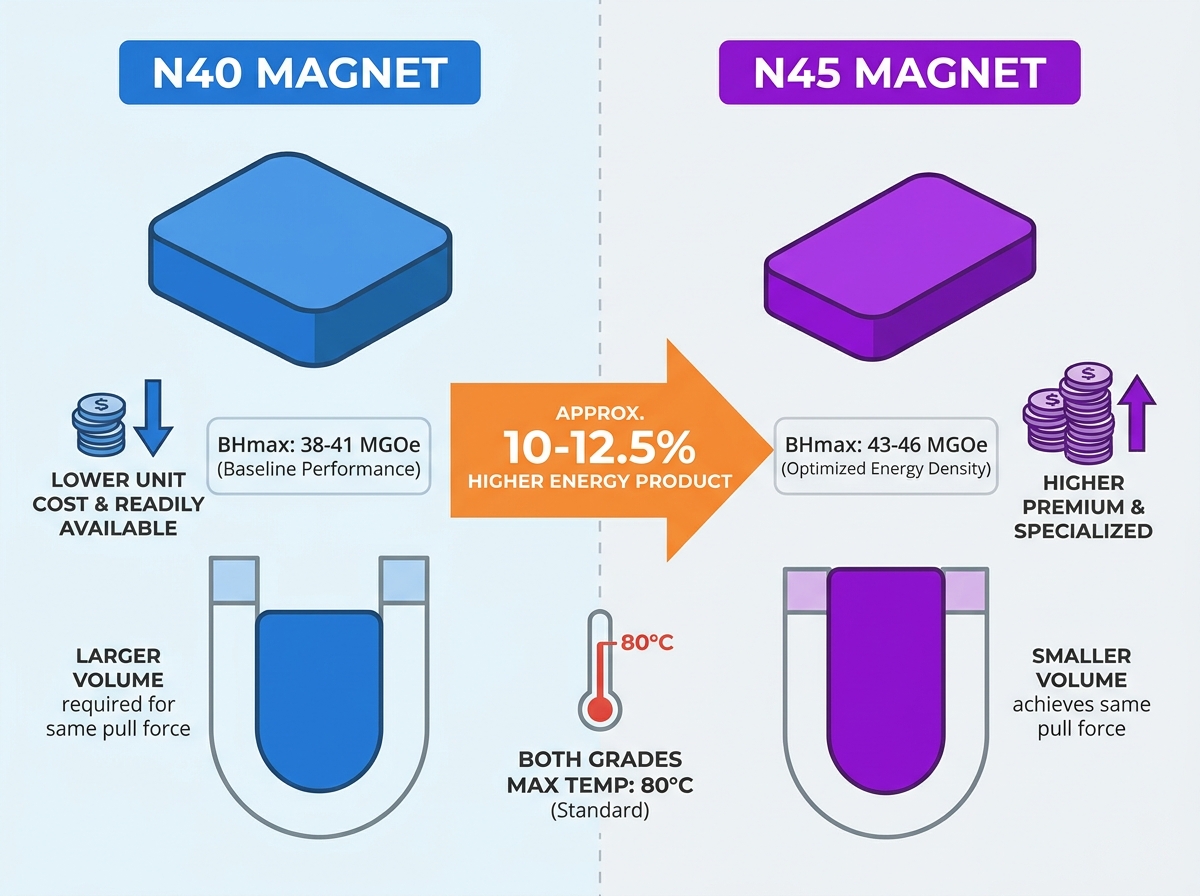
- Strength Delta: An N45 magnet offers roughly 10–12.5% more magnetic energy (BHmax) than an N40 magnet of the exact same dimensions.
- Cost Efficiency: An N40 magnet is generally more cost-effective and readily available, making it ideal for standard assemblies where space is not severely restricted.
- Thermal Limits: Both standard N40 and N45 grades max out at 80°C (176°F) operating temperatures; high-heat applications require specific suffixes (e.g., N40H, N45SH) rather than a higher base grade.
- Design Trade-offs: Upgrading to N45 is only strictly necessary when physical space constraints require a smaller magnet volume to achieve a specific pull force.
1. Core Magnetic Properties: N40 vs. N45 Benchmarks
You must understand the foundational metrics to compare neodymium magnets accurately. The "N" prefix simply stands for Neodymium. The number immediately following it represents the Maximum Energy Product. We measure this value in Mega-Gauss Oersteds (MGOe). It quantifies the absolute maximum magnetic energy stored within the material. A higher number indicates a stronger magnetic field per unit of volume.
N40 Magnet Specifications
An N40 Magnet delivers a typical BHmax between 38 and 41 MGOe. Its Remanence (Br) generally falls around 12.5 to 12.8 Kilo-Gauss (KGs). Remanence measures the residual magnetic flux density after magnetization. For industrial buyers, this grade represents the reliable baseline. It powers most commercial and industrial applications efficiently. You get a strong, durable magnetic field without paying for unnecessary rare-earth material density.
N45 Magnet Specifications
The N45 grade steps up the performance. It offers a typical BHmax between 43 and 46 MGOe. The Remanence (Br) pushes higher, typically landing between 13.3 and 13.7 KGs. Manufacturers position the N45 as the optimized choice for restrictive footprints. When your design demands higher torque or superior pull force in a tiny space, N45 delivers the necessary energy density. It packs more power into the exact same physical dimensions.
Coercivity and Demagnetization
Coercivity (Hc) measures a magnet's baseline resistance to demagnetization. Buyers often assume higher grades resist demagnetization better. This is largely incorrect. Base coercivity remains relatively similar between standard N40 and standard N45 grades. Both will lose strength if exposed to severe opposing magnetic fields. You only gain significant demagnetization resistance by specifying high-temperature variants.
Magnetic Property Comparison Chart
| Magnetic Property | N40 Grade Range | N45 Grade Range | Unit of Measurement |
| Maximum Energy Product (BHmax) | 38 - 41 | 43 - 46 | MGOe |
| Remanence (Br) | 12.5 - 12.8 | 13.3 - 13.7 | KGs |
| Intrinsic Coercivity (Hcj) | ≥ 12.0 | ≥ 12.0 | kOe |
| Max Operating Temperature | 80 | 80 | °C |
2. Cost vs. Performance ROI for Procurement
Procurement teams must balance upfront capital against necessary performance. Understanding the price dynamics between N40 and N45 helps optimize your budget. The rare-earth market fluctuates constantly. Small changes in grade specifications dramatically impact your bulk purchasing efficiency.
The Price Premium of N45
Producing an N45 magnet requires a slightly higher concentration of premium rare-earth elements. Manufacturers also employ more refined sintering processes to achieve the higher energy product. This directly translates to a price premium. You can typically expect a 10% to 15% increase in bulk unit cost when upgrading from N40 to N45. This premium compounds quickly in high-volume manufacturing runs. Procurement must justify this extra expense through strict engineering necessity.
Volume vs. Grade Substitution
Smart engineering can often bypass the N45 price premium entirely. We call this volume versus grade substitution. Calculate whether it is cheaper to use a slightly larger N40 Magnet instead of a smaller N45 magnet. Increasing the physical volume of an N40 often matches the total magnetic output of an N45. If your product housing has empty space, use it. Filling that space with a larger N40 usually costs less than paying the material premium for a higher grade.
Supply Chain Realities
Raw material availability heavily influences lead times. The N40 grade is highly ubiquitous across global supply chains. Almost every magnet manufacturer produces it in massive quantities. This ubiquity results in shorter lead times and highly competitive multi-vendor sourcing. You can easily switch suppliers if delays occur. N45 is common but slightly more specialized. Sudden spikes in global rare-earth demand can choke N45 availability faster than N40.
3. Temperature Resistance and Environmental Constraints
Environmental factors dictate magnet longevity just as much as base strength. Engineers often make critical errors when specifying magnets for harsh environments. Heat and moisture will destroy neodymium quickly if you ignore proper specifications.
The 80°C Baseline Misconception
Let us clarify a very common engineering misconception. Upgrading from an N40 magnet to an N45 magnet does not improve temperature resistance. Base grades only indicate magnetic strength at room temperature. Both standard N40 and N45 grades begin to suffer irreversible flux loss around 80°C (176°F). If your application runs hot, changing the number from 40 to 45 provides zero thermal protection. The magnet will still degrade and fail.
Suffixes Matter (M, H, SH, UH)
You must use specific suffixes to specify for elevated temperatures. Manufacturers add heavy rare-earth elements like Dysprosium to increase intrinsic coercivity. This raises the thermal threshold. If a motor runs at 120°C, you do not need a stronger base grade. You need an N40H or an N45H.
- M Grade: Max operating temperature of 100°C.
- H Grade: Max operating temperature of 120°C.
- SH Grade: Max operating temperature of 150°C.
- UH Grade: Max operating temperature of 180°C.
Specify the letter suffix based on your peak operating temperature, not your continuous average. A temporary heat spike can permanently weaken an under-specced magnet.
Coating Requirements and Corrosion
Sintered neodymium is predominantly composed of iron. It oxidizes rapidly in ambient humidity. Both N40 and N45 are highly susceptible to corrosion. You must evaluate standard coating options based on your operational environment.
- Ni-Cu-Ni (Nickel-Copper-Nickel): The industry standard. It provides excellent indoor durability and a clean, shiny finish.
- Epoxy: Superior for damp environments or salt spray exposure. It resists chipping better but adds slight dimensional thickness.
- Zinc: A cost-effective alternative for low-humidity environments. It offers decent protection but dulls aesthetically over time.
Do not neglect coating tolerances in your mechanical drawings. Layer thickness affects the final geometric fit of your assembly.
4. Application Matching: Which Grade Fits Your Industry?
Aligning the magnet grade to your specific industry application prevents engineering bottlenecks. The choice between N40 and N45 becomes obvious once you define your primary functional priority. Space constraint is usually the deciding factor.
Where to Specify an N40 Magnet
The standard N40 Magnet excels in environments where space allows for adequate magnet volume. It balances impressive holding force with sensible material costs. We recommend N40 for the following scenarios:
- Sensor triggers and magnetic switches: Hall effect sensors rarely require massive magnetic fields to actuate reliably. N40 provides ample flux density for consistent switching.
- Standard magnetic fasteners and closures: Furniture latches, purse clasps, and industrial holding jigs operate perfectly well with N40.
- Heavy-duty packaging and consumer electronics: High-end retail boxes and tablet covers need a strong, satisfying snap. N40 achieves this tactile feel economically.
The core rationale here is straightforward. You secure ample holding force without paying unnecessary material premiums. If your design has room for a slightly thicker magnet, default to N40.
Where to Specify an N45 Magnet
You should specify N45 when every millimeter of your assembly footprint counts. These applications suffer mechanically or aesthetically if the magnet grows larger. We recommend N45 for the following scenarios:
- Compact brushless DC (BLDC) motors: Drone motors or surgical power tools require minimal rotor weight. N45 maintains high torque while keeping the rotor dimensions slim.
- Energy harvesting applications: Devices converting kinetic motion into electricity rely on extreme magnetic density. Energy density per cubic millimeter is absolutely critical here.
- High-performance magnetic couplings: Sealless pumps use magnetic couplings to transmit torque through solid walls. N45 transmits higher torque across wider air gaps.
The core rationale centers on miniaturization. Space-constrained environments require the highest possible energy density to maintain function.
5. Implementation Risks and Assembly Considerations
Procuring the right grade is only half the battle. You must actually assemble the product safely and efficiently. Higher magnetic energy introduces specific manufacturing risks. Ignoring these risks leads to scrap waste and worker injuries.
Handling and Safety Protocols
Higher magnetic strength directly increases the risk of magnets snapping together violently. N45 generates a stronger attractive force at a distance compared to N40. This poses a marginally higher risk during assembly line handling. Workers can easily trap their fingers between two N45 blocks. Furthermore, the violent impact of magnets snapping together causes immediate chipping or complete shattering. NdFeB material is inherently brittle. Provide non-magnetic tweezers, durable assembly jigs, and strict handling training to mitigate these safety hazards.
Demagnetization Curves and B-H Data
Engineers must review the manufacturer's specific B-H curve for the chosen grade. This is non-negotiable for motor applications. Motors subject magnets to strong opposing magnetic fields from stator coils. You must ensure the chosen batch operates safely above the "knee" of the demagnetization curve at your maximum operating temperature. Operating below this knee causes permanent flux loss. Ask your supplier for the exact demagnetization curve data for their N40 and N45 materials, as quality varies between foundries.
Over-Speccing Pitfalls and Saturated Steel
Paying for an N45 upgrade often results in completely wasted capital due to surrounding material limits. Magnets are part of a broader magnetic circuit. They usually attach to a steel backing plate to direct flux. Steel can only carry a finite amount of magnetic flux before it saturates. If your backing steel thickness already maxes out the flux of an N40, upgrading to N45 does absolutely nothing. The extra magnetic energy simply leaks into the surrounding air. Always calculate your steel saturation limits before paying for higher grades.
6. B2B Decision Framework: Shortlisting and Sourcing
We developed a concrete framework to help buyers finalize their procurement strategy. Follow these chronological steps to lock in the correct grade and source it reliably from global vendors.
Step 1: Define Dimensional Constraints
Analyze your CAD models rigorously. Can the mechanical design accommodate a larger N40 magnet? Are your physical spaces completely locked? If you can expand the pocket depth by just one millimeter, you can likely save money by sticking with N40. Only move to Step 2 if space is absolutely restricted.
Step 2: Calculate Pull/Torque Requirements
Guessing leads to failure. Use magnetic simulation software (like FEMM or advanced FEA tools) to map your magnetic circuit. Input the parameters for an N40. Check if the simulated pull force or torque meets your minimum operational threshold. If it fails, simulate the exact same dimensions using N45 material data. This math proves whether the upgrade is functionally required.
Step 3: Establish Operating Environment
Determine your peak environmental stressors. Log the maximum expected operating temperatures. Remember to factor in enclosed heat buildup, not just ambient room temperature. Next, assess chemical and moisture exposure. Select the required temperature suffixes (M, H, SH) and the necessary coating (Nickel, Epoxy) before locking in the final grade.
Step 4: Requesting Comprehensive Quotes
Ambiguous RFQs (Request for Quotes) lead to inaccurate pricing and delayed lead times. Give your suppliers exact, comprehensive specifications. Your RFQ must explicitly detail the chosen grade (e.g., N40H), exact dimensions with tight machining tolerances, the specific magnetization direction (e.g., magnetized through the thickness), coating type, and a brief description of the intended application. This transparency helps suppliers flag potential manufacturing issues early.
Conclusion
For the vast majority of standard industrial applications, the N40 magnet provides the optimal intersection of cost, availability, and magnetic strength. It delivers reliable power without straining your procurement budget. The stronger N45 grade should be strictly reserved for dimensionally constrained engineering challenges where miniaturization justifies the price premium.
Before committing to bulk orders, we strongly encourage buyers to request physical samples of both grades. Test them rigorously within your specific physical assembly. If you remain unsure about flux density limits or steel saturation, consult directly with a dedicated magnet engineer for finite element analysis (FEA). Making data-driven choices ensures optimal product performance and maximum capital efficiency.
FAQ
Q: Can I replace an N45 magnet with an N40 magnet to save money?
A: Yes, if you have the physical space to slightly increase the size of the N40 magnet to match the total magnetic output of the N45. Expanding the volume of a lower grade often costs less than buying a smaller, higher-grade magnet.
Q: What is the actual pull force difference between N40 and N45?
A: Assuming identical dimensions, an N45 will typically generate 10% to 15% more pull force than an N40. The exact increase depends heavily on the specific magnetic circuit and the thickness of the steel it attracts.
Q: Do N40 and N45 magnets look different?
A: No. Grade refers strictly to the internal magnetic crystalline structure and energy density. Outward appearance is dictated entirely by the chosen protective plating (e.g., shiny nickel, black epoxy, or dull zinc).
Q: Are N40 magnets more brittle than N45?
A: Both are sintered neodymium-iron-boron (NdFeB) materials and are inherently brittle. The N45 may snap to other ferrous objects with slightly more velocity due to its stronger field. This marginally increases the risk of chipping upon violent impact.