You know exactly what your project demands: spherical magnets. However, navigating the highly fragmented market quickly becomes overwhelming. Buyers often face a confusing spectrum of products. These range from recreational desk toys to high-performance industrial components. Selecting the wrong material, magnetic grade, or protective coating causes serious problems. It can lead to rapid degradation, insufficient magnetic pull, or severe safety compliance issues. We designed this guide to help you cut through the noise. Our goal is to provide an evidence-based framework. You will learn how to evaluate different materials and understand complex pricing structures. By the end of this article, you will have the knowledge needed to make a compliant, risk-free purchase. Whether you source components for precision engineering or educational models, understanding these core variables ensures you get exactly what you need.
Key Takeaways
- Material dictates performance: Neodymium (NdFeB) offers the highest magnetic strength, while Ferrite provides cost-effective durability for lower-stress applications.
- Coatings are non-negotiable: Without proper plating (e.g., Ni-Cu-Ni or epoxy), neodymium ball magnets are highly susceptible to corrosion and chipping.
- Pricing scales with grade and volume: Costs are primarily driven by the magnetic grade (e.g., N35 vs. N52), raw material market fluctuations, and bulk purchasing tiers.
- Safety compliance is critical: Consumer applications (toys/hobbyist) require strict adherence to regulatory sizing and pull-strength limits to mitigate ingestion risks.
Evaluating Ball Magnet Types: Materials and Magnetic Grades
When you select a Ball Magnet, the base material dictates its entire performance profile. You must match the material chemistry to your specific application requirements. Failing to do so results in underperforming components or unnecessary expenditures.
Neodymium (Rare Earth) Ball Magnets
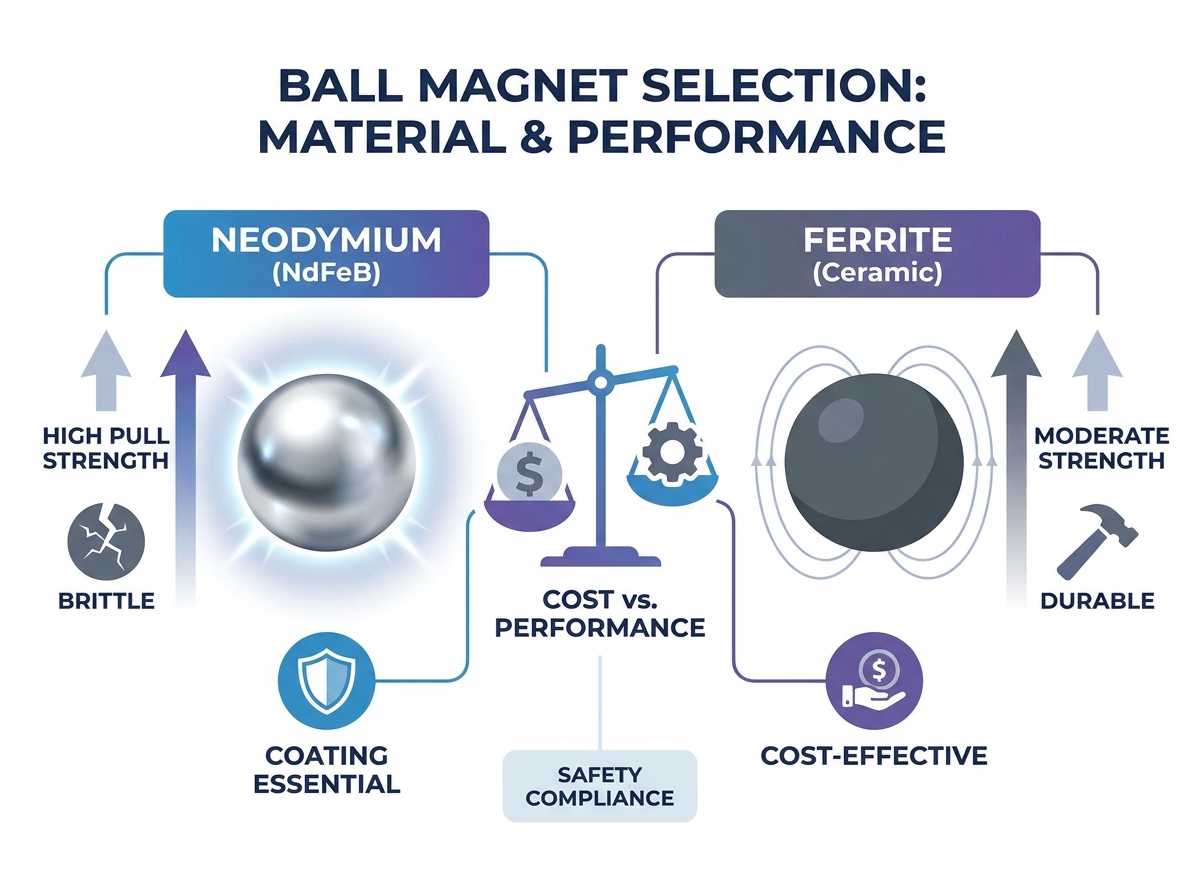
Neodymium magnets, composed of neodymium, iron, and boron (NdFeB), deliver the highest pull strength-to-size ratio available today. They are incredibly powerful but inherently extremely brittle. We highly recommend them for high-performance industrial holds, premium educational models, and precision electronics where space is limited.
When choosing neodymium, you must select a specific grade on the N-scale. This scale typically ranges from N35 to N52. The number represents the maximum energy product in Mega-Gauss Oersteds (MGOe). Higher grades like N52 offer maximum magnetic strength. However, they are much more prone to shattering upon physical impact. You must balance your need for pure strength against the risk of physical damage during regular operation.
Ferrite (Ceramic) Spheres
Ferrite spheres offer much lower magnetic strength compared to rare earth options. Despite this limitation, they are highly resistant to corrosion and demagnetization. They do not even require protective surface coatings to survive harsh elements. They work best for cost-sensitive, outdoor, or high-temperature applications. If your project does not require maximum pull force, ferrite provides excellent, long-lasting durability at a fraction of the cost.
Alnico and Samarium Cobalt (SmCo)
Manufacturers rarely shape Alnico or Samarium Cobalt into consumer spheres. However, they remain vital for specialized industrial use cases. SmCo offers extreme temperature resistance and excellent corrosion stability, making it ideal for aerospace or military applications. Alnico provides high magnetic stability at very high temperatures. You will typically only source these materials for highly specialized engineering projects that exceed the thermal limits of neodymium.
Magnetic Material Comparison Chart
| Material Type | Magnetic Strength | Corrosion Resistance | Primary Use Case |
| Neodymium (NdFeB) | Very High | Low (Requires Coating) | Precision electronics, strong holds |
| Ferrite (Ceramic) | Low to Medium | High | Outdoor, cost-sensitive projects |
| Samarium Cobalt (SmCo) | High | High | Extreme temperature environments |
| Alnico | Medium | Medium | High-temperature industrial tools |
Sizing, Tolerances, and Essential Coatings
Size and surface protection play massive roles in magnet longevity and performance. You cannot overlook these factors during the purchasing and design process.
Sizing and Pull Force Dynamics
A magnet's diameter exponentially impacts its magnetic pull and overall weight. Doubling the diameter of a sphere does not just double its strength. It increases the volume eightfold, which drives the pull force up dramatically. For example, a 10mm sphere is vastly stronger than a 5mm sphere. You must calculate your required holding force carefully. Oversizing your magnets leads to unnecessary raw material costs and introduces severe handling hazards.
The Brittleness Factor (Why Coatings Matter)
Neodymium is inherently brittle and highly vulnerable to oxidation. Moisture in the air alone can cause an uncoated neodymium sphere to rust and crumble. Protective coatings are absolutely essential to prevent rapid degradation.
- Nickel-Copper-Nickel (Ni-Cu-Ni): This triple-layer plating serves as the industry standard. It provides a shiny, metallic finish and excellent basic corrosion resistance for indoor use.
- Epoxy / Rubberized Coatings: These offer the best impact resistance. They absorb shock and prevent chipping when spheres inevitably snap together across distances.
- Gold/Zinc: Buyers choose these specialty platings for specific aesthetic requirements or targeted environmental resistances.
Manufacturing Tolerances
B2B buyers must specify exact dimensional tolerances during the quoting phase. Standard commercial tolerances hover around +/- 0.1mm. Precision engineering applications often require tighter tolerances, such as +/- 0.05mm. Always confirm tolerance capabilities with your manufacturer. Precise dimensions ensure seamless integration into your final product assemblies without binding or rattling.
Pricing Breakdown: What Drives Ball Magnet Costs?
Understanding pricing structures helps you negotiate better deals and forecast budgets accurately. Several distinct variables influence the final quote you receive from a manufacturer.
Raw Material Market Volatility
Rare-earth metal supply chains directly impact the base cost of neodymium. The mining, refining, and global distribution of these metals fluctuate based on complex trade dynamics. When raw material costs spike due to export restrictions or mining shortages, manufacturers immediately pass those increases down the line to buyers. Monitoring the rare-earth market helps you time your bulk purchases.
Grade and Size Premiums
Jumping from an N35 to an N52 grade significantly affects the price-per-unit. Higher grades require more precise manufacturing controls and higher-quality raw material blends. Similarly, larger diameters consume exponentially more raw material, driving up the cost. You pay a premium for the density of the magnetic energy.
B2B Wholesale vs. Retail Pricing
The purchasing channel alters pricing dramatically.
- Retail/Consumer: These channels carry a higher markup. Sellers often package them in specific sets, such as 216-piece 5mm sets. The final price accounts for consumer-friendly packaging, marketing, warehousing, and immediate shipping.
- B2B/Wholesale: Manufacturers utilize volume-tiered pricing. Minimum Order Quantities (MOQs) apply, often starting at thousands of units. However, the per-unit costs drop significantly. Buying direct in bulk always yields the best margins for commercial projects.
Customization Costs
Standard spheres are relatively cheap to produce because manufacturers run them continuously. Custom diametric magnetization, non-standard sizes, or specialized colored coatings add extra fees. Manufacturers must retool machines, adjust electroplating baths, or alter magnetization coils. These adjustments incur setup charges that get baked into your final invoice.
Safety, Compliance, and Implementation Risks
High-powered magnetic spheres carry unique, sometimes severe risks. You must prioritize safety and regulatory compliance above all else when sourcing these components.
Regulatory Compliance
The legal and safety landscape surrounding high-powered magnetic spheres is incredibly strict. In the United States, the Consumer Product Safety Commission (CPSC) heavily regulates magnetic toys. Consumer applications require strict adherence to sizing and pull-strength limits, often measured by a specific flux index. These rules exist to mitigate severe ingestion risks among children. You face very different legal liabilities when selling industrial components versus consumer goods. Always consult local regulations and legal counsel before importing or selling magnetic spheres in your target market.
Handling and Storage Risks
Magnets larger than 10mm pose serious pinch hazards. They can snap together across surprisingly long distances and trap skin or crush fingers. Shatter risks are also a major operational concern. High-grade spheres can fragment violently upon impact, sending sharp metallic shards into the air. When handling a Ball Magnet, you should always separate it from a stack by sliding it apart horizontally. Never try to pull them straight apart.
Environmental Degradation
Standard neodymium balls will fail rapidly in wet or highly acidic environments. Without specialized encapsulation, the internal material oxidizes, expands, and turns to a useless powder. This expansion can shatter the outer plating entirely. Always specify heavy-duty epoxy coatings or integrate plastic casings if your application involves outdoor use or moisture exposure.
How to Shortlist and Choose a Supplier
Finding a reliable manufacturing partner requires diligent vetting. Do not rely solely on the lowest quote, as cheap imports often mask severe quality defects.
Certifications to Look For
Always request proof of current ISO 9001 certification. This standard ensures the factory maintains consistent manufacturing and quality control processes. Additionally, verify RoHS and REACH compliance. These certifications guarantee the products are free from hazardous substances, which is critical if your final product enters the European market.
Vetting Supplier Claims
Overseas sourcing often involves exaggerated pull-force claims. Some suppliers intentionally mislabel magnetic grades to inflate prices. You must stay vigilant. If a quote for N52 magnets seems too good to be true, it likely is an N35 disguised as a premium product. Ask detailed technical questions about their testing methodology to weed out deceptive suppliers.
Sampling and Testing
We highly recommend following a strict sampling process before committing to bulk MOQs. Protect your investment by following these steps:
- Request a small sample batch from your shortlisted suppliers.
- Test the coating durability by simulating everyday impact and friction.
- Measure the spheres with digital calipers to verify true dimensional tolerances.
- Use a Gauss meter to assess magnetic consistency across the entire sample batch.
Shipping Considerations
Strong magnets require specialized magnetic shielding packaging for air freight. This compliance aligns strictly with International Air Transport Association (IATA) regulations. Unshielded magnets can interfere with sensitive aircraft navigation systems. Ensure your supplier understands and routinely handles IATA-compliant packaging to avoid customs delays or rejected shipments.
Conclusion
Purchasing spherical magnets requires a strategic, well-informed approach. You must align your material choice with your specific use case. Neodymium offers unmatched strength for compact designs, while ferrite provides highly affordable durability for less demanding environments. Always prioritize appropriate coatings to prevent chipping and oxidation. Above all, respect strict safety regulations to avoid catastrophic compliance failures.
When making your final decision, look beyond the initial sticker price. Evaluate the long-term value of the component. Cheap imports often suffer from high failure rates, poor coating adhesion, and inconsistent magnetic strength. Investing in high-quality materials upfront prevents product failures down the line and protects your brand reputation.
Before you reach out to certified manufacturers for quotes, clearly define your exact specifications. Document your required size, magnetic grade, coating type, and total volume. Presenting clear, professional specifications guarantees accurate quotes and facilitates a much smoother procurement process.
FAQ
Q: Are N52 ball magnets better than N35?
A: N52 is much stronger than N35, but "better" depends entirely on your application. Higher grades like N52 offer maximum magnetic pull but are significantly more brittle. If your application involves frequent impacts, an N35 magnet might survive longer than an N52. Choose N52 for pure strength, and N35 for a reliable balance of strength and physical durability.
Q: Can ball magnets lose their magnetism?
A: Yes, they can lose their magnetism under certain conditions. Every magnetic material has a maximum operating temperature and a Curie temperature. Exposing them to heat beyond these thresholds causes permanent demagnetization. Extreme physical impacts or constant exposure to stronger opposing magnetic fields can also degrade their magnetic strength over time.
Q: Why are strong magnetic spheres sometimes banned or restricted?
A: Consumer safety agencies strictly regulate them due to severe ingestion hazards. If a child swallows multiple high-powered magnetic spheres, the magnets can attract each other across intestinal walls. This causes life-threatening tissue damage and blockages. Consequently, many countries heavily restrict or ban the sale of small, high-powered magnet sets marketed as toys.
Q: What does "diametrically magnetized" mean for a ball magnet?
A: Diametrically magnetized means the magnetic poles are located on exactly opposite sides of the sphere's curved surface. This specific magnetic pole orientation allows the spheres to link together in long, continuous chains. It serves as the standard magnetization method for recreational magnetic desk toys and intricate geometric building sets.