N52 neodymium magnets offer the highest commercially available magnetic energy product (BHmax) today. However, integrating them into a custom project requires far more than just requesting the strongest option on the market. Engineers often mistakenly assume peak magnetic strength automatically guarantees better product performance.
At the decision stage, your focus must shift from general magnetic properties to precise engineering specifications. You need to evaluate dimensional tolerances carefully. You must select optimal surface coatings to prevent rapid oxidation. You must also analyze operating environments and verify supplier reliability. Ignoring these factors usually leads to rapid component failure, assembly line headaches, or expensive tooling revisions.
This guide provides a rigorous framework for specifying Custom N52 Magnets for demanding applications. We will explore how to evaluate manufacturing partners thoroughly. You will learn how to navigate physical limitations and move smoothly from prototype testing to scaled production without costly design revisions.
Key Takeaways
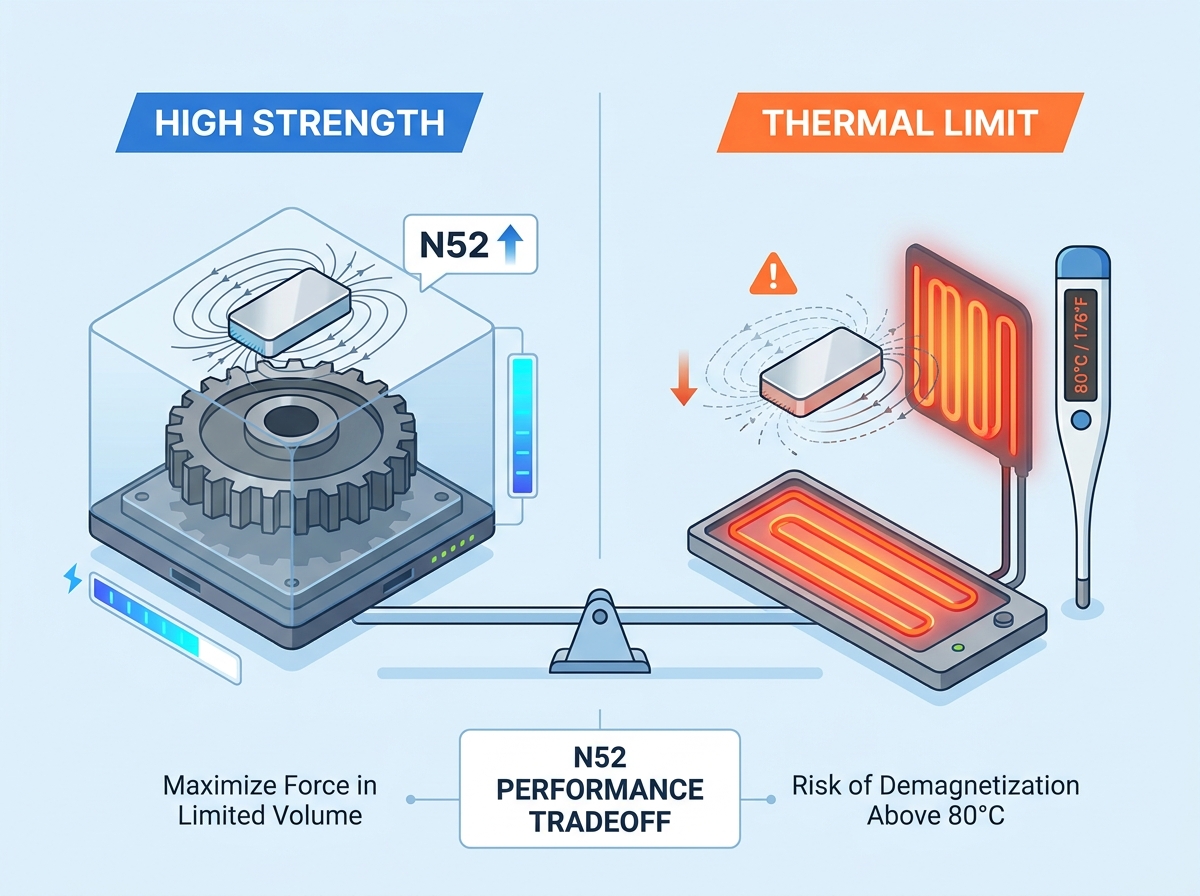
- Performance vs. Limitations: N52 delivers maximum pull force but is highly susceptible to thermal demagnetization (max operating temperature typically 80°C/176°F) and physical chipping.
- Customization Variables: Successful integration depends on defining exact shapes, magnetization directions, and protective coatings (e.g., Ni-Cu-Ni, Epoxy) tailored to your assembly.
- Supplier Vetting: Reliable procurement requires partnering with manufacturers who provide verifiable hysteresis graphs, documented quality control (RoHS/REACH), and transparent tooling costs.
- Cost Drivers: Precision tolerances (below ±0.1mm) and complex geometries significantly impact unit price and lead times for custom magnets.
Validating Your Requirement: Is N52 the Right Grade for Your Project?
You must carefully assess if the premium cost of N52 is justified. High-grade neodymium carries a higher raw material price. You should frame this as a practical business problem. Does your application truly demand the absolute highest magnetic flux? You need to weigh your space constraints and force requirements against environmental limits.
The Space-to-Strength Ratio
N52 becomes strictly necessary when you require a massive magnetic field within a heavily restricted physical volume. Engineers frequently turn to N52 for miniaturized designs. You cannot simply use a larger N35 magnet if you lack the physical space.
Typical applications demanding this extreme space-to-strength ratio include:
- Micro-electronics: Smartphone speakers and haptic feedback motors rely entirely on N52.
- High-performance motors: Drone propulsion systems require maximum torque for minimum weight.
- Specialized sensors: Hall-effect sensors in tight medical devices need strong, stable fields.
If you have ample design space, you might achieve the same pull force using a larger, lower-grade magnet. This approach often reduces raw material expenses while improving thermal stability.
Thermal and Environmental Limitations
Every magnet grade has a physical thermal ceiling. You must address the standard N52 operating limit, which typically sits at 80°C (176°F). Exceeding this threshold causes irreversible flux loss. The magnet will permanently lose a portion of its strength. If your assembly runs hot, N52 will fail.
You must carefully discuss this design trade-off. If your application environment exceeds 80°C, you should evaluate high-temperature variants instead. Grades like N50M (up to 100°C) or N48H (up to 120°C) provide much better thermal resilience. They sacrifice a small percentage of room-temperature strength to guarantee reliable performance under heavy thermal loads. Always prioritize thermal stability over peak room-temperature strength.
Brittleness and Assembly Risks
You must acknowledge the harsh physical reality of neodymium. N52 is fundamentally a sintered ceramic material. It behaves much more like brittle glass than tough steel. N52 magnets produce extreme pull forces. These forces drastically increase the risk of violent collision shattering during your assembly process.
When two unconstrained N52 magnets snap together, they frequently chip, crack, or completely shatter. This creates hazardous flying debris. It also exposes the inner neodymium to immediate oxidation. You must design assembly jigs to control the approach speed. Workers need specialized training to handle these high-strength components safely.
Core Dimensions of Customizing N52 Magnets
Defining the physical and magnetic architecture of your custom component is your next major hurdle. You cannot treat magnets as simple, off-the-shelf blocks. Every physical parameter changes how the magnet interacts with your broader mechanical assembly.
Geometry and Shape Selection
You must rigorously evaluate the manufacturability of your desired shape. Sintered neodymium starts as a pressed powder block. Manufacturers then slice and grind it into the final geometry. Standard shapes include simple blocks, cylinders, rings, arcs, and countersunk designs.
Complex shapes require customized tooling and highly precise wire EDM (Electrical Discharge Machining) cutting. For example, creating highly precise arcs for rotor assemblies demands custom grinding wheels. It also extends lead times significantly. Keep your geometry as simple as functionally possible.
Consider these shape-specific manufacturing realities:
- Blocks and Cylinders: Easiest to manufacture. They require minimal custom tooling and offer the fastest lead times.
- Countersunk Rings: Excellent for mechanical fastening. However, the thin walls near the screw hole fracture easily if over-torqued.
- Rotor Arcs: Highly efficient for motor stators. They demand precise inner and outer radii machining, heavily influencing upfront mold fees.
Magnetization Direction
The orientation of the magnetic field dictates how the component performs. You must explicitly define whether you need axial, diametrical, or radial magnetization. You cannot change this after the manufacturing process concludes.
You must match the magnetization axis directly to your specific functional outcome. For example, a heavy holding application usually relies on simple axial magnetization through the thickness. Conversely, rotating sensor triggering often requires diametrical magnetization across the diameter. Radial magnetization is incredibly complex to manufacture. It requires specialized magnetizing coils but offers unparalleled performance for advanced motor rings.
Precision Tolerances
Standard commercial tolerance for neodymium magnets typically sits around ±0.1mm. This works perfectly for most general holding or clearance-fit applications. However, aerospace and precision robotics often demand much tighter engineering controls.
You need to discuss the real-world cost-to-benefit ratio of requesting tight engineering tolerances. Pushing tolerances down to ±0.05mm or ±0.02mm requires extensive post-sintering diamond grinding. This drastically reduces the manufacturer's yield rate and spikes the final unit price. Only specify ultra-tight tolerances for critical press-fit applications.
| Tolerance Level | Typical Variance | Best Application Use Case | Manufacturing Impact |
| Standard | ±0.1mm | General assembly, glued fittings | High yield, standard pricing |
| Tight | ±0.05mm | Precision sensors, high-end consumer goods | Requires secondary grinding, moderate premium |
| Ultra-Tight | ±0.02mm | Press-fit aerospace, specialized medical | Intensive diamond machining, high premium |
Mitigating Failure: Coatings and Corrosion Resistance
Neodymium (NdFeB) oxidizes incredibly rapidly when exposed to ambient moisture. Without robust surface protection, an N52 magnet will rust, expand, and crumble into magnetic dust. Choosing the right coating prevents catastrophic implementation risks.
Comparing Standard and Specialty Coatings
The operating environment directly dictates your coating selection. You must match the surface protection to your specific exposure levels.
- Ni-Cu-Ni (Nickel-Copper-Nickel): This represents the industry standard. It provides a shiny, durable finish. It is highly optimal for indoor, non-corrosive environments. Most commercial electronics use this reliable three-layer plating.
- Epoxy: This coating is vastly superior for high-humidity, outdoor, or marine applications. Black epoxy provides an excellent moisture barrier. It also offers a slight degree of impact resistance against chipping during assembly.
- Zinc / Gold / Parylene: These serve niche applications. Zinc works for low-cost, short-life temporary uses. Gold is utilized heavily in specialized medical devices and high-end audio for its unreactive nature. Parylene provides ultra-thin, pinhole-free protection for sensitive internal micro-electronics.
Coating Thickness vs. Magnetic Gap
You must understand how your chosen coating physically affects magnetic strength. Magnetic fields degrade rapidly across distance. Even microscopic distances matter.
Explain how thicker protective layers introduce a built-in microscopic air gap. Heavy Epoxy coatings are noticeably thicker than standard Ni-Cu-Ni plating. This added thickness pushes the magnet's core slightly further away from the targeted ferrous surface. As a result, it slightly reduces the effective surface pull force of the N52 magnet. While the core remains N52, the usable strength drops fractionally. You must factor this tiny gap into your precision force calculations.
How to Evaluate and Shortlist Custom Magnet Manufacturers
Moving beyond basic unit price is critical for long-term project success. You must rigorously assess supplier credibility and technical manufacturing capability. A cheap quote usually hides poor quality control or inferior raw materials. Partnering with a reliable factory prevents disastrous line stoppages later.
Testing and QA Transparency
Quality assurance separates decent suppliers from excellent ones. You should look for suppliers fully capable of providing comprehensive batch testing data. Reliable partners will eagerly share empirical evidence of their quality.
Demand transparency. Ask for demagnetization curves (hysteresis graphs) specific to your ordered batch. Request Gauss meter readings and physical pull-force testing documentation. If a manufacturer cannot provide verifiable QA reports, you should walk away immediately. Trust requires verifiable data.
Engineering Support and Prototyping
A true manufacturing partner acts as an extension of your engineering team. Before any steel is cut for tooling, they should actively review your designs.
Does the supplier review your CAD files for magnetic efficiency and manufacturability? An experienced magnet engineer will spot impossible tolerances or overly brittle geometries. They will suggest minor tweaks to improve yield rates. This proactive prototyping support saves months of frustrating trial and error.
Compliance and Certifications
Global supply chains demand strict regulatory compliance. You cannot afford to integrate uncertified materials into your end products. Verify that your shortlisted supplier maintains active ISO 9001 certification for quality management.
Furthermore, you must demand RoHS and REACH compliance documentation. This is completely non-negotiable for consumer electronics, automotive components, or medical applications. Using non-compliant toxic materials will result in heavy fines and global product recalls. Always keep compliance certificates on file.
Preparing Your RFQ: The Sourcing Workflow for Custom Magnets
Structuring a clear, professional Request for Quote (RFQ) is your vital next-step action. Vague requests yield wildly inaccurate pricing. A detailed RFQ eliminates ambiguity, secures accurate cost estimates, and helps you avoid costly miscommunication with overseas factories.
Essential Data for a Complete RFQ
Your RFQ must leave nothing to interpretation. Provide highly detailed 2D and 3D CAD drawings. These drawings must clearly indicate precise magnetic pole locations and magnetization directions.
You must explicitly specify the following variables to get an accurate quote for your Custom magnets:
- Grade: Explicitly state N52.
- Dimensions: Include exact length, width, and thickness alongside required tolerances (e.g., ±0.1mm).
- Maximum Operating Temperature: State your peak environmental heat limit.
- Coating Type: Specify Ni-Cu-Ni, Epoxy, or other specialized finishes.
- Estimated Annual Volume (EAU): Share your expected yearly usage. Volume heavily dictates unit pricing.
Understanding Tooling and Lead Times
You need to clarify internal expectations around initial mold and tooling fees. Standard blocks usually require minimal setup. However, custom arcs or countersunk shapes require specialized pressing molds or cutting jigs. Clarify exactly who owns these tools after payment.
Understand the typical timeline realities. A reputable manufacturer generally needs 2-3 weeks to deliver initial prototypes. Once you approve the prototype, scaled production usually takes another 4-6 weeks. Do not rush the prototyping phase. Rushing often locks in fundamental design flaws.
Conclusion
Specifying custom N52 magnets requires carefully balancing peak magnetic performance against physical vulnerabilities. You must constantly weigh thermal limits, tight physical tolerances, and robust environmental protection. The strongest magnet is useless if it shatters during assembly or corrodes in the field.
Focus on rigorous documentation and clear communication. Evaluate your suppliers based on their engineering transparency and quality certifications, not just the lowest initial bid. Proper design prevents production failures.
Finalize your 3D models and firmly establish your environmental testing criteria today. Then, engage a fully vetted manufacturer to launch your initial prototype run. Moving thoughtfully through these steps guarantees a successful, high-performance product launch.
FAQ
Q: What is the difference in pull force between N50 and N52 custom magnets?
A: N52 magnets generally offer a 4-5% increase in magnetic strength compared to N50 grades. For large-scale industrial assemblies, this minor increase is rarely noticeable. However, for ultra-compact micro-electronics where every millimeter counts, that 5% premium is highly valuable and justifies the increased cost.
Q: Can custom N52 magnets be machined or drilled after I receive them?
A: No. You must never machine neodymium magnets after manufacturing. They are extremely brittle and will shatter. Drilling destroys the protective coating, causing rapid, irreversible corrosion. Furthermore, NdFeB dust created during machining is highly flammable and poses a severe fire hazard. All shaping must occur at the factory.
Q: What is the minimum order quantity (MOQ) for custom neodymium magnets?
A: MOQ varies heavily by manufacturer and shape complexity. Simple blocks cut from existing raw material might have an MOQ of just 100 pieces. Complex arcs requiring custom pressing molds often demand MOQs of 5,000 to 10,000 units to offset the heavy upfront tooling and labor costs.
Q: How do custom coatings affect the N52's performance?
A: Coatings introduce a microscopic "air gap" between the magnet's core and the target surface. Thicker layers like heavy epoxy push the core slightly further away, causing a negligible to minor drop in overall surface pull force. For most applications, this tiny loss is practically undetectable.