Poor fit-up and manual clamping bottlenecks are the fastest ways to lose margin and introduce distortion in metal fabrication. Achieving perfectly held 90° and 45° joints requires stable, hands-free workholding. A high-quality Magnetic Square solves this problem instantly. Without proper clamping, weldments shift as they cool and contract. Selecting the wrong magnet type can lead to severe heat degradation, unpredictable arc blow, and dangerous safety hazards on the shop floor. Many fabricators underestimate the specific demands of their daily welding environment when purchasing these essential tools. This comprehensive guide breaks down the technical evaluation criteria, implementation risks, and feature-to-outcome realities. You will learn exactly how to match holding power to material thickness, avoid common magnetic interference, and select the best setup for your shop. Ultimately, this ensures smoother operations and vastly improved joint precision.
Key Takeaways
- Switchable vs. Fixed: Switchable (On/Off) magnets require a higher initial investment but drastically reduce setup time and swarf (metal shavings) buildup compared to fixed-block magnets.
- Pull Force Matching: Holding capacity must be paired with material thickness; excessive pull force on thin gauge metal is inefficient and creates pinch hazards.
- Heat Vulnerability: Unprotected neodymium magnets permanently lose magnetism if exposed to high ambient welding heat; proper placement and material selection are critical.
- Mitigating Arc Blow: Proximity to the weld pool influences the welding arc. Superior models allow for rapid repositioning to prevent arc deflection.
Framing the Need: Why Upgrade to a Dedicated Magnetic Square for Welding?
Traditional workholding methods often slow down production. You likely know the struggle of juggling heavy steel parts while trying to tighten a C-clamp. C-clamps and locking pliers are notoriously slow. They limit your access to tight inside corners. Operators frequently require a second set of hands just to hold heavy stock in place before tacking. This manual process introduces human error and slows down output.
A dedicated Magnetic square for welding offers a streamlined solution. These tools provide instant, multi-angle fixturing. Most models support 45°, 90°, and 135° configurations out of the box. You simply place the magnet, align your steel pieces, and turn on the holding power. This allows a single operator to tack weld complex assemblies efficiently. It removes the need for clumsy mechanical clamps in tight spaces.
Evaluating success here is straightforward. A successful purchase completely eliminates secondary operator needs for basic fit-ups. It must hold true, zero-tolerance angles under the actual weight of your material. Furthermore, it must withstand the harsh realities of a heavy fabrication environment. Sparks, grinding dust, and heavy impacts are daily threats. Your chosen workholding tool needs to survive these conditions without losing accuracy.
Best Practices for Upgrading
- Audit your current fit-up time to establish a baseline.
- Identify the most common joint angles you fabricate daily.
- Start by upgrading the clamping systems on your most frequently delayed workstations.
Solution Categories: Fixed vs. Switchable Magnetic Squares
When you enter the market, you will encounter two primary styles of magnetic squares. Understanding the mechanical differences helps you choose the right tool for your specific operations.
Traditional Fixed Magnetic Squares
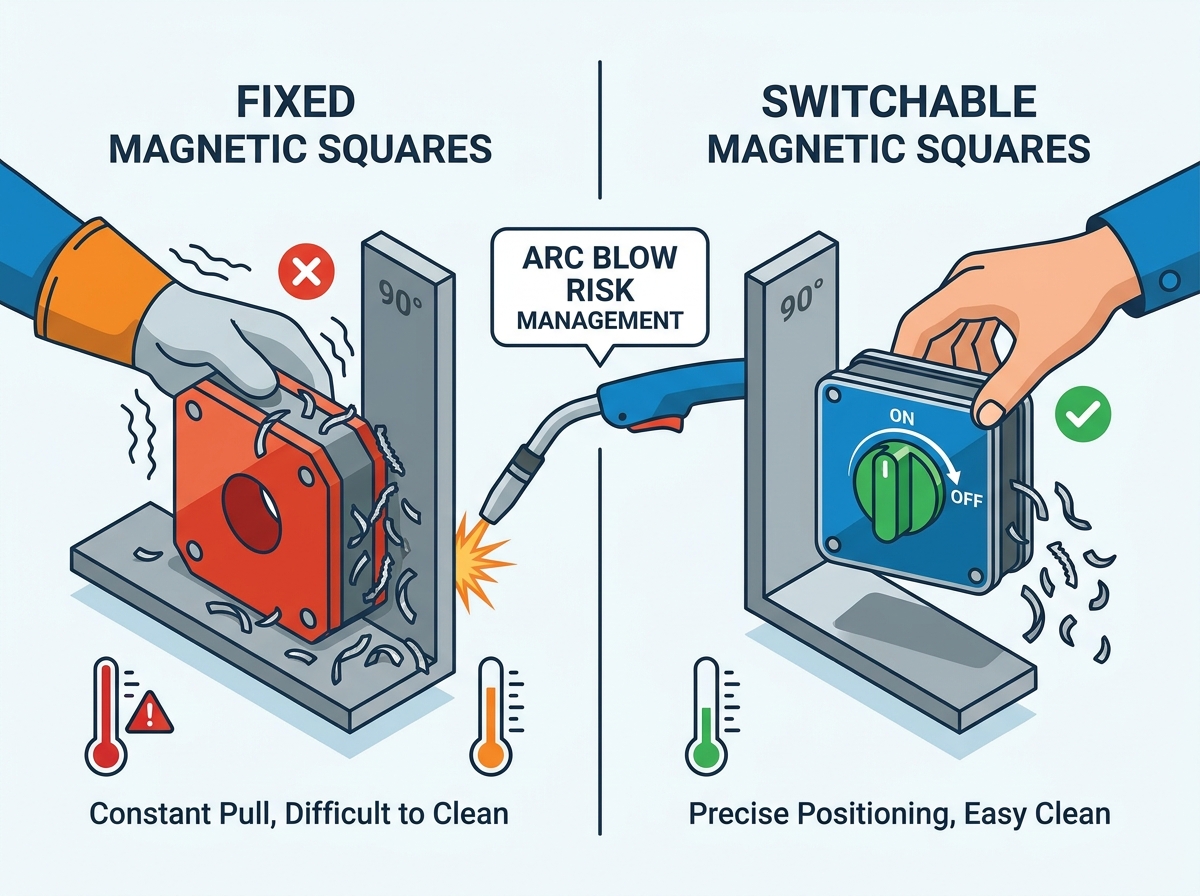
Fixed squares rely on a constant magnetic field. Manufacturers typically encase these magnets in a riveted steel frame. The magnetic pull is always active.
These tools are highly cost-effective. They contain no moving parts to fail, making them extremely durable against drops. They are ideal for light-duty tasks or occasional hobbyist use. However, the constant magnetic field creates distinct challenges. It is notoriously difficult to clean metal dust and swarf off the contact points. When you position heavy steel, you must constantly fight the magnet's pull. This makes micro-adjustments nearly impossible.
Switchable (On/Off) Magnetic Squares
Switchable squares use an internal rotating mechanism. Twisting a dial or flipping a switch aligns or disrupts the internal magnetic field. This turns the holding power on or off.
These models allow exact positioning before you engage the magnet. You can align your parts perfectly without fighting magnetic resistance. When deactivated, the tool drops any accumulated metal dust for effortless cleaning. They are also significantly safer for operators handling heavy materials. The main drawback is a higher upfront cost. Extreme physical impacts can sometimes compromise the internal rotating mechanisms.
Fixed vs. Switchable Workholding Comparison
| Feature | Fixed Magnetic Square | Switchable Magnetic Square |
| Holding State | Always ON | Toggle ON/OFF |
| Positioning Ease | Difficult (fights the operator) | Effortless (position, then engage) |
| Cleaning | Requires manual wiping or covers | Sheds debris instantly when OFF |
| Durability | Very high (no moving parts) | Moderate (internal parts can jam) |
| Safety | High pinch hazard | Low pinch hazard |
Core Evaluation Dimensions: Specifications to Outcomes
Selecting the correct magnet requires looking past the marketing labels. You must translate raw specifications into real-world shop floor outcomes.
Pull Force vs. Material Thickness
Manufacturers often advertise massive pull force ratings. A 150 lb pull force rating sounds impressive. However, factories test this rating on thick, flat, finely ground steel plates. Your reality is likely different. Thin gauge metals cannot absorb the full magnetic flux. Painted materials, mill scale, and rust create physical air gaps. These gaps yield significantly lower holding power.
You must evaluate capacity based on the heaviest standard stock in your shop. If you mostly weld 1/8-inch wall tubing, a 300 lb magnet is overkill. It will not hold any stronger than a 100 lb magnet because the thin steel saturates quickly. Factor in a 20-30% holding reduction for standard surface imperfections.
Machined Precision and Angle Availability
Stamping processes introduce physical stress into steel. Stamped steel frames often warp over time. If your magnet face is warped, your 90-degree joint will be out of square. Only fully CNC-machined contact faces guarantee true, lasting alignments.
Look for solid billet construction. Precision-ground faces are non-negotiable for high-end fabrication. Ensure the tool offers the specific angles your shop fabricates most frequently. Do not settle for "close enough" when it comes to machined tolerances.
Heat Resistance and Material Degradation
Heat is the natural enemy of magnetism. Rare-earth magnets, like Neodymium, boast incredible strength. However, they have a relatively low Curie temperature. They can permanently lose their magnetic charge if exposed to direct, sustained heat.
For close-proximity tacking, you must evaluate the physical housing. The housing should act as a robust heat sink. If extreme heat exposure is unavoidable in your process, prioritize Ferrite or Samarium Cobalt variants. These materials hold less overall weight but survive much higher temperatures.
Common Mistakes to Avoid
- Buying the strongest magnet available for thin sheet metal work.
- Assuming a stamped frame will remain square after heavy use.
- Leaving neodymium magnets attached to the metal during a heavy, continuous weld pass.
Navigating Implementation Risks and Real-World Maintenance
Even the best tools fail if implemented poorly. You must manage several distinct risks to maintain quality and safety on the shop floor.
Managing Magnetic Arc Blow
Magnetic fields near the weld joint actively deflect the electrical arc. This phenomenon is known as arc blow. When the arc wanders, it leads to severe porosity, lack of fusion, and excessive spatter. It ruins the aesthetics and structural integrity of the weld.
Standard protocol requires strict distance management. Place magnets at least a few inches away from the joint. More importantly, remove them entirely after tacking. Never leave the magnet attached during the final continuous weld. This simple habit completely eliminates arc blow issues.
The Swarf Control Problem
Grinding dust and metal shavings are everywhere in a fab shop. These shavings aggressively stick to the faces of fixed magnets. They act like tiny ball bearings between the magnet and your workpiece. This alters the intended 90° angle, causing misaligned fit-ups.
If you use fixed magnets, operators must implement strict wiping protocols. Some fabricators use custom protective covers. Switchable magnets solve this elegantly. They naturally shed debris when you deactivate them. A quick wipe down is all you need before the next setup.
Pinch Hazards and Operator Safety
High-capacity rare-earth magnets are incredibly aggressive. They can violently snap to steel surfaces from several inches away. If a finger is in the way, it will get trapped. This pinch hazard is a serious safety concern for new operators.
Switchable designs are inherently safer. You position the tool while it is inert, keeping fingers safe. For fixed models, evaluate the physical design carefully. Look for a large center finger hole. This allows for safe handling and gives you leverage during removal.
- Always clear the work area of loose tools before engaging a heavy-duty magnet.
- Wear heavy leather welding gloves to mitigate minor pinch injuries.
- Store magnets on a dedicated steel board, separated from each other, to prevent unexpected snapping.
Shortlisting Logic: Selecting Magnetic Square Applications for Your Shop
Every fabrication environment has unique demands. Tailoring your purchase to your specific environment guarantees better results. Review these operational categories to match Magnetic square applications to your daily needs.
For High-Volume Industrial Fabrication
High-volume shops cannot afford downtime. You must prioritize heavy-duty, switchable magnetic squares. Ensure they feature fully machined steel faces. The initial cost will be higher. However, the labor saved in cleaning and setup quickly eclipses the unit cost. When operators stop fighting magnetic pull during fit-up, daily output skyrockets.
For Light Sheet Metal and TIG Welding
Sheet metal warps easily. TIG welding requires extreme precision and is highly sensitive to arc blow. Opt for smaller, lower-pull-force magnets. High pull force is completely unnecessary here. A massive magnet only increases the risk of magnetic arc deflection. Choose lightweight, highly accurate tools that allow for delicate adjustments.
For Mobile and Field Welding
Field work is brutal on tools. Drop hazards, rain, mud, and grit are constant threats. Consider multi-angle fixed magnets for these environments. They offer unmatched durability against physical abuse. Internal switch mechanisms might fail or jam from job site grit. A solid, fixed block magnet provides rugged reliability when you are miles away from a replacement tool.
Conclusion
Investing in the right magnetic square directly influences your fit-up speed and overall weldment accuracy. Moving away from clumsy manual clamps allows your operators to work faster and safer. Proper magnetic fixturing transforms frustrating setups into quick, repeatable processes.
Do not over-index on raw pull force. Instead, prioritize cleanability by leaning toward switchable designs. Demand machined face accuracy to guarantee perfectly square joints. Always ensure appropriate sizing for your specific material thicknesses. A balanced approach yields the best shop floor results.
Your next step is simple. Audit your most common joint configurations and average material thicknesses today. Once you identify your core needs, select a mix of two to four switchable squares. This establishes a robust, highly versatile baseline fixturing kit for your fabrication team.
FAQ
Q: Can magnetic squares be used for welding aluminum or stainless steel?
A: No. Aluminum and austenitic stainless steels are non-magnetic. Magnetic flux cannot penetrate or hold these materials. Specialized mechanical clamps, toggle clamps, or custom jigs are required to properly fixture aluminum and stainless steel components.
Q: Do magnetic welding squares lose their magnetism over time?
A: High-quality magnets will not lose noticeable charge under normal conditions. However, repeated exposure to high heat (above the magnet's rated threshold) or severe physical impacts can cause permanent degradation. Keep them away from direct welding arcs to ensure longevity.
Q: How far should the magnet be from the weld to prevent arc blow?
A: As a general rule, keep magnets at least 2 to 3 inches away from the active arc. For sensitive TIG applications, you should remove the magnet entirely after placing your initial tack welds before running a continuous bead.