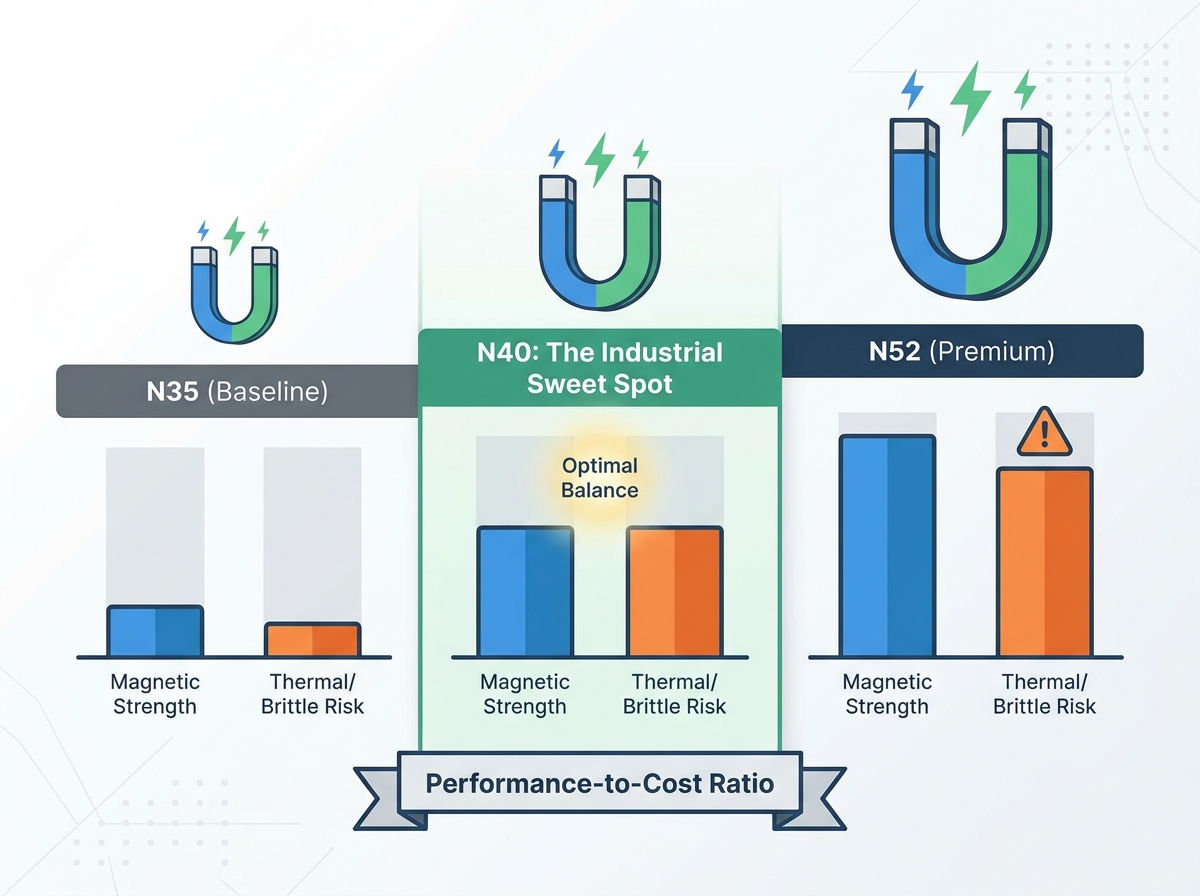
Selecting a custom neodymium magnet is rarely about just maximizing pull force. It is an exercise in balancing magnetic yield, thermal resilience, physical constraints, and unit cost. Design engineers frequently seek a reliable material offering high performance without breaking the budget. This is where the N40 grade enters the picture. It serves as the industrial "sweet spot," offering higher magnetic energy than baseline N35s without the extreme thermal fragility and premium costs associated with N52s. Making the right choice requires careful planning and deep technical understanding. We designed this guide to provide B2B buyers and engineers with a rigorous framework for defining specifications, mitigating implementation risks, and vetting a reliable production partner for custom orders. Understanding these critical parameters ensures you secure robust components perfectly tailored to your specific application limits.
Key Takeaways
- Grade Nuance: Standard N40 has a maximum operating temperature of 80°C (176°F); high-heat applications require suffix variants (e.g., N40H, N40SH).
- Dimensional Precision: Specifying tolerances tighter than the industry standard (±0.05mm) drives up machining costs and necessitates specific supplier capabilities.
- Corrosion Defense: Neodymium is highly susceptible to oxidation; coating selection (Ni-Cu-Ni, Epoxy, Zinc) must align directly with the environmental application.
- Supplier Validation: A credible custom magnet manufacturer will provide demagnetization curves and batch-specific testing data (e.g., Helmholtz coil reports) rather than just theoretical specs.
Why Engineers Default to N40: Framing the Performance-to-Cost Ratio
Many engineering projects face a common dilemma. You need robust magnetic fields, but you also have strict budget limits. We often see engineers defaulting to the N40 grade to solve this exact problem. In magnetic terms, the "40" represents the Maximum Energy Product (BHmax). This value roughly spans 38 to 41 MGOe (Mega Gauss Oersteds). It serves as a direct indicator of overall magnetic strength.
When evaluating trade-offs, we must look at the alternatives available in the market. The N35 grade is generally cheaper. Yet, it delivers significantly weaker performance, forcing you to use larger volumes of material to achieve the same hold. Conversely, N52 offers maximum available strength. But N52 parts are highly brittle, extremely temperature-sensitive, and quite expensive to manufacture at scale. Choosing a Custom N40 Magnet bridges this gap perfectly. You gain a strong energy yield while maintaining acceptable physical durability and manageable production expenses.
Let's outline some ideal use cases where this specific grade truly excels:
- Mid-torque Brushless DC (BLDC) motors: They require stable operation and consistent flux without overheating the core assembly.
- Magnetic couplings: These components operate in moderate industrial environments demanding reliable torque transfer.
- High-reliability sensors: Hall-effect sensors demand consistent flux density over time to provide accurate environmental readings.
- Consumer electronics: Laptops and tablets need compact, powerful fasteners to maintain a sleek user experience.
Engineers love this middle-ground approach. It provides enough headroom for design safety factors. You avoid over-engineering the solution while still ensuring the component performs flawlessly under normal stress.
Core Technical Specifications to Define for Custom N40 Magnets
Before ordering Custom magnets, you must define exact technical parameters. Missing one detail can ruin your entire assembly. We recommend building a robust specification sheet covering every physical and environmental variable.
Geometry and Dimensional Tolerances
Shape dictates manufacturability and overall price. Simple blocks and solid cylinders process easily through standard slicing machines. Complex rings, arcs, or countersunk shapes require expensive custom tooling and slower grinding cycles. You must also establish dimensional tolerances early. The industry standard tolerance sits at ±0.05mm. Demanding precision tolerances like ±0.02mm drastically alters the production process. This tighter limit increases grinding time, demands specialized measurement equipment, and raises scrap rates exponentially. Only specify ultra-tight tolerances if your design strictly requires them to function.
Orientation of Magnetization
You must specify the magnetization direction before manufacturing begins. Manufacturers press and orient the raw neodymium powder inside a powerful magnetic field during early production stages. Common orientations include axial, diametrical, radial, or custom multipole patterns. Once the material sets and solidifies, you cannot change this orientation. A perfectly machined part becomes entirely useless if magnetized across the wrong axis.
Thermal Thresholds (The Letter Suffixes)
Heat destroys magnetic fields. If you exceed a magnet's thermal limit, you risk irreversible demagnetization. Standard N40 handles a maximum operating temperature of 80°C. Warmer environments require high-coercivity variants. We identify these variants using specific letter suffixes. N40H works safely up to 120°C. N40SH pushes the limit to 150°C, making it ideal for automotive under-hood applications. N40UH can withstand 180°C environments. Always match the suffix to your peak operating temperature, leaving a small safety margin for unexpected thermal spikes.
Surface Treatments and Coatings
Sintered NdFeB material rusts rapidly when exposed to moisture or high humidity. You must seal them properly. Selecting the right surface treatment prevents catastrophic failure and extends operational life.
Table 1: Coating Decision Matrix for Neodymium Magnets
| Coating Type | Physical Characteristics | Best Environmental Use Case |
| Nickel-Copper-Nickel (Ni-Cu-Ni) | Standard three-layer protection, highly durable, metallic finish, slightly slick surface. | General indoor use, enclosed mechanical assemblies, and consumer electronics. |
| Zinc | Cost-effective, single layer, lower corrosion resistance than Nickel. | Budget-sensitive projects, completely dry environments, temporary holding fixtures. |
| Epoxy | Excellent moisture block, thicker layer, superior adhesion properties. | Salt spray exposure, marine environments, and high-vibration glued assemblies. |
Choosing the wrong coating often leads to premature oxidation. Once rust forms, the material expands, causing the protective layer to flake off and destroy the internal assembly.
Reading the Data: Magnetic Performance Metrics to Verify
A reliable supplier provides detailed technical data before production begins. You need to know how to interpret these numbers accurately. Understanding performance metrics ensures you get exactly what you specified.
Remanence (Br)
Remanence measures the residual magnetic flux density left in the material after full magnetization. For the N40 grade, this value typically ranges from 12.5 to 12.9 kGs (KiloGauss). Always check your supplier's stated Br value against this range. Ensure it aligns exactly with established industry charts. Lower values indicate substandard raw materials or poor manufacturing controls. Higher values might mean they are quoting an N42 instead.
Coercivity (Hcb & Hcj)
Coercivity defines a magnet's resistance to demagnetization. We divide this critical metric into normal coercivity (Hcb) and intrinsic coercivity (Hcj). Normal coercivity measures basic resistance to external magnetic fields. Intrinsic coercivity (Hcj) is the ultimate metric for durability. It evaluates how well the core material resists demagnetization under both external magnetic fields and extreme heat. High Hcj values mean better stability in harsh environments. You should always prioritize Hcj when designing motors or high-temperature sensors.
Testing Documentation
Never accept simple room-temperature theoretical data for critical applications. We strongly advise buyers to request comprehensive Hysteresis graphs (B-H curves) measured at their specific operating temperature. These curves reveal exactly how the material behaves as it heats up in real time. Reputable suppliers generate these reports using specialized Helmholtz coil equipment. This empirical data validates whether the part will actually survive real-world conditions inside your machine.
Commercial & Production Factors: Vetting a Custom Magnet Manufacturer
Selecting the right partner involves carefully assessing their commercial maturity and production capabilities. You need a Custom magnet manufacturer capable of scaling alongside your success.
Quality Assurance and Traceability
You should look for specific quality certifications when auditing a facility. ISO 9001 serves as a mandatory good baseline. IATF 16949 is even better, especially for automotive or high-stakes industrial applications. A credible factory will perform rigorous internal quality control tests. Ask them for Salt Spray Testing (SST) reports to verify coating integrity over 24 or 48 hours. Request Pressure Cooker Test (PCT) data to assess moisture resistance under extreme atmospheres. Additionally, demand 100% automated visual inspection processes. This ensures they catch dangerous micro-cracks before shipping parts to your assembly line.
Tooling Costs and Minimum Order Quantities (MOQs)
Custom dimensions naturally require unique manufacturing setups. Suppliers must build specific slicing jigs, specialized grinding fixtures, or custom powder pressing molds. These custom requirements generate initial Non-Recurring Engineering (NRE) fees. When navigating MOQs, discuss your long-term volume needs openly. Suppliers often lower unit prices and happily amortize tooling costs if you commit to larger annual blanket orders. Transparent communication regarding your production timeline helps negotiate better minimum order thresholds.
Batch-to-Batch Consistency (The Cpk Metric)
Making one perfect prototype is relatively easy for any machine shop. However, producing 100,000 units exhibiting less than 2% variance in magnetic flux requires immense process control. Ask potential suppliers about their Process Capability Index (Cpk). A Cpk above 1.33 indicates a highly controlled, statistically stable manufacturing process. This consistency prevents erratic sensor readings or unbalanced motor rotation in your final consumer product. If a supplier cannot explain their Cpk tracking, you should look elsewhere.
Implementation Risks and Prototyping Considerations
Engineers often design brilliant magnetic circuits but overlook physical assembly risks. Implementing rare earth materials requires careful handling protocols on the factory floor.
Assembly Hazards
Sintered neodymium is fundamentally a ceramic-like material. It is highly brittle and prone to structural failure under shock. High-impact assembly methods will cause the material to fracture instantly. Press-fitting parts into tight metal housings often results in severe edge chipping. Chipping destroys the protective coating immediately. Once the internal neodymium gets exposed to ambient air, it oxidizes and crumbles rapidly. You must design your housings to allow for gentle insertion or use dedicated potting compounds to hold the magnet safely in place.
Adhesion and Gluing Realities
Standard Nickel-plated magnets present extremely low surface energy. Industrial adhesives struggle to bond effectively to this slick, metallic surface. If your final assembly requires strong gluing, you must plan ahead. We recommend light mechanical surface preparation to improve grip. Better yet, specify an Epoxy coating instead of Nickel. Epoxy provides a highly receptive, textured surface for industrial adhesives. This ensures the part stays rigidly secured even under heavy mechanical vibration.
The Prototyping Phase
Never rush straight into expensive mass production tooling. We strongly recommend ordering a small, non-tooled prototype batch first. Suppliers can manufacture these initial test units using slow wire-EDM cutting. While wire-EDM makes each prototype unit slightly more expensive, it completely eliminates expensive upfront mold fees. This approach allows you to validate the N40 magnetic circuit inside your physical assembly. Once physical bench testing confirms absolute success, you can confidently release funds for mass production tooling.
Conclusion
Successfully procuring reliable custom neodymium magnets requires discipline and foresight. You must lock down dimensional tolerances, thermal requirements, and specific coating needs long before approaching a supplier. Use the N40 grade to intelligently balance magnetic strength and production cost. Always verify intrinsic coercivity and request detailed B-H curves for your specific operational environment.
To ensure project success, keep these key action steps in mind:
- Finalize your maximum operating temperatures to select the correct letter suffix accurately.
- Choose a surface coating matching your actual environmental exposure risks.
- Design your assembly process carefully to avoid high-impact press-fitting damage.
- Request batch-specific empirical testing data instead of relying purely on theoretical datasheets.
Remember, do not select a manufacturing partner based on unit price alone. The long-term cost of assembly failure due to inconsistent magnetic flux or premature corrosion far outweighs any initial upfront savings. We highly encourage you to consult with a qualified manufacturing partner early in the design phase. Bring your CAD files, expected operating temperatures, and proposed assembly methods to the first meeting. This proactive collaboration ensures you secure optimal component design and flawless production execution.
FAQ
Q: Is N40 stronger than N35?
A: Yes, N40 is noticeably stronger. It offers an approximate 14% increase in maximum energy product (BHmax) compared to standard N35. In practical applications, this translates directly to a higher pull force and a denser magnetic field. This extra strength allows you to downsize the magnet slightly while achieving the exact same holding power, saving valuable space in compact designs.
Q: Can I machine or drill my custom N40 magnet after receiving it?
A: No. Machining sintered neodymium after production is extremely dangerous. NdFeB dust is highly flammable and presents a severe fire hazard in any workshop. Furthermore, drilling instantly destroys the applied anti-corrosion coating, guaranteeing rapid oxidation and structural material failure. All custom machining and drilling must happen at the factory prior to final magnetization and plating.
Q: How long does it take to manufacture custom neodymium magnets?
A: A standard production run typically takes 3 to 5 weeks. This timeline accounts for raw material preparation, custom block pressing, precise slicing or grinding, coating application, and final magnetization. Projects requiring complex custom molds, ultra-tight tolerances, or extensive environmental quality testing may extend this lead time slightly depending on factory capacity.