Many engineers assume specifying the highest available grade is the safest route. They default to N52 for their magnetic assemblies to guarantee maximum strength. This approach often misfires. N52 does offer the highest commercially available Maximum Energy Product (BHmax). However, over-specifying this grade routinely causes bloated manufacturing budgets. It also leads to unexpected thermal failures in the field. Massive magnetic strength is useless if the material degrades in its native operating environment.
We built this guide to fix this specific disconnect. You will explore an objective, engineering-focused evaluation framework. We will help you choose between Custom N52 Magnets and alternative neodymium grades. You will learn to balance spatial constraints, thermal limits, and raw material costs effectively. By the end, you will confidently specify the exact grade your project actually requires.
Key Takeaways
- N52 is for miniaturization: Best suited for applications where maximum magnetic field density must fit within an extremely restricted footprint.
- Thermal limits are the primary bottleneck: Standard N52 degrades faster than lower grades (like N42SH) in environments exceeding 80°C (176°F).
- Cost vs. Yield: The raw material and machining costs for Custom N52 Magnets carry a premium; N35 or N42 often provide a better ROI if space permits a slightly larger magnet.
- Tolerances dictate feasibility: Custom shapes in high-grade NdFeB require precise coating and handling due to inherent material brittleness.
The Baseline: What Defines a Custom N52 Magnet?
To make an informed decision, you must first understand the material science behind the label. The "N" stands for Neodymium-Iron-Boron (NdFeB). This specific alloy currently dominates the permanent magnet industry. The number "52" represents the material rating. It translates to roughly 52 Mega-Gauss Oersteds (MGOe). This figure measures the maximum energy product of the material. Essentially, it tells you how much magnetic energy is stored within a specific volume.
You can verify this performance through two core metrics. The first is High Remanence (Br). Remanence measures the residual magnetic flux density remaining after magnetization. A high Br value means the magnet produces a exceptionally strong magnetic field. The second metric is Coercivity (Hcj). Coercivity measures the material resistance to demagnetization. Standard N52 boasts excellent remanence but possesses relatively standard coercivity compared to specialized high-temperature grades.
The customization factor adds another layer of complexity to these raw materials. Buying off-the-shelf discs is simple. Developing Custom magnets requires extensive engineering. Customizing entails machining specific geometries like arcs, stepped rings, or irregular polygons. You must define tighter dimensional tolerances to fit precision housings. You may also specify unique magnetization directions, such as multi-pole or diametrical alignments. Finally, customization involves applying specialized protective coatings to shield the vulnerable alloy from environmental corrosion.
Custom N52 Magnets vs. Lower Grades (N35–N45): The Strength-to-Cost Trade-off
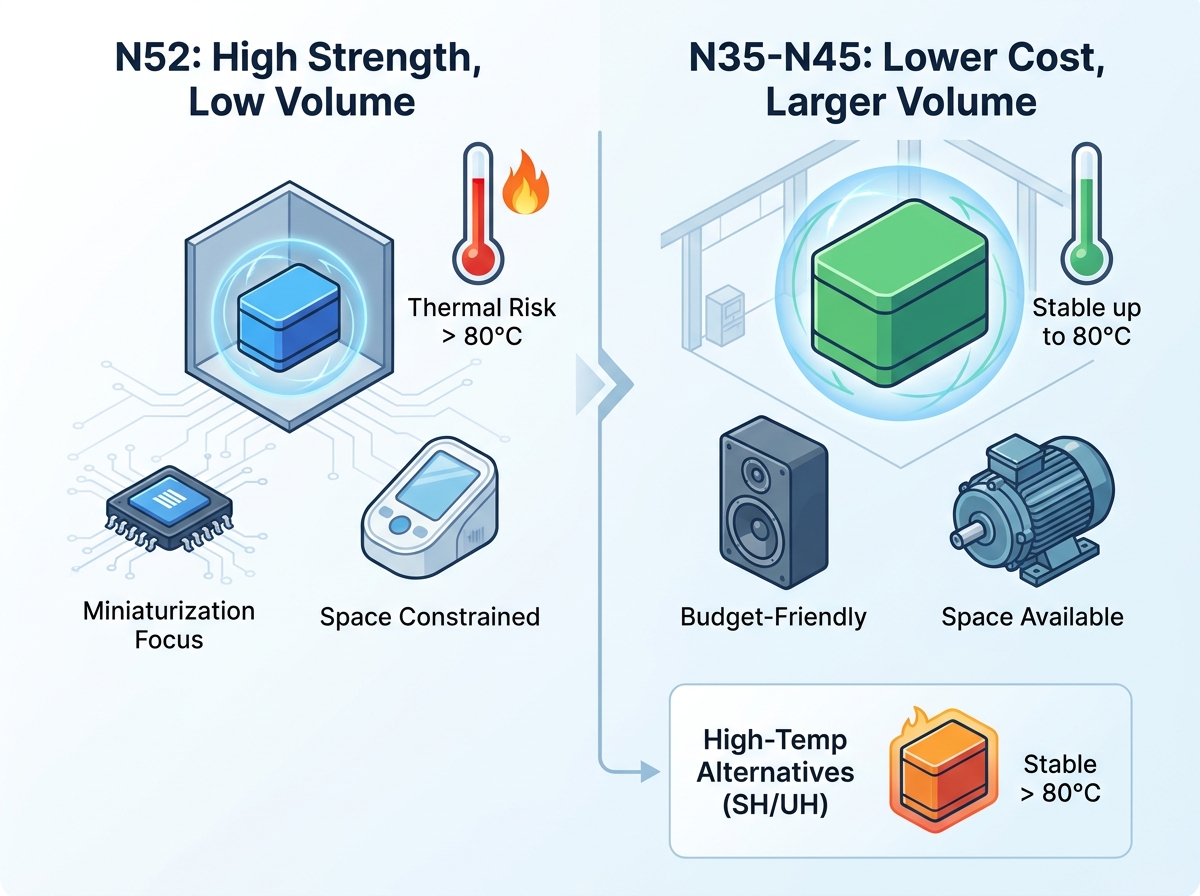
Engineers face a constant battle between performance and budget. Lower grades like N35 or N42 often provide more than enough magnetic strength for standard applications. You must evaluate the relationship between pull force and physical volume. Replacing an N35 magnet with an N52 variant allows for a 30% to 40% reduction in total magnet volume. You achieve this size reduction while maintaining the exact same holding force. This volume reduction is the primary engineering justification for selecting a higher grade.
Cost implications play a massive role in this decision. You pay a steep price premium for top-tier grades. The manufacturing process requires higher purity raw materials. If your application space is virtually unlimited, using a larger N35 custom magnet is substantially more cost-effective. The raw material savings easily offset the slightly larger housing requirements.
| Magnet Grade | Relative Strength Base | Cost Premium Estimate | Ideal Application Environment |
| N35 | Baseline (1.0x) | Lowest Cost | Large assemblies, heavy industry |
| N42 | High (1.2x) | Moderate (+15-20%) | General electronics, standard motors |
| N52 | Maximum (1.4x+) | High (+40% or more) | Miniature sensors, precision tools |
You should shortlist N35 through N45 grades under specific conditions. Consider these mid-tier options for budget-constrained consumer electronics. They also excel in heavy industrial applications. In massive motor assemblies or magnetic separators, bulk weight and size are rarely limiting factors. The cost savings at high volumes become significant.
Conversely, you should heavily shortlist N52 when space is your absolute bottleneck. Micro-sensors require intense magnetic fields inside microscopic housings. Medical devices like pacemakers or surgical tools demand maximum strength in minimal profiles. High-performance aerospace motors also benefit immensely. In these arenas, every single millimeter counts. The performance gains easily justify the premium material costs.
The Thermal Risk: N52 vs. High-Temperature Grades (SH, UH, EH)
Temperature dictates magnetic performance just as much as raw material composition. Standard N52 has a strict thermal boundary. The industry recognizes an 80°C (176°F) ceiling as the standard maximum operating temperature for this grade. Heat increases atomic kinetic energy. This energy eventually overcomes the magnetic alignment within the crystal structure. This thermal limit is the most common reason engineers must pivot away from standard high-strength materials.
If you push standard N52 past this 80°C threshold, you risk irreversible demagnetization. The magnetic field will slowly weaken as the temperature rises. If it exceeds the maximum threshold, the magnet suffers permanent magnetic loss. It will never recover its original strength, even after cooling back to room temperature. This failure can completely destroy the functionality of a precisely calibrated sensor or motor.
Evaluating high-temperature alternatives is critical for demanding environments. Industry standards append suffix letters to indicate thermal stability. "SH" indicates stability up to 150°C. "UH" pushes limits to 180°C, and "EH" stretches up to 200°C. You must compare baseline N52 against grades like N42SH or N35EH.
Your evaluation criteria should be strict. If operating temperatures routinely exceed 80°C, you cannot safely specify N52. Sacrificing baseline magnetic strength is mandatory. You must drop your specification to an N42 or N35 grade to gain the necessary high-temperature stability. A stable N42SH magnet at 120°C will vastly outperform an N52 magnet that has suffered irreversible thermal degradation.
Manufacturing Realities: Machining and Coating Custom Magnets
Designing a custom shape in CAD software is simple. Manufacturing that shape in reality introduces severe mechanical challenges. Neodymium is essentially a hard, brittle ceramic material. Higher magnetic strength does not mean higher physical durability. Discussing the mechanical realities of cutting and grinding N52 blocks is crucial. Machining intricate shapes like thin arcs or countersunk rings creates significant mechanical stress.
Brittleness leads directly to yield loss during production. Grinding wheels can easily chip the edges of a high-grade block. Manufacturers must machine at slower speeds to prevent micro-fractures. This slow processing increases labor time. A complex geometry might experience a 20% scrap rate during the machining phase alone. You absorb these scrap costs when ordering specialized parts.
Coating dependency is another critical manufacturing reality. Because custom parts are machined to exceptionally tight tolerances, you must factor the coating into your final dimensions. Standard options include Ni-Cu-Ni (Nickel-Copper-Nickel), Epoxy, or Parylene. A standard nickel coating adds roughly 15 to 20 microns of thickness per surface. Epoxy can add up to 25 microns. N52 is highly susceptible to rapid oxidation and corrosion. If the custom coating is compromised during assembly, the underlying alloy will quickly degrade into a magnetic powder.
You must also consider lead times and supply chain realities. Custom N52 batches often require longer lead times. High-grade rare-earth materials experience more supply fluctuations compared to easily sourced N35 stock. Manufacturers rarely keep large, unmagnetized blocks of N52 sitting idle. You should anticipate longer procurement cycles when specifying the absolute highest grade available.
Decision Framework: Selecting the Optimal Grade for Your Project
Choosing the right specification requires a logical, step-by-step approach. Do not rely on guesswork or assumptions. Use this structured decision framework to evaluate your specific application needs. This process will protect your budget while ensuring reliable field performance.
- Step 1: Define Spatial Constraints. Measure your available volume. Must the magnet fit into a micro-housing or a tightly packed circuit board? If yes, N52 is likely your best option. If you have flexible design parameters and ample room, drop down to N35 or N42. You will save money without losing functional strength.
- Step 2: Map the Thermal Environment. Calculate the worst-case scenario for heat exposure. Will peak operating temperatures exceed 80°C? Include ambient environmental heat and internal heat generated by nearby electronics. If temperatures cross this threshold, you must switch to SH, UH, or EH grades immediately. If temperatures remain stable and cool, standard top-tier grades remain viable.
- Step 3: Analyze the Budget ROI. Evaluate the financial impact of your material choice. Does the performance gain of a top-tier grade justify the raw material premium? Remember to calculate potential custom machining scrap rates. High scrap rates drive unit prices up significantly. Ensure the extra magnetic flux actually improves your final product enough to warrant the expense.
- Step 4: Prototype Testing. Never rely solely on theoretical datasheets. We highly recommend ordering rapid prototypes in two different grades. Order a batch of N42 and a batch of N52. Assemble them into your physical product. Validate the actual pull force and flux density in real-world scenarios. Physical testing often reveals that a lower grade performs perfectly well in the final assembly.
Conclusion
Specifying the right neodymium grade requires careful engineering analysis. High-grade materials provide incredible magnetic density, but they are not a universal default. They remain a highly specialized solution designed for extreme spatial and performance requirements. Overlooking thermal limits or underestimating machining costs will negatively impact your final product.
You should prioritize professional validation before moving to mass production. We encourage buyers to consult with a dedicated magnet engineering specialist before finalizing CAD drawings or issuing RFQs. An expert can spot subtle design flaws, suggest optimal tolerances, and verify your chosen coatings.
Take proactive steps today to secure your design. Submit your 3D models or technical specifications to an experienced manufacturer. Request a comprehensive manufacturability and grade-optimization review. A thorough review guarantees you get the exact magnetic performance your application demands.
FAQ
Q: Are there neodymium magnet grades higher than N52 (like N54 or N55)?
A: While grades like N54 or N55 do exist in highly controlled lab settings, they are not practical for standard manufacturing. N52 remains the highest practical, commercially stable, and widely available grade for custom orders. Higher experimental grades are exceedingly brittle and highly sensitive to minor temperature fluctuations. You should be cautious of suppliers making exaggerated claims about consistently supplying bulk N55 materials.
Q: Does a Custom N52 Magnet cost significantly more than N35?
A: Yes. The cost difference stems primarily from a higher percentage of pure neodymium required in the alloy. Market volatility surrounding rare-earth elements also drives up the price of premium grades. However, the exact premium you pay depends heavily on your custom geometry, tight machining tolerances, and total order volume.
Q: Can I machine or drill an N52 magnet myself after I receive it?
A: No. Attempting to machine these parts yourself poses severe safety hazards. Neodymium dust is highly flammable. Drilling will immediately destroy the protective coating, causing rapid corrosion. Furthermore, the brittle ceramic nature of the material means it will likely shatter under a standard drill bit. All custom features must be machined prior to final magnetization and coating by the manufacturer.