N52 currently represents the highest commercially available grade of neodymium magnets. It delivers unmatched magnetic energy and incredible pull force. However, raw power alone rarely guarantees a successful product design. You must pair this extreme strength with precise engineering specifications. Otherwise, you risk encountering severe mechanical failures, rapid thermal degradation, or frustrating assembly issues on the production line. Navigating these complexities requires a thorough understanding of unique magnetic properties.
This guide serves as a comprehensive technical checklist for engineers, product designers, and procurement teams. We will break down the exact parameters you need to finalize your technical specification sheets. You will learn how to optimize dimensional tolerances, select proper coatings, and avoid critical thermal errors. Finally, we will show you how to confidently evaluate manufacturing partners before signing off on your next major production run.
Key Takeaways
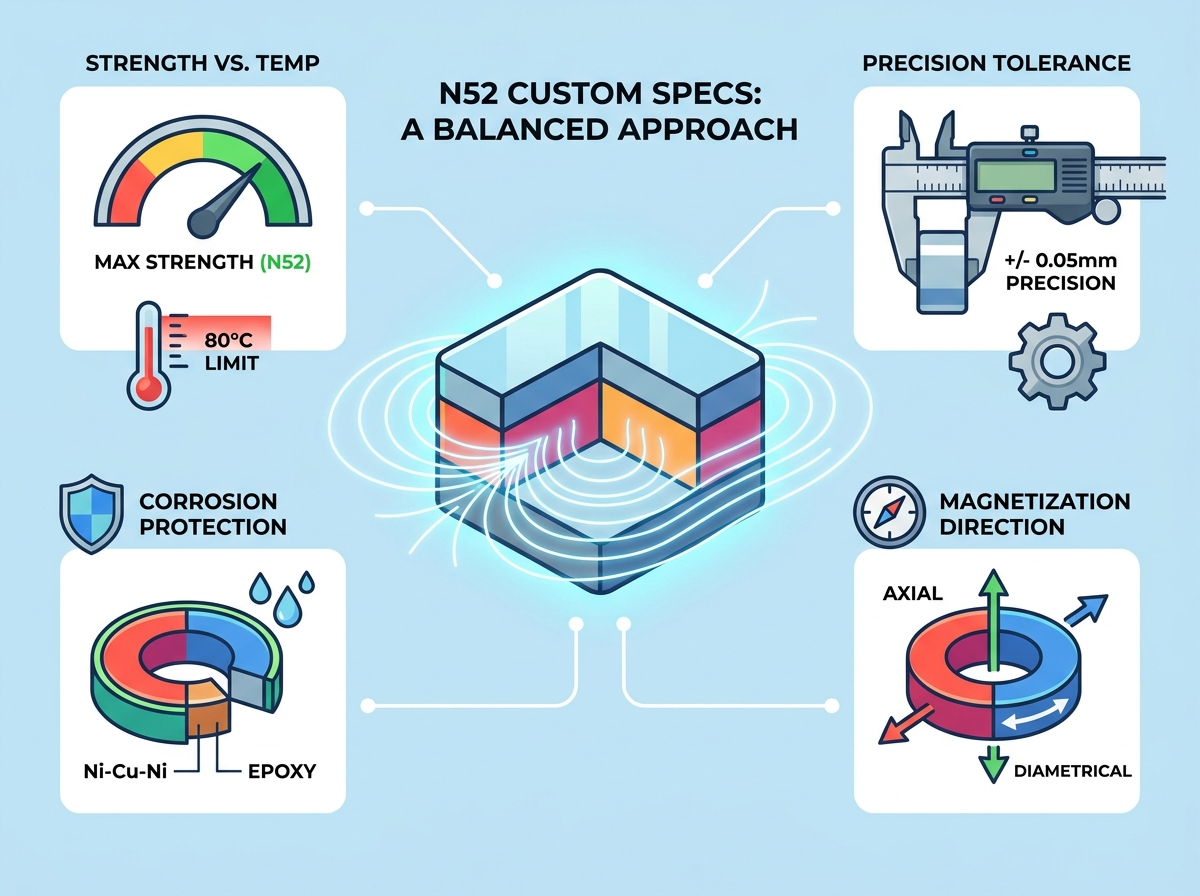
- N52 magnets offer maximum magnetic strength but have a lower thermal threshold (typically 80°C) compared to lower grades; thermal operating environments must dictate the final spec.
- Standardizing dimensional tolerances (+/- 0.1mm to +/- 0.05mm) is critical for preventing mechanical stress in precision assemblies.
- Proper coating selection (e.g., Ni-Cu-Ni, Epoxy) is non-negotiable due to the rapid oxidation of raw NdFeB material.
- Clearly defining the magnetization direction (axial, diametrical, radial) ensures the custom magnets align exactly with intended application vectors.
- Selecting a manufacturer requires verifying material traceability, ISO/RoHS compliance, and comprehensive QA reporting (e.g., hysteresis loop data).
Aligning N52 Magnetic Strength with Application Realities
Many engineers immediately default to N52 material during the initial design phase. They want maximum pull force for their upcoming projects. However, this reflex often leads to unnecessary over-specifying. Choosing the absolute highest grade inflates unit costs immediately. You might find an N42 or N45 grade performs perfectly well for your specific needs. You should only specify N52 when absolute maximum flux density is strictly critical.
High magnetic strength comes alongside a distinct physical trade-off. N52 features an extremely high density of magnetic material. This chemical composition makes the final product highly brittle. They chip and shatter easily during high-impact collisions. You must design physical housings to protect them from direct, forceful impacts. Dropping a bare piece onto a steel workbench usually destroys it completely. You need to plan your assembly line handling procedures accordingly.
Where is N52 strictly necessary? Identify applications demanding maximum performance within extremely tight spatial constraints. Miniaturized electronics frequently require them because space remains highly restricted. High-performance drone motors benefit immensely from the intense magnetic field. Specialized medical sensors also rely on this material to achieve high resolution. Use these powerful grades specifically when you cannot increase the physical component size to achieve more holding force.
Navigating Thermal Limitations and Demagnetization Risks
Standard Custom N52 Magnets usually feature a Maximum Operating Temperature of 80°C (176°F). This specific thermal threshold demands strict attention from mechanical engineers. If your application environment exceeds this limit, the material suffers instantly. Heat directly impacts magnetic stability over continuous operating periods. You must accurately predict the real-world operating temperatures of your device.
What happens beyond this 80°C threshold? You risk massive, irreversible flux losses. The component begins to permanently lose its charge at an atomic level. If temperatures reach the Curie temperature, it demagnetizes completely. It becomes nothing more than a useless piece of metal alloy. Do not rely solely on ambient room temperature estimates during your calculations. Consider the secondary heat generated by nearby electrical components or friction.
Sometimes, your application inevitably requires high-temperature exposure. You can specify high-temp variants for these demanding situations. Engineers often look to N52M or N52H grades for enhanced stability. The 'M' variant typically operates safely up to 100°C. The 'H' variant pushes this boundary safely to 120°C. Keep in mind, these specialized materials cost significantly more to produce. They require different elemental compositions, specifically involving heavy rare earth elements like dysprosium. Dysprosium stabilizes the magnetic domains at higher heat levels. Evaluate your thermal environment carefully before approving these expensive variants.
Precision Engineering: Dimensional Tolerances for Custom Magnets
Precise dimensional tolerances heavily impact final assembly integration on the factory floor. You often need to fit these components into highly constrained mechanical housings. Press-fit applications require exact dimensions to prevent cracking the brittle material. Glued assemblies need specific clearance gaps for the adhesive layers to bond properly. If the dimensions fluctuate between production batches, your assembly line will face significant mechanical bottlenecks.
Industry-standard tolerances usually sit at +/- 0.1mm (0.004 inches). This baseline works perfectly well for most general consumer applications. However, certain high-tech industries require much tighter control over physical dimensions. You might require precision tolerances approaching +/- 0.05mm. Achieving this elevated level of precision demands specialized, slower machining processes.
You must understand the cost-to-outcome reality of precision engineering. Demanding tighter tolerances exponentially increases the factory machining time. Manufacturers must operate slower, more precise grinding equipment to meet your demands. This strictness also drives up scrap rates considerably. Defective units pile up quickly during internal quality control checks. Ultimately, this reality raises your individual unit costs substantially. Only specify tight tolerances when the final assembly strictly requires them.
Best Practices for Tolerance Specification
- Review the mating mechanical components carefully before defining your magnet tolerances.
- Account for thermal expansion differences between the magnet and the surrounding plastic housing.
- Consult your chosen supplier directly about their standard in-house machining capabilities.
- Leave at least a 0.1mm gap if you plan to use industrial epoxies for mounting.
Selecting Coatings for Corrosion Resistance and Durability
Raw NdFeB material contains a massive amount of highly reactive iron. This introduces a major material vulnerability into your product lifecycle. Unprotected Custom magnets will rapidly corrode if left uncoated. They degrade exceptionally quickly in normal atmospheric conditions. Humidity alone causes severe oxidation within a few days. As rust forms, the structural integrity weakens dramatically. The overall magnetic output also degrades proportionally as the material flakes away. You must select a robust protective coating to prevent this disaster.
We can evaluate common industrial options using a simple coating decision matrix below.
| Coating Type | Durability Characteristics | Ideal Applications | Typical Thickness |
| Ni-Cu-Ni (Nickel) | Industry standard, good general durability, shiny metallic finish. | Indoor electronics, consumer goods, standard motors. | 15 - 20 microns |
| Epoxy (Black) | Superior moisture and salt-spray resistance, highly durable. | Outdoor applications, marine environments, harsh climates. | 20 - 30 microns |
| Zinc | Basic corrosion resistance, lower cost, dull grayish finish. | Internal components fully sealed from humidity. | 8 - 15 microns |
| Gold / Parylene | Biocompatible, extremely high corrosion resistance, high cost. | Medical devices, specialized cosmetics, aerospace sensors. | 1 - 5 microns |
A common implementation risk involves poor dimensional planning. Many designers fail to account for the actual coating thickness. They finalize overall dimensional tolerance specifications based entirely on the bare, uncoated material. A standard Ni-Cu-Ni coating adds roughly 15-20 microns per surface. Epoxy adds an even thicker dimensional layer. You must deduct the anticipated coating thickness from the raw machining dimensions. Otherwise, the final coated product will simply not fit inside your precision assembly.
Specifying Magnetization Direction and Polarity
Engineers frequently misunderstand critical vector requirements. The physical shape of a component does not automatically dictate its field orientation. A simple metallic cylinder could be magnetized in several completely different ways. You must explicitly define this exact parameter on your drawings. Without clear instructions, suppliers might guess incorrectly. This miscommunication leads directly to entirely useless prototypes and wasted engineering time.
You should detail these precise configurations clearly on your engineering blueprints. Here are the most common configurations you need to know:
- Axial Magnetization: The magnetic field travels directly through the thickness of the material. This represents the most standard configuration for flat discs and rectangular blocks.
- Diametrical Magnetization: The field travels laterally across the diameter. Engineers often use this specific vector for specialized rotating sensors.
- Multi-pole Magnetization: One single surface contains multiple alternating north and south poles. This pattern greatly increases the holding force on a single functioning face.
- Radial Magnetization: The field radiates outward from the center like wheel spokes. This complex configuration requires highly specialized and expensive manufacturing tooling.
Prototyping considerations require extra care and verification. You should always request a 3D magnetic field map from your supplier. Alternatively, specify exact Gauss requirements at a specific distance from the component. For example, demand "3000 Gauss measured at 2mm from the top surface." This ensures complete supplier alignment from day one. It completely eliminates guesswork and confirms the actual field strength matches your theoretical models.
Supplier Evaluation: QA Testing and Compliance Standards
Selecting a truly reliable manufacturer determines your entire project's success. Material verification stands as your first major procurement hurdle. How do you ensure the supplier actually provides true Grade 52 material? Some dishonest vendors substitute cheaper, lower grades to maximize their own profits. You must demand rigorous scientific proof. Request detailed Demagnetization Curve reports immediately. Ask for Hysteresis Graph data directly from their testing laboratory. These documents verify the actual energy product of your specific batch.
Global distribution requires strict adherence to international certifications. Your chosen manufacturing partner must hold essential industrial credentials. ISO 9001 certification ensures they utilize proper quality management systems daily. ISO 14001 indicates responsible, heavily monitored environmental practices. Furthermore, you must verify compliance frameworks like RoHS and REACH. These standards prove the materials remain entirely free of hazardous substances. You cannot sell your product globally without these exact certifications.
Develop a clear shortlisting logic for prospective vendors. Evaluate them based on their willingness to provide First Article Inspection (FAI) reports. Examine their in-house testing capabilities thoroughly. Do they own calibrated Gauss meters? Can they utilize precision Fluxmeters for accurate readings? Do they conduct rigorous Salt Spray testing to verify coating durability? Finally, assess their communication skills. They should provide clear, transparent pricing regarding custom tooling costs. Avoid suppliers who hide these essential fees until the absolute last minute.
Conclusion
Successfully procuring high-strength magnetic materials requires careful, strategic balancing. You must weigh the design demand for extreme flux density against strict environmental realities. Physical limitations dictate how these advanced materials perform in the real world. Over-specifying strength while ignoring thermal thresholds guarantees product failure.
Here are your crucial next steps:
- Finalize a comprehensive technical drawing before reaching out to manufacturers for quotes.
- Explicitly list dimensional tolerances, thermal limits, surface coatings, and precise polarity on your blueprints.
- Demand comprehensive QA data, including hysteresis loops, during the initial prototyping phase.
- Audit prospective suppliers for active ISO, RoHS, and REACH certifications.
Take control of your engineering procurement process today. Arm yourself with these exact specifications to guarantee flawless integration and long-lasting product performance.
FAQ
Q: Are N52 magnets stronger than N42?
A: Yes, they offer significantly higher magnetic energy. The number denotes the Maximum Energy Product measured in MegaGauss-Oersteds (MGOe). N52 delivers around 52 MGOe, while N42 provides roughly 42 MGOe. This translates to roughly a 20-25% increase in raw pull force for identically sized items.
Q: Can custom N52 magnets be machined or drilled after manufacturing?
A: No, you should never attempt to machine them post-production. NdFeB dust is extremely flammable and poses severe fire risks. Drilling also generates intense heat, which permanently destroys the local magnetization. Furthermore, breaking the protective surface coating guarantees rapid and irreversible corrosion.
Q: What is the minimum thickness achievable for a custom N52 magnet?
A: Manufacturability limits depend heavily on the specific supplier's grinding equipment. Generally, producing pieces thinner than 0.5mm is highly problematic. The material possesses extreme brittleness. Ultra-thin profiles easily snap during handling, coating, or manual assembly. Always consult your manufacturer before finalizing ultra-thin designs.
Q: How long does an N52 magnet hold its charge?
A: Under standard, non-extreme conditions, they retain their charge almost indefinitely. Permanent neodymium materials typically lose less than 1% of their total magnetic flux every ten years. As long as you avoid extreme heat, radiation, and strong opposing fields, the lifespan is essentially permanent.