Sourcing a Custom N40 Magnet is rarely as simple as matching a magnetic grade on a datasheet. You must constantly balance tight engineering tolerances against strict unit economics. It requires precision, technical clarity, and foresight at every stage of the procurement cycle.
Selecting an unverified supplier creates massive downstream risks for your production line. Failing to specify secondary parameters like coatings or thermal thresholds often leads to assembly failures. These blind spots can derail an entire product launch, trigger product recalls, and cause severe manufacturing delays.
We built this guide to give you a transparent, technical framework for evaluating sourcing options. You will learn how to analyze pricing structures, verify material specifications, and vet a reliable Custom magnet manufacturer. Ultimately, you will gain the knowledge needed to secure high-performance neodymium components without falling into common procurement traps.
Key Takeaways
- N40 is a strategic middle-ground: It offers a roughly 10-15% stronger magnetic field than standard N35 without the premium pricing and extreme brittleness of N52.
- Pricing depends on yield: The cost of custom magnets is heavily dictated by raw rare-earth market indices, machining complexity (which reduces yield), and coating requirements.
- Manufacturer vetting requires testing proof: A reliable custom magnet manufacturer must provide demagnetization curves, flux density reports, and salt-spray test results for every batch.
- Beware of "Grade Slipping": Aggressively low prices often indicate a supplier substituting N35 or N38 and passing it off as N40. In-house or third-party QA is mandatory.
Why Choose a Custom N40 Magnet? (Performance vs. Cost Analysis)
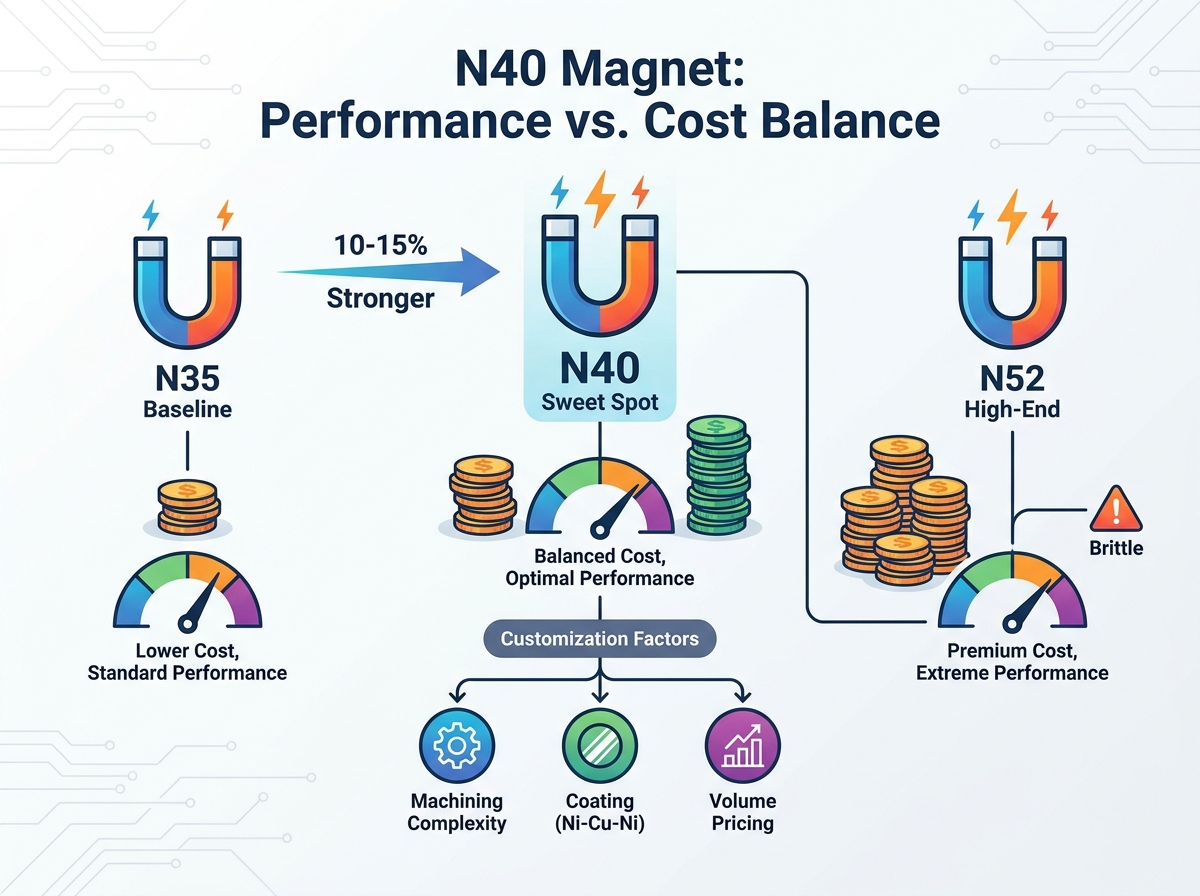
Engineers consistently specify the N40 grade because it occupies a highly strategic sweet spot. Lower commercial grades, like N35, often lack the energy product necessary for compact, modern designs. Conversely, high-end grades like N52 command steep price premiums and introduce severe manufacturing difficulties due to extreme brittleness. The N40 grade perfectly bridges this gap. It provides a robust, reliable magnetic field while keeping production costs sensible.
Temperature limits demand your immediate attention during the design phase. Standard N40 magnets reach their maximum operating temperature at 80°C (176°F). Pushing them beyond this limit causes irreversible flux loss. They will permanently lose their magnetic strength.
You must know when to upgrade your specifications. If your application involves intense friction, enclosed electronics, or automotive engine bays, you need high-temperature variants. Engineers swap standard N40 for N40H (up to 120°C), N40SH (up to 150°C), or N40UH (up to 180°C). These upgraded materials contain added Dysprosium to stabilize performance under thermal stress.
This balance makes N40 exceptionally versatile across industries. We see it deployed extensively in everyday applications. High-performance brushless DC motors use it to maximize torque. Industrial sensors rely on its stable magnetic field for accurate proximity readings. Consumer electronics integrate it to ensure strong, snap-on holding forces without occupying excessive physical space.
| Magnetic Grade | Relative Strength (vs N35) | Standard Max Temp | Primary Advantage |
| N35 | Baseline (0%) | 80°C (176°F) | Lowest upfront cost |
| N40 | + 10-15% | 80°C (176°F) | Optimal cost-to-performance ratio |
| N52 | + 40-45% | 60°C (140°F) | Maximum holding force in tight spaces |
Understanding the Pricing Structure for Custom Magnets
Pricing Custom magnets begins with raw material commodity markets. Neodymium, Iron, and Boron form the baseline foundation. Rare-earth material prices fluctuate daily based on global mining outputs and refining capacities. When Dysprosium or Praseodymium prices spike, the baseline cost of your N40 components will inevitably increase.
Machining complexity dramatically alters your final unit price. Manufacturers slice standard shapes like blocks and simple discs easily from large sintered blocks. However, complex shapes require extensive secondary operations. Arcs, countersunk holes, and bread-loaf geometries demand precise wire EDM or specialized diamond cutting tools.
This shaping process inherently generates waste, known in the industry as yield loss. Since you cannot easily recycle sintered neodymium dust, you pay for the wasted material. High machining complexity exponentially increases your per-unit cost.
You should also expect specific Non-Recurring Engineering (NRE) costs. These upfront setup fees cover custom molds, specialized cutting jigs, and bespoke inspection tools. Legitimate suppliers break down these NRE costs transparently during the quoting process.
- Raw Material Mix: The factory blends specific rare-earth elements based on market rates.
- Pressing and Sintering: The material is shaped into large standard blocks and baked in vacuum furnaces.
- Custom Machining: Blocks are sliced and shaped, generating inevitable yield loss.
- Surface Treatment: Plating is applied to prevent rapid oxidation.
Finally, economies of scale dictate the actual feasibility of your order. Volume pricing drastically reduces the impact of NRE fees. Manufacturers enforce Minimum Order Quantity (MOQ) thresholds because configuring a specialized production line for just 50 pieces loses them money. Higher volumes spread the fixed setup costs across thousands of units, driving your per-magnet price down significantly.
Quality Control: How to Verify N40 Specifications
Never trust a datasheet blindly. You must always request a B-H curve (hysteresis graph) from your supplier. This technical document proves the magnetic performance mathematically. It verifies the Remanence (Br) and Coercivity (Hcb) values precisely match N40 standards. If a supplier refuses to provide a B-H curve for your batch, find another partner immediately.
Dimensional tolerances dictate how well the magnet fits into your final assembly. The industry standard tolerance normally sits at ±0.1mm. If your design demands tighter tolerances, such as ±0.05mm, you will pay a steep premium. Tighter tolerances drive up rejection rates during the machining phase, and factories pass those waste costs directly to you.
Neodymium oxidizes rapidly when exposed to moisture. Therefore, coating integrity is a critical success factor. You must evaluate and select coatings based on your specific operational environment.
- Ni-Cu-Ni (Nickel-Copper-Nickel): The standard industry choice. Excellent for indoor, dry environments.
- Zinc: Cheaper, but offers lower corrosion resistance. Good for low-risk internal components.
- Epoxy: Provides superb salt-water and chemical resistance. Best for marine or harsh industrial applications.
Always demand Salt Spray Test (SST) hours and Cross-Cut adhesion tests from your supplier. These tests prove the coating will not flake off under stress. A compromised coating leads to rapid rust, expansion, and catastrophic failure of the magnetic material.
Lastly, ensure your magnetization direction aligns perfectly with your assembly needs. You must clearly define whether you require axial, diametrical, or multi-pole magnetization. A perfectly machined N40 disc is entirely useless if the poles face the wrong direction.
How to Vet a Custom Magnet Manufacturer
Vetting a manufacturing partner requires strict due diligence. Begin by examining their facility certifications. You should demand ISO 9001 compliance as a bare minimum. If you operate in automotive, aerospace, or high-reliability medical sectors, you must require IATF 16949 certification. These frameworks ensure the factory uses standardized, repeatable quality management systems.
Next, evaluate their in-house testing capabilities. A credible manufacturer does not outsource basic quality assurance. They must own and operate their own Helmholtz coils to measure magnetic moments. They need digital flux meters to verify surface fields. They should also run high-temperature ovens to perform accelerated thermal aging tests on your components.
Supply chain transparency separates direct manufacturers from simple brokers. Trading companies rarely control the raw material mixing or sintering processes. They simply buy blocks and cut them. A true manufacturer controls the entire process, from alloy blending to final plating. Dealing directly with a factory ensures better technical support and eliminates middleman markups.
Evaluate their willingness to move from prototyping to production smoothly. A trustworthy manufacturer will gladly provide small-batch prototypes. They understand you need physical validation before demanding high-volume financial commitments. If a supplier demands a massive order before producing a single test unit, consider it a major red flag.
Procurement Risks, Shipping, and Next Steps
The "Grade Slipping" trap represents your highest procurement risk. Aggressively low quotes often indicate a dishonest supplier. They will substitute cheaper N35 or N38 materials and pass them off as N40. Because they look identical, you will not notice until the magnets fail in the field. You protect your supply chain by using third-party metallurgical labs to verify initial shipments.
You must also factor in strict shipping regulations. Custom N40 magnets generate strong fields that interfere with aircraft navigation systems. IATA and FAA regulations dictate strict packaging rules. Suppliers must use heavy magnetic shielding (often steel-lined boxes) to ensure the exterior field remains below dangerous thresholds. This shielding adds significant dead weight, dramatically increasing your air freight costs.
Expect realistic lead times. Standard custom orders require three to six weeks. The factory needs time to design custom tooling, mix the raw alloy, sinter the blocks, machine the shapes, apply the coating, and finalize QA testing. Expedited timelines usually result in rushed curing processes or skipped quality checks.
When comparing quotes, use a logical shortlisting framework to ensure an apples-to-apples comparison:
- Verify the grade and temperature limit: Ensure all quotes specify N40, not a generic "strong magnet" label.
- Confirm the exact coating thickness and SST hours: A cheaper quote often hides a thinner, inferior plating.
- Check the dimensional tolerances: Ensure they priced the specific ±0.1mm or ±0.05mm tolerance you requested.
Conclusion
Successfully procuring these materials requires a careful balancing act. You must weigh the raw magnetic performance against verifiable quality standards and your final landed costs. By understanding yield loss, enforcing strict testing requirements, and deeply vetting your partners, you mitigate the risks of grade slipping and assembly failures.
Your most actionable next step happens before you even contact a supplier. Prepare highly detailed technical drawings. You must clearly annotate specific dimensional tolerances, require exact coating types, and visually indicate the required magnetization direction. Ambiguous drawings invite ambiguous, unreliable quotes.
Stop relying on guesswork for your critical components. Submit your CAD files or engineering requirements today for a comprehensive technical review. Obtain a preliminary quote from our manufacturing team and ensure your next project launches flawlessly.
FAQ
Q: Is an N40 magnet noticeably stronger than an N35?
A: Yes, it typically provides a 10-15% higher maximum energy product (MGOe). This increased strength means you can often achieve the exact same holding force using a slightly smaller magnet, which saves critical space in tight mechanical assemblies.
Q: Can a custom N40 magnet be machined after I receive it?
A: No. Sintered neodymium is highly brittle. Machining it post-sintering breaks the anti-corrosion layer and likely shatters the material. Furthermore, grinding it generates highly pyrophoric dust that can easily catch fire. All custom shaping must be done by the manufacturer.
Q: What is the standard lead time for custom neodymium magnets?
A: Standard custom orders typically require 3 to 6 weeks. This timeline depends heavily on whether custom tooling and molds are needed for unique shapes, or if the factory can machine your design directly from existing standard raw blocks.
Q: How do I know if my custom magnet manufacturer is actually giving me N40?
A: You must always require a material certification and a digital or printed demagnetization curve report directly linked to your specific batch lot number. For highly critical applications, we recommend verifying the shipment with an independent, third-party metallurgical lab.