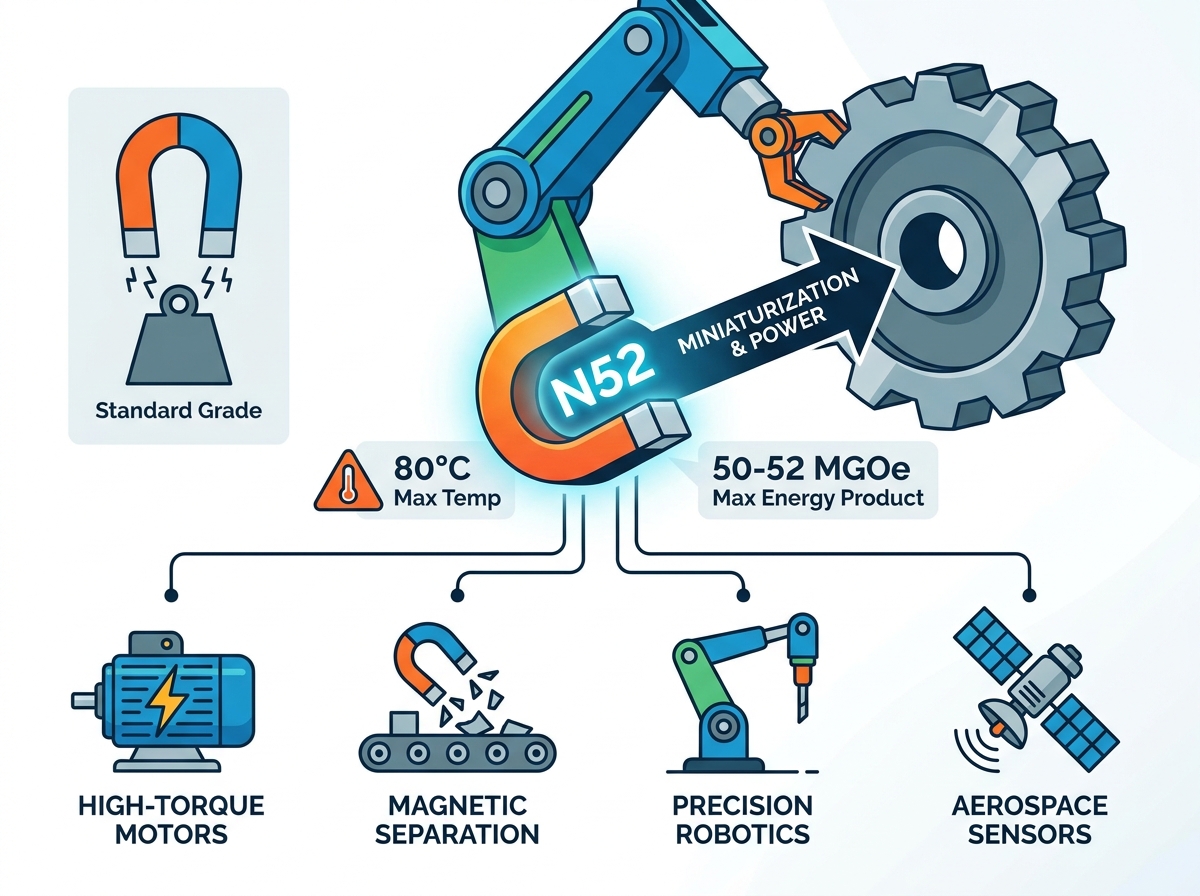
Engineers constantly push the boundaries of modern industrial design to achieve more power in less space. To meet these rigorous demands, many professionals turn to N52 neodymium magnets. They yield a maximum energy product of 50 to 52 MGOe, making them the strongest commercially available permanent magnets today. However, relying on raw power alone rarely guarantees success in complex assemblies. Off-the-shelf options routinely fail in the field. You often face improper dimensional tolerances, inadequate thermal ratings, or incorrect coating choices when buying standard catalog parts. This guide helps engineers and procurement teams navigate these vital technical realities. We will explore strict application criteria, review practical risk mitigation strategies, and outline the steps required to successfully integrate Custom N52 Magnets into demanding industrial workflows. By understanding these principles, you can prevent costly mechanical failures.
Key Takeaways
- Unmatched Strength-to-Weight: Custom N52 magnets enable critical miniaturization in industrial designs without sacrificing holding force or torque.
- Strict Thermal Boundaries: N52 typically caps at an 80°C (176°F) operating temperature; exceeding this requires engineered mitigations or alternative grade evaluation.
- Customization is Crucial: Purpose-built shapes, tailored magnetization directions, and application-specific coatings are necessary to prevent mechanical failure and corrosion.
- Evidence-Based Sourcing: Reliable vendor selection must rely on verifiable magnetic testing (BH curves), tight dimensional tolerances, and transparent supply chain practices.
The Engineering Case for Custom N52 Magnets: When to Specify
Engineers frequently encounter severe spatial constraints during new product development. You must often deliver massive mechanical force from a tiny physical footprint. Aerospace engineers face relentless lightweighting initiatives to improve fuel efficiency and payload capacity. Industrial automation designers must constantly compact their form factors to fit more robotics onto crowded factory floors. In these high-stakes scenarios, standard magnetic materials fall remarkably short. Purpose-built components solve this exact physical problem. They provide the maximum possible magnetic output in the absolute minimal volume.
To truly understand the advantage, you must look at comparative performance metrics. N52 outpaces lower neodymium grades and alternative materials entirely. It provides substantially higher holding force per cubic centimeter. It also generates superior flux density, allowing for larger air gaps in sensor applications.
| Material Grade | Max Energy Product (MGOe) | Relative Holding Force | Ideal Application Fit |
| N52 Neodymium | 50 - 52 | Very High | Severe space/weight limits |
| N35 Neodymium | 33 - 35 | Moderate | Standard industrial use |
| Ceramic (Ferrite) | 3 - 4 | Low | Low-cost, bulky assemblies |
| Alnico | 5 - 9 | Low to Moderate | Extreme high heat |
Specifying customized solutions requires careful ROI justification from procurement teams. Custom units carry higher upfront unit costs compared to standard catalog sizes. However, they deliver compounding financial returns across the lifespan of your project. They reduce long-term assembly costs because they fit perfectly into your housings. They lower the overall device weight, which drastically cuts shipping and operational costs. Ultimately, they improve system efficiency dramatically. You avoid redesigning your entire mechanical assembly just to accommodate a poorly sized standard magnet.
High-Impact Industrial Solutions Powered by N52
Different heavy industries leverage extreme magnetic strength to solve unique mechanical challenges. We see four major industrial sectors driving this specialized demand today.
Advanced Electric Motors and Actuators
Engineers constantly strive to improve high-performance servo motors. High-speed linear actuators also require similar demanding design upgrades. N52 neodymium provides the necessary magnetic density to make this possible.
- Success Criteria: The primary goal is reducing overall motor inertia. Engineers achieve this while simultaneously maintaining high torque density. A physically smaller rotor spins up much faster. It also stops faster, directly improving machine responsiveness and positional accuracy.
Magnetic Separation and Filtration Systems
Food processing lines and commercial mining operations require intense material purity. Chemical refinement plants use similar liquid filtration lines to protect downstream equipment.
- Success factor: These systems must capture microscopic ferrous contaminants reliably. They operate in high-flow, high-pressure environments. Field penetration depth is absolutely critical here. Only the strongest magnetic fields can reach out and pull tiny iron particles from fast-moving, viscous fluids.
Precision Robotics and Automation Tooling
End-of-arm tooling (EOAT) relies heavily on magnetic grippers to move heavy steel parts. Magnetic couplings also transmit heavy rotational torque across physical barriers without touching.
- Success Criteria: These factory tools require highly reliable, repeatable holding force. The magnetic assembly must resist sudden shear forces. Rapid mechanical acceleration during robot movement can easily detach heavy parts if the magnetic grip fails.
Aerospace and Defense Sensors
Mission-critical aviation instrumentation simply cannot fail in flight. Hall effect sensors monitor landing gear position and turbine engine speed continuously.
- Success Criteria: The sensor system must deliver a concentrated, highly predictable magnetic field. Aerospace applications enforce stringent size and structural weight allowances. N52 provides a dense, reliable field without adding unnecessary payload mass to the aircraft.
Evaluation Dimensions for Customizing Your Magnetic Solution
Specifying Custom magnets involves much more than just selecting a raw grade. You must evaluate critical dimensions, tailored magnetization vectors, and robust protective coatings to ensure long-term viability.
Dimensional Tolerances and Geometry
Machining raw sintered neodymium presents distinct physical realities. The standard industry tolerance sits at ±0.004 inches. However, precision industrial applications often demand tolerances tighter than ±0.002 inches. You must discuss structural design limitations directly with your manufacturer. Thin-walled magnetic rings are highly fragile during production. Sharp corners concentrate mechanical stress significantly. We strongly recommend adding slight chamfers or radiused edges to your CAD files. This simple best practice prevents micro-cracking during shipping and final assembly.
Magnetization Direction
Most basic catalog products feature standard axial magnetization. However, custom alignment directly dictates how your component functions. Engineers can specify diametrical, multi-pole, or radial magnetization patterns. Advanced sensors and BLDC motors rely heavily on these tailored magnetic fields. A radial ring magnet, for example, streamlines complex motor assembly. It eliminates the tedious need to glue individual magnetic arc segments onto a steel rotor one by one.
Coating and Plating Strategies
Bare neodymium oxidizes and rusts rapidly when exposed to air. You must assess environmental exposure risks immediately during the design phase. A poor coating choice guarantees catastrophic field failure.
Consider this practical decision framework for industrial coatings:
- Ni-Cu-Ni (Nickel-Copper-Nickel): This remains the standard choice for most engineers. It suits indoor industrial environments perfectly. It provides excellent durability against minor physical impacts and standard factory humidity.
- Epoxy: Choose this specifically for humid or mildly corrosive environments. It offers superior moisture resistance compared to standard nickel. It performs exceptionally well in marine settings or outdoor enclosures.
- Specialized Encapsulation: Harsh chemical environments require full physical isolation. You can encapsulate the magnet completely in injection-molded plastic, Teflon, or welded stainless steel.
Implementation Realities: Mitigating N52 Operational Risks
Raw magnetic strength introduces specific, unavoidable engineering challenges. You must proactively mitigate both thermal degradation and mechanical risks before launching production.
Thermal Demagnetization Limits
The Risk: N52 carries a strict upper thermal limit. Its maximum operating temperature typically caps at just 80°C (176°F). It features a much higher temperature coefficient than lower performance grades. Heat causes it to lose its magnetic flux rapidly. If you exceed this threshold, the magnet suffers irreversible demagnetization.
The Mitigation: You must calculate exact thermal loads in the specific application environment. Account for ambient room heat and internal motor friction. If your assembly operates continuously above 80°C, you must pivot your strategy. Provide a framework for shifting to high-temp grades like N48H or N42SH instead. This proactive shift prevents irreversible flux loss. Sacrificing a tiny percentage of room-temperature strength ensures vital high-temperature stability.
Mechanical Brittleness and Assembly
The Risk: Sintered neodymium is inherently brittle by nature. These strong magnets produce extreme attractive forces from a distance. They easily slam together without warning. They are highly prone to chipping, cracking, or shattering upon direct impact during manual assembly.
The Mitigation: You must outline strict, safe handling protocols for your floor workers. Assembly personnel should use specialized non-magnetic fixtures. These jigs mechanically control the speed of engagement. Consider using protective non-magnetic housing or industrial potting compounds. Polyurethane potting absorbs sudden mechanical shock. It also prevents delicate edge chipping over the product's operational lifespan.
Shortlisting a Manufacturing Partner for Custom Magnets
Your final product depends heavily on the integrity of your supply chain. You must vet your manufacturing partners thoroughly before signing contracts.
Verification of Grade and Performance
Never accept generic, copied material data from a supplier. Demand verifiable, batch-specific documentation for every single shipment. A trustworthy vendor must provide accurate demagnetization curves. These BH curves must apply specifically to your custom production batch. This documentation proves the material actually meets the required remanence and coercivity under physical load.
Prototyping to Production Scalability
Evaluate the vendor's specialized prototyping capabilities. They must confidently produce initial low-volume test runs quickly. You absolutely need these physical samples to validate your thermal and mechanical assumptions. Only after successful real-world lab testing should you scale up. Ensure the manufacturer can transition smoothly to high-volume automated manufacturing without dropping dimensional quality.
Quality Assurance Standards
Rigorous quality control prevents costly assembly line disasters. Look for active ISO 9001 certification first. Require strict dimensional inspections using advanced Coordinate Measuring Machines (CMM). Demand precise coating thickness verification using X-Ray Fluorescence (XRF) scanners. Finally, they must perform comprehensive magnetic flux testing on finished parts prior to packaging and shipment.
Conclusion
Custom N52 magnets provide unparalleled performance for space-constrained, high-demand industrial applications. They allow modern engineers to shrink devices significantly while maintaining massive holding force and torque. However, sustained success requires careful, proactive planning. You must respect rigid thermal limits and harsh environmental constraints. Selecting the right physical tolerances and protective coatings prevents premature field failures and expensive recalls.
We encourage engineering decision-makers to move aggressively from conceptual design to strict specification. Do not settle for inadequate, off-the-shelf catalog options that compromise your product. Submit your mechanical CAD drawings or detailed operating parameters today. Request a comprehensive engineering review and secure a highly accurate custom quote for your next major project.
FAQ
Q: What is the difference between standard off-the-shelf and custom N52 magnets?
A: Off-the-shelf options force you to adapt your design to existing sizes. Custom variations focus on a precise dimensional fit for your assembly. They allow you to select specific coating choices. You can also specify tailored magnetization directions to match proprietary assemblies perfectly.
Q: Can N52 magnets be used in high-temperature industrial environments?
A: Typically no. Standard N52 degrades rapidly above 80°C (176°F). Exposure to higher heat causes permanent loss of magnetic strength. High-heat applications require specific grade variations. You must evaluate 'H', 'SH', or 'UH' grades for reliable high-temperature resistance.
Q: How do you test and verify the holding force of a custom N52 magnet?
A: Verification begins during the design phase. Engineers use finite element analysis (FEA) to predict magnetic performance. During physical prototyping, manufacturers use specialized pull-test stations to measure direct holding force. They also employ precise gauss meters to map the magnetic field density accurately.
Q: What is the typical lead time for engineering and manufacturing custom N52 batches?
A: Lead times vary based on design complexity. Prototyping generally takes three to five weeks, covering custom tooling and initial fabrication. Once you approve the test run, final high-volume production typically requires another four to six weeks. Set realistic procurement expectations accordingly.