Sourcing industrial-grade magnetic spheres carries extremely high stakes for manufacturers. You need absolute quality consistency, reliable supply chains, and strict regulatory compliance. These factors prevent catastrophic field failures in your final products. We must clearly differentiate between consumer-grade novelty magnets and precision-engineered industrial components. Standard desk toys lack the rigorous testing required for advanced mechanical or electronic integration. They often degrade rapidly under thermal stress or physical impact.
This article provides procurement managers and engineers a vendor-neutral framework for evaluating suppliers. You will learn how to define technical requirements accurately for your specific use cases. We will also explore how to mitigate serious compliance risks effectively. By following these structured steps, you can confidently secure dependable components for your production lines.
Key Takeaways
- Supplier Vetting is Critical: Direct manufacturers offer better traceability and QA for industrial needs compared to general B2B wholesale directories.
- Precision Matters: Defining exact magnetic balls specifications (e.g., N-grade, coating, tolerance) prevents application failure and cost overruns.
- Compliance is Non-Negotiable: Industrial buyers must document end-use applications to navigate strict CPSC safety regulations regarding small high-powered magnets.
- Bulk Economics: Purchasing magnetic balls in bulk requires upfront sampling, batch-testing agreements, and clear lead-time guarantees.
Evaluating Sourcing Channels: Where to Find Reliable Suppliers
Finding the right vendor determines your project success. You essentially have two main paths. You can choose direct specialized manufacturers or general B2B marketplaces. Each channel serves entirely different procurement needs. Understanding their structural differences helps you allocate resources effectively.
Direct specialized custom magnet producers offer exceptional engineering support. They usually maintain ISO-certified quality assurance programs. You can demand custom tolerances and verifiable material origins. This route guarantees high precision for sensitive equipment. Direct communication allows engineers to troubleshoot thermal degradation or mechanical wear early. However, you will face higher Minimum Order Quantities (MOQs). The initial onboarding and factory audit process also takes significantly longer.
General B2B marketplaces like Alibaba or TradeIndia provide aggregated pricing models. They make initial contact very easy. You can quickly find lower MOQs for standard off-the-shelf sizes. This works well for basic, early-stage prototypes. Conversely, you face severe risks regarding inconsistent batch quality. Counterfeit material grades occasionally enter these open supply chains. You might also find recourse extremely difficult for out-of-spec deliveries.
Your shortlisting logic should rely directly on your current project phase. Use B2B marketplaces for early R&D or fast conceptual prototyping. Transition to direct manufacturers for full-scale production runs. Your required risk tolerance dictates this pivot. Industrial integration always demands high traceability.
Review the comparison chart below to align your sourcing strategy.
| Sourcing Channel | Primary Advantages | Key Disadvantages | Best Suited For |
| Direct Manufacturers | ISO QA, deep engineering, traceable origins | High MOQs, slow initial setup | Full-scale production, custom specs |
| General B2B Marketplaces | Low MOQs, fast ordering, price variety | Inconsistent batches, low accountability | Early R&D, generic prototyping |
Core Magnetic Balls Specifications to Define Before Purchasing
You must dictate exact requirements to avoid costly manufacturing errors. Defining comprehensive magnetic balls specifications forms the rigid foundation of any purchase order. Vague requests inevitably lead to incompatible parts.
First, determine the material grade and expected pull force. Engineers delineate Neodymium (NdFeB) grades from N35 to N52. Higher numbers indicate exponentially stronger magnetic fields. You must also consider maximum operating temperatures carefully. Standard grades lose permanent magnetization above 80°C. High-temperature applications require specialized SH, UH, or EH grades. These advanced variants withstand extreme thermal environments without degrading.
Dimensional tolerances hold equal importance. Mechanical and sensor applications demand strict machining accuracy. A variance of +/- 0.002 inches or tighter prevents dangerous assembly friction. Loose tolerances cause catastrophic failures in precision ball bearings. You should mandate rigorous post-machining inspections.
Next, evaluate coatings and exterior plating. Raw neodymium corrodes rapidly when exposed to oxygen. You must select appropriate protective layers based on environmental exposure. Common industrial options include:
- Ni-Cu-Ni (Nickel-Copper-Nickel): Offers excellent mechanical wear resistance for moving assemblies.
- Zinc: Provides adequate protection for low-friction, dry environments.
- Epoxy: Delivers superior corrosion resistance in highly humid or chemically exposed conditions.
- Gold/Silver: Used strictly for specialized high-conductivity electronic applications.
Finally, specify the magnetization direction. You can request diametric or axial magnetization. Diametric magnets have poles on their curved sides. Axial magnets feature poles on completely opposite ends. Your structural housing dictates this critical engineering choice.
Navigating Industrial Magnetic Balls Applications
Industrial environments utilize magnetic spheres in highly specific ways. You must understand permitted industrial use cases clearly. These differ vastly from recreational magnets. Proper magnetic balls applications demand absolute reliability under stress.
Typical integrations include advanced electronics and sensitive automotive sensors. Modern vehicles rely on them for anti-lock braking systems. You will also find them in magnetic filtration systems. Here, they capture microscopic ferrous debris from flowing industrial coolants. They serve as frictionless ball bearings in premium mechanical assemblies. Specialized fastening mechanisms also utilize their extreme pull force to eliminate mechanical latches.
You must explicitly define the boundary between industrial components and consumer goods. Industrial spheres belong exclusively in closed commercial systems. Supply chain contamination occurs when vendors mix these two distinct sectors. You must avoid sourcing from factories primarily producing consumer toys. This hard separation prevents severe legal liabilities down the road. It also ensures proper metallurgical standards.
Success criteria depend on environmental alignment. You must align the physical application environment against your chosen specifications. Consider ambient heat, moisture exposure, and constant physical impact. High-impact environments might chip standard nickel coatings rapidly. Extreme heat demagnetizes standard N52 spheres instantly. Analyzing these variables ensures long-term product longevity and reduces warranty claims.
Regulatory Compliance and Risk Management (E-E-A-T Focus)
Handling strong neodymium spheres requires strict adherence to institutional safety guidelines. You must prioritize regulatory compliance at every operational level. Ignorance of legal frameworks invites massive corporate penalties.
The U.S. Consumer Product Safety Commission (CPSC) heavily regulates these items. The CPSC enforces strict rules regarding high-powered magnetic ball sets. These aggressive regulations exist due to severe pediatric ingestion hazards. When swallowed, multiple magnets attract across intestinal walls. This causes life-threatening tissue necrosis. Industrial buyers must completely separate their components from consumer markets. You should clearly label all bulk packaging as restricted industrial materials.
Comprehensive supplier documentation proves your corporate due diligence. You must require specific paperwork before approving any new vendor. Request Material Safety Data Sheets (MSDS) immediately during onboarding. You should also demand RoHS and REACH compliance certificates. These documents verify the complete absence of hazardous restricted substances. Furthermore, ask for magnetic testing curves, commonly known as B-H curves. They prove the true magnetic saturation limits of your specific order.
Internal handling protocols protect your factory floor personnel daily. Establish clear rules for safe storage and active assembly:
- Store highly magnetized spheres exclusively in magnetically shielded, lockable containers.
- Require thick, non-magnetic protective gloves during manual assembly to prevent severe pinching injuries.
- Keep all spheres strictly away from sensitive electronic testing equipment or pacemakers.
- Train employees thoroughly on the severe dangers of swallowing or inhaling small magnetic components.
- Implement strict inventory counting protocols to prevent internal component theft or misplacement.
A Step-by-Step Buying Guide for Magnetic Balls
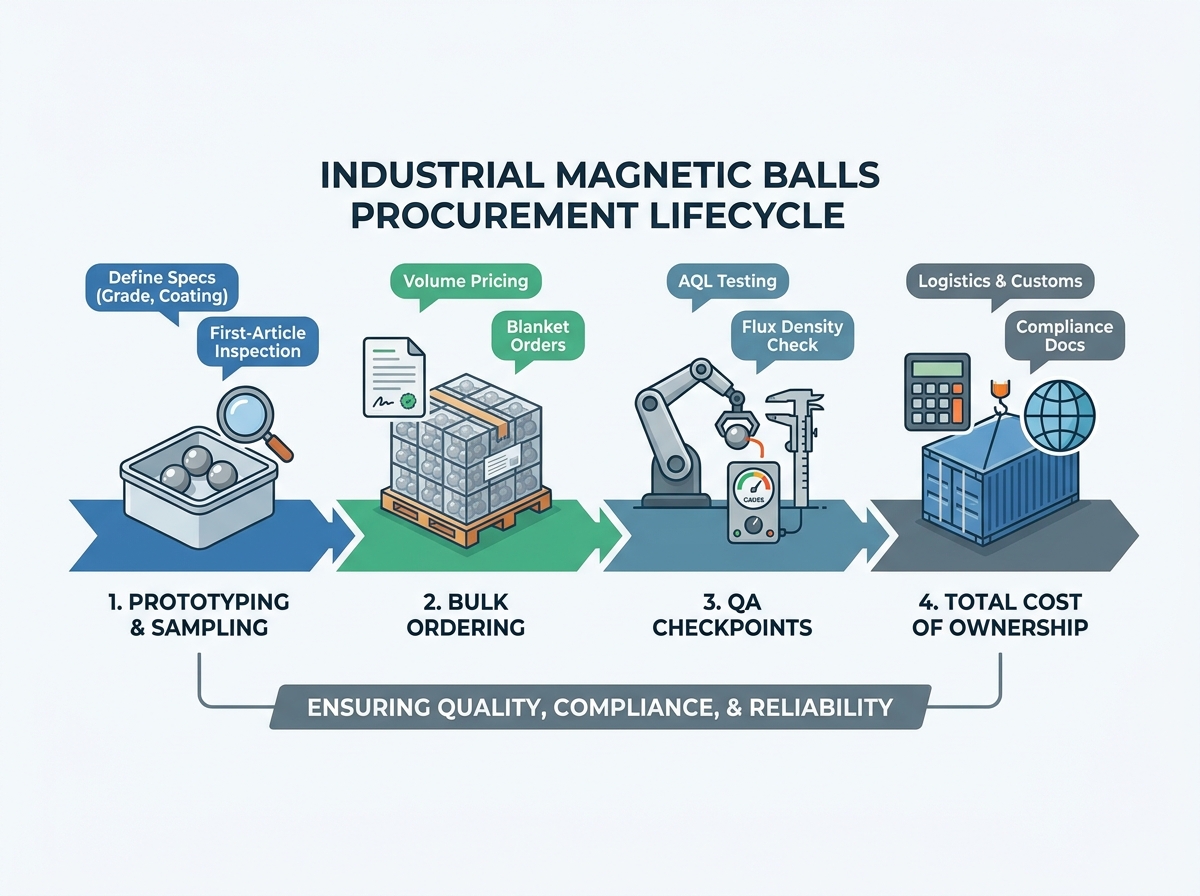
Strategic procurement requires a deeply methodical approach. This structured buying guide for magnetic balls minimizes supply chain disruptions. It transforms chaotic purchasing into a predictable, engineered process.
- Step 1: Requesting Samples and Prototyping. You should never skip the first-article inspection (FAI) phase. Prototyping allows you to test pull force and coating durability physically. Engineers can verify if the spheres fit seamlessly into the intended housing tolerances. FAI catches structural misalignments before they escalate into massive financial losses. Subject these samples to destructive testing if necessary.
- Step 2: Securing Magnetic Balls in Bulk. Structuring volume pricing tiers lowers your per-unit expenses drastically. You should negotiate split shipments or blanket orders early on. Purchasing magnetic balls in bulk helps manage factory inventory flow efficiently. It prevents warehouse overloading while securing lucrative bulk discounts. Always establish clear lead-time guarantees and penalty clauses during this negotiation phase.
- Step 3: Establishing QA Checkpoints. You must set precise Acceptable Quality Limits (AQL) before the batch arrives. Test incoming shipments randomly for flux density and coating thickness. Use calibrated micrometers to verify dimensional accuracy against your initial CAD drawings. Reject any batch failing these predetermined AQL metrics immediately. Consistent QA eliminates downstream assembly errors.
Conclusion
Procurement managers actively bridge the gap between complex technical specifications and reliable vendor relationships. Precise communication dictates the ultimate success of your sourcing efforts. You must carefully transition from defining physical neodymium grades to enforcing rigorous compliance documentation. We cannot overstate the importance of strict tolerances and proper environmental coatings.
Never compromise on safety testing or verified supplier paperwork. We highly encourage engineering teams to finalize their internal spec sheets today. Cross-reference your thermal requirements and dimensional needs. Once aligned, reach out to verified manufacturers for technical consultations. Request specialized prototyping samples to validate your theories. Finally, secure custom bulk quotes to stabilize your long-term production schedule.
FAQ
Q: What is the standard MOQ for ordering magnetic balls in bulk?
A: Minimum Order Quantities vary heavily based on customization. Off-the-shelf standard sizes typically require an MOQ of 1,000 units. Custom diameters or specialized high-temperature grades often demand MOQs exceeding 10,000 units. Always verify these minimums during your initial vendor outreach.
Q: How do I verify the magnetic grade (e.g., N52) of a bulk order?
A: You should request official demagnetization curve (B-H curve) reports directly from your supplier. Once the shipment arrives, conduct in-house gauss meter testing. Compare your internal surface field readings against the supplier's certified documentation to confirm the exact grade.
Q: Are there shipping restrictions for high-powered magnetic spheres?
A: Yes. The International Air Transport Association (IATA) strictly classifies strong magnets as Dangerously Magnetic Goods. You must use specialized magnetic shielding packaging for any air freight. This packaging prevents hazardous interference with critical aircraft navigation systems.
Q: Can industrial magnetic balls be used in consumer products?
A: No. High-powered small magnets are strictly regulated and generally banned for consumer toy applications. The CPSC issues strong warnings and product recalls due to severe pediatric ingestion hazards. Industrial spheres belong exclusively inside closed, secure commercial applications.