Specifying the right neodymium magnet presents a serious engineering challenge today. You must carefully balance magnetic flux density, operating environment conditions, and unit cost at scale. As modern devices shrink and performance demands rise, selecting an optimal magnetic grade becomes absolutely critical. Enter the N40 Magnet. We consider it the high-efficiency sweet spot for modern industrial applications. It delivers roughly 14% more magnetic energy than a baseline N35 magnet. Importantly, it achieves this performance bump without the premium pricing and extreme physical brittleness associated with ultra-high N52 grades. This comprehensive guide will help engineers and procurement teams make informed decisions. We will explore how this specific grade aligns with your core performance criteria. You will learn how to evaluate its suitability for specific operating temperatures and manage tight production budgets effectively.
Key Takeaways
- Performance-to-Cost Ratio: N40 magnets provide an optimal balance of strong pull force (~40 MGOe Max Energy Product) and cost-efficiency for mid-to-high tier industrial builds.
- Versatile Industrial Fit: Serves as a standard specification in precision servo motors, magnetic separators, and industrial sensor arrays.
- Thermal Considerations: Standard N40 degrades at 80°C (176°F), requiring high-temp variants (N40M, N40H, N40SH) for rigorous manufacturing environments.
- Sourcing Prerequisite: Successful implementation requires strict attention to dimensional tolerances, surface coatings, and verifiable testing data from compliant suppliers.
The Engineering Case: Why the N40 Magnet is an Industrial Standard
Engineers consistently choose the N40 grade when designing reliable industrial equipment. The reasoning relies heavily on core physics and manufacturing economics. We must look closely at the underlying technical parameters to understand this dominance.
The Technical Baseline
Every neodymium magnet carries a specific grade rating based on its Maximum Energy Product (BHmax). The N40 grade typically features a Remanence (Br) between 12.5 and 12.8 kGs. Remanence dictates the residual magnetic flux density remaining in the material after magnetization. In practical terms, this high Br value translates directly into substantial holding force. It also allows the magnetic field to project further out into an air gap. This projection capability proves essential for triggering remote sensors or driving motor coils efficiently.
Standard Technical Parameters of N40 Grade
| Property | Symbol | Standard Range | Unit |
| Remanence | Br | 12.5 - 12.8 | kGs |
| Coercivity | Hcb | ≥ 11.4 | kOe |
| Intrinsic Coercivity | Hcj | ≥ 12.0 | kOe |
| Max Energy Product | BHmax | 38 - 41 | MGOe |
Cost-Efficiency at Scale
Mass production forces teams to scrutinize every line item. When comparing standard grades, an N40 Magnet offers distinct economic advantages. It allows engineers to reduce the overall size and weight of a component. You can often swap a bulky N35 magnet for a smaller N40 equivalent. This size reduction requires less raw material per unit. Consequently, you can miniaturize surrounding housings and brackets. The overall bill of materials (BOM) remains stable, but the final product becomes significantly lighter and more compact.
Structural Stability
Physical durability matters deeply during assembly. All sintered neodymium magnets are inherently brittle materials. They resemble advanced ceramics more than standard metals. However, structural stability varies slightly across different grades. Ultra-high grades like N52 contain higher ratios of neodymium to iron. This composition makes them exceptionally fragile. The N40 grade strikes a safer balance. It offers better structural reliability during automated assembly processes. Factory robots and pressing machines cause fewer chips and micro-fractures when handling N40 blocks compared to their N52 counterparts.
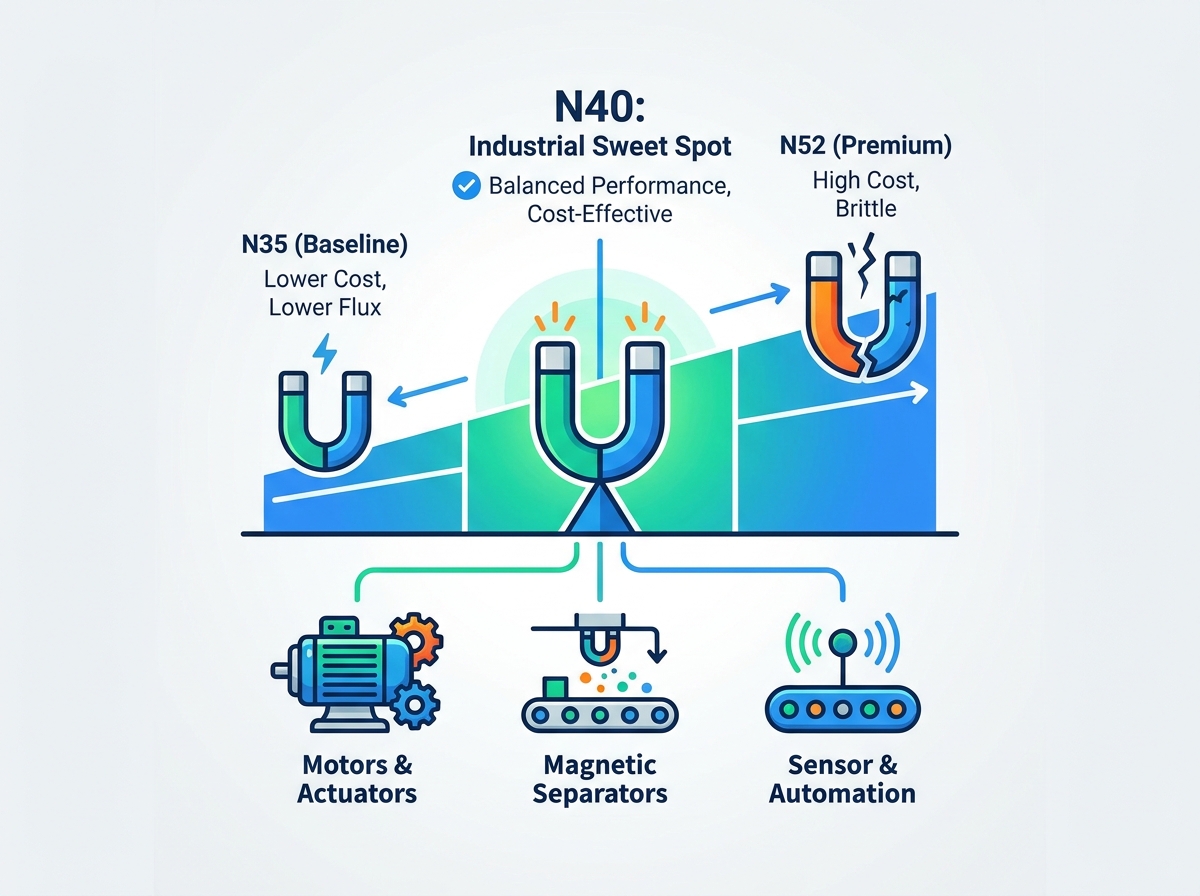
Core N40 Magnet Applications in Industrial Environments
Industrial applications demand consistent performance over millions of operational cycles. The N40 grade steps up to this challenge across multiple manufacturing sectors. Let us explore four primary use cases where this specific grade dominates.
- Electric Motors and Actuators
Mechanism: High coercivity ensures stable torque in highly constrained spaces. Motor efficiency depends directly on strong, reliable magnetic fields interacting across a narrow air gap.
Use Case: Engineers deploy them extensively in stepper motors, precision servo motors, and robotics joints. These applications require exceptional size-to-power ratios. A compact N40 Magnet rotor delivers smooth, continuous motion without inflating the motor housing dimensions.
- Industrial Magnetic Separators
Mechanism: Deep magnetic field penetration acts as the primary driver here. The magnet must pull ferrous particles through thick layers of fast-moving materials.
Use Case: Facilities use them in conveyor belt filtration systems. Food processing plants, pharmaceutical labs, and mining operations rely on these separators. They extract dangerous ferrous contaminants from bulk powders and liquid slurries, ensuring end-product safety and regulatory compliance.
- Sensor and Automation Technologies
Mechanism: Consistent magnetic flux over time guarantees reliable sensor activation. Degrading fields cause missed triggers and line shutdowns.
Use Case: Automation systems use them for triggering Hall effect sensors. You will find them installed along automated assembly lines, inside commercial elevator shafts, and embedded in proximity switches. The stable field strength ensures the sensor registers the passing component every single time.
- Heavy-Duty Magnetic Fastening and Tooling
Mechanism: High surface pull force creates secure, temporary bonding. The magnetic circuit directs maximum holding power to a specific contact face.
Use Case: Factories utilize them in industrial lifting magnets. Machinists rely on magnetic chucks for CNC milling operations. Custom tooling fixtures use N40 blocks to lock heavy steel plates in place safely during aggressive drilling and grinding processes.
Evaluating N40 vs. Alternative Neodymium Grades
Selecting the right grade means understanding acceptable trade-offs. You must weigh physical constraints against unit costs. Below, we compare the N40 against the industry baseline and the premium alternative.
N40 vs. N35 (The Baseline)
The N35 grade serves as the absolute entry point for neodymium magnets. It costs less per gram. However, it requires significantly more physical volume to achieve specific holding forces. The N40 provides superior strength. This strength allows for aggressive miniaturization of parts where an N35 would require far too much space. You should choose N40 when spatial constraints justify a slight bump in unit cost. Modern drone motors and compact medical devices almost exclusively favor N40 over N35 for this exact reason.
N40 vs. N52 (The Premium)
The N52 grade represents the pinnacle of commercial magnetic strength. It offers maximum pull force. Unfortunately, it costs significantly more to manufacture. Furthermore, N52 magnets chip very easily during handling. They also suffer from lower baseline thermal stability. Engineers generally prefer N40 for mass production. You should only select N52 if absolute maximum flux density remains the solitary constraint and budget is unlimited.
Decision Matrix
Use the following logic to guide your procurement strategy. We have formatted this decision matrix into a simple summary chart for quick reference.
Material Selection Decision Chart
| Space Constraint | Budget Limit | Thermal Requirement | Recommended Grade |
| High (Plenty of room) | Low (Strictly capped) | Standard (<80°C) | Choose Grade: N35 |
| Medium (Tight spacing) | Medium (Balanced) | Standard (<80°C) | Choose Grade: N40 |
| Low (Extreme miniaturization) | High (Premium allowed) | Standard (<80°C) | Choose Grade: N52 |
| Medium (Tight spacing) | Medium (Balanced) | High (Up to 150°C) | Choose Grade: N40SH |
Operational Risks and Implementation Considerations
Even the highest quality magnets fail if deployed incorrectly. Engineers must anticipate environmental hazards. Thermal dynamics, ambient moisture, and mechanical assembly realities all pose distinct risks to magnetic integrity.
Thermal Degradation and Demagnetization
Heat destroys magnetic alignment. A standard N40 grade possesses a strict operating hard limit of 80°C (176°F). If you push the ambient temperature past this threshold, the magnet begins to demagnetize. This loss of strength becomes permanent upon cooling. Fortunately, manufacturers provide a clear migration path. You can specify high-temperature suffix variations.
- N40M: Handles environments up to 100°C. Ideal for enclosed motor housings.
- N40H: Pushes the limit to 120°C. Common in automotive under-hood sensors.
- N40SH: Survives up to 150°C. Essential for applications involving heavy friction or massive electrical currents.
Corrosion Vulnerabilities
Raw NdFeB material rusts incredibly fast. The high iron content reacts rapidly to atmospheric moisture. You must evaluate coating solutions based on your specific operational environment.
- Ni-Cu-Ni (Nickel-Copper-Nickel): The standard industrial choice. It provides a shiny, durable finish resistant to general factory humidity.
- Epoxy: Best for highly humid or chemically aggressive environments. Marine sensors and fluid pumps rely heavily on black epoxy coatings.
- Zinc: A cost-sensitive option designed for low-exposure environments. Use it only when the magnet sits entirely sealed inside a plastic housing.
Mechanical Handling Risks
You must address the physical reality of assembly. Neodymium blocks snap together violently if left unchecked. This sudden impact causes severe chipping or complete shattering. Safety protocols require strict design tolerances. We highly recommend using non-magnetic assembly jigs. Machining fixtures out of aluminum or brass prevents accidental bonding. Workers can slide components into place safely without fighting overwhelming magnetic pull forces.
Procurement Criteria: Sourcing N40 Magnets Safely
Sourcing unreliable materials cripples production lines. You need strict procurement guidelines to ensure lot-to-lot consistency. Protect your supply chain by verifying critical parameters upfront.
Verifying Magnetic Specifications
Never rely solely on a vendor's website description. You must ensure you actually receive genuine N40 grade material. Always request official B-H curve test reports from the factory. Ask for accompanying material certifications. These documents prove the exact remanence and coercivity values of your specific production batch.
Dimensional Tolerances
Slight physical deviations cause massive assembly failures. Emphasize the importance of tight dimensional tolerances during purchasing. We recommend specifying tolerances of ±0.002" (or ±0.05mm). If a magnet arrives too large, press-fit operations will crack it instantly. If it arrives too small, it will rattle inside the motor housing, causing fatal imbalances at high RPMs.
Supply Chain Compliance
Global distribution requires adherence to strict legal frameworks. Emphasize the need for certified suppliers. Verify their RoHS and REACH compliance status immediately. This ensures your final product can enter European and North American markets without legal friction. Furthermore, look for ISO 9001 or TS16949 certifications. These automotive-grade quality standards guarantee rigorous factory inspections and stable lot-to-lot consistency over years of production.
Conclusion
The N40 neodymium magnet undeniably remains the reliable workhorse of modern industrial design. It offers engineers the optimal intersection of raw pulling power, structural stability, and budget-friendly pricing. By standardizing on this grade, you can successfully miniaturize complex assemblies while keeping production costs predictable.
Before launching into mass manufacturing, follow these core next steps:
- Request small batches of prototype samples to confirm physical fitment.
- Demand certified testing data, specifically B-H curves, to validate magnetic performance claims.
- Subject prototypes to rigorous thermal testing to ensure they survive your peak operating temperatures.
- Finalize coating specifications based on real-world environmental exposure risks.
FAQ
Q: What is the maximum operating temperature of an N40 magnet?
A: A standard N40 grade operates safely up to 80°C (176°F). Exceeding this causes permanent demagnetization. If your application runs hotter, you must specify high-temperature variants like N40M (100°C), N40H (120°C), or N40SH (150°C).
Q: Can N40 magnets be machined or drilled?
A: We strongly advise against machining them. Drilling generates immense heat, which instantly demagnetizes the material. Furthermore, raw NdFeB dust is highly flammable and poses a severe fire hazard. Always purchase pre-machined, pre-coated shapes directly from the manufacturer.
Q: How does the N40 compare to ceramic (ferrite) magnets in industrial use?
A: An N40 neodymium magnet is roughly ten times stronger than a standard ceramic ferrite magnet. This massive strength difference allows engineers to transition from bulky, heavy ferrite motors to incredibly compact, high-efficiency modern actuators.
Q: What is the standard lead time for custom-shaped N40 industrial magnets?
A: Lead times typically range from 3 to 6 weeks. This timeframe depends heavily on custom tooling requirements, specific coating applications, and factory testing procedures. Always factor this delay into your initial prototyping schedule.