Engineers frequently face a familiar specification challenge. Finding the perfect balance is difficult. You need higher magnetic strength for your design. However, strict dimensional constraints limit your options. You also want to avoid overpaying for premium grades like N52. Standard N35 grades often fall short here. They lack sufficient power in high-torque situations. Miniaturized applications also suffer from weak baseline magnets. Procurement and design teams must look elsewhere. They increasingly evaluate mid-tier solutions. An N40 Magnet frequently emerges as a highly capable alternative.
We created this guide to clarify the facts. We provide a strictly objective, data-backed evaluation. You will learn exact specifications and critical thermal limitations. We also detail comparative performance against other grades. Readers will gain actionable insights from these sections. This knowledge will confidently inform your final sourcing decisions.
Key Takeaways
- Performance Sweet Spot: An N40 magnet provides a Maximum Energy Product (BHmax) of 38-41 MGOe, offering roughly a 10-15% strength increase over standard N35 within the same volume.
- Thermal Constraints: Standard N40 is limited to an 80°C maximum operating temperature; specific suffixes (M, H, SH) must be evaluated if thermal degradation is a risk.
- Cost-to-Output Ratio: N40 serves as the critical middle ground for assemblies that cannot accommodate larger N35 magnets but do not possess the budget margins for N52.
- Specification Reality: Real-world pull force and field strength depend heavily on geometry, operational air gaps, and environmental exposure—not just the N40 grade designation.
Defining the N40 Magnet: Core Specifications and Tolerances
Establishing proper expectations begins by understanding exact physical parameters. The N40 grade represents a specific tier of neodymium-iron-boron (NdFeB) composition. Engineers rely on standardized testing to define this grade. These metrics define raw magnetic potential. We must examine four primary values to evaluate performance accurately.
The Maximum Energy Product dictates overall magnetic density. Remanence measures the remaining magnetic flux. Coercivity indicates resistance to demagnetization. Finally, intrinsic coercivity measures internal resistance to permanent flux loss.
Standard Laboratory Specifications for N40 Grade
| Magnetic Parameter | Value Range | Unit of Measurement |
| Maximum Energy Product (BHmax) | 38 – 41 | MGOe (MegaGauss Oersteds) |
| Remanence (Br) | 12.5 – 12.8 / 1.25 – 1.28 | kG (Kilogauss) / T (Tesla) |
| Coercivity (Hcb) | ≥ 11.4 | kOe (KiloOersteds) |
| Intrinsic Coercivity (Hcj) | ≥ 12.0 | kOe (KiloOersteds) |
You must recognize key evaluation dimensions when reviewing this data. These metrics represent optimal conditions. Manufacturers test blocks in controlled environments at 20°C room temperature. Your final magnetic flux density will vary in application. The physical shape heavily dictates field strength. We call this relationship the permeance coefficient. A thin disc behaves differently than a thick cylinder. You cannot rely on raw material data alone. You must always account for your specific operational geometry.
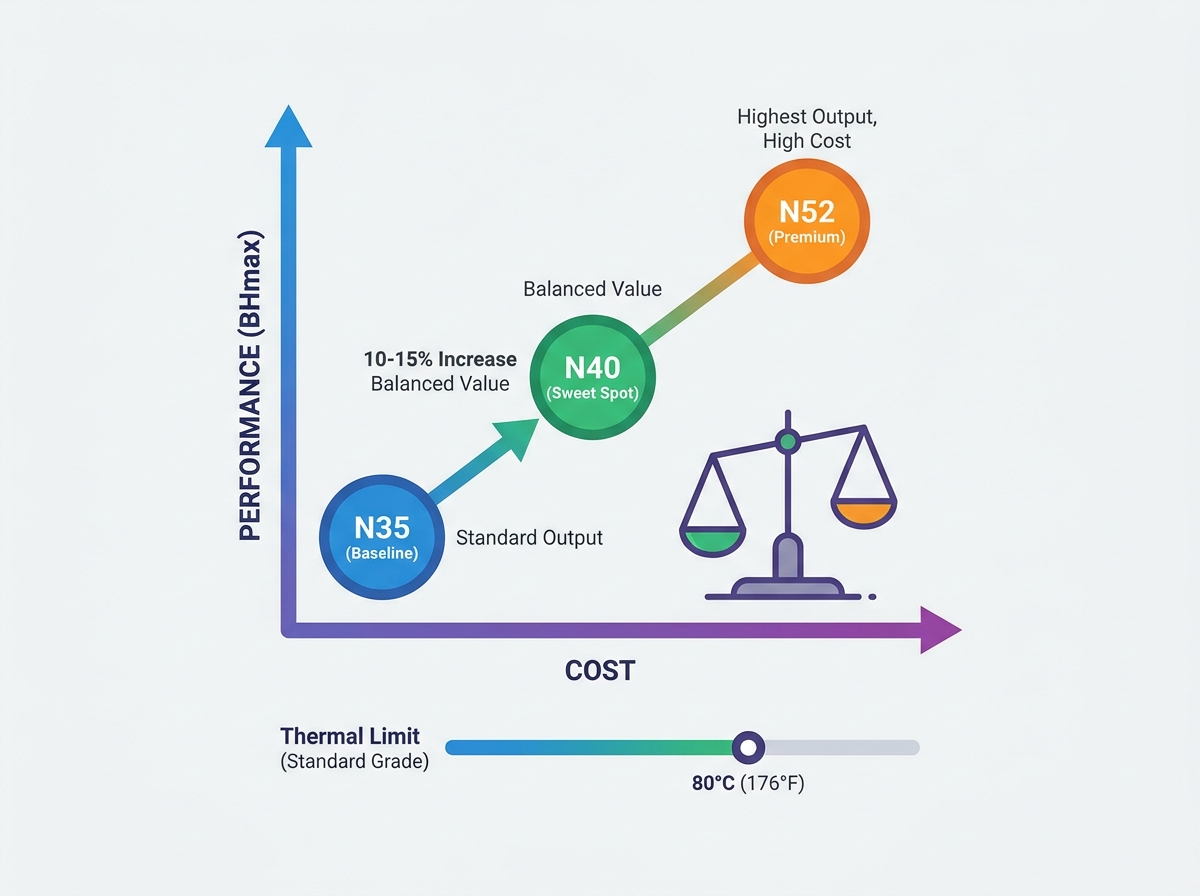
N35 vs. N40 vs. N52: The Cost-to-Performance Calculus
Selecting the exact grade requires a structured comparative framework. Buyers often struggle to short-list the right material. You must balance raw output against commercial reality. We will compare the mid-tier option against both the baseline and the premium standard. This comparison helps clarify your purchasing decisions.
N40 vs. N35: The Baseline Upgrade
You already have a designed product housing. The N35 baseline magnet feels too weak. You cannot simply enlarge the plastic cavity. A larger magnet requires expensive tooling redesigns. Upgrading to an N40 Magnet solves this engineering dilemma. It eliminates the need for physical alterations. You gain more magnetic output. The physical footprint remains exactly the same. We highly recommend this upgrade for space-constrained assemblies. The slight price increase easily offsets massive tooling expenses.
N40 vs. N52: The Budget Reality Check
Many engineers face the temptation to over-specify. N52 sounds incredible on paper. It offers roughly 30% more strength than a standard grade. However, this power incurs significantly higher raw material costs. N52 uses purer neodymium blends. It is also notoriously brittle. It chips easily during automated assembly. Furthermore, N52 is highly susceptible to high-temperature demagnetization. Most commercial applications do not genuinely require N52 strength. Specifying it often drains your budget unnecessarily.
Grade Recommendation Matrix Chart
| Success Criteria / Scenario | Recommended Grade | Justification |
| Low cost priority, ample space available | N35 | Budget-friendly; larger volume achieves needed pull force. |
| Volume is constrained by <15%, torque requirements increased | N40 | Increases flux density without altering existing CAD dimensions. |
| Absolute maximum holding force needed, cost is flexible | N52 | Delivers highest possible BHmax for ultra-compact luxury/medical devices. |
Thermal Risks and Coercivity: Evaluating High-Temp N40 Variants
We must address implementation realities directly. Thermal degradation remains a primary failure point for neodymium materials. Heat destroys magnetic flux. You cannot ignore your operational environment. Even minor temperature spikes cause measurable performance drops.
The 80°C Limitation
Standard blocks and discs have strict limits. You will experience irreversible flux loss above 80°C (176°F). The crystalline structure destabilizes. The field weakens permanently. The magnet will not recover its full strength upon cooling. You must explicitly state thermal requirements to your supplier. Do not assume standard grades survive warm environments.
High-Temperature Shortlisting
Manufacturers produce specialized variants for demanding environments. We classify these by their suffix letters. You must evaluate these options if thermal risk exists.
- N40M (Medium): Rated for a maximum operating temperature of 100°C.
- N40H (High): Rated for a maximum operating temperature of 120°C.
- N40SH (Super High): Rated for a maximum operating temperature of 150°C.
Skeptical-Friendly Advice
Buyers should approach temperature resistance logically. You cannot get high thermal stability for free. Manufacturers increase Intrinsic Coercivity (Hcj) through specialized doping. They add heavy rare earth elements. Dysprosium and Terbium stabilize the magnetic domains. However, these elements are scarce. They are expensive. As temperature resistance increases, the baseline cost rises proportionally. We advise buyers to avoid over-specifying suffixes. Do not request an SH grade if your device never exceeds 60°C.
Proven Commercial and Industrial Applications
We validate material grades by observing real-world success. This specific grade traditionally outperforms other options in several massive sectors. The balance of power and cost makes it uniquely versatile.
- High-Efficiency BLDC Motors: Brushless DC motors demand precise engineering. Stators and rotors require strong magnetic flux across the air gap. The gap creates resistance. The magnetic field must jump this distance effectively. An N40 Magnet provides the necessary force. It does this without the prohibitive costs of N48 or N52 grades. You see this heavily in consumer electronics. Automotive actuators also rely on this balanced performance.
- Magnetic Separators and Sensors: Industrial filtration systems capture ferrous contaminants. They need consistent field depth. Hall-effect sensors trigger mechanical actions. They require predictable flux lines. This grade delivers moderate-to-high field strength reliably. It maintains this consistency over a rigorous 10-year lifecycle. Fluctuations are minimal if temperatures remain stable.
- Audio Equipment (Transducers): High-end loudspeaker drivers prioritize acoustic accuracy. Bulky magnets interfere with sleek designs. Heavy assemblies alter resonance. Engineers focus on severe weight reduction. Smaller magnet sizes directly correlate with improved acoustic performance. This mid-tier option shrinks the driver footprint. It still pushes the voice coil forcefully. Listeners enjoy clearer, punchier audio.
Sourcing Checklist: Coating, Compliance, and Quality Control
Moving toward a qualified purchasing decision requires diligence. You must outline strict demands for your magnet manufacturer. Poor quality control ruins excellent engineering. We created a standard checklist to guide procurement teams.
Surface Treatment Protection
Neodymium rusts rapidly. It is highly susceptible to severe oxidation. Bare magnets crumble into powder over time. Proper coating selection is absolutely critical to implementation success. You must evaluate various surface treatments. Ni-Cu-Ni (Nickel-Copper-Nickel) provides robust, shiny protection for general use. Zinc works well for lower-cost adhesive applications. Epoxy coatings resist salt sprays and harsh industrial chemicals. Always specify your required coating thickness.
Machining and Dimensional Tolerances
Mass production requires consistency. You must outline standard tolerances. A standard metric is ±0.05mm. Some applications tolerate ±0.1mm. Warn your purchasing department about false promises. Manufacturers sometimes promise impossibly tight tolerances. They will charge massive cost premiums for grinding. Only demand ±0.02mm if your aerospace assembly genuinely requires it. Otherwise, stick to standard manufacturing ranges.
Regulatory Compliance
Global markets enforce strict environmental rules. You cannot sell non-compliant products internationally. Mention the absolute necessity of requesting certifications. Your suppliers must provide REACH documentation. They must also prove RoHS compliance. Keep these documents in your quality management system. This ensures smooth customs clearance worldwide.
Next Steps for Procurement
Procurement teams must demand data before placing bulk orders. Request specific demagnetization curves. We call these B-H curves. Ask for curves mapped at your precise expected operating temperatures. Testing at 20°C means nothing if your device runs at 75°C. Reviewing this data prevents expensive mass-production failures.
Conclusion
Choosing the correct magnetic material requires balancing multiple competing factors. The N40 grade represents the definitive choice for many engineers. It easily handles applications requiring enhanced magnetic output in a constrained footprint. You simply must ensure your design respects the 80°C thermal limits.
We leave buyers with three core final takeaways and action steps:
- Verify the Internal Specs: Do not focus solely on the broad label. Always verify the intrinsic coercivity (Hcj) with your manufacturer to prevent demagnetization.
- Inspect the Armor: Confirm the coating integrity. Nickel layers must be uniform. Poor plating leads to rapid oxidation and catastrophic mechanical failure.
- Take Action: We encourage engineers and buyers to move forward confidently. Submit your CAD drawings today. Include your maximum operational temperature requirements. Request a custom quote or a formal engineering review from a certified manufacturer.
FAQ
Q: Is an N40 magnet noticeably stronger than an N35?
A: Yes. It provides roughly a 10-15% increase in maximum energy product. This directly translates to increased magnetic flux. However, the actual noticeable pull force heavily depends on your physical geometry and the target material. A thicker N35 can sometimes outpull a paper-thin N40. In identical sizes, the upgrade is highly noticeable.
Q: How do I calculate the pull force of an N40 magnet?
A: Pull force relies on several variable factors. You must measure the target material thickness. You must account for the gap distance. The magnet shape also changes the calculation. We recommend using a professional magnetic field simulation tool. Alternatively, ask your manufacturer for direct pull-test data based on your specific dimensions.
Q: Can an N40 magnet be machined or drilled?
A: No. Sintered neodymium is extremely brittle. Attempting to drill it causes shattering. Furthermore, neodymium dust is highly flammable and presents a severe fire hazard. You must advise your team that all shaping, drilling, and machining must be done by the manufacturer prior to the final magnetization process.
Q: Will an N40 magnet lose its strength over time?
A: Permanent magnets are incredibly stable under normal conditions. They generally lose less than 1% of their total flux over a 10-year period. However, this stability disappears if you expose them to high heat, severe physical shock, or strong opposing magnetic fields. Keep them cool and protected to ensure longevity.